People for Bike City Ratings for Sacramento

You won’t be surprised, but City of Sacramento achieved a score of 34 out of 100 on the People for Bikes annual City Ratings. The scores are simplistic, using road width and bike lane mileage, but are still indicative of the relative ranking of cities and of the progress being made. Progress in the case of Sacramento is very slow.

I believe Sacramento’s poor ranking is due largely to the city’s policy of building bicycling infrastructure almost entirely with grant funding, and not with city budget. When you are competing nationally, statewide, or regionally for grants, funds will be limited and progress very slow. The city must spend more of its general fund on shifting our transportation system away from unsafe car dominated streets to streets that work for all users.

Streetsblog: Has Your City Passed the ‘Bikeability Tipping Point’? (2024-06-25)

Broadway Complete Streets update

This is the eighth post (I think) on the Broadway Complete Streets project. Additional posts on Broadway Complete Streets are available at category ‘Broadway Complete Streets‘.

The long-line striping on Broadway is essentially complete, with the addition of yellow lines for center dividers and the center turn lane. There is still no green paint for bicycle facilities, and the shared transit/bike areas. None of the crosswalks have been installed. This lack of attention to crosswalks is typical of the entire project, motor vehicles first, sidewalks last and walkers crossing last.

Broadway at 3rd St striping

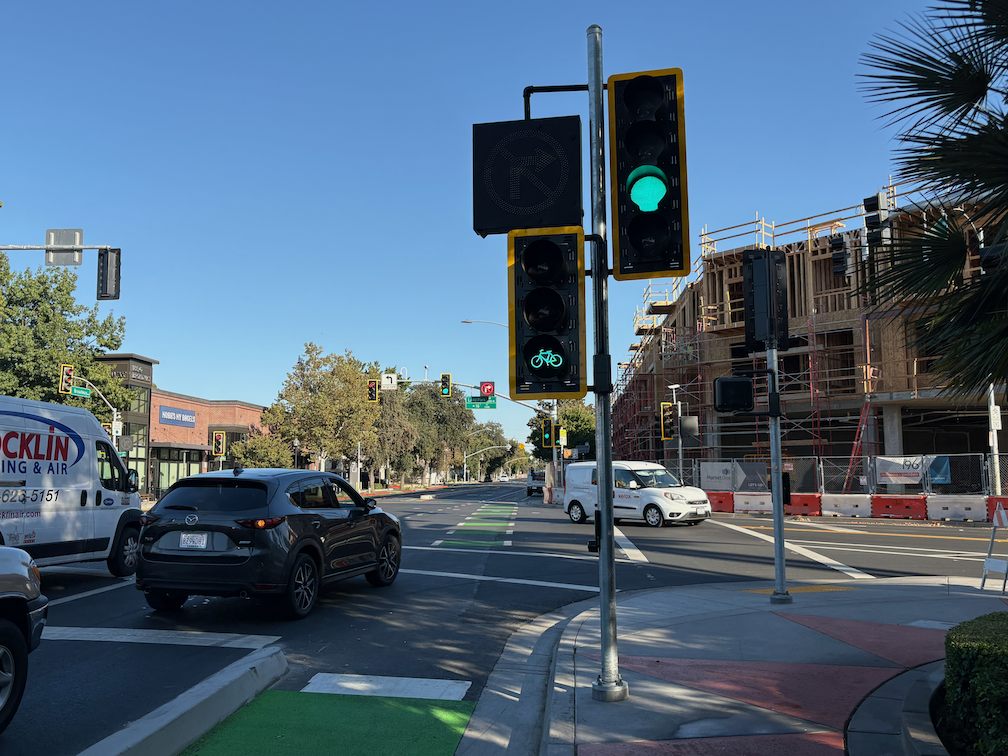
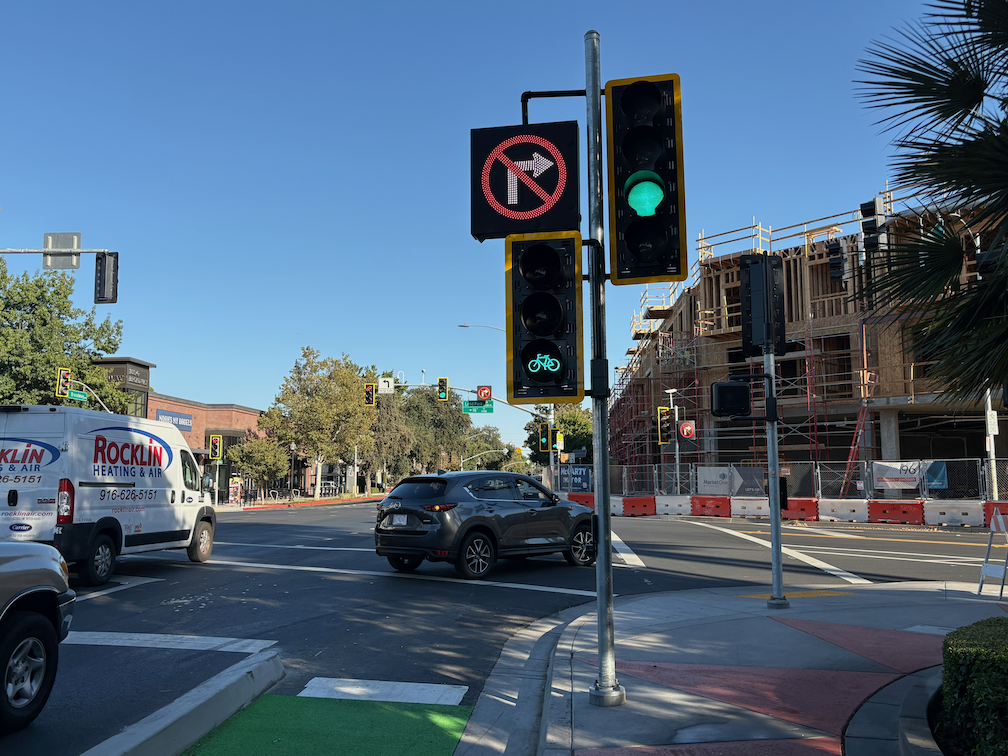
The short curb-separated bikeway eastbound between 15th Street and 16th Street was closed yesterday, though I had used it a few days earlier. I noticed a bicycle signal on Broadway at 16th Street / Land Park Drive, which may have not been there before or may not have been activated and so I didn’t notice it. In a short while of observing, it did not change to green, so perhaps it is awaiting completion of the curb-separated bikeway.

Broadway at 16th St / Land Park Dr, eastbound, bicycle signal

I continue to have concerns about the RRFBs (rectangular rapid flashing beacon) used for several crosswalks along Broadway. The one in the photo below seemed to be stuck on, for unknown reasons. The rate of driver yielding to people crossing is very low. An observer pointed out that because RRFBs are not common in Sacramento, drivers may not know how to deal with them, and that this would be a perfect time for a city educational effort to bring drivers up to speed (so to speak). The particular location shown below, Broadway at 22nd, has a median island in the center, preventing drivers from passing stopped motor vehicles by using the center turn lane. Other locations do not have this protection, and I observed at least one instance of a driver passing a stopped vehicle by using the center turn lane at Broadway and 18th Street. Reduced general purpose lanes, from two per direction to one per direction, do significantly reduce the multi-lane threat, where one vehicle stops and others do not, but the center turn lane allows drivers to continue to threaten walkers, and to violate the law.

Broadway at 22nd Str, RRFB and walker

As recently as the Broadway Fact Sheet in 2019, conversion of 16th Street between Broadway and X Street from one-way to two-way was part of the project. I’ve seen no evidence of work on that part, so it may have been delayed or may have been dropped. Also, work on Broadway between 19th Street and 21st Street has been delayed to another phase due to prolonged negotiation with Union Pacific over whether there will be one or two traffic lanes per direction approaching the railroad tracks between 19th Street and 20th Street.

I’ll post again when green paint has been installed, and the crosswalks completed.

Streets for People traffic calming

The city yesterday added the Neighborhood Connections Story Board to the Streets for People Active Transportation Plan webpage. I encourage you to look at the entire storymap, but the traffic calming slides are worth sharing independently. The slideshow below has the 13 traffic calming features, with photos, brief descriptions, and relative costs. These traffic calming features are meant for local and minor collector streets, not for major collector and arterials streets. Note that the city is still using the outmoded classification system (local, collector, arterial) that focuses on motor vehicle throughput. This typology approach must change.

Broadway Complete Streets update

Additional posts on Broadway Complete Streets are available at category ‘Broadway Complete Streets‘.

Striping is finally occurring on Broadway, more than two weeks after marking for the striping was completed. Crosswalks have not been striped, though if I were in charge, they would be the first thing striped. Striping is incomplete from 3rd Street to 11th Street, and there is minor striping east of there. There is no green paint yet.

photo of partial striping on Broadway at 3rd St
partial striping on Broadway at 3rd St

RRFBs (rectangular rapid flashing beacon) signals have been installed at three locations. These are mounted on poles and mast arms. Some observation has indicated they are being widely ignored by drivers. A person who has watched the RRFB at 18th Street says that only about 5% of the drivers were yielding to walkers who had triggered the lights. I will do more observation and talk to more people about their observations, but so far, the concerns I expressed in RRFBs are being ignored are true on Broadway.

SacATC 2024-06-20 on Streets for People

The City of Sacramento Active Transportation Commission (SacATC) will meet today, June 20, 2024, 5:30PM in city council chambers, 915 I Street. 

The main agenda item is: 

  1. Streets for People Active Transportation Plan

This is a discussion and feedback item, not for decision.

The attachments to the staff report are available separately on the Streets for People webpage. Hopefully this will solve issues with the very large and likely corrupted combined document.

You can comment via eComment at the city’s meeting page, http://sacramento.granicus.com/ViewPublisher.php?view_id=21, before the meeting starts, or in person. Of course in-person is more powerful, but eComments are valuable and the only method many people can use. eComments submitted well ahead of time can be viewed by commissioners, while last-minute ones will go into the record but not be viewed before the meeting.

If you are frustrated by my posting the meeting on the day of the meeting, please view or subscribe to the calendar hosted by STAR, at https://star-transit.org/events/, which has this event and many others of interest to transportation advocates.

what is public safety?

This post is a response to the Sacramento City Council meeting last Tuesday on the FY 2024-2025 budget adoption.

A number of people spoke on the budget, the majority of them downtown power brokers who were adamant that the police department budget not be reduced. They painted a picture of lawlessness in the central city that could only be reversed by not only not reducing, but increasing the police budget. Most of the problem was blamed on unhoused people, who were presented as violent drug addicts and criminals (never mind the white collar crime going on inside the buildings). Mayor Steinberg right off the bat said that the police budget was being increased, not reduced, but that did not prevent the speakers from claiming that it was being reduced. Several speakers used the term ‘defund the police’, which was originally an effort to reduce police budgets to force the police to be more accountable to the people, but has now been weaponized by pro-police people to suggest that every effort to hold police accountable is an effort to defund the police. One speaker attacked Councilmember Valenzuela, suggesting that she was personally responsible for all the problems in the central city.

To say the least, I was very disturbed by these messages. These are people of great privilege, asking that the city elevate their privilege over other citizens.

Not one of these central city people spoke about the epidemic of traffic violence that is harming people more than traditional crime. Several city council members did speak about this, but none of the downtown power brokers.

None of the power brokers even mentioned other parts of the city. Were they concerned about crime elsewhere? Apparently not.

Only one of the people who spoke in favor of the police budget appeared to be a person of color. He was not from the central city, and expressed ambivalence about police, acknowledging that he was concerned about crime related to his business, but also that many people were uncomfortable about the police.

Not one person from the low-income parts of the city spoke in favor of the police, or the police budget. There is a deep, and well deserved, distrust of the police in large parts of the city. Police have served as oppressors and killers in many, many incidents. Take a moment to think about all the incidents where the police escalated the situation, and then started shooting. Think about the incidents where they showed up and started shooting before they even knew what was going on, and killed innocent people. Think about the incidents where an unarmed person was running away ‘resisting arrest’ and the police shot them in the back. This is a reality that low-income people of color live with and are traumatized by.

In my view, police do not keep us safe. They respond to incidents involving bullets and knives. They often don’t respond to other incidents, or respond very slowly. And it is always response, never prevention.

What does this have to do with traffic violence and safe streets?

The police budget takes a large and growing part of the city budget. These are dollars that could be spent on solving problems, making the city a safer place, but instead they go to the police, who have only one solution, themselves. Councilmember Valenzuela made an effort to keep personal in internal affairs, the police who investigate police malfeasance and crime, but was rebuffed by Police Chief Kathy Lester who doesn’t believe internal affairs is important. Several times the issue came up, as it has many times before, about transferring a small part of the police budget to efforts that actually make a difference, such as Department of Community Response, but no action was taken.

The number of deaths in the city from traffic violence is larger than the number from homicide. Yet the city has only eight traffic enforcement officers. Eight, out of nearly 700 sworn officers (there are others who work for the department but are not officers). This understaffing is a choice that the police department makes, it was not forced on them by anyone else. It reflects their attitude that people who die by guns and knives are worth notice, but people who die by traffic violence are not. It also reflects their attitude that it is better to respond to violence than prevent violence.

I am not in favor of direct traffic enforcement by police. Of the few stops that occur, they are almost all pretextual, meaning that the police officer has stopped the person for a traffic violation, but really is seeking other violations. Most stops are of people of color, as documented by the police’s own data. These stops not infrequently escalate, escalation as often on the part of the officer as the person stopped. Some of these stops result in death.

Automated enforcement is the answer to most traffic enforcement. The city had a red light camera program, but when the county dropped it, so did the city. The police made no request to continue to program. Though the city has encouraged the legislature to pass and the governor to sign automated speed enforcement, the police have been silent. Again, an attitude that only an officer can enforce the law, technology cannot.

I have watched police officers routinely ignore traffic violations, just sitting around waiting for something ‘important’ to happen.

So what is public safety? Public safety is when:

  • resources are spent equally on protecting all citizens, not just the privileged
  • police and the city as a whole focuses on reparation, reinvestment, and dialog to heal the trauma created by police oppression
  • police allocate their officers and other resources based on actual threats to the public safety, not on outmoded perceptions
  • the city reallocates budget to those programs that are making a positive difference in people’s lives, not just increasing the budget of the loudest voices

I know I’ll lose some readers with this post. I know that some people concerned about traffic violence and safe streets are also supporters of the police and of direct traffic enforcement. Sorry to see you go. But I can no longer be silent when I see police and pro-police people claiming the right to use the term ‘public safety’ for their own benefit, to the detriment of others.

a tax JUST to fix roads?

While attending the Sacramento Transportation Authority meeting last Thursday, and hearing the long painful discussion about how there isn’t, and never will be, enough money to fix our roads to the level that the public desires, a thought occurred to me. Keeping roads in good shape is often called ‘fix-it-first’ or ‘state of good repair’.

What about a sales tax of a quarter cent, JUST for maintaining roads? It would have a short term, perhaps 10 years, with language included that it could not be extended. It would only be for fixing pavement. It would not includes complete streets or sidewalks. It could include the addition of regular bike lanes as the street is re-striped after paving, but would not include high quality bike facilities. It would include language to ensure that it is not used to expand roadway capacity or to build new roads.

I know that many of my transportation advocacy friends are cringing. What about all the other things that need to be fixed? What about missing sidewalks? What about complete streets? What about traffic calming? Yes, all of those are important, and must be funded in some way. But useable streets are the base of everything else we do for mobility and access. Sacramento area streets are certainly not the worst in California. I know that Los Angeles, and San Francisco, and parts of Oakland, are much worse.

There would also be a tremendous question of fairness. The tax would be collected from all citizens of the county, but most of it would be spent in unincorporated Sacramento County. The county has a long, long history of underinvesting in its roads, building new but not maintaining. That keeps taxes lower, which is in part why there are so many anti-tax people in unincorporated county, but it does not create useable roads. Should the rest of the county be responsible for fixing the county’s underinvestment? Its a fair question.

photo of potholes on Sacramento County road, credit SacBee
potholes on Sacramento County road, credit SacBee

the albatross of cars

The expression I’m exploring here is ”albatross around the neck’. I think that it very well illuminates the role of cars in people’s lives.

“The word albatross is sometimes used metaphorically to mean a psychological burden (most often associated with guilt or shame) that feels like a curse. It is an allusion to Samuel Taylor Coleridge’s poem The Rime of the Ancient Mariner (1798).” – Wikipedia, https://en.wikipedia.org/wiki/Albatross_(metaphor), retrieved 2024-06-16.

For very rich people, who can afford to buy a new car every one or two years, a car is probably not an albatross. But for everyone else, who cannot buy a new car as often, or who can never buy a new car, they are an albatross.

  • A car loses about 20% of its value just being driving off the car lot, and about 15% per year thereafter. What other major investment do people make that loses value so rapidly? If you own a vehicle and claim it as a work vehicle, you can deduct this depreciation. For individuals, no such luck.
  • People focus on the cost of gas, pushing from their mind all the other ongoing expenses of registration, taxes, routine maintenance. But gas is only about half of the cost of keeping a car.
  • Cars always break down more frequently than expected, and always cost more to repair than expected. For lower income people, these unplanned breakdowns often push them over the edge.
  • The availability of cars and the roadways built specifically to support them (only in part paid for by gas taxes), encourages people to work and live further apart. But the CNT H+T Index says the real cost of decisions about housing and work are the sum of housing and transportation. The further away from everything one lives the less housing costs, but the more transportation costs. The ‘drive until you qualify’ expression focuses on housing costs and ignores transportation costs, but transportation is a significant portion.
  • Cars crash, whether it is the driver’s fault or someone else’s, the damage occurs. We’ve all seen crash damage that doesn’t get repaired because the cost of repair is more than insurance pays out, even if you have insurance, and many people don’t.
  • Cars fall apart. Stand on a corner and you will hear cars with loose wheel nuts rattling, loose exhausts rattling or making unwanted noise (not talking people who intentionally make their cars louder), hubcaps and trim and bumpers long gone. Older cars are belching exhaust, older cars are barely making it up hills, and many can’t even go on the freeway because they can’t keep up.
  • When cars are at the end of their life, they are a piece of junk for which there is no profitable recycling. If you want your car recycled, it is going to cost you money. Or you can let it sit in your front yard, or backyard, or garage, or the street in front of your house, as many do, rusting away and leaking toxic fluids. It is a liability to you and to society.
  • People who drive cars are routinely late because what they plan in their mind is a free-flowing trip, but that is not what usually happens. So they are late, and they drive too fast to try to make up for it. See ‘cars crash’ above. This is probably worst for school drop-off and pick-up.
  • Because cars allow people to travel longer distances to lower priced (and usually but not always lower quality) stores, locally owned businesses disappear, and we are left with chain stores and big box stores. One of the reasons restaurants and bars and coffee shops and entertainment are scarce in the suburbs is that many people drive to the central city, where such things are available. Good business for those of us who live in the central city, but bad for the suburbs. When was the last time you saw a quality locally-owned coffee shop in the suburbs?
  • When I view areas where the unhoused are living in their vehicles, I am amazed at some of the high-end vehicles I see there. Whether they are still running or permanently broken down, I don’t know. But every instance makes me wonder if buying a vehicle they could not afford, payments and maintenance, is what pushed them over the edge, into homelessness.

What have I forgotten? You people out there who own cars but wish you didn’t can add to the list in comments.

photo of car crash on 9th St, Sacramento, cause unknown
car crash on 9th St, Sacramento, cause unknown

we are all just trying to get somewhere

Yesterday a local politician spoke about how adding bicycle facilities to our roadways is what got us into the pavement condition crisis, implying that if we made bicyclists ride on sidewalks, everything would be fine.

My alternate title for this post is: ‘the pernicious arrogance of car drivers’.

There is a common belief that people driving cars are doing something important, and that people walking and bicycling are not doing anything important. It is true that this attitude is most prevalent in upper income white males, but it certainly exists to some degree with others. A related idea is that if you aren’t driving, you are poor, and its your fault, a very common bias against people who use transit. Bicyclists are most likely to come in for criticism because a common view is that bicycling is just for recreation, or for kids. All of this is wrong. It is not factual, and it is arrogant.

I do not drive. I haven’t owned a car in 13 years. When I started this blog, my tag line was (and still is) ‘BY FOOT, BICYCLE, AND PUBLIC TRANSIT (CAR-FREE!)’. I get everywhere by walking, bicycling and transit. I prefer walking, but bicycling and transit are useful when I need to get somewhere faster or a longer distance. It is true that I walk for pleasure most mornings, and ride for pleasure on occasion, but nearly all of my trips are purposeful. Yesterday I walked to the Chavez Plaza farmers market for some produce, then rode my bike to a public meeting, and then walked to have a beer. Today I’m walking to a meeting, and then riding my bike to Davis for the Davis Music Fest, and then taking the Capitol Corridor train home. When I do my grocery shopping, I walk or bicycle. When I go to medical appointments, I walk or bicycle. When I travel, I take the train, often with my bicycle, and then walk or bicycle or transit at the other end.

My trips are just as important as anyone driving a car. I am just as important as anyone driving a car.

Though I don’t want to overstate the case, my trips are actually more important in several ways. I am supporting a dense urban environment (I live in the central city) and the businesses and organizations located here. I am not endangering other people by my mode of travel. I’m a respectful bicyclist who always yields to walkers, which irritates the hell out of many drivers who have to wait while I wait for someone to cross the street. My walking and bicycling trips have almost zero carbon footprint, and my transit and train trips have a very low carbon footprint. I have never injured another person while walking or bicycling (though occasionally myself). I rarely take single-purpose trips, rather I chain errands.

I worked in the suburbs for many years. Three frequent driver behaviors I observed there that irritate me:

  • People drive from their work or house to get coffee, and back again. Just for a cup of coffee. It is true that the suburbs are a coffee desert, with few coffee shops and even fewer locally owned coffee shops. There are 12 local coffee shops within walking distance of where I live, and about 30 within bicycling distance.
  • People shopping at Trader Joe’s, and coming out with a small bag of groceries to their car. The groeries could easily be carried on a bike, and in many cases by walking. People seem to think that are doing good by shopping at Trader Joe’s, or Whole Foods, or Spouts, but the carbon impact of their driving trip undoes all the good of shopping there.
  • Parents driving their kids to school, and often pickup, when they live within easy walking or bicycling distance of school. I realize that it is not safe to cross many arterials, but rather than working to make things safe, or taking the time to go with their children, parents just default to driving without thinking about it.

This list could be very long, but the point is that people driving are NOT doing something more important than people walking and bicycling.

So why do people drive? Because we have built low-density places with destinations far away, so for many people driving seems the logical solution. Did we force people to prefer driving by making everything so far apart? Yes. Are people happy with this situation? Mostly not. Is there another way? Yes! Urban areas with moderate density allow people to make many trips by walking, bicycling and transit. It is time to stop the insanity, stop investing in long distance driving and commuting, and create places where everyone making trips will be seen as equal.

Strong SacTown Street Design: Lane Widths

The third post by Strong SacTown to improve and promote the City of Sacramento update to its Street Design Standards. Other posts at tag: street design standards.

Narrower lanes are generally correlated with slower speeds, reduced collisions, and safer streets. Our recommendations:Lane widths instituted as maximums (rather than minimums) Maximum 10 feet for any streets 30+ mph (except limited cases) Increased flexibility for streets designed for 25 mph or lowerOver 80% of the fatalities and serious injuries on Sacramento roadways happen on streets signed between 30 mph and 45 mph. Taking a serious approach to Vision Zero will mean addressing these higher-speed, higher-volume roads. Both a reclassification of these roads (discussed later) and redesign of the current geometry to appropriate speeds is crucial. 

Lane Widths – Strong SacTown