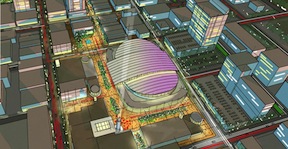
Whether the arena is built or not, I care little, and whether the Kings stay or not, I care not at all. But what I find interesting is that no one any longer talks about a public asset like this being located in the suburbs. When it was in the railyards, it was a downtown arena. As it is now proposed on the footprint of the mall, it is the downtown arena. It is the same in Seattle, where the arena location is not so central but is still part of downtown.
Sacramento has grown up! It realizes that downtown is the place for public assets. Downtown has a high density of public transit, walkable and bikeable areas, a grid street pattern, established businesses that can serve patrons of an events center, and yes, even freeways.
The ARCO/Power Balance/Sleep Train facility squats in the middle of acres of parking, a 12,000 parking space wasteland. It is far from light rail, is poorly served by bus (you can get there, but you can’t get home, for evening events, and not at all on Sunday, transit score 24, minimal), is in an un-walkable and un-bikeable area (all high speed arterial roads, walk score 48, car dependent), where almost no streets go through (the classic suburban street system of cul-de-sacs and streets that wind interminably). Why anyone ever thought an arena in Natomas was a good idea, I don’t know, but at least no one any longer thinks it is. And that is progress!
Downtown Plaza, the currently proposed location, has a walk score of 94, walker’s paradise, and a transit score of 67, good transit.
This graphic, from the Chicago Department of Transportation Complete Streets Design Guide, better captures what our spending priorities should be in Sacramento that anything else I’ve seen. Wow!
Sacramento is updating its Transportation Programming Guide, and has sought public input on projects. A survey (deadline April 15) seeks input on specific improvements at specific locations, but it does not seek input on the overall approach of the guide. The 2010 guide is available for review. Since the survey did not allow me to comment on the overall plan, I submitted some comments, below. I could have said a lot more about each of these, but only have time for this at the moment.
Roadway widening is not needed anywhere in Sacramento. Widening generally induces more traffic, and when it does not, is a waste of limited resources. We need a fix-it-first policy, and roadway widening is not part of that.
AB-184: Statute of limitations: lengthens statue of limitation for hit and run, probably a good bill
AB-206: Vehicles: length limitations: buses: bicycle transportation devices (SacRT): amended to add an onerous process for approval, but probably still a good bill
AB-417: Environmental quality: California Environmental Quality Act: bicycle transportation plan: no changes so far, a good bill
AB-666: Automated traffic enforcement systems: violations: red light cameras, it restarts the program, but with civil rather than criminal penalties, supported by CaliforniaWALKS and California Bicycle Coalition; hearing in Assembly Judiciary 04/23/13
AB-738 Public entity liability: bicycles: no changes so far, still a bad bill; hearing in Assembly Judiciary 04/23/13
AB-840: Vehicles: driver’s licenses: application requirements: stripped of all bicycling knowledge language, now only requires that drivers license applicants acknowledge the dangers of distracted driving
AB-956: Vehicle accidents: fleeing: no changes so far
AB-1002: Vehicles: registration fee: sustainable communities strategies: changed to remove urgency language and detail use for sustainable communities; still a good bill; hearing in Assembly Transportation 04/22/13
AB-1179 Regional transportation plan: sustainable communities strategy: schoolsites: language slightly diluted, still a good bill
AB-1193 Bikeways: allows cities and counties to use industry standards rather than the requiring the use of the Highway Design Manual; language improved, a great bill; hearing in Assembly Local Government 04/24/13
AB-1194: Safe Routes to School Program; maintains SRTS program at state level, added non-infrasture, statewide coordinator, and TARC; better; hearing in Assembly Transportation 04/15/13, 1:30PM
AB-1290: Transportation planning: broadens representation on the California Transportation Commission and requires reports on progress of transportation agencies in reaching sustainable community goals; seems to be a good bill; hearing in Assembly Transportation 04/29/13
AB-1371: Vehicles: bicycles: passing distance: this bill originally had a different purpose, and was revised to be a three foot passing law, it looks to me to be good; hearing in Assembly Transportation 04/22/13
Please let me know if you are aware of any other bills. I’ve signed up for tracking on these particular bills, but may not be keeping up to date.
On I Street between 7th and 6th streets, there is a floating bike lane on the north side. A floating bike lane, also called a part-time bike lane, is one that is designed to be a parking lane for part of the day and a motor vehicle travel lane for part of the day.
The first photo below is the lane when parking is prohibited, and it is a shared motor vehicle travel lane. The signing indicates that parking is prohibited from 4 to 6PM on weekdays. This is in order to provide more lanes for the flush of traffic heading to the freeway during the afternoon rush hour. There are sharrow markings at the beginning and near the end of the block, to reinforce the “bikes may use full lane” sign (MUTCD R4-11).
The next photo shows the same floating bike lane when parking is allowed, the rest of the time. As you can see, the sharrows are partly covered by parked cars. The remaining width of the lane, which forms a de-facto bike lane, is too narrow for a lane adjacent to parked cars and is unsafe. In this particular location in front of the county jail, it is doubly unsafe because frequent turnover in cars (one hour limit) and the type of people who park here, not the sort to be thinking of bicyclists before they open their car door. In fact, guidance on floating bike lanes recommends against their use in situations with high-turnover parking.
I Street floating bike, parking prohibited
I Street floating bike lane, parking permitted (Elle Bustamante)
I never ride in this floating bike lane when there are parked cars, I always ride in the full travel lane to the left, but I often get honked at by drivers who think I should be in the “bike lane,” and don’t realize it is not a safe place to ride.
There is nothing inherently wrong with floating bike lanes. A number of cities use them in cases where they perceive a need to carry high volumes of motor vehicle traffic at certain times of day, but want to accommodate bicyclists at other times. They are always seen as a compromise that doesn’t make anyone completely happy. However, this is the only instance that I’m aware of in Sacramento, and it is not signed and marked in such a way as to communicate its purpose and use to either drivers or bicyclists. It needs to be crystal clear for everyone, or be removed. Maybe it is time for this floating bike lane to sink.
This section of I Street is the logical main access route for bicyclists to the train station. Rush hour for cars is also rush hour for bicyclists. What I see during this time of day (4-6PM) is a lot of bicyclists riding the wrong way, or on the light rail tracks, along H Street in order to access the train station. It is worrisome to me that that I Street was not designed with bicyclist safety in mind. Bicyclists feel that it is safer to ride against traffic on H Street than with traffic on I Street, despite the fact that wrong way riding is the leading cause of bicycle-motor vehicle crashes, or to risk spills getting caught in the light rail tracks, anything to avoid I Street. I have seen several bicyclists fall on the light rail tracks here.
I Street in this section could be made safe for bicyclists in two ways:
Remove parking from the left side of I Street and shifting travel lanes to the south so that a full 6.5 foot bike lane could be installed. The sharrows would not then be needed. Or,
Make the right hand lane a full-time parking lane and move the sharrows into the next travel lane to the left.
Given that there are bike lanes both east and west of this block, option one is probably the best because it would create a continuous bike lane, but option two is workable.
Thank you, Elle, for reminding me in your “transportation ‘planning’ downtown” that I wanted to write about I Street. Note: If you are looking at Google Maps, it does not show the current lane configuration on I Street since the repaving and re-striping project of last fall, nor the realignment of tracks and work on extending 5th and 6th streets over the tracks.
I Street from the 4th Street crosswalk; I have the walk signal but this is still scary
I Street in Sacramento approaching the train station is a mess. Starting with the confusing floating bike lane between 7th and 6th streets (subject of a future post), the street becomes worse and worse: five lanes wide, high speed, and completely unfriendly to bicyclists and pedestrians. For pedestrians, the crossing on the east side of the I/5th intersection is uncomfortable because westbound traffic is already moving at high speed and often runs the red light, and right turning cars from I to 5th often do not yield to pedestrians in the crosswalk. The west side is so unsafe due to traffic turning left off 5th Street, it is signed against pedestrian crossing, even though this is a logical walking route from downtown to the train station. A crosswalk has been added on the east side of the I/4th intersection, but it has the same challenges that drivers are moving too fast and often run the run light. When I used this new crosswalk, I was very concerned, and I have a much higher tolerance for danger than most people do.
The right-most two travel lanes lead to the high-speed northbound I-5 freeway onramp, so drivers passing 6th Street are already accelerating to freeway speeds, many times going 55 mph as they cross through the I/5th intersection. The next two lanes lead to a medium speed onramp to the I Street bridge over the Sacramento river, and to the southbound I-5 onramp. For pedestrians, the only way to go westbound towards Old Sacramento is to go through the parking lot for the train station and under the onramps along an ugly, dark, poorly marked pedestrian way.
There are several bills before the California Legislature that would affect bicycling, walking, and livability.
added: AB-184: Statute of limitations: lengthens statue of limitation for hit and run, probably a good bill
AB-206: Vehicles: length limitations: buses: bicycle transportation devices (SacRT): added complicating language, but still good
AB-417: Environmental quality: California Environmental Quality Act: bicycle transportation plan: no changes so far, a good bill
added: AB-666: Automated traffic enforcement systems: violations: red light cameras, it restarts the program, but with civil rather than criminal penalties, supported by CaliforniaWALKS and California Bicycle Coalition
AB-738 Public entity liability: bicycles: no changes so far, still a bad bill
AB-840: Vehicles: driver’s licenses: application requirements: stripped of all bicycling knowledge language, now only requires that drivers license applicants acknowledge the dangers of distracted driving
AB-956: Vehicle accidents: fleeing: no changes so far
AB-1002: Vehicles: registration fee: sustainable communities strategies: changed to remove urgency language and detail use for sustainable communities; still a good bill
AB-1179 Regional transportation plan: sustainable communities strategy: schoolsites: language slightly diluted, still a good bill
AB-1193 Bikeways: allows cities and counties to use industry standards rather than the requiring the use of the Highway Design Manual; language improved, a great bill
AB-1194: Safe Routes to School Program; maintains SRTS program at state level, added non-infrasture, statewide coordinator, and TARC; better
AB-1371: Vehicles: bicycles: passing distance: this bill originally had a different purpose, and was revised to be a three foot passing law, it looks to me to be good
Please let me know if you are aware of any other bills. I’ve signed up for tracking on these particular bills, but may not be keeping up to date.
My post on the new downtown bike lanes, shortly after the work was completed in fall 2012, had some mild criticism of the placement of sharrows. After many months of riding on these particular streets, and observing how bicyclists and motor vehicle drivers respond to their placement on the roadway, I am now prepared to criticize the sharrow placement more strongly.
The California MUTCD section 9C.07 specifies that shared lane markings (commonly called sharrows) must be at least 11 feet from the curb where parking is present. Either traffic engineers or paint crews, not sure which, are taking this to mean that the sharrows should be placed exactly 11 feet from the curb, as many of those in the recent Sacramento project were. The NACTO Urban Bikeway Design Guide has a better recommendation, “On streets with posted 25 mph speeds or slower, preferred placement is in the center of the travel lane to minimize wear and encourage bicyclists to occupy the full travel lane.” However, the NACTO guide has not been recognized or adopted by either the state or Sacramento, and in fact some vehicular cyclists are opposed to the NACTO guide because it promotes separate facilities over riding in traffic, but that is a conversation for another post.
One of the purposes of the sharrows is to guide bicyclists about the best place to ride in situations where bike lanes are not present and the lane is too narrow to share, 14 feet or less. When sharrows are placed to the side of the travel lane, they are too close to parked vehicles and their car doors. Doors on some two-door vehicles come out an amazing 54 inches from the side of the car. So if the side of a parked car is 7 feet from the curb, the door comes out 11.5 feet, more than the minimum specified in the MUTCD, and that does not even count handlebar width and shy distance. Eleven feet is not a safe placement. Many bicyclists know that this is not safe, and therefore ride in the middle of the travel lane, but since they are no longer riding on the sharrows, motor vehicle drivers think that they are riding in an illegal fashion and do the typical immature driver things: yelling, honking, following too close, and intimidation through close passing. Yet if the bicyclist is riding on the sharrows, then many motor vehicle drivers feel that there is room to squeeze by in the same lane, thereby coming much too close to the bicyclist and endangering them. The only safe place for the bicyclist to be is in the middle of the travel lane, and that is where the sharrows should be.