So if you forced me to have a federal transportation bill, then I would want it to do two things. First, I would want it to place a moratorium on the expansion, extension or construction of any new auto-oriented facilities. No new road miles anywhere. There is no need for this country to ever build […]
At the November 13 Sacramento City Council meeting, the next step for the Sacramento River Parkway will be on the agenda. This is just a small step. primarily to allocate funds to start property research, but it is an important next step. It may be controversial, with a small number of property owners in the Pocket and Little Pocket area opposed to public access to the publicly owned levees. The City Council meeting starts at 6:00PM, in the City Council Chambers of the City Hall at 915 I St. It is difficult to guess how much time will be taken with preceding agenda items, but item 19 might come up about 7:30PM.
19.
American and Sacramento River Parkway Plans 2012 Implementation Program Report # 2012-00851 Estimated Time: 45 Minutes
Location: Districts, 3, 4, and 7
Recommendation: Pass a Resolution: 1) approving the American and Sacramento River Parkway Plans 2012 Implementation Program; 2) establishing a new Capital Improvement Program (CIP) for the River Parkway Plans Implementation (L19016500) project; 3) transferring $100,000 from the Regional Park/Parkway Acquisition/ Development (L19003500) project to L19016500; 4) authorizing the City Manager, or City Manager’s designee to negotiate with public agencies and private parties for public access trail easements; and 5) authorizing the City Manager, or City Manager’s designee, to coordinate with local, state, and federal agencies regarding associated flood protection permit and easement compliance and removal of unpermitted encroachments. Contact: J.P. Tindell, Park Planning & Development Manager, (916) 808-1955, Parks and Recreation Department Item 19-American and Sacramento River Parkway Plans 2012 Implementation Program (PDF-1689 KB)
Tomorrow night (Nov. 8) at 6 PM the Sacramento City Council meets to vote to adopt a plan for the Freeport Blvd. Bike Lane project.
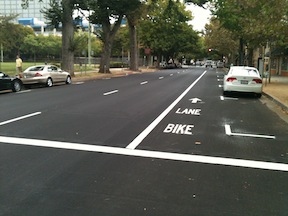
City staff propose replacing 4 substandard-width traffic lanes on Freeport Blvd. between 4th Ave and Sutterville Rd with 5 lanes: 2 standard-width traffic lanes and a center turn lane for motor vehicles and bike lanes in both directions (Segment Design Concept 2 on the website below). Staff also proposes bike-friendly modifications to the intersection at Freeport and 4th Ave, in front of Taylor’s Market (Intersection Design Concept 2).
The segment improvements are exactly what bicyclists need for safety, and while the intersection improvement isn’t the best one (see #4), it’s affordable and workable.This is a good plan and it looks likely a council majority is prepared to approve it.We need **100** bicyclists to attend this meeting to show the council that our community supports these kinds of essential safety improvements. If you ride on Freeport or care about the safety of someone who does, please join us and please share this invitation with others!
Questions? Contact SABA at jim@sacbike.org or 916-444-6600.
10th Street northbound at Roosevelt Park, three lanes reduced to two
As part of a recent repaving project, now mostly complete, bike lanes were added to several streets in the downtown area, sometimes by converting three travel lanes to two, and sometimes just by narrowing the travel lanes. As an example, 9th Street (one-way southbound) and 10th Street (one-way northbound) were converted from three lanes to two, which freed up space for bike lanes. 10th Street is shown at right. A reduction in the number of travel lanes is sometimes referred to as a road diet. However, the amount of right of way is the same, it has just been shifted to serve all modes of travel more effectively. The reduction in motor vehicle lanes reduces the motor vehicle road capacity slightly, but far less than many people think it will. In fact, with more space for bicycles, more people will bicycle and the motor vehicle traffic drops somewhat, lessening congestion for everyone.
I Street westbound just past 7th St; sharrow in time restricted lane
Sharrows (shared lane markings) were also used liberally throughout, particularly on east-west streets. Along I Street westbound, bike lanes are present in some blocks and sharrows in others. The photo at right shows the sharrows placed within a time restricted travel lane in front of the courthouse on I Street. When parking is allowed, the sharrows form a defacto bike lane adjacent to parked cars. This lane is a bit wider than it was before. During no-parking times, the sharrows define their usual meaning, that “Bikes Can Use Full Lane”. The MUTCD R4-11 sign is used at times to provide the same indication. Sharrows are placed in lanes which are too narrow for a motor vehicle and a bicycle to share side by side, which is less than 14 feet. In any lane narrower than 14 feet, the bicycle not only can be should occupy the middle of the lane to prevent motor vehicles from passing too closely.
Some criticisms of the project:
Sharrows are placed inconsistently within the travel lanes. They should always be centered in the travel lane, but it looks like in some cases they were placed a certain distance out from the curb. Placement too far to the right encourages motor vehicle drivers to try to squeeze by, which is what creates the hazard.
The alternating of bike lanes when there is space with sharrows when there is not space is an understandable effort to create the best solution to a challenging situation, but in my mind, it fails. Regular bicyclists often take the travel lane anyway, in order to create the necessary distance from parking cars and their dooring hazard, to bypass slow traffic, and to prepare for left turns. It is the less confident bicyclists who would benefit most from the new bike lanes, but I think they will be quite confused with the change back and forth between bike lanes and sharrows.
I think that all three lane streets in downtown should be converted to two lanes. Three lane streets encourage high vehicle speeds. It is not unusual during non-congested times to see vehicles going 40 mph on these streets, where the posted speed limit is 25. An opportunity was missed to make these conversions.
I also think that one-way streets should be converted to two-way streets. Again, one-way streets encourage high vehicle speeds, and in fact they are designed to do this, to flush cars in and out of downtown twice a day. They are called traffic sewers for a reason. Two-way streets create an environment where drivers are much less likely to speed. Of course once a street has been road dieted to two travel lanes, a conversion to two-way is much easier.
Despite these criticisms, though, I am pleased to see the new bike lanes freshly painted. I suspect this project has doubled the number of sharrows in Sacramento, and as people see them used more and more, they will become more effective. It was a pleasure riding on Sunday from my residence in midtown south to the farmers marked on 9th Street, and then back north on 10th Street.
Promising a college, project seeks approval (SacBee, 2012-10-12); this is an example of yet more suburban sprawl, far from transit, that will increase driving and trap residents into having to drive everywhere



 Getting Around Sacramento