H Street Bikeway: driveway speed bumps

For other posts on the H Street Bikeway project, see category: H Street Bikeway. For the city webpage on the project, see H Street Bikeway to Sacramento Valley Station.

The H Street Bikeway design has 6 driveways crossing it, 2 on 5th Street to 6th Street, 3 on 6th Street to 7th Street, 1 on 7th Street to 8th Street, and none on 8th Street to 10th Street. Though none of these driveways are heavily used, all are potential conflict points for the bikeway. The 30% design diagrams do not detail how these driveways crossing the separated bikeway will be handled. It is imperative that motor vehicles using the bikeway are moving slowly enough that drivers will see and yield to bicyclists, and bicyclists have time to avoid collisions with drivers who do not yield.

San Francisco has a two-way separated bikeway (cycletrack) on Battery Street in the financial district. Each driveway has speed control devices to ensure that drivers are moving slowly entering and exiting the driveways. The photo below shows one installation, between Pine Street and Bush Street. As a frequent user of this bikeway, I can attest that they are a critical safety feature.

A note about speed bumps. Speed bumps are illegal across roadways in the US. They are most often seen in parking lots, where they are still legal. This use across driveways, and not streets, is legal. The traffic calming devices that are legal across roadways are speed humps, speed cushions, and speed tables.
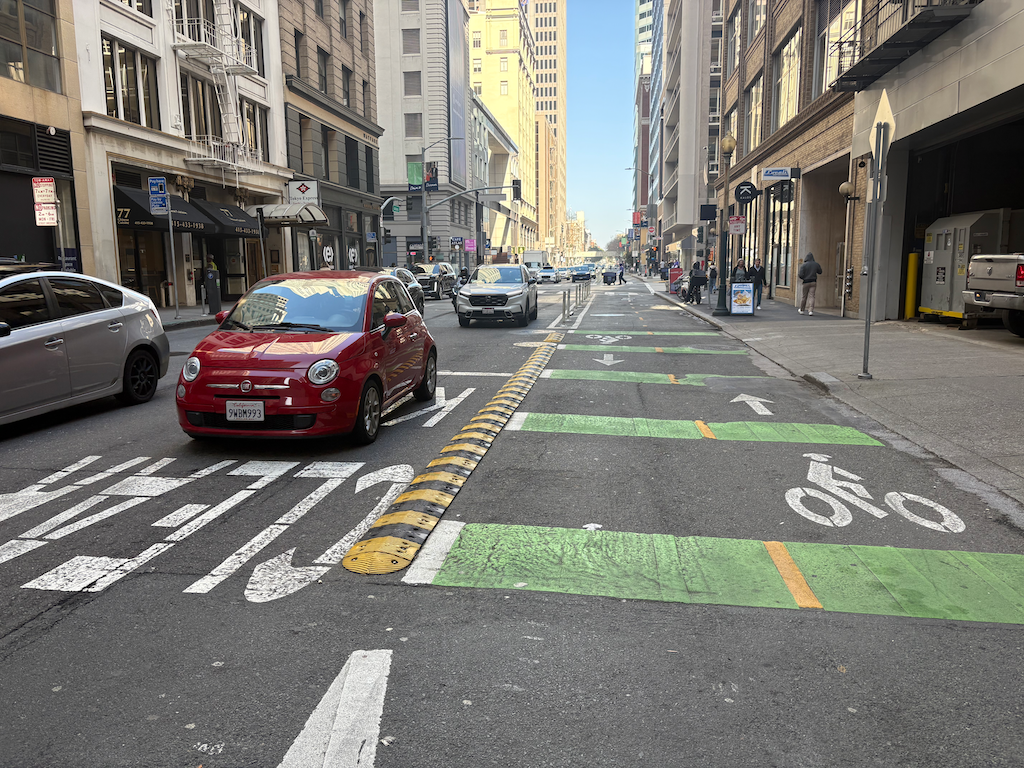
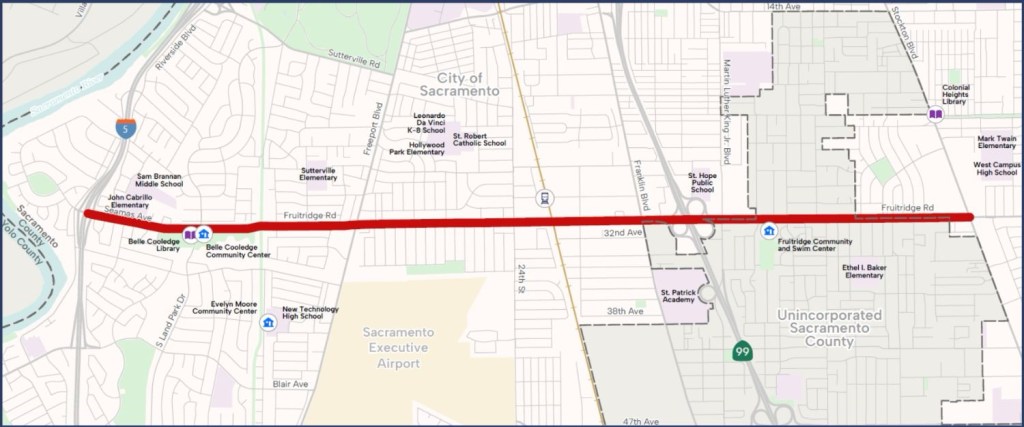
photo of speed bumps across driveway on Battery St bikeway
speed bumps across driveway on Battery St two-way bikeway, San Francisco

Fruitridge Road Safety and Mobility Plan

Yet another planning project starting up for the City of Sacramento, webpage at https://www.cityofsacramento.gov/public-works/mobility-and-sustainability/transportation-planning/current_transportation_planning_efforts/fruitridge-road-safety-and-mobility-plan.

A community workshop will be held March 4. See the webpage for details. There is an Eventbrite registration link, though you do not need to register to attend.

You can also sign up for email updates.

Fruitridge is on the city’s Vision Zero High Injury Network, so attention is appropriate.

barricades

An article in the MinnPost makes me very happy, and engenders thoughts of what citizen action could do on the streets of Sacramento.

In occupied Minneapolis, neighborhood barricades rightly slow injustice, MinnPost, 2026-02-11

Here upon these stones
We will build our barricade
In the heart of the city
We claim as our own!
Each man to his duty
And don’t be afraid.

Les Miserables, Upon These Stones (At the Barricade)

Though nothing currently happening in Sacramento rises to the level of government initiated violence and oppression in Minneapolis, it is true that motor vehicle hegemony here creates a hostile city for people who walk and bicycle. Law enforcement, both CHP and SacPD, are either supportive of this hegemony, or indifferent to its effects.

There are parts of the city government trying to change this, but the cultural norm is still an acceptance and celebration of car dominance. It is not just the people killed and injured, but the intimidation of walkers and bicyclists that denies them their right to the city, and to the streets of the city.

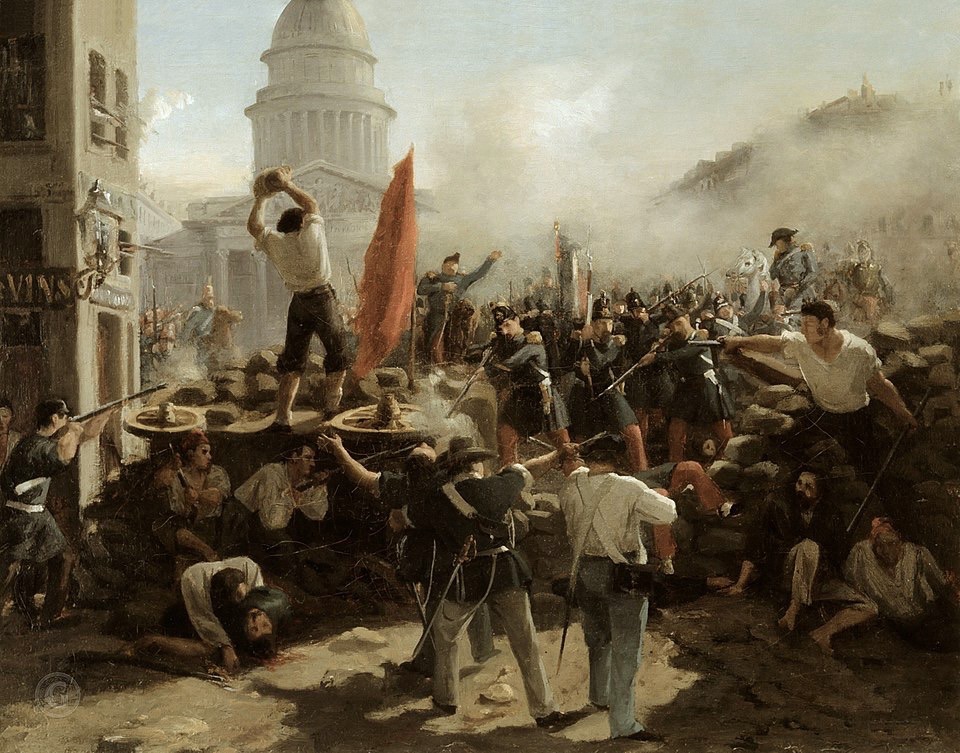
Is it time for citizens to rise up, and erect barricades?

Horace Vernet: On the barricades on the Rue Soufflot

Sac City abandons separated bikeways

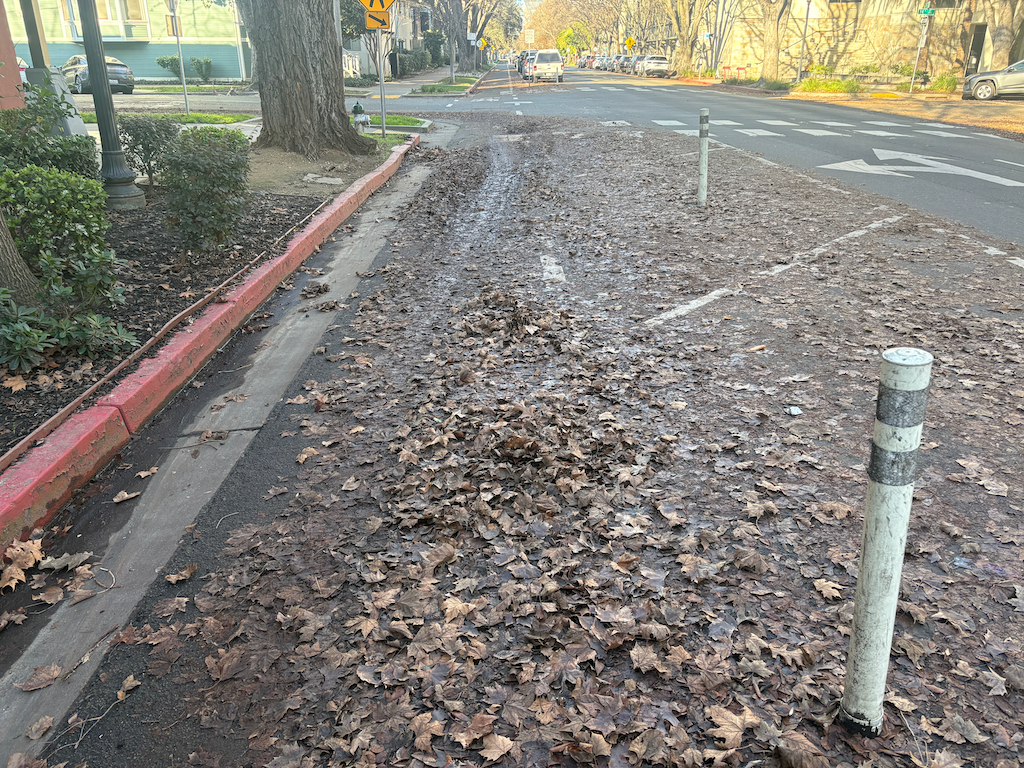
The City of Sacramento has installed a number of separated, parking-protected bikeways, including P St, Q St, 19th St, 21st St, 9th St, 10th St, and J St. It is failing FAILING to maintain these bikeways. They have not been swept by the city since the beginning of leaf season, early November.

You can find several blocks, or portions of blocks that have been cleared, but these have not been cleared by the city. They have been cleared by landscape services contracted by adjacent property management companies, mostly for multi-family housing. It is not the responsibility of these companies to clear the bikeways, but they do so both as a community service, and to maintain a higher level of appearance for their housing and businesses.

The city should be ashamed of itself. It has created a hazard of its own making.

It would probably be better if the city returned these streets to their previous configuartion, with traditional bike lanes. At least these could be swept by the city, and to some degree are swept by the wind of passing motor vehicles.

photo of SacCity P St separated bikeway; yes there is a bikeway under the leaf piles and leaf slime
SacCity P St separated bikeway; yes there is a bikeway under the leaf piles and leaf slime

SacATC 2025-11-20

The Sacramento Active Transportation Commission (SacATC) will meet Thursday, November 20, 2025, at 5:30 PM. The meeting will be at Sacramento City Hall, council chambers. The meeting is livestreamed from the Upcoming Meetings Materials page at the time of the meeting. Comments may be made in-person, or via eComment on the Upcoming Meetings Materials page up to the time of the meeting, but should be submitted well ahead of time if you wish the commission members to see the comment before the meeting. No comments are taken online.


Agenda (pdf)

Open Session

Roll Call

Land Acknowledgement

Pledge of Allegiance

Welcome New Commissioner – Justine Recio-Patel

Consent Calendar

  1. Approval of Active Transportation Commission Meeting Minutes
  2. Active Transportation Commission Log File ID: 2025-00201 Location: Citywide Recommendation: Pass a Motion adopting the Active Transportation Commission Log.

Discussion Calendar

  1. Franklin Boulevard Complete Street Informational Update
  2. Transportation Planning Current and Planned Projects
  3. Active Transportation Commission 2025 Annual Report

Commission Staff Report

Commissioner Comments – Ideas and Questions

Public Comments-Matters Not on the Agenda

Adjournment


SacATC 2025-09-18

The Sacramento Active Transportation Commission (SacATC) will meet Thursday, September 18, 2025, at 5:30 PM. The meeting will be at Sacramento City Hall, council chambers. The meeting is livestreamed from the Upcoming Meetings Materials page at the time of the meeting. Comments may be made in-person, or via eComment on the Upcoming Meetings Materials page up to the time of the meeting, but should be submitted well ahead of time if you wish the commission members to see the comment before the meeting. No comments are taken online.


Agenda (pdf)

Open Session

Roll Call

Land Acknowledgement

Pledge of Allegiance

Consent Calendar

All items listed under the Consent Calendar are considered and acted upon by one Motion.

1. Approval of Active Transportation Commission Meeting Minutes

2. Active Transportation Commission Log

Discussion Calendar

3. 9th St Separated Bikeway

4. Marysville Boulevard Vision Zero Safety Project

5. Fiscal Year (FY) 2026/2027 Caltrans Sustainable Transportation Planning Grant Application

6. Active Transportation Commission 2025 Annual Report

Commission Staff Report

Commissioner Comments – Ideas and Questions

Public Comments-Matters Not on the Agenda

Adjournment


SacTA Board 2025-09-11

The Sacramento Transportation Authority (STA or SacTA) Board of Directors is meeting this Thursday, September 11, at 1:30 PM in Sacramento County Board of Supervisors chambers, 00 H St, Ste 1450, Sacramento.

Comments may be made in person, or via email ahead of time to BoardClerk@saccounty.gov. If you want board members to see your comment before the meeting, send it at least 24 hours in advance.

The meeting may be viewed online at Metro Cable 14. It will be the video on the home page, at the time of the meeting. Comments may not be made through the live stream.

For more information about the SacMoves Coalition presentation, see SacMoves to present at Sacramento Transportation Authority. I strongly encourage people interested in transportation and transportation funding attend the meeting, or at least view it online. SacMoves Coalition is being offered the opportunity to present before the stakeholder engagement process has started because it is a coalition of 25 organizations with interests in transportation funding and related issues.

Documents not linked below are available on the SacTA website: https://www.sacta.org/2025-09-11-board-meeting.


Agenda (pdf)

COMMENT ITEMS

  1. Comments From The Public Regarding Matters Not On The Agenda

CONSENT ITEMS

GENERAL

  1. Approve Action Summary: August 14, 2025, Sacramento Transportation Authority Governing Board Meeting
  2. Adopt Resolution Amending STA Personnel Rules And Regulations For The CALPERS 457 Loan Program Provision

MEASURE A

  1. Receive And File A Contract With Lucas Public Affairs For Community Listening Sessions On Transportation
  2. Amendment To Ongoing Annual Programs Memorandum Of Understanding – Reporting Frequency Change ◄
  3. Receive And File Capital Project Status Reports Fourth Quarter Fiscal Year 2024-25
  4. Receive And File Measure A Ongoing Programs Annual Report – Fiscal Year 2024-25

SACMETRO FREEWAY SERVICE PATROL

  1. SacMetro Freeway Service Patrol Zones 3, And 4 Request For Bids Result And Authorize The Executive Director To Award And Execute Contracts ◄

SEPARATE ITEMS

  1. Receive A Presentation Regarding Coordination Of State Transportation Improvement Program And The Results Of The Four-County State Funding Program
  2. Receive A Presentation From The SacMoves Coalition On Principles To Consider For Future Ballot Measures (note: the SacMoves presentation is available: SacMoves presentation for STA 2025-09-11
  3. Executive Director’s Report
  4. Comments and Reports From Authority Members
    • Capital Area Regional Tolling Authority (CARTA)
    • New Transportation Funding Subcommittee
    • STA’s Role in the Region Subcommittee

local knowledge should not be free

I have participated in more agency planning projects than I can count, mostly transportation-related, but other topics as well.

Every project has a well-paid staff project lead, and sometimes other agency staff. Almost all have a well-paid outreach consultant, and almost all have very-well-paid technical consultants, sometimes several.

And then there is the community, the people with local knowledge that is critical to a successful project that meets the needs of the community. These people are rarely paid. Sometimes there will be a focus group that receives some sort of stipend or something of value, but rarely. Sometimes community groups are contracted to bring community members together, but rarely. Sometimes advocacy organizations with some degree of local knowledge are contracted.

But just plain people, who live in their community, have local knowledge, and lived experience with challenges and opportunities, almost never. These people are expected to attend in-person or online workshops and provide their knowledge, for free. This is wrong.

Sometimes food is provided at workshops and meetings, but not often, and when it is, is provided by community nonprofits, not by the grant or agency. There are restrictions on providing food with government grants (as though providing food is ‘wasteful’ while paying agency staff and consultants is not), so this particular issue is often not solvable by the grant recipients.

Child care can be provided by grants, but rarely is. The agencies expect parents to attend, but don’t welcome their kids. Meeting the needs of the kids is often the point of the grant, but the setup makes is difficult for families to participate.

I was just at a workshop, scheduled 5:30 to 7:00 PM. This is dinner time for many families. No surprise, community attendance was very low, with as many advocates as community members. Why are workshops at dinner time? Why are they not scheduled in the afternoon, when the caregiver parent can attend with their children, or after dinner time when the family can attend with their children?

The concept of community outreach is broken. It is the community members that should be treated well, not the professionals.

I’m not looking at you

Everywhere I travel, and walk, most other people walking will at least glance at me, and often acknowledge or smile, and sometimes say hi or good morning or good evening, or even talk. But that is rare in Sacramento. At least on the sidewalk, this is the least friendly place I’ve ever lived.

People passing look studiously at their phones, as though there were something important there, or look at the ground, or look away to the other side. 95% of people walking will not make eye contact, let alone give a positive vibe.

Why is this a transportation issue? The message is that I am an island (Simon and Garfunkel), I don’t need you, I don’t acknowledge you, I don’t care about you. Communities are built on trust, and trust does not occur if people don’t interact with other people. Sacramento (the city and region) has serious problems that can only be solved by group action and personal engagement. In particular, we have a very serious problem with traffic violence. That we are so bad at solving our problems is not surprising when we don’t think of anyone else except close friends as ‘our people’. Of course this is worse since the pandemic, but it has existing as long as I have lived in Sacramento (14 years) and spent time in Sacramento (22 years).

Is it different elsewhere? Yes, it is. In San Francisco, almost everyone I pass on the sidewalk will at least nod their head, and frequently more. Los Angeles. Portland. Seattle. Las Vegas. Denver. Salt Lake City. San Diego. And on and on.

I am very sad about this. But I do not know the cause, and I do not know the solution.