Cordova Hills on Tuesday

The Sacramento County Board of Supervisors will consider the Cordova Hills sprawl development again on this coming Tuesday, January 29. The issue is agenda item #44, which will not be considered before 2:00PM, but may be considered later if the meeting is behind schedule. I don’t know whether this will again be a marathon meeting going on for hours, but if you wish to comment or observe, it is better to be there on time.

On the request of Phil Serna, SACOG considered the Greenhouse Gas (GHG) implications of the development, with and without a university. You can read the full letter SACOG_MikeMcKeever-on-CordovaHills (1.6MB), but the summary statement on page one is enough:

Cordova Hills will face challenges being included in the next MTP/SCS (to be adopted spring, 2016) largely based on market feasibility considerations, with or without a University. Those challenges are greatest if it is not clear when the University is likely to be built.

On a per capita basis (the relevant performance metric for SB375) Cordova Hills will create higher transportation greenhouse gas emissions relative to other development opportunities in the region, with or without a University. Per capita emissions will be significantly greater without a University than with a University.

An updated Air Quality Mitigation Plan has been provided, with approval from the Sacramento Metropolitan Air Quality Management District, which reflects their midnight conversion to accept the project. The primary added mitigation is the reduction of natural gas combustion through the use of tankless water heaters. As I’ve said before, if it was so easy to achieve these reductions, why were they not included in the project to begin with? [If you want to look at this and other documents (there are now about 72), go to the agenda page and download them. Some are huge.]

There have been several letters and comments in the Sacramento area media since the last hearing, urging that the development be approved because we can trust that the developer will obtain a university. There is no evidence for this, but I guess if you have enough friends in high places, you can make such claims.

I remain absolutely opposed to this project. If we can stop this one, there is hope that there won’t be any more of these sprawl-inducing, urban-services-boundary-busting proposals, but if this one goes through, the floodgates are open and quality of life in Sacramento County for all of us is down the tubes.
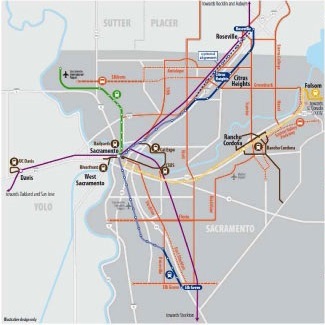
Transit projects in Sacramento region

SacTransitActionPlanScenarioC-map-onlyReconnecting America, a transportation advocacy organization, just published Transit Space Race 2013. To see the Sacramento area projects, click on the < 3 million tab, and then sort by state. The eleven projects will be at the top of the list. The transit agency link in the right-most column links back to a page or website about the project.

Though the south corridor extension is shown as engineering in the status column, construction is underway on parts of the extension, the two bridges, and will start soon on other parts, with the help of a recent federal grant as well as regional funds. The airport extension and streetcar projects also have their own webpages.

Most of the other projects link to the Sacramento TransitAction Plan, which show all possible projects in Scenario C (map at right, more detail in the plan starting on page 50). This plan does not give much detail on each project, but the name of the project gives you an idea.

Fatality trends

The Sacramento Bee today had an article titled Fatal wrecks decline across Sacramento region. I was curious about where the data came from, and asked the author, Phillip Reese. He pointed me to the FARS (Fatality Analysis Reporting System) database. With reluctance, I finally dove in to this database which I’ve long been curious about but afraid of. It is quite hard to use, and it does not allow retrieval of multiple years at once. I compiled a data table of fatalities in the Sacramento region for the last ten years, and the table and graph are below. I used the SACOG region, which includes the six counties of El Dorado, Placer, Sacramento, Sutter, Yolo, and Yuba, so my numbers do not exactly match the four county region used by the Sacramento Bee for the map and 170 number.

The chart shows that there is in fact a downward trend in fatalities in the region, though it is not a consistent decline. Part of the reason 2011 looks good is that 2010 was bad.

Let me say, as I’ve said before, that fatality counts are a mis-measure of roadway safety. The best measure is the rate per vehicle mile traveled (VMT). Injuries are just as important as fatalities because they indicate trends in driver behavior, while fatalities reflect the internal safety of motor vehicles for occupants, and the effectiveness of the emergency medical system in responding to crashes. I will look more at the data, including looking specifically at pedestrians and bicyclists, and the rate for all modes. In meanwhile, here is the data and chart, to be taken with a grain of salt.

chart of traffic fatalities in Sacramento region

No decision on Cordova Hills

Vernal Pools, from ECOS

I attended the six hour long (!) hearing on Wednesday. Supervisors Don Nottoli and Phil Serna asked a series of probing questions, many of which had to do with what effect the lack of a university would have on the project benefits and impacts. The private university that had been part of the project withdrew, no replacement has been found, and many people including myself doubt that a replacement will be found. What university would want to be located on the far edge of the Sacramento region, in a place not accessible by public transportation from the rest of the region? Every other institution of higher learning in the region is accessible by public transportation, and SacRT is currently spending millions to extend light rail to Cosumnes River College. Free land is not a sufficient enticement.

Planning staff could not really answer questions about the lack of a university because they had decided that they would only analyze the “with university” scenario in the environmental impact statements and other documents. Supervisor Serna clearly felt that this was a mistake, as did most of the people in the room. Without any hard information, planning staff could make only vague guesses, and seemed lost at sea.

Specifically, the lack of a university would change the jobs/housing balance and would increase vehicle miles traveled (VMT) for the development, leaving it further from meeting SB375 greenhouse gas reduction goals. Somehow, the developer and planning staff were able to get a midnight agreement from the Air Quality Management District (AQMD) that additional mitigations would meet the goals, but there was doubt expressed by many about this. Since SB375 requires that developments “adopt all feasible measures to mitigate those impacts”, it left me scratching my head as to how planning staff and developer were suddenly able to come up with more mitigations that they hadn’t initially included.

Since the development is outside the Urban Services Area, which under the Sacramento County General Plan defines the area which is expected to be developed in the next 25 years, the planning staff and developer kept touting that the development met the criteria established by LU-120, so that it should be accepted even though it was outside the area. The LU-120 is a series of criteria which judge the quality and sustainability of the project. The document is here, but be prepared to spend some real time working to understand it. I spent much of the six hours looking at and trying to understand it, and I’m not completely there yet. Planning staff presented a slide which contains the same information in a different format, and I was not able to find that slide on the website. The slide crammed text onto the slide so that no one could read it.

When challenged by supervisors to explain why the project had received the scores on several of the criteria, planning staff was very vague in their answers, basically saying “well, that’s what we decided.” When asked how the lack of a university would affect those scores, they really had no idea, because, again, they had chosen not to look at this scenario. I suspect that the LU-120 scores will end up being the major flaw in the planning process, and will leave any approval of the development open to legal challenge.

The hearing was closed with no decision. The development will be taken up again by the Board of Supervisors on January 29 at 2:00PM, at which time planning staff promised that they would have answers to some of the supervisor’s questions, and a response from SACOG on the implications of this development which was not included in the MTP (Metropolitan Transportation Plan for 2035 / Sustainable Communities Strategy “The Blueprint for Sustainability”).

The Environmental Council of Sacramento (ECOS) and members spoke eloquently and in great detail about why the project should be disapproved. Two ECOS references of great interest:

I will have more to say about Cordova Hills, as I have the time. The developer’s lawyer said that this development was a “poster child” for quality, sustainable development. Well, it certainly is a poster child, but it is a poster child for sprawl. I think that this particular development has much more impact than one would expect, as approval would open the floodgates for sprawl developers wanting to go outside the Urban Services Area, to latch on the to Southeast Connector for access, and to try to sell their development with promises of a university.

No net pavement: a modest proposal

I have long been thinking about a policy for construction of roads and highways, that would result in no more pavement. A post by Charles Marohn on Strong Towns blog titled “What is the federal role?” reminded me that I’d not posted on my idea. An excerpt from his post:

So if you forced me to have a federal transportation bill, then I would want it to do two things. First, I would want it to place a moratorium on the expansion, extension or construction of any new auto-oriented facilities. No new road miles anywhere. There is no need for this country to ever build another mile, another lane, another overpass or anything — we have far more than we can take care of now, most of it very unproductive. I would make this exception, however: any state that wants a new mile of highway has to remove two miles of existing. This would allow flexibility for states that wanted a strategic contraction, allowing them to allocate scarce resources to areas that would have the greatest benefit. In short, I would ensure the bill funded maintenance (which would make it politically irrelevant in the current context, but that is beside the point).”

I worked for several years in the Lake Tahoe basin, doing watershed education. The policy for hard coverage such as buildings and pavement, which produces runoff to the lake and a decline in water quality, is that there be no net increase in coverage over time. If a developer or homeowner wants to increase their coverage by expanding the areal extent of a building or parking lots, they must retire other buildings or pavement. The policy has been quite effective, and is primarily responsible the reversal in the steep decline of lake clarity. I realized that the policy would be a good one to apply everywhere. Pavement everywhere has the same effect, causing rain and snow to run off, carrying sediment and debris into waterways. Less pavement equals cleaner water. But there are so many more benefits of less pavement to the environment and to livability in towns and cities, that it makes no sense to continue paving, anywhere, anytime.Read More »

High speed rail crawls forward

The California Senate joined the Assembly in passing SB 1029, which funds the first part of the California High Speed Rail system (see SacBee: California high-speed rail gets green light), using both state bond issue and federal transportation funds. The high speed part will be the Madera to Bakersfield section in the central valley (or just short of those end points), and there will be improvements not as clearly defined to the bay area and southern California rail networks, and may include electrification of Caltrain on the bay area peninsula. Of course all Republicans were opposed. I assume they just don’t like public money spent on things that don’t have to do with cars, their favorite welfare recipient. They claim that there isn’t money for it, but there seems to be money for highways.

It will be a long while before the system is done, and service to Sacramento is presumably at the tail end of the system. It may not ever be completed with the original vision, but I do think it will be completed, and will be one of the best things California has ever done for itself.

The central valley focus does not make many people happy, but the federal government essentially forced this on the state, saying they wouldn’t provide money if it didn’t start there. I don’t really understand their reasoning, but so be it. I also have concerns about where the line will go from Bakersfield. The rail authority has designated a route through Palmdale, even though no one wants to go to Palmdale, which is longer in both miles and time than a route over or under the Grapevine. On the northern end, the selected route goes through Pacheco Pass to pick up San Jose, which is at least more logical, but then faces the NIMBY towns on the peninsula to get to San Francisco. Another route across Altamont Pass was rejected but may not be completely dead – there is now a branch line over Altamont, the same route as the current Altamont Commuter Express (ACE), to serve Sacramento. Just to think outside the box, I actually think that a route directly across the bay bridge and into San Francisco might be the best. What are all those people doing driving across the bridge when they could be using public transportation? BART goes under the bay, why not additional options over the bay, on the bay bridge. Giving up a lane or two to rail traffic would be of benefit to all.

May Is Bike Month

The month has started, and I’m logging my miles at May Is Bike Month, which is for the greater Sacramento region. I’ll be out of town for 10 days this month, so my mileage will be lower than usual, first a trip to Arizona without my bike, and then a backpack trip without my bike, and maybe even a second backpack trip. Oh well.

I’m logging my miles under San Juan Unified School District, my employer, though there are several other connections I have. May is Bike Month also has a Facebook presence, which seems pretty active already.

Arena thoughts

The SacBee headlined Saturday, “Arena Deal Dead.” I never really cared that much about the idea of a new arena for the Kings. I’m not a big sports fan, and of all the sports, I think that professional basketball is the most boring of them all (not so for college ball). Whether the Kings play […]

SACOG transportation plan

An interesting SacBee editorial, SACOG sets high bar on transportation plan. SACOG is the Sacramento Area Council of Governments, responsible for overall planning and much of the distribution of transportation funds for the region. The plan funds transit, state highways and local roadways, and pedestrian/bicycle facilities. I’ve reviewed the Metropolitan Transportation Plan 2035 (MTP), and […]