What if they held a traffic jam and no one came?

What if the predicted carmageddon is not? What if the expected traffic jam does not occur? I know I’m going out on a limb here, but I’d like to speculate that not only will the Fix50 project not be a big deal, but that it will result in a permanent change in driver behavior.

  • What if people discovered a lower-stress, lower-cost method of commuting? Bicycling? Light rail? Commuter buses? Car pooling?
  • What if employers realized that their employees are more productive if at least some of the time their employees telecommuted instead of sat in their cubicles?
  • What if people started to make different decisions about where they live and where they work? Many people say that this isn’t possible because people “have” to commute to work. But most people and families change work and housing locales many times. What if the next change brought work and home close together?
  • What if people started to value their time, realizing that there are more productive things to do than sit in traffic? Than sit in a car?
  • What if people started to question why we spend huge sums of money building and maintaining freeways for the benefit of those people who choose long commutes, and prefer to use personally owned vehicles, rather than spending money on those who want to live and work close together, and who want transit and bicycling facilities and walkable neighborhoods, to live car-free and car-light lifestyles?

And the most important question of all, what if the freeway re-opens, and the traffic has permanently disappeared?

There are many examples of magical disappearing traffic. The most recent and I think most interesting is the Alaskan Way Viaduct in Seattle. When parts of it were closed to address earthquake hazards, and to prepare for the tunnel that may replace the viaduct, about 2/3 of the traffic simply disappeared. It was not on local streets, it was just not there. People made different choices.

Though the focus of the Fix 50 media storm has been on commuter traffic, the fact is that commuter traffic as a portion of daily traffic has continued to decline. I don’t know the numbers for Highway 50, but nationally the number is down to 15-20% of all traffic. Some of the remaining traffic is commerce, the transport and delivery of goods, though even there a lot of options exist. Most of the traffic is what is called discretionary travel. Sometimes it doesn’t need to happen at all – a lot of people drive just to drive, to fill their time with activity that seems meaningful even if it is not. Sometimes it does need to happen, such as grocery shopping (though again, there are options: buy less at a time, walk, use a bicycle, get a cargo bike), but could happen at any time of day, avoiding commute hours.

In a few days, and over the next two months, we will see what actually happens. Here is hoping that the result is a more livable Sacramento.

Arena for revitalization and transit?

Richard Layman, author of the Rebuilding Place in the Urban Space blog, posted yesterday on “An arena subsidy project I’d probably favor: Sacramento.”

After an extensive review of the benefits and pitfalls of arenas and stadiums, and subsidies of them, he goes on to look at the Sacramento subsidy for the Kings arena (the Entertainment and Sports Complex). He gives it a tentative up vote, based on the effects of moving investment from the suburbs to the center city, and utilizing the existing transit system.

Take a read and see what you think.

speed limits

I can be an incredible cynic sometimes, but here goes another one. Particularly true of drivers in the suburbs, and of suburban drivers in the urban areas, but more widespread than just that.

What drivers see
What drivers see
What drivers understand

transit vs parking parity?

There is a bill before Congress to restore the parity between parking tax breaks and transit tax breaks. Most of the media, unions and environmental organizations are arguing to achieve parity in the tax subsidy, by raising the transit benefit to that of the parking benefit. Some have questioned whether it might not be better to reduce the parking benefit to that of the transit benefit (Level the Commuter Playing Field By Reducing the Tax Break for Parking, Streetsblog DC 2014-01-02). I’ll argue that there should be no tax benefit whatsoever for parking. As Shoup says, there is no such thing as free parking. Any parking subsidy at all encourages drivers to make poor economic choices, which means in this case that they are more likely to drive to work than they otherwise would be. Ultimately, there shouldn’t be any direct tax benefit for any modes of transportation, not even bicycles. We can better express societal priorities by rational expenditure decisions than by subsidies. In the short term, however, it might make sense to continue transit (and bicycling) subsidies in order to make up for the past perturbations that we forced into the system with parking subsidies.

We should be arguing for the complete elimination of the parking tax benefit. Period.

When people, and their employers, come closer to paying the real costs of parking, we will have less parking and fewer people commuting by motor vehicle. That is a benefit that doesn’t require a tax subsidy.

ESC workshop, and initial reading

Sac_ESC-DEIR_workshop2The Workshop

The Draft Environmental Impact Report (DEIR) for the Entertainment and Sports Complex (ESC, or arena) was released a few days ago, and this evening there was a public workshop on the DEIR. About 70 people were in attendance, perhaps 1/4 of them city and consultant staff, and about 1/4 were wearing Kings supporter T-shirts or other Kings clothing. I recognized a few faces from the active transportation world, but many I did not know. A speaker gave a quick run-through of the DEIR, sort of executive summary of the summary section of the DEIR.

Following the introduction, people went to the stations on the topics covered in the DEIR to ask questions (and of course make comments, though that was not the purpose of the workshop). At least half the people gravitated to the transportation section, as it seemed to be their area of most interest. Probably parking is the issue most on the minds of Kings fans, but for many, the issues of pedestrian, bicyclist, and transit access to events, and the potential impact on these, are of great interest.
Read More »

trenching and decking Interstate 5

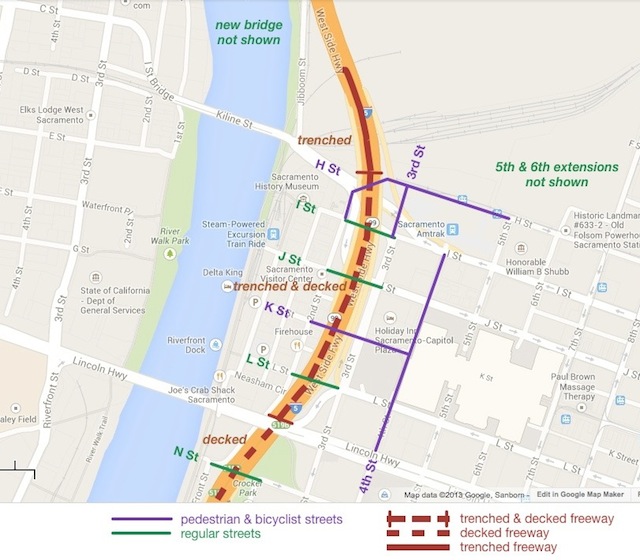
Interstate 5 is a Berlin Wall through the heart of Sacramento, severing the connections between downtown and Old Sacramento. It was a product of a time when cars ruled the world, and no other values were of importance. Those times are over, and now it is time to tear down the wall and re-unify Sacramento. A map showing the general idea follows the break, but here are the highlights:

  • the current Interstate 5 elevated freeway would be torn down, and replaced by a trenched and decked section
  • I Street, J Street, L Street, and N Street would be reconnected over the freeway as regular streets; K Street would be reconnected over (not under) the freeway as a pedestrian and bicyclist street, the main grand entrance to Old Sacramento for tourists and many locals
  • Old Sacramento would not only be easily accessible from downtown, but visible from downtown
  • other adjustments would be made to the streets and circulation in this area

This will certainly not be my last post on these ideas, and I will explore the why and how of the pedestrian and bicyclist streets shown.

Note on terms: “cut and cover” is often used for underground transit and rail lines, but the term seems less commonly used for freeways, so I’ve used “trench and deck”; “the big dig” is also often used, after the project in Boston, which went way over budget and took years longer than intended, but apparently has had a very positive affect on the city

Read More »

re-gridding Sacramento

J Street, from Old Sac - you can't get there from here!
J Street – you can’t get there from here! *

Traffic circulation, for everyone, is handicapped or prevented by an incomplete grid system in downtown and midtown Sacramento. Three recent posts have addressed this issue, I’m thinking about several more, and several posts over the last year were also on the same topic. So I created a new category for the Getting Around Sacramento blog, re-gridding Sacramento.

Re-gridding is an awkward phrase, but I haven’t come up with a better one yet, so I’ll use it for now.

Read More »

5th Street mess at Sac Valley Station

With this post, I’ve added a new category to my blog: re-gridding Sacramento. I’ll have more to say about that category, and many more posts, in the near future.

Sac Valley Station exit, forced right
5th St to I St, forced right turn

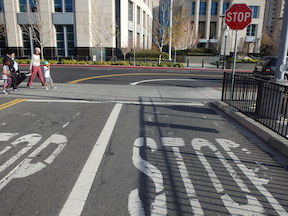
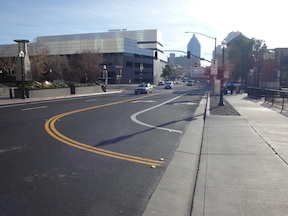
Let’s say one was driving and wanted to leave the Sacramento Valley Station (Amtrak and Capitol Corridor) to head southbound or eastbound. Tough luck. The exit at the east end of the parking lot forces you to turn right, to the south, onto 5th Street. I often see people turning across the double yellow line to go northbound on 5th Street, and to be honest, I don’t blame them, because this is the logical though illegal way to go south or east.

Read More »

Sacramento Riverfront Reconnection, Phase 1

2nd Street extension to Capitol Mall

SACOG in the 2013 funding round allocated $9M to the Riverfront Reconnection project in the City of Sacramento. This phase extends 2nd Street from Old Sacramento to Capitol Mall, providing an easier access to Old Sacramento, and also adds sidewalks to O Street and improves sidewalks and bike lanes on Capitol Mall between 3rd Street and the Tower Bridge. The overall purpose is to create or restore connections between downtown Sacramento and Old Sacramento which were severed by Interstate 5.

Read More »

streetcar moves forward

Steve Cohn, Christopher Cabaldon, Steve Hansen, and other streetcar supporters

The Downtown/Riverfront Streetcar is moving forward. Today there was a demonstration of a Siemens S70 streetcar (made in Sacramento, but unfortunately on its way to Atlanta) at the Township 9 (Richards & 7th St) SacRT light rail station. Mayor Christopher Cabaldon (West Sacramento), Councilmember Steve Cohn (Sacramento) and several others spoke about the future of the streetcar linking West Sacramento and downtown/midtown Sacramento. After the speeches, there was a ride downtown and back so people could see the streetcar in action, and informally discuss the project on the way.

Siemens S70 streetcar at Township 9 station

Yesterday the SACOG (Sacramento Area Council of Governments) board allocated $5M in funding for phase 1 of the project, which is the initial planning, route selection, and environmental review of the system. SACOG is one of the project partners, along with the City of Sacramento, the City of West Sacramento, Sacramento Regional Transit (SacRT), and Yolo County Transit (Yolobus). The remainder of the project costs totaling $12.3M are being provided by the partners. (Details of the SACOG application are at the bottom.)

Read More »