I just ran across an interesting piece of data that I was not aware of before, in Motor Vehicle Crash Deaths in Metropolitan Areas — United States, 2009. Sacramento area ranks 8.3/100,100 for motor vehicle related crash deaths, but 14.4 for the city, which is in the middle of pack for the US, but worse than most of California. Riverside area is 10.6 and city 11.9, San Diego area 7.8 and city 5.6, San Francisco area 5.6 and SF 4.0 and Oakland 5.0, Los Angeles area 6.6 and Los Angeles city 7.7 and Long Beach 6.1 and Anaheim 7.8. This 2009 data, and I could not find anything from CDC more recent. For contrast, London is 1.6 and New York is 3.2, both considered dangerous places in the mis-informed public mind.
The Keys to Designing Cities With Fewer Traffic Fatalities (CityLab 2015-07-23)
Category: transportation
parking fees
The Sacramento News & Review published this week Parking Nightmare: Major changes in Sacramento could mean higher prices, stiffer restrictions, following up on a earlier blog post (https://www.newsreview.com/sacramento/pageburner/blogs, scroll down to July 15). SacBee also had an article on Friday, Downtown Sacramento parking rates likely to rise. Apart from the SN&R click-bait headline, the article provides more depth than anything else available at the moment, and provides me a chance to review parking fees and consequences. First, I would not for a moment counter the claim that an increase in parking charges is due at least in part to the city’s need to increase revenue to pay off arena bonds. But beyond that, it is possible to evaluate how parking should be priced.
My views on parking are all based on two concepts:
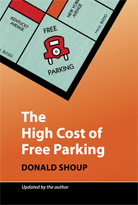
 There is no such thing as free parking. If parking is free, it is being subsidized by someone. The seminal thinking on this issue is The High Cost of Free Parking, by Donald Shoup, as well as writings by others. The objective of managed parking pricing should be to ensure some free parking on every block so that people do not circle looking for parking, and that some of the parking fee income be returned to the neighborhood for improving the right-of-way, including sidewalks and pedestrian amenities.
- On-street parking is not, as some people think, a bad thing. It slows traffic by generating “friction.” On street parking might be removed when there is clearly a higher use for road right-of-way, such as bike lanes or sidewalks, however, in almost all cases, removal of a travel lane is better for everyone than removal of on-street parking. I don’t support on-street parking because I want to see more space devoted to motor vehicles, but because of the traffic calming effect and because I think on-street parking creates a more livable environment than do parking garages, which I consider to be the lowest use (or mis-use) of urban land, only exceeded by off-street surface parking lots. Our streets would in fact be safer if there were more on-street parking on weekends and evenings, when most of the extremely dangerous and egregious speeding occurs.
transportation funding must be weight-based
The California legislature is meeting in special session to discuss sources of funding for transportation (they are on summer break, but will get back to it). The state uses the number $5.7B as the annual shortfall in funds available for maintenance, and these discussion are largely an effort to close that gap. Some of the solutions are: 1) indexing the gas tax so that it doesn’t fall behind (it was last raised in 1990); 2) increasing transportation related fees such as vehicle registration; 3) increasing the tax on specific fuels such as diesel; and 4) basing taxes on VMT (vehicle miles traveled) rather than fuel purchase. Of course there have been other ideas such as redirecting high-speed rail funds (which would be illegal unless legislation and the voter-passed bond are completely undone), and using cap-and-trade funds for highways (also illegal because maintenance and certainly construction would not reduce greenhouse gases), but those right-wing ideas won’t receive consideration by me.
I think it extremely important that all taxes and fees be at least partially based on the weight of the vehicle. The amount of damage caused to roadways and bridges is almost exactly proportional to the weight of the vehicle, and those that weigh more should pay more, at least for the maintenance portion of the transportation budget. If, for example, VMT were used instead of or in addition to fuel tax, one mile by a lightweight passenger vehicle is in no way proportional to one mile by a heavy truck. The tax should instead be a multiplier of VMT and weight, with a strong component of weight. And yes, all vehicles should be charged, including government-owned vehicles, which cause just as much damage to roadways as commercial vehicles. There has been a ballooning of vehicle sizes and weights with the government to match the commercial sector, and this is one way of bringing that under some control. Yes, I realize this means public buses would be paying weight fees, and I think this is appropriate since they do cause significant damage to the roadways. However, public transportation could be more than compensated as we save money on wasteful parts of our transportation system.
Vehicle registration fees are based on the type and price of a vehicle, which means that commercial vehicles are already paying relatively more than less expensive private vehicles, but they are not paying their fair share in relationship to damage caused to roads. It is not just an issue of commercial vehicles, however. Heavy passenger vehicles (you know what I’m talking about) also pay much less than their share of maintenance because the price differential is not as great as the weight differential.
Commercial vehicles do pay a weight fee, which is the sort of thing I’m requesting, but it is not assessed at a high enough level to pay for the damage caused, and at least for now these fees are being diverted to the general treasury rather than being used for maintenance.
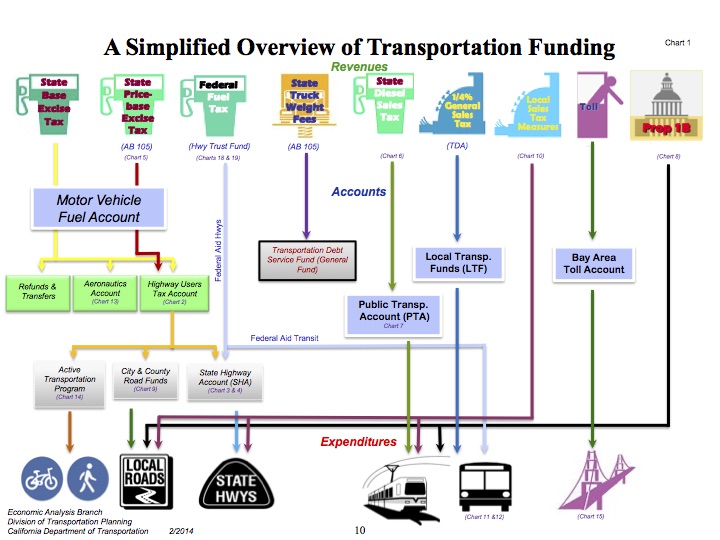
Note that I am intentionally ignoring the finer points of sales tax, excise tax, and the arcane fuel tax swap. They are important, but not important to this issue of all users paying their way. It is important to remember that only a portion of transportation funds in the state flows through the federal and state government. Local governments are actually the larger and more significant players. As well, the idea that gas tax pays for roadways is myth, it pays less than half, and has never paid all.
A lot of information about funding, including the chart above, is in the Transportation Funding in California – 2014 document from Caltrans. If this document doesn’t make your head spin, I don’t know what will.
bridge design was the problem
I normally don’t comment on events or issues outside of the Sacramento region, but I just can’t resist commenting on the closure of Interstate 10 in southern California due to a bridge washout and collapse. Many people have used this incident as justification for devoting more money to road maintenance and bridge repair, and many more will. But this was not a maintenance problem, it was a design problem.
Below is a photo, courtesy of AZCentral (The Arizona Republic). It shows the collapsed bridge, the damaged and still closed bridge, and the old highway bridge. Notice that the bridge portion of the old highway spans the entire wash, and is entirely undamaged (I’m not claiming that the old highway is perfect – it has been damaged in other locations, if not by this flood then by other floods). The two new freeway bridges span only a portion of the wash. Caltrans engineers apparently decided that they could funnel the wash into a narrow space by armoring the abutments with rock. They were wrong, and they should have known this was an irresponsible design. Were they trying to save money, or were they so arrogant as to think nature can be pushed around? I don’t know, but clearly there was a mistake, and the mistake was not a lack of maintenance.

Scofflaw bicyclists, or drivers?
I was walking around midtown this afternoon, and riding this evening, watching the behavior of bicyclists, and wishing it was better. I saw bicyclists running stop signs without looking, failing to yield to pedestrians crossing the street, and not taking turns at intersections. Yes, we’ve all seen it before. But what struck me is that almost all of these bicyclists are also car drivers, and they are exhibiting exactly the same behavior driving their bike and they do driving their car. These are all the same thing motor vehicle drivers do. The only real difference is that the car drivers are almost all exceeding the speed limit, whereas the bicyclists are not.
Though there are some car-fee people living in midtown, and the number is growing, it is not large, and most of the people riding also drive. What they are showing is the same me-first attitude that shows up on the streets all the time, and it shows because these people are me-first whether they are riding their bike or driving their car. The problem is not bicyclists, it is attitude.
#StuckInTraffic
There was a Twitter townhall today hosted by Secretary of Transportation Anthony Foxx and House Transportation Infrastructure Committee Chair Bill Shuster, organized around the Twitter hashtag #StuckInTraffic. I was expecting the worst, given that the hashtag presupposes that the main issue is congestion, but was pleasantly surprised. The questions they answered were softball questions, but the cars-first, highways-only message was absent in their answers, and that has to be a good sign.
The #StuckInTraffic hashtag has all the related tweets and provides a wider range of opinions, but other than the Heritage Foundation cars-only fringe pushing their Transportation Empowerment Act, there was a surprising across-the-board support for a true multi-modal transportation system.
I believe that we should have a multi-modal system, but I also believe that we have already spent enough money on highways and stroads, and that we should now be spending money only on maintenance, walking, transit and bicycling. What multi-modal should mean going forward is that we make up for our past cars-only mistakes by not spending any more on that ultimately dead-end enterprise. One of my favorite transportation graphics of all time is below, showing Chicago’s transportation priorities. Though the mix may be different in different locations, it is good place from which to start discussions at all levels, federal, state and local.

SHSP Update
 This is one of the nerdier posts I’ve written in a while, and much of it probably won’t make sense to anyone who has not been involved in SHSP. Why is it important? Because all of the safety funds in California, some of the transportation budget, and much agency effort go to the priorities identified by SHSP. In the past, that has meant a focus on the safety of motor vehicles drivers, focus to issues such as distracted and drunk driving (which are important but not everything), and in a perversion of priorities, stings on pedestrians and bicyclist funded by OTS.
On November 14, 2015, the SHSP (Strategic Highway Safety Plan) Safety Summit was held on the CSU Sacramento campus, part of the SHSP Update process that seeks to revised the Strategic Highway Safety Plan for California. The summit was very well attended, nearly filling the ballroom. After some introductions from various agencies (Caltrans, Office of Traffic Safety, and California Highway Patrol are the main partners in the program, but several other agencies participate), there were six breakout sessions to provide input on different topics, and an opportunity to participate in two of the six.
I participated first in the Active Transportation (bicycling and walking) breakout, which was facilitated by Katherine Chen & Jill Cooper. Issues identified: we really don’t know why there has been an increase the last few years in bicyclist and pedestrian injury and fatality, whether due to increased mode share or some other reason; the CHP 555 form and SWITRS database do not offer all the information we need; there is almost no injury/fatality rate data available because agencies are not collecting counts; rather than transportation funds being allocated based on injury/fatality rates, bicycling and walking receives a tiny portion construction and safety funds. The session went well, with good discussion and a lot of good information gathered onto charts by Katherine.
I also attending the Infrastructure and Operations breakout session, which was facilitated by two individuals from Cambridge Systematics, the contractor being used for the update process. This session did not go well. The participants provided thoughtful input, but much of it was rejected by the facilitators, either not written onto charts, or crossed out because they didn’t agree with it. The group wanted to use rates rather than counts, education is needed to create a culture of safety, distracted driving is epidemic, automated enforcement of red lights and speed are critical to changing behavior, and we need to focus on intersections since that is where most problems occur. The facilitators wanted to hear none of it, and were disappointed that no one seemed interested in spending money on “improving safety” for motor vehicle drivers by building more highways.
We were promised at the summit that the breakout session notes would be tabulated and made available to participants “soon.” As of today, 11 weeks later, no information has shown up on the SHSP Update web page. I doubt that the information will show up before the process is complete. I would guess that the contractor and Caltrans didn’t like what they heard and decided to suppress the information.
Despite the lack of input from the SHSP Safety Summits (there was one northern and another in southern California), the SHSP Steering Committee has been pushing forward with updating the SHSP strategies. The SHSP Bicycling committee (formerly Improving Bicycle Safety) on which I serve, and the other committees, were given a very short deadline to provide a new short set of strategies (up to five). It seems as though we will be locked into these for several years. In the committee’s January meeting we made remarkable progress on coming up with strategies, coming to consensus on a number of issues that we’ve discussed for years and never quite come to common understanding or agreement. When we ask where the Safety Summit information was, we were told by Pamela Beer of Cambridge Systematics that she had all the information we needed, that the printed notes that we were given at the meeting but not beforehand where all we would get, and that we should not expect to see any outcomes from the summit before the strategies finalized. Somehow she had inserted herself into our committee meeting as a facilitator/controller, without the knowledge of anyone on the committee.
The strategies adopted by the Bicycling committee, pending some wordsmithing, are:
- Improve roadway and bikeway planning, design, and operations to enhance bicycling safety and mobility while supporting bicycling to and from all destinations.
- Improve data collection regarding bicyclist trips, injuries and fatalities on California roadways and bicycle paths.
- Improve education and enforcement based on the protection of everyone’s right to travel by lawful means.
- Encourage more bicycle travel by improving public attitudes about bicycling safety and the need for safe and courteous behavior toward all roadway users.
- Develop safe, direct, and connected routes on which bicycling is a priority mode of transportation.
Riverfront streetcar makes FTA budget list
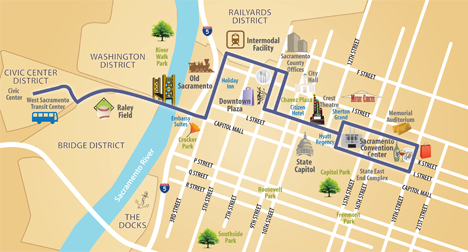 The list of transit projects put out by the Federal Transit Administration (FTA) as part of President Obama’s proposed 2016 budget includes $75,000,000 in Small Starts funding for the Sacramento Downtown Riverfront Streetcar. The FTA Project Profile is available with some detail that may be of interest.
Foxx challenges mayors, but not funding
Secretary of Transportation Anthony Foxx challenged the nation’s mayors to reduce pedestrian and bicyclist fatalities and injuries on his Fast Lane blog and detail. The challenge has been repeated many places, including Streetsblog USA. Though I’m happy that the secretary is bringing attention to the issue of rising pedestrian and bicyclist fatalities (while motor vehicle driver fatalities are declining), I have to see this campaign as disingenuous. Of his seven challenge activities, not one of them mentions funding. Yet a significant contribution to pedestrian and bicyclist fatalities and injuries is that we continue to spend transportation dollars on motor vehicles and not on pedestrians and bicyclists. Though pedestrian and bicyclist fatalities are now 17.3% of the total, we spend only about 2% of our transportation funds on protecting pedestrians and bicyclists.
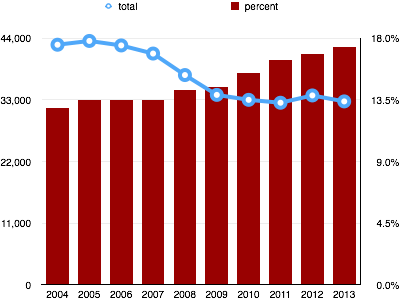 Foxx says “Unfortunately, in the five years from 2009 to 2013, bicyclist deaths were up 15 percent and pedestrian deaths are up 16 percent. In 2013, more than 5,000 pedestrians and bicyclists were killed, and more than 100,000 were injured.” More significant is that pedestrian and bicyclist fatalities are have continued to be an increasing portion of total fatalities. In the chart at right, the blue trend line, of total fatalities is clearly down, and NHTSA (National Highway Traffic Safety Commission) and others have tooted this horn at every chance. What they rarely talk about, and in fact try to hide in their reports, is the other trend, shown by the red bars, that the percentage of fatalities for pedestrians and bicyclists has continually climbed. These are not two unrelated trends. We have spent tremendous amounts of transportation money, and imposed increasing requirements on car manufacturers, in order to reduce the fatality and injury rate of motor vehicle drivers. But this reduction has led to an increase in pedestrian and bicyclist rates. They are inversely correlated to a remarkable degree. This data in the chart is from the NHTSA Fatality Analysis and Reporting System (FARS).
If Foxx were serious in his commitment to pedestrian and bicyclist safety, he would do everything in his power (considerable but not complete) to shift transportation funding to the protection of pedestrians and bicyclists, and would be before Congress daily supporting this change (for the portions he cannot control).
So, here is Dan’s challenge to Secretary Foxx: Take pedestrian and bicyclist fatalities seriously by immediately shifting the federal portion of transportation funds to match the fatality rate of 17.3%.
Sacramento region transit projects in 2015
Jonah Freemark on The Transit Politic has detailed transit projects in Openings and Construction Starts Planned for 2015. For Sacramento, it will be the end of work on extension of the SacRT light rail Blue Line to Consumnes River College, and the start of planning for the Sacramento/West Sacramento streetcar. It is good that these projects are happening, but in comparison to many other urban areas, Sacramento is falling further behind. We spend most of our money on expanding the freeways, building new freeways such as the Southeast Connector, and upgrading arterial roadways. Almost all of this work furthers suburban commuting and sprawl, and very little if any of it leads to true economic vitality.
Projects I’d like to see joining the list for next year are:
- Green line extension to Natomas. Not necessarily the airport, and I’m not sure that pencils out as a beneficial project.
- Blue line extension to Elk Grove. Though I don’t like the suburban wasteland that is Elk Grove, it is nevertheless true that there are a huge number of commuters from there to downtown Sacramento, who could be pried out of their cars if we spent money on light rail instead of highway and roadway expansion. Just the interchanges on Interstate 5, largely purposed to serve the commuter crowd, cost more than the entire light rail system.
- Blue line extension to American River College, and eventually to Roseville. The college is a huge trip generator, and this part of the county is very underserved by transit. Though the Capitol Corridor third track will take some of some of the demand, light rail with its more frequent service would be a great complement.
- Bus rapid transit (BRT). I’m not sure where the best location would to pilot bus rapid transit in the Sacramento region, but the fact that we are not even really experimenting with it (other than the tiny Watt Ave over US 50 bridge) does not bode well. Bus rapid transit could be an even more important solution for the region, particularly because much of the region lacks the density to make light rail successful.
Here’s to seeing more Sacramento projects on the 2016 list.
 Getting Around Sacramento