Just for laughs, a word cloud generated from the Measure 2022 Exhibit A: Transportation Expenditure Plan.
Just for laughs, a word cloud generated from the Measure 2022 Exhibit A: Transportation Expenditure Plan.
Note: I had said I was pausing on the proposed transportation sales tax Measure 2022, but I’d forgotten to write about interchanges.
The proposed transportation sales tax measure Exhibit A: Transportation Expenditure Plan includes 31 instances of ‘interchange’. If you aren’t familiar with the term, it means the intersection of freeways and expressways with other sorts of roadway, or with other freeways and expressways. Two examples, one of a freeway interchange, and one of a freeway and arterial interchange:


Interchanges are very popular in the proposal.
| location | # |
| Citrus Heights | 2 |
| Elk Grove | 2 |
| Folsom | 5 |
| Galt | 1 |
| Rancho Cordova | 4 |
| City of Sacramento | 5 |
| County of Sacramento | 2 |
| Highway Congestion Improvements | 4 |
Interchanges are very expensive. Miles of sidewalk or bike lanes could be constructed for the cost of one single interchange. Or new buses or bus-only lanes, or new light rail cars, or a bike-share program. Interchanges are far more expensive than the straight sections of freeways. Interchanges take a good deal of land, removing it from productive use and leaving wastelands in between that are not accessible and not usable for anything else. Interchanges are complex for drivers, so have many far more crashes than the straight sections.
Probably most important, freeway on-ramps and off-ramps create the most hostile and dangerous points for people walking and bicycling. Though interchanges can be build with right angle turns to enter from and exit to surface streets, and can be signalized so as to allow safe passage by walkers and bicyclist, they were never built that way in the past, and are only sometimes built that way now. Instead, there are swooping on-ramps that encourage drivers to reach freeway speeds while still on the surface street and ramp, and off-ramps that encourage drivers to maintain freeway speeds coming off the ramp and continuing on the surface streets. If you don’t believe this, please watch a freeway off-ramp for a while, for example, if you live in central city Sacramento, I-5 to P Street off-ramp, or I Street to I-5 on-ramp. You will see people going 55 mph or more on the surface street, slow to decelerate and quick to accelerate. Freeway on-ramps and off-ramps kill hundreds of walkers and bicyclist a year.
Our freeway system was essentially complete years ago, with the 1972 completion of the I-80 (then I-880) northern bypass. Freeways provide quick travel from point A to point B. As earlier explained in the streets – stroads – roads post, roads that imitate railroads, for quick travel between productive places, are a good thing. The original idea of Interstate highways was, for the most part, a good idea. Of course then they were driven through the heart of cities, including Sacramento, lost most of their value as travel routes, and destroyed the value of the cities they went through.
So why, now, do we need more interchanges, more points of access to and from freeways? The answer is almost entirely greenfield development, and the promotion of car trips for commuters from those greenfield developments. Interstate 5 and Interstate 80 could easily handle all the freight and long distance travel demands with two lanes in each direction. So what are all the other lanes for? Commuters. And what are all the new interchanges for? Commuters. Note that in this use of ‘commuter’, I’m including not just home to work trips, but all the other trips that are induced by having more lanes and more interchanges. Job-related trips are now only about 20% of all trips, even before the pandemic. For the existing interchanges proposed to be improved, the reason again is primarily the induced travel through greenfield development. If there weren’t new greenfield development, there wouldn’t be increased traffic.
Each interchange reduces the safety and speed of the freeway. Each interchange encourages motor vehicle trips that would otherwise not occur, by allowing people to travel longer distances more quickly, therefore considering living and working and shopping and recreating in places they would not have otherwise considered. Of course the convenience is illusory. It makes sense right after the new lanes and interchanges are added, but the law of induced travel quickly fills those lanes and those interchanges, generating calls for more lanes and ‘improved’ interchanges. Which induces more travel, which…, well, you get the idea.
If you haven’t, please walk or bike to any of the freeway overpasses in the Sacramento region, and spend some time observing the traffic below. You will see freight traffic, trucks trying to get through the area on their way somewhere else, stuck behind commuter traffic, crawling along. You will see most vehicles carrying a single person, what are called single-occupant vehicles (SOVs), but taking up the space that could be serving multiple individuals. Though there are only a few freeways where buses also run (I-80 towards Davis and I-5 towards the airport), you will see those multi-passenger vehicles stuck in traffic with SOVs.
The second Google map above, showing the new interchange at I-5 and Cosumnes River Blvd, is instructive. Why is the interchange here? To serve the Delta Shores development, which is currently just a suburban big box store shopping area, though it was intended to and may eventually serve new housing. This area was greenfield before, agricultural farming or ranching. The purpose of the interchange is not to serve existing drivers or residents or city, but to create new drivers, new customers in this case. It is true that a portion of the cost of the interchange was paid for by the developers, but there was still a huge cost to us, the taxpayers.
If you want a lot of new and improved interchanges, which induce more motor vehicle trips, pave over greenfield areas, and create serious hazards for walkers and bicyclists, then the proposed measure may be to your liking. If not, then I hope you see it as the wrong road to travel.
Search for category Measure 2022 to see posts as they are added.
Note: I’ll pause for a bit on the Measure 2022 posts. What would you like to hear about? What are your perspectives? There will be a few posts on the transit aspects of the measure on Sacramento Transit Advocates and Riders (STAR) website and cross-posted here.
The proposed transportation sales tax measure neglects or discounts a number of progressive transportation items that certainly should be in a proposal in 2022. Overall, it pays too much attention to motor vehicle travel and too little to walking, bicycling and transit. Implementation Guidelines mention a number of good ideas, but these don’t really show up in the project list.
Some of the ‘paths not taken’:
• Managed lanes on freeways. Managed lanes should be rolled, and the income dedicated to maintaining those lanes, and funding other modes. Managed lanes should be converted from general purpose lanes, not added as capacity expansion.
• A major investment in maintaining and adding sidewalks would be a far better investment in a modern transportation network than any motor vehicle project.
• Parking should be managed so as to reduce motor vehicle use and to use some of the income to fund other modes. Parking is the purview of cities and the county, but to not even mention this critical issue seems an oversight.
• Land use is not mentioned, though transportation and land use are inextricably linked. An effective transportation network cannot succeed without supportive land use, and wise land use is not possible without a supportive transportation system. Sprawling transportation encourages sprawling land use, and vice-a-versa.
• Safe Routes to School programs are not mentioned. These programs increase student safety and are an aspect of transportation demand management, but they are not mentioned or funded, though the concept is partly addressed in the ‘Road Health and Safety’ paragraph.
• Transportation is a public health issue, but health is mentioned only in passing in the ‘Road Health and Safety’ paragraph and in the context of air quality. The car dominated environment we have created with prior transportation projects is a direct and continuing threat to public health. A transportation plan should work to undo these harms, not perpetuate them.
And here are some ideas from Jeff Speck, that are of relevance to this proposal. Quoted info from Walkable City Rules: 101 Steps to Making Better Places by Jeff Speck. If you don’t have a copy, you should!
Bike share is mentioned, but there is no acknowledgment that it can be a key factor to providing equitable transportation at lower cost.
Freeway removal, freeway lane reduction, and/or freeway capping is not mentioned.
Congestion pricing is not mentioned, though it is the least expensive way of increasing capacity by reducing unnecessary travel.
Speed reduction is not mentioned. The arterial and collector streets already have posted speed limits and design speeds too high for a safe and livable place.
Vision zero has only one mention, as a City of Sacramento project. Just as a complete streets policy is required, so should be a Vision Zero policy and implementation plan be required. So far as I know, only the City of Sacramento has this.
Speed and red light running cameras, no mention at all.
The entire plan relies on the functional classification system of freeways, arterials and collectors. This is an outmoded way of looking at transportation infrastructure.
No mention of separated bikeways as best practice for arterials and collectors, or bike boulevards for parallel routes.
Search for category Measure 2022 to see posts as they are added.
The proposed transportation sales tax measure includes several paragraphs on fix-it-first. The concept is that our transportation network should be maintained in a state of good repair, and that existing infrastructure should be maintained before new stuff is built. It is clear that we are not there. In fact, we can never get there. We have built more infrastructure than we can possibly maintain. There is no amount of money or taxation that can maintain what we’ve built. That is true everywhere, not just Sacramento County.
Many people were disappointed that SB 1 increase in gas tax didn’t fix very many streets. The legislation was directed mostly to state highways, and only partly to local streets and roads. Even at the state highway level, it is not enough money. At the local level, the amount of funding is a tiny fraction of what would be needed.
The proposal acknowledges the need for maintenance, beginning with the second paragraph of the Local Street and Road Repair and Transformative System Improvements section. The sales tax proposal is in part an attempt to overcome the local maintenance deficit with local funds.
For the first five years following implementation of this Measure (April 1, 2023, to March 31, 2028), not less than 90% of the funds identified for the Local Street and Road Repair and Transformative System Improvements program shall be used exclusively by all cities and the County of Sacramento for “Fix It First” road and bridge preventative maintenance and rehabilitation, including safety improvements, so as to bring these facilities throughout Sacramento County to a pavement condition index (PCI) of at least 70 at the soonest possible time, and bridges to meet acceptable state and federal standards.
Exhibit A: Transportation Expenditure Plan
This commitment is good. Every survey has indicated that fix-it-first is the highest public priority, and this interest probably accounted for much of the yes votes for the 2016 Measure B.
At the end of the five-year period following the date of implementation of this Measure (after March 31, 2028), not less than 50% of the funds identified for the Local Street and Road Repair and Transformative System Improvements program shall be used exclusively by all cities and the County of Sacramento for “Fix It First” street, road, and bridge preventative maintenance and rehabilitation so as to continue efforts to bring these facilities throughout Sacramento County to PCI of at least 70, and bridges to meet acceptable state and federal standards.
Exhibit A: Transportation Expenditure Plan
So, for the next 35 years of the measure, the allocation to maintenance can be much lower, or zero if PCI 70 is achieved. This seems reasonable, in the sense that if every cent were spent on maintenance, nothing new would ever be built. Of course, when it comes to motor vehicles, that would be just fine with me. But probably not with the public.
Notwithstanding these allocation restrictions, the percentage commitments to “Fix It First” maintenance and rehabilitation may be reduced, and any city and the County of Sacramento may direct a higher percentage of those funds to new transformative system improvements, provided the following conditions have been met:
The public agency manager responsible for road maintenance has certified in writing to the City Council and City Manager in a city and the Board of Supervisors and the County Chief Administrative Officer that the road facilities under their management have met or will meet within the next 12 months a 70 PCI rating.
The public agency manager responsible for road maintenance has submitted a written plan to the City Manager or County Chief Administrative Officer clearly demonstrating how the 70 PCI rating will be sustained in the future. Any diversion of the funds committed to maintenance and rehabilitation can only continue as long as ajurisdiction maintains an average PCI of 70 or above for its street and road system.In addition, local jurisdictions must maintain current levels of funding for maintenance and rehabilitation and shall not use funds from this allocation to offset existing funding planned or allocated for this purpose.
Exhibit A: Transportation Expenditure Plan
What concerns me is that there are exceptions offered. The transportation agencies have gamed the system before, building new while not maintaining existing, and in fact that is the pattern of tranportation spending ever since World War II. It seems unlikely that they will immediately change their approach to infrastructure maintenance. What if it becomes obvious that our roads, bridges and other transportation infrastructure are continuing to deteriorate? Will the engineers and planners and politicians be willing to forgo the big new projects and ribbon cuttings?
Search for category Measure 2022 to see posts as they are added.
A group calling themselves A Committee for a Better Sacramento is sponsoring a citizen-initiated ballot measure for the November election, titled “Sacramento County Transportation Maintenance, Safety, and Congestion Relief Act of 2022—Retail Transactions and Use Tax”. (Note: Some people are referring to this as Measure A, but measure letters are assigned by county elections, not by the sponsors. I’ll continue to refer to it as Measure 2022, for now.)
As pointed out in Measure 2022: words have meaning, the word congestion or the term congestion relief is used 24 times in the proposal. It is in fact the major theme of the Transportation Expenditure Plan. 22.4% of the measure is set aside specifically for major congestion relief categories. Since most projects are not individually costed, it can’t be determined how much of the 47.3% for local roads and streets is for congestion relief, but Citrus Heights has two and Elk Grove four called out. The 3.7% for Capital Southeast Connector is also congestion relief.
Not acknowledged, but likely true, is that many of the projects could be considered ‘congestion prevention’, meaning that if roadways and freeways and interchanges are expanded now, future congestion can be prevented.
The committee and supporters seem to have bought into the falsehood that capacity expansion solves congestion. It does not, or rather, solves it for a short period of time, then induced travel returns congestion to previous levels, or higher. It is a never ending cycle. Congestion is not a major contributor to air pollution. It does have an effect, but the effect is very limited in time and space. The big contributor to air pollution, and of course greenhouse gas emissions, is vehicle miles traveled. The measure will increase, not decrease, VMT.
Twenty-eight lanes on the Katy Freeway in Texas have not solved congestion, nor reduced air pollution in Houston. The 405 freeway over the Sepulveda Pass in southern California was widened to the tune of $1 billion dollars in 2011-2012. Traffic is now much worse on the freeway than it was before the widening, and air quality is of course also worse.
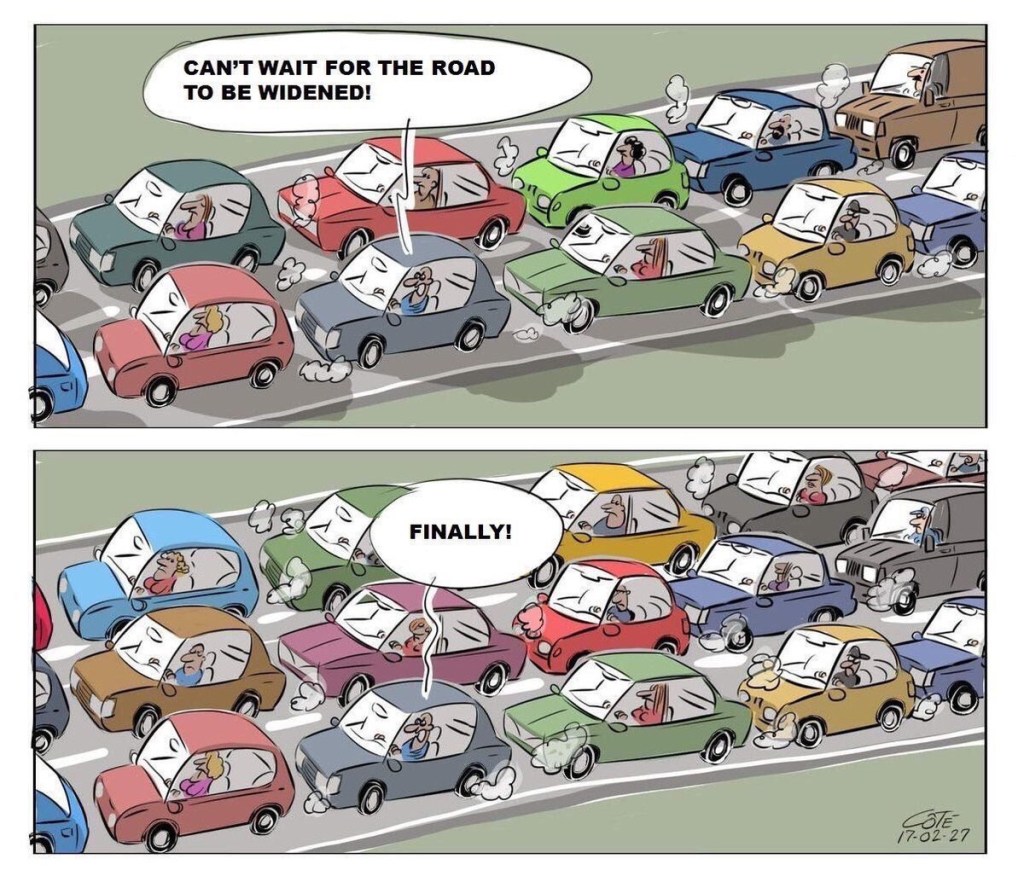
Induced travel or induced demand is broadly accepted by researchers in transportation both on a theoretical basis and with many, many case studies, but there is still resistance among some traffic engineers and politicians. The question for me is why those who resist the obvious are writing transportation sales tax measures.
Induced travel says that after spending billions to try to reduce congestion, our roadways will be as congested, or more congested, than they were before.
But over many years of observation and analysis, we have learned that adding supply has a paradoxical outcome. It generates more driving, which is both costly to personal budgets and the environment, and which often re-congests the very roadways we built or expanded.
Caltrans, Rethinking How We Build So Californians Can Drive Less, https://dot.ca.gov/programs/sustainability/sb-743
Empirical research shows that expanded roadway capacity attracts more vehicles. However, environmental impact assesments of roadway expansion projects often ignore, underestimate, or mis-estimate this induced travel effect and overestimate potential congestion relief benefits.
National Center for Sustainable Transportation, https://ncst.ucdavis.edu/tags/induced-travel
Induced demand is “the great intellectual black hole in city planning, the one professional certainty that everyone thoughtful seems to acknowledge, yet almost no one is willing to act upon.”
Speck, Jeff (2012). Walkable City: How Downtown Can Save America, One Step at a Time. New York: North Point Press. ISBN 978-0-86547-772-8.
Induced traffic occurs when new automobile trips are generated. This can occur when people choose to travel by car instead of public transport, or decide to travel when they otherwise would not have.
Wikipedia, https://en.wikipedia.org/wiki/Induced_demand?wprov=sfti1
Search for category Measure 2022 to see posts as they are added.
This post is a follow up to (in)complete streets and streets – stroads – roads, and will make more sense if you read those first.
The proposed sales tax measure Transportation Expenditure Plan (TEP) for Sacramento County has 20 occurences of the term ‘complete streets’. The first is this phrase: “complete streets with or without capacity expansion”. This alone should make everyone uncomfortable – the sponsors are perfectly happy with expanding roadway capacity so long as all modes are accommodated in some way. The roadway could be 20 lanes wide, and that would be fine so long as there is some facility for walking and bicycling. Within the ‘Local Street and Road Repair and Transformative System Improvements’ section, Citrus Heights lists 15 possible projects, and within the ‘Local Projects of Regional Significance’ section no projects. The table below shows the complete streets summary (note that Isleton is an insignificant portion of the measure and is not listed). Only County of Sacramento specifically calls out that 15 of the projects will include road capacity expansion, but many of the other projects in all of the locations might also include expansion.
In the lead implementation section, paragraph H, ‘complete streets’ are sort of defined:
Complete Streets. Transportation projects provide opportunities to improve safety, access, and mobility for all users of streets, roads, and highways in Sacramento County and recognizes bicycle, pedestrian, vehicle, and transit modes as integral elements of the transportation system. The term “Complete Streets” describes a comprehensive, integrated transportation network with roadways designed and operated to enable safe and convenient travel for users of all abilities, including motorists, pedestrians, bicyclists, persons with disabilities, seniors, children, movers of commercial goods, operators of public transportation, public transportation users, and emergency responders, in a balanced manner that is compatible with an urban, suburban, or rural context.
Transportation Expenditure Plan, I. Implementation, H. Complete Streets
Sounds OK, but it is so vague as to allow practically anything, based on the preference and judgement of city or county. No reference is made to state or federal definitions or guidelines.
The TEP does require the cities and counties to adopt a ‘complete streets’ policy. So far as I’m able to determine, only the City of Sacramento has a policy at this time. That is good. But again, no guidelines as to what a good policy would address. No reference to the National Complete Streets Coalition model, or state or federal guidelines. All of the General Plans address complete streets to some degree. It is not clear whether these existing aspirations constitute a policy.
Within one year following the implementation of this Measure, each local jurisdiction in Sacramento County receiving Measure funds shall adopt or maintain an existing “complete streets” policy or a similar document that incorporates design guidelines and standards promoting safe and convenient travel for all users including bicyclists and pedestrians when considering any construction, reconstruction, retrofit, or alteration of streets, roads, highways, bridges, and other elements of the transportation system.
Transportation Expenditure Plan, I. Implementation, H. Complete Streets
And lastly, the TEP says that projects should be consistent with policy. But again, the language is vague. What does consistency mean? Always, or only when it doesn’t impact traffic flow? No performance measures for the jurisdictions to achieve, or against which to judge their success.
Planning and design of projects affecting the transportation system shall be consistent with any local bicycle, pedestrian, transit, multimodal, and other relevant plans and/or the local complete streets policy to ensure that all transportation types and users are considered in the expenditure of Measure funds.
Transportation Expenditure Plan, I. Implementation, H. Complete Streets
So, does use of ‘complete streets’ and identifying projects as complete streets mean anything. No, not really. It is up to each transportation department to determine for themselves whether the project is complete streets, and what it would have to do to ensure that.
Even if the project does produce a ‘complete street’, it still won’t address frequent safe crossings of the corridor for walkers, nor the need to significantly reduce motor vehicles speeds to create comfortable walking and bicycling streets.
Search for category Measure 2022 to see posts as they are added.
Under the Transportation Expenditure Plan major category of Local Streets and Roads (page A-8 of Exhibit A), both ‘Local Street and Road Repair and Transformative System Improvements’ and ‘Local Projects of Regional Significance’ funds are allocated to the cities and county. The table below show these allocations.
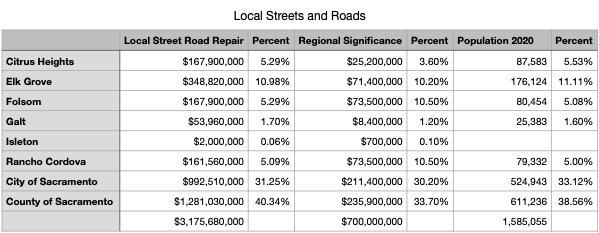
The percentages for each city and the county are not too far off of what would be their allocation if based solely on population. So this aspect of the TEP can be considered to be not unfair. However, as with all transportation funding, the question arises whether this ‘formula grants’ allocation, as it is called, is the best way to meet the transportation needs of the county. 47.25% of the entire measure is dedicated to local streets and roads, so this is an important question. But one which I don’t have a clear answer to.
A future post will take a closer look at the 93 projects that are listed under both ‘Local Street and Road Repair and Transformative System Improvements’ and ‘Local Projects of Regional Significance’, and the fix-it-first language in this section.
Search for category Measure 2022 to see posts as they are added.
A group calling themselves A Committee for a Better Sacramento is sponsoring a citizen-initiated ballot measure for the November election, titled “Sacramento County Transportation Maintenance, Safety, and Congestion Relief Act of 2022—Retail Transactions and Use Tax”. (Note: Some people are referring to this as Measure A, but measure letters are assigned by county elections, not by the sponsors. I’ll continue to refer to it as Measure 2022, for now.)
One of the categories in the Exhibit A: Transportation Expenditure Plan is Congestion Relief Improvements (page A-16), and the subcategory Transit and Rail Congestion Relief Improvement Projects, which is allocated 10.85% of the measure, or about $890M over the 40 years. Projects listed are (they are not numbered in the document, but are here for reference):
The document does say that funding is ‘intended to be flexible’, which is good since the types of projects that might be constructed over 40 years will likely have little to do with this list. None of this funding is available for operations, which is in a different category, Sacramento Regional Transit District (SacRT) Maintenance, Operations, and Transformative System Improvements. More about that soon.
Light rail extensions and improvements for more frequent peak service (not for operating more frequent peak service, just for the infrastructure) sound appealing (items 1 and 2). Currently SacRT has unofficially prioritized Green Line to the airport, even though that would do almost nothing to reduce congestion. Infrastructure for Gold Line to Folsom is already funded, so it is strange to see it here. On the other hand, Blue Line to Citrus Heights is here, even though SacRT has removed it from consideration for the foreseeable future.
The terms ‘high capacity bus corridor network’ and ‘BRT’ (items 3 and 4) are not defined in the document, so the public really has little idea what is intended. SacRT has not been very clear about this either. Projects in other places have revealed that the quality of the improvements to a corridor, and the restraints placed on private vehicle travel, make all the difference in whether bus corridor enhancements are valuable or pointless.
The $40M for the Capital Southeast Connector (item 5) is small in comparison to the size of the allocation, but it points out how poorly thought out the entire measure is. Who would even use transit on this corridor? The connector is designed to serve commercial traffic between Folsom (really El Dorado County) and Elk Grove, and to promote greenfield development along the connector. Greenfield developments are not designed to appeal low income workers, they are designed to appeal to high income white collar workers, who might be commuting to Folsom, Rancho Cordova, and Elk Grove. But those are not the sort of people who use transit unless it is clearly superior to drive-alone, and transit on this soon-to-be-congested corridor will not make the grade.
All of these projects are premised on the idea that the other projects in the measure will maintain or increase congestion, so it is necessary to improve transit to mitigate for that other congestion. Sadly, the SACOG MTP/SCS makes the same assumption, that transit projects will counteract the increased VMT and GHG emissions from other projects and poor land use.
Transit should not be a mitigation; it should have standing in its own right as a superior mode of travel. It should not be an attempt to make up for bad decisions made elsewhere. The question should be: what can we do to better serve existing riders, and what can we do to induce new riders?
This section of the Transportation Expenditure Plan is so-so. Not bad, not good, but mostly not well thought out and not clear what the benefits and trade-offs will be.
Search for category Measure 2022 to see posts as they are added.
A group calling themselves A Committee for a Better Sacramento is sponsoring a citizen-initiated ballot measure for the November election, titled “Sacramento County Transportation Maintenance, Safety, and Congestion Relief Act of 2022—Retail Transactions and Use Tax”. (Note: Some people are referring to this as Measure A, but measure letters are assigned by county elections, not by the sponsors. I’ll continue to refer to it as Measure 2022, for now.)
One of the major projects in the measure is the Capital Southeast Connector, a new freeway from Folsom to Elk Grove. Future posts will talk about what a bad transportation idea this is, but for now, what a bad part of the measure it is.
The measure essentially makes the Capital Southeast Connector JPA the judge of whether the project meets air quality requirements – the fox watching the henhouse. It is somewhat obscure what the language means, and takes a close reading, but the gist is that if the project fails to meet air quality requirements and therefore is not included on the project list in the MTP (SACOG Metropolitan Transportation Plan), the JPA can go its own way and decide for itself that the project meets requirements.
K. Metropolitan Transportation Plan & GHG Reduction Targets. The Sacramento region Metropolitan Transportation Plan/Sustainable Communities Strategy (MTP) currently requires that the region meet a 19% per capita greenhouse gas (GHG) reduction target. Expenditure Plan projects that are planned or programmed for construction in an MTP, as may be amended from time to time, shall be eligible for Measure funds. Expenditure Plan projects not planned or programmed for construction in an MTP shall be eligible for Measure funds if the construction phase of the project is exempt from project-level and regional level air quality conformity.
For any non-exempt projects that are not planned or programmed for construction in an MTP, as may be amended from time to time, the following requirements will apply:
For any non-exempt projects that are not planned or programmed for construction in an MTP, as may be amended from time to time, the following requirements will apply:
1. In order to meet the then applicable regional GHG reduction target for the MTP, project sponsors (parties) shall develop mitigation measures for any project(s) that increases GHG emissions.
2. If the parties can mitigate any such project impacts to maintain adherence to the then applicable regional GHG reduction target, the project(s) shall be eligible for Measure funds.
3. If the GHG impacts are not mitigated to meet the region’s then applicable GHG reduction target, and as a result the region cannot meet its applicable GHG target, the funds planned for the non-exempt project(s) may be used by the corresponding Implementing Agency at their discretion, for other than the originally intended project(s), provided any alternative project(s) are consistent with the Expenditure Plan and included in an MTP, as may be amended from time to time, that meets the then applicable target. Per above, alternative project(s) not planned or programmed for construction in an MTP shall be eligible for Measure funds if the construction phase of the project(s) is exempt from project-level and regional-level air quality conformity.
Measure 2022, Exhibit A, Chapter 1, Section K
This treatment of the JPA might very likely be found to be unconstitutional, but the measure proponents have thought of that too:
If any portion of this Measure is held by a court of competent jurisdiction to be invalid, we the People of the Sacramento Transportation Authority indicate our strong desire that: (i) the Authority use its best efforts to sustain and re-enact that portion, and (ii) the Authority implement this Measure by taking all steps possible to cure any inadequacies or deficiencies identified by the court in a manner consistent with the express and implied intent of this Measure, including, to the extent permitted by law, adopting or reenacting any such portion in a manner consistent with this Measure.
Section XII, Paragraph B, of the potential measure
In other words, if we, the sponsors included something illegal or unconstitutional in this measure, we expect the Sacramento Transportation Authority to defend the measure and make sure it all gets implemented.
To mitigate the immense GHG/VMT (greenhouse gas emissions / vehicle miles traveled) generated by the Connector, the measure proposes Transit and Rail Congestion Improvement Projects. With somewhat less money allocated to this than the Connector, these expenditures might make up for the harm of the Connector, but would not address any other needs in the county. It also proposes BRT features for the Connector, which is ridiculous as this is the last place in the county that a transit agency would propose BRT.
If the Connector, as a whole or in the piecemeal projects by which is has already been partially constructed, causes the region to not meet its legally required greenhouse gas reduction target of 19%, the entire region would therefore be under non-compliance, and therefore ineligible for federal grants.
The proponents see the value of the Connector as enabling greenfield development in the southeast area of the county. Though touted as a solution to congestion on Hwy 50 and Hwy 99, it will not be. What it will do is encourage long distance commuting between El Dorado County and Elk Grove, and generate VMT trips due to the greenfield developments along the corridor. The Connector will not turn out to be a boon to Folsom, Rancho Cordova, and Elk Grove, but yet another congested highway, sucking value away from the cities and citizens.
Search for category Measure 2022 to see posts as they are added.
Tonight (March 10, 2022), the ECOS Climate Change Committee received a presentation on the potential transportation sales tax measure (which I’m calling Measure 2022, until it receives an official name). The presentation was given by Roger Dickinson, who was a member of the state Assembly and the Sacramento County Board of Supervisors. It was very well presented, concise and on topic. My summary will not cover all the points of the presentation and following discussion, but I think will interest people who are starting to follow the potential measure.
Roger said the measure is very much like the 2020 measure which was not placed on the ballot: 1) fix-it-first; 2) solving congestion; and 3) transportation alternatives. But there are some poison pills included in this measure that were not in the 2020 measure, specifically the Capital Southeast Connector and related issues.
The language included in the 2020 measure to make sure the Capital Southeast Connector complied with air quality requirements of the SACOG MTP/SCS (Sacramento Area Council of Governments Metropolitan Transportation Plan / Sustainable Communities Strategy) was removed. This language was specifically worked out by Sacramento Mayor Darrell Steinberg as a compromise to ensure the city’s support for the measure. The removal is likely to ensure opposition from Steinberg and others in the city. The potential measure essentially makes the Capitol Southeast Connector JPA the judge of whether the project meets air quality requirements – the fox guarding the henhouse. More on this in an upcoming posts.
If the Connector causes the region to not achieve the legally required 19% reduction in greenhouse gas emissions, the region will be non-compliant and likely not eligible for federal transportation grants.
Discussion that followed Roger’s presentation largely revolved around two issues: 1) is it possible to stop this measure, before or after it makes the ballot, and what would that take?; and 2) should the measure be opposed even though it is likely the only significant source of match funding for SacRT grant applications to advance capital projects including light rail modernization, light rail extension, and BRT (bus rapid transit) corridors?
No answers yet, but this will likely be a major topic of conversation within and among all the transportation advocacy and equity organizations in the county, for many months to come.

