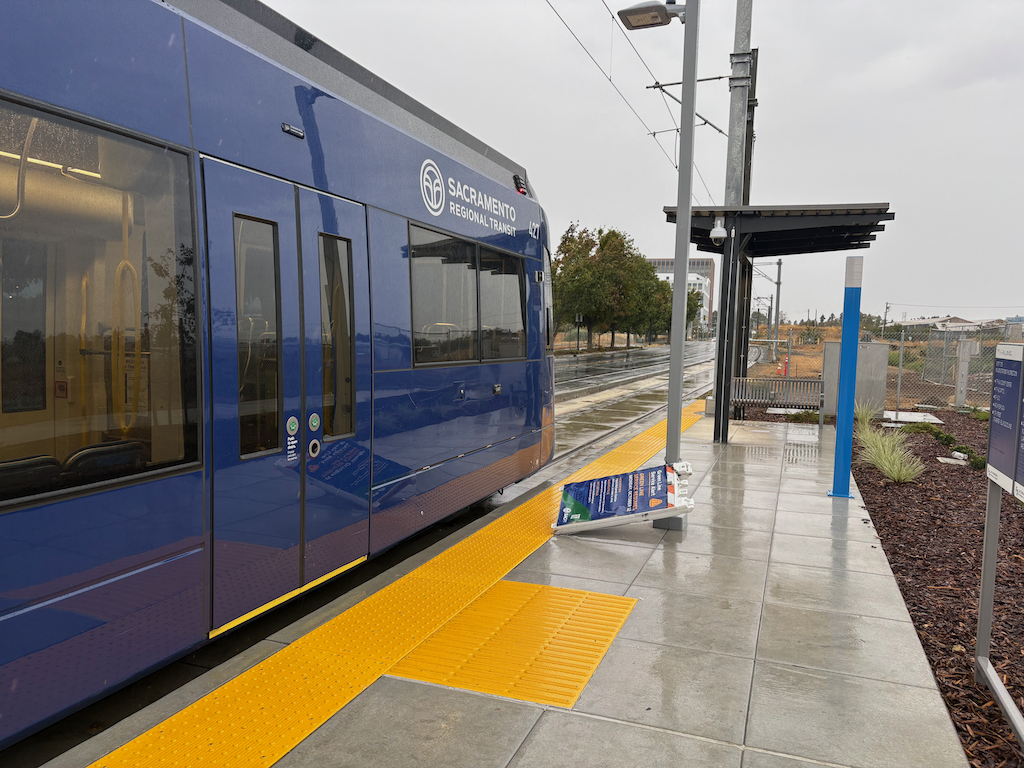
I visited the new SacRT light rail station at 7th & Railyards yesterday. The station has been open several days. Green Line service started October 12, and the station opened October 15.
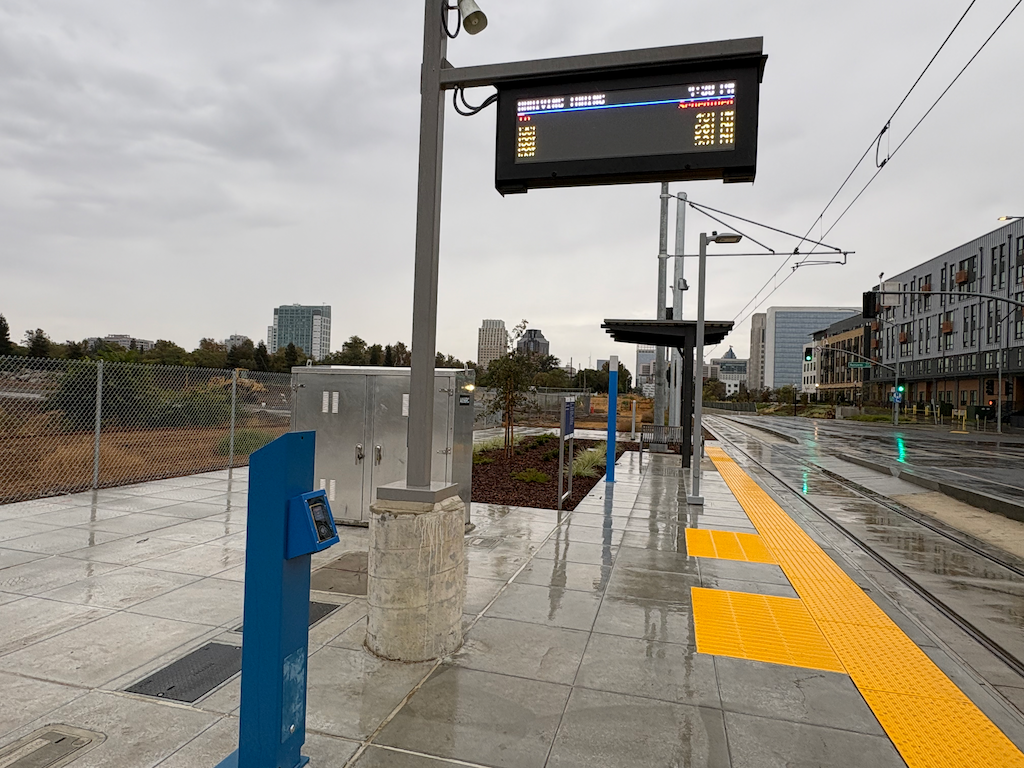
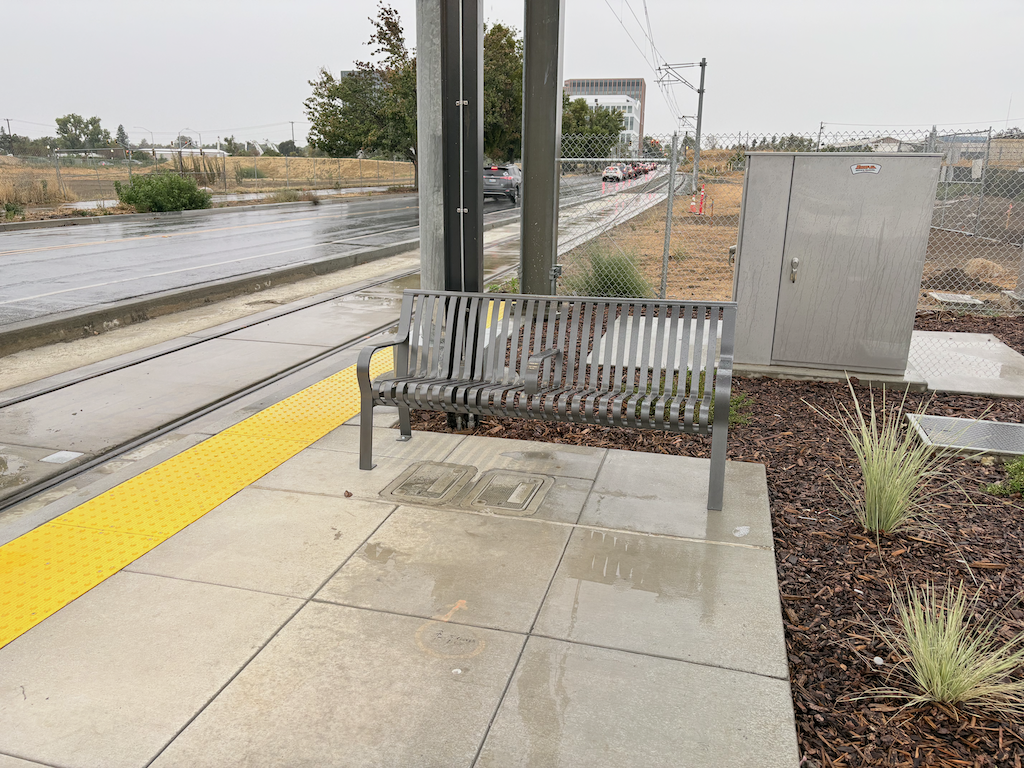
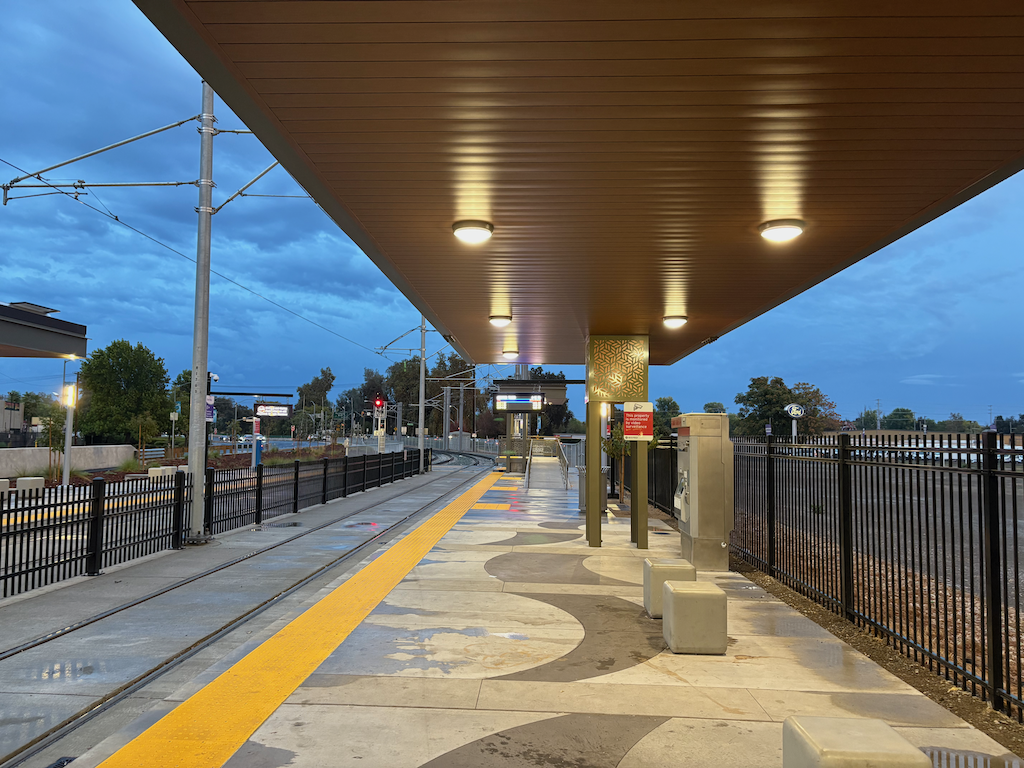
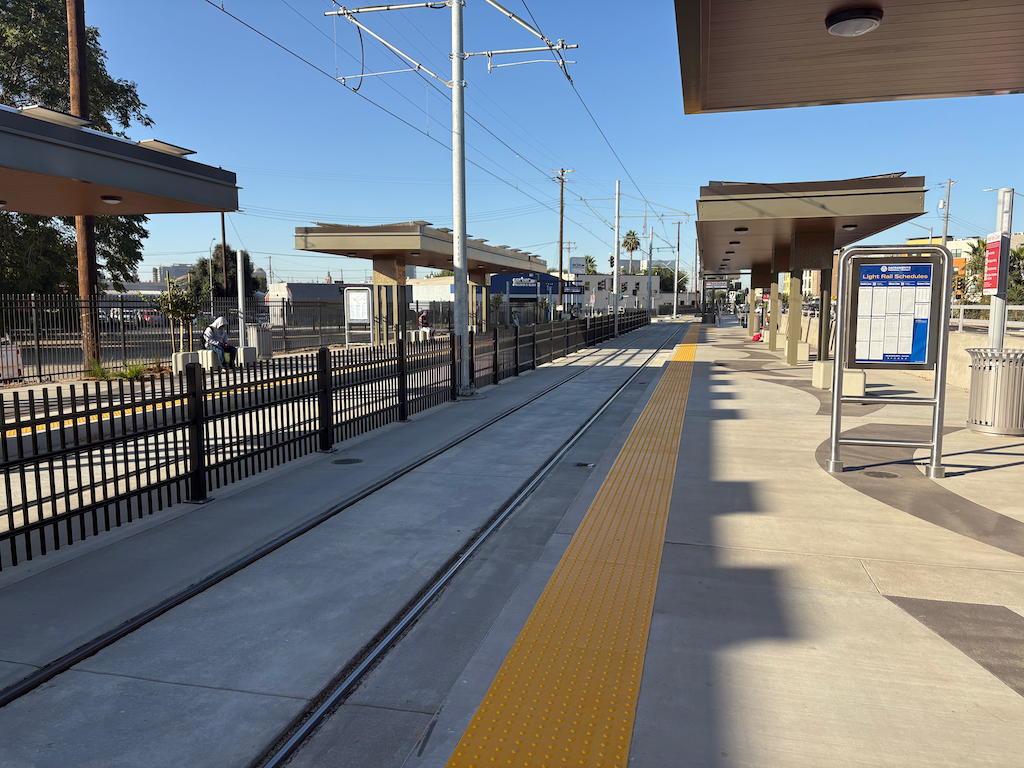
The station is very bare bones, especially compared to the new Dos Rios Station. There are two benches, at either far end of the platform. There are shelters, but they are small, don’t fully shelter the benches. I was not there at night, so I don’t know how well lit the station is. There are two trash cans, and both had been vandalized already. There is some planting, not much.
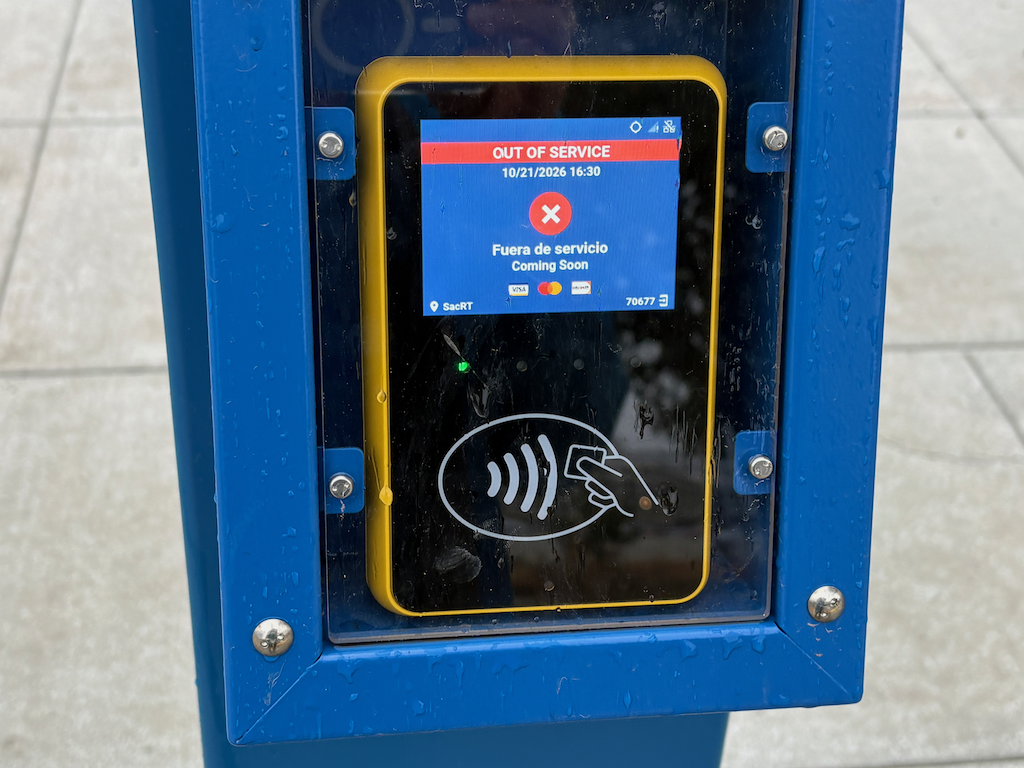
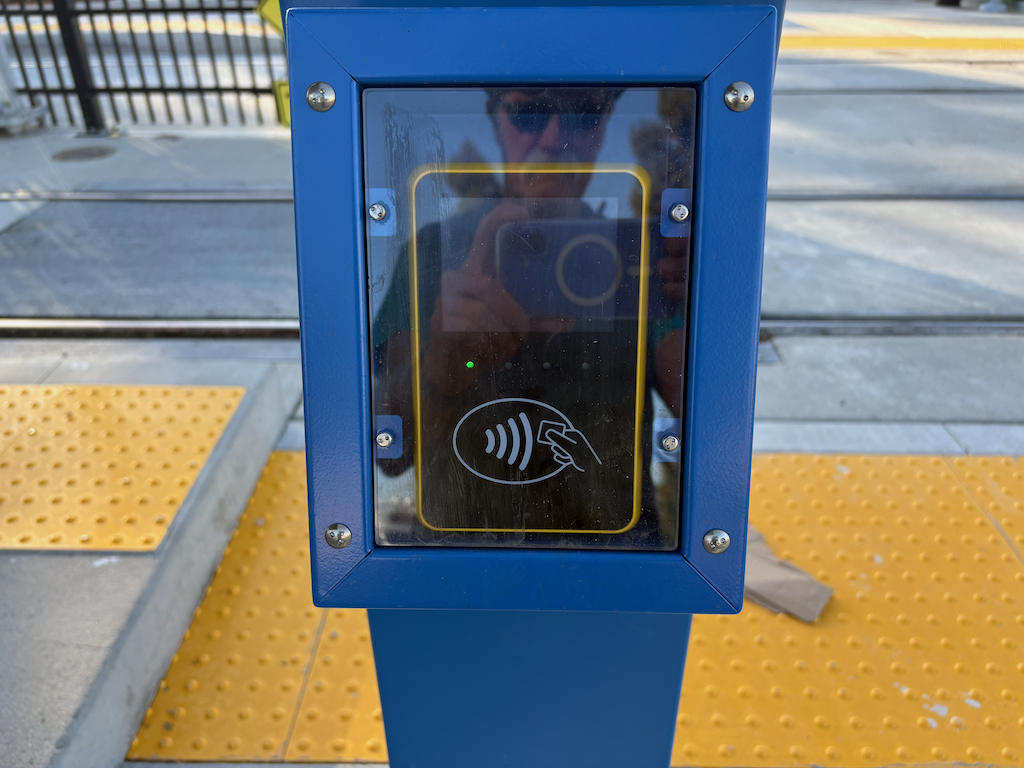
There are two Tap2Ride readers, at both ends of the platform, but they were out of service when I visited. This was supposed to be the second pilot site for Tap2Ride on light rail. There is no ticket vending machine (TVM) at the station.
There is single track, so the 30-minute headway train from the end point at 7th & Richards/Township 9 Station just returns through the same station and platform. Since there is not much to see, I caught the same train southbound that had brought me northbound. The trains are single car S700s.
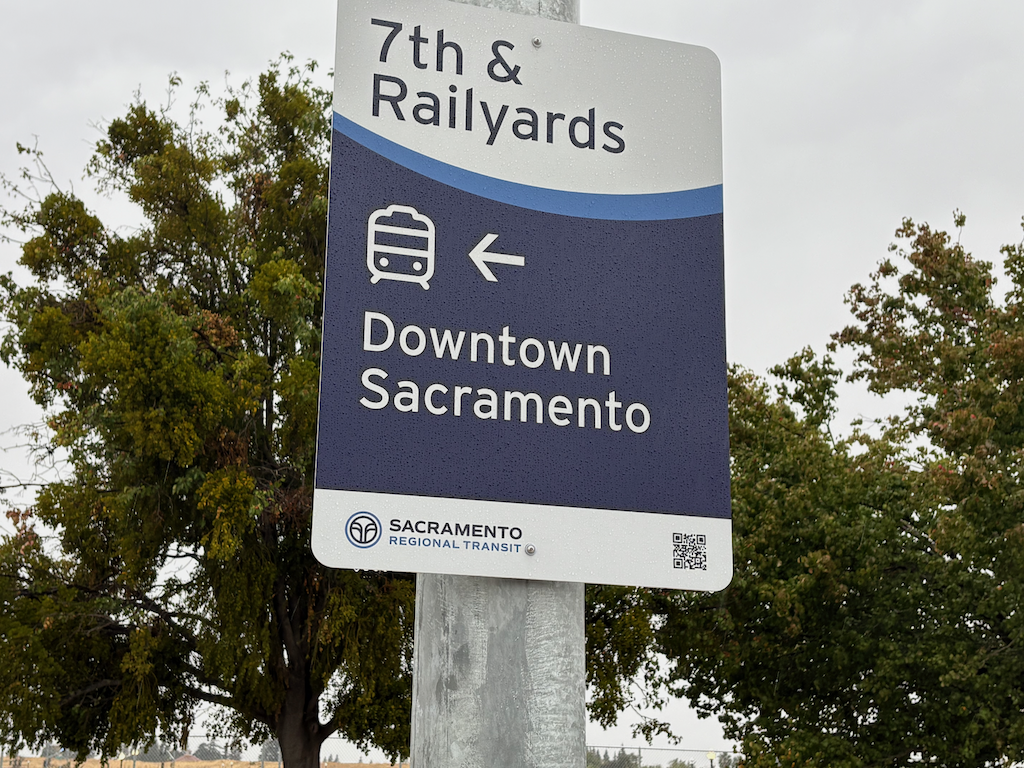
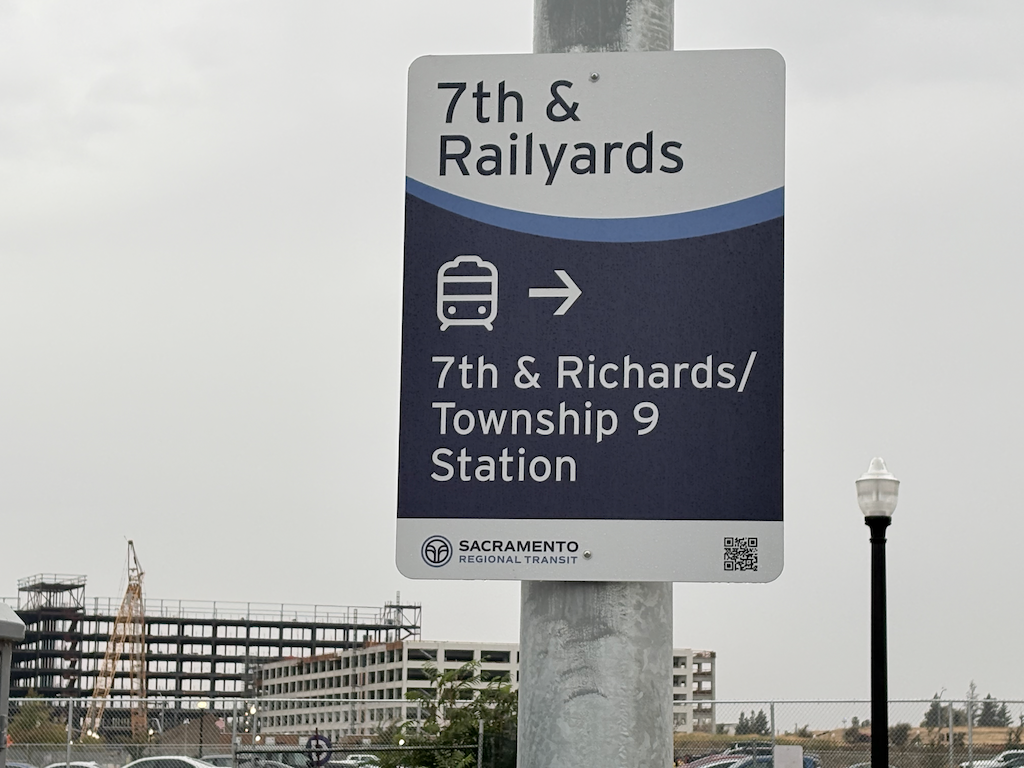
There are signs that indicate destination, but there are no signs to indicate that the northbound train stops at the north end of the platform, and the southbound train at the south end of the platform. This is a major flaw, since a person waiting at the wrong end would likely not be able to get to the other end in time to catch a train.
This station was paid for and built by the Sacramento Republic FC (soccer) owners, not by SacRT. SacRT said that when the developments in the Railyard come on line, the station will be upgraded with access to the soccer stadium, a wider plaza, and double-tracking at least for the station. It is not clear whether the route along 7th Street will ever be double-tracked.
The gallery below is my photos from the brief visit.
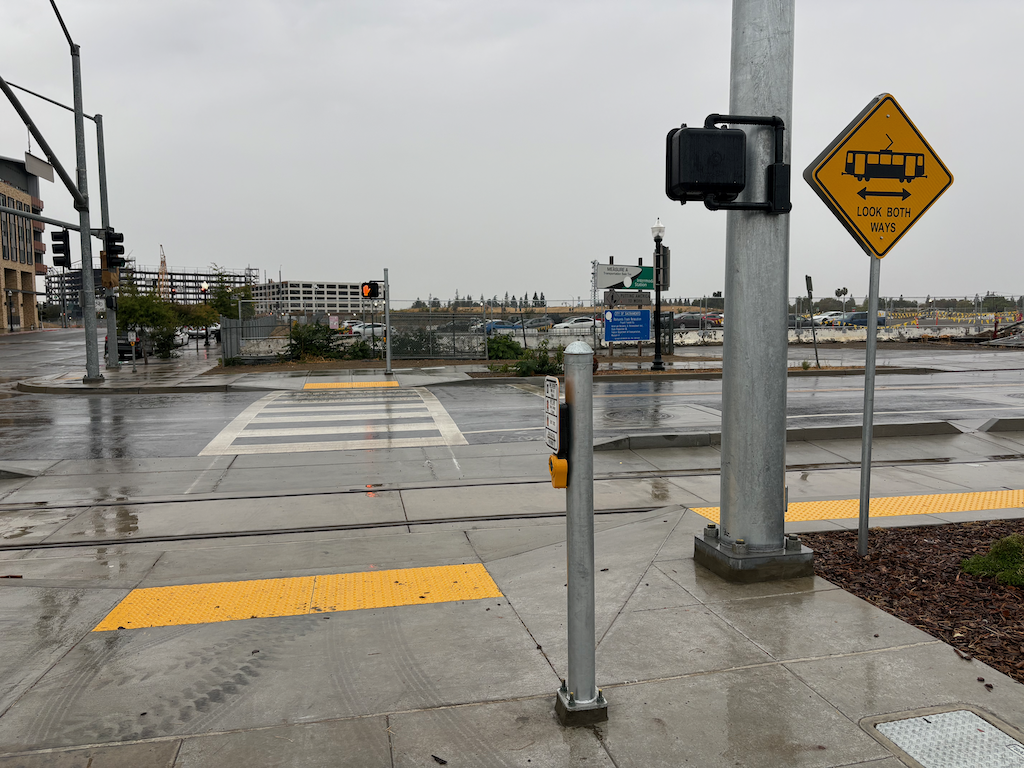
7th & Railyards Green Line train northbound7th & Railyards platform looking south7th & Railyards sign to downtown7th & Railyards sign to Township 9Tap2Ride out of servicecrosswalk over 7th St7th & Railyards bench
Update 2026-10-22: At a Sacramento Transit Alliance meeting at Dos Rios Station last evening, the group was there when the lights came on. Wonderful! This is by far the best-lit station on the entire light rail system.
SacRT Dos Rios Station lights
The Dos Rios light rail station is now open, as of September 28, 2026. This station, between Alkali Flat/La Valentina and Globe stations, was built to serve Mirasol Village and other homes and businesses just south of the American River.
Though you won’t find mention of this on the SacRT website, SacRT and SACOG tried to kill this station, but Mirasol Village residents, the public, and transit advocates rose up to defend it, and it was eventually approved and constructed (SacRT board passes Dos Rios station). Construction took a long while, mostly to move utilities and address contaminated soil which was more extensive at the site than originally estimated.
The station is very nice. A SacRT employee commented that it would be great if all the light rail stations were this nice.
The station has the traditional ticket vending machines (TVMs), but to my surprise also has the new Tap2Ride readers that will eventually be installed at all light rail stations. These are the same readers that have been installed on all the SacRT buses, but here they are housed in a protective box. I noticed three readers, though there may have been a fourth, located at ends of the platforms where the track crossings are located. For two of the three, the screens were illuminated. I used one as an experiment, and it worked, deducting $1 from my account (I am registered in SacRT’s Tap2Ride as a senior). One reader had a blank screen, but it beeped at my phone, so might be working. SacRT’s original intent was to integrate Tap2Ride into the TVMs, but I am glad to see they are separate, since many functions of the TVMs do not work properly. It isn’t clear whether the eventual Transit Connect physical cards will be read by these Tap2Ride readers, or by some modification of the TVMs. No Connect Transit Card readers, the old legacy system, were installed, and the TVMs never were able to read these cards, though they claim to.
SacRT Tap2Ride reader at Dos Rios Station
The station has a fence installed between the two tracks for this side-boarding station. Though these are not required at stations with the higher platforms, 8 inches above top of rail, they may be required when the platforms are eventually raised to 14 inches above top of rail, sometime in the 2030s. There are track crossings at the north and south ends of the platform. All of the side-loading stations on the north section of the Blue Line have these median fences. I think they are a good thing.
There is a crosswalk over North 12th Street towards Mirasol Village from the southbound platform, and access to Sproule Avenue from the northbound platform.
The station has ample sun/rain shelters, and ample seating blocks (not benches), and trash cans. Though I did not visit at night, it appears lighting is good. I did not notice a drinking fountain. Many light rail stations have drinking fountains, but almost all are non-functional. I guess SacRT has decided they are not capable of maintaining drinking fountains.
SacRT Dos Rios station
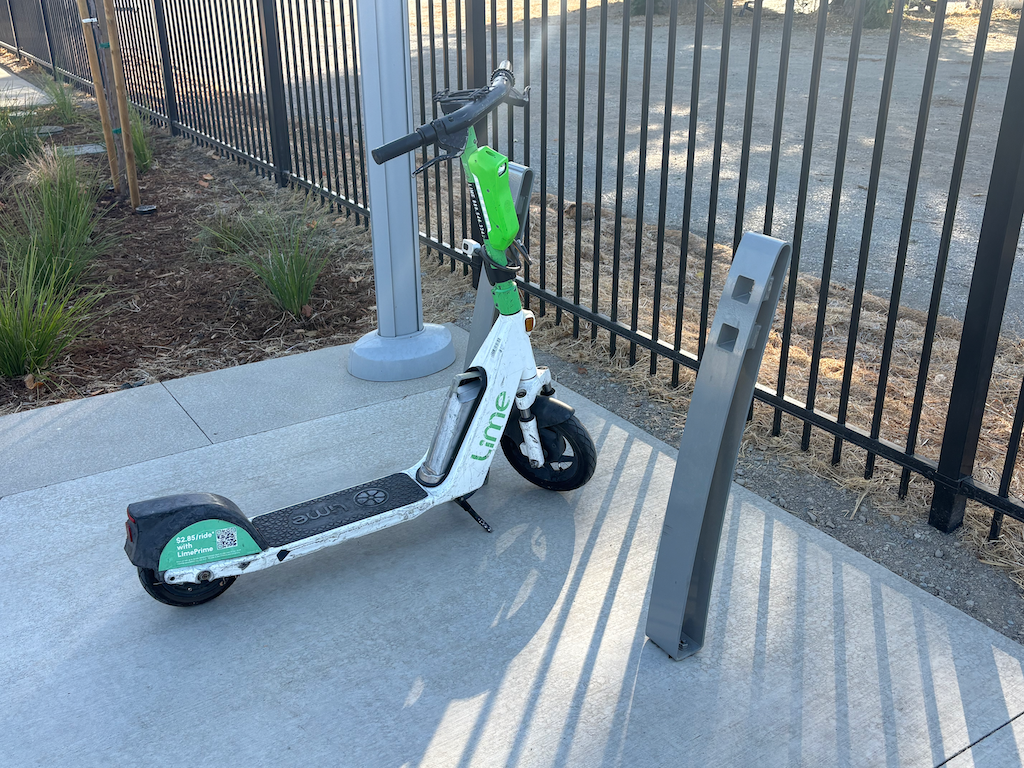
At the south end of the northbound platform, there are some odd devices that might be intended to be bike/mobility racks. These do not meet the requirements of the APBP (Association of Pedestrian and Bicycle Professionals) bike parking standards, which are recognized by the City of Sacramento. Of maybe they are just intended to be for scooters, but then there aren’t any bicycle racks. I don’t know.
SacRT bike racks ? at Dos Rios station
Another infill light rail station in the River District is due to open sometime this fall. SacRT is advancing planning for an infill station on the Gold Line at Horn Road, but this one is in early stages.
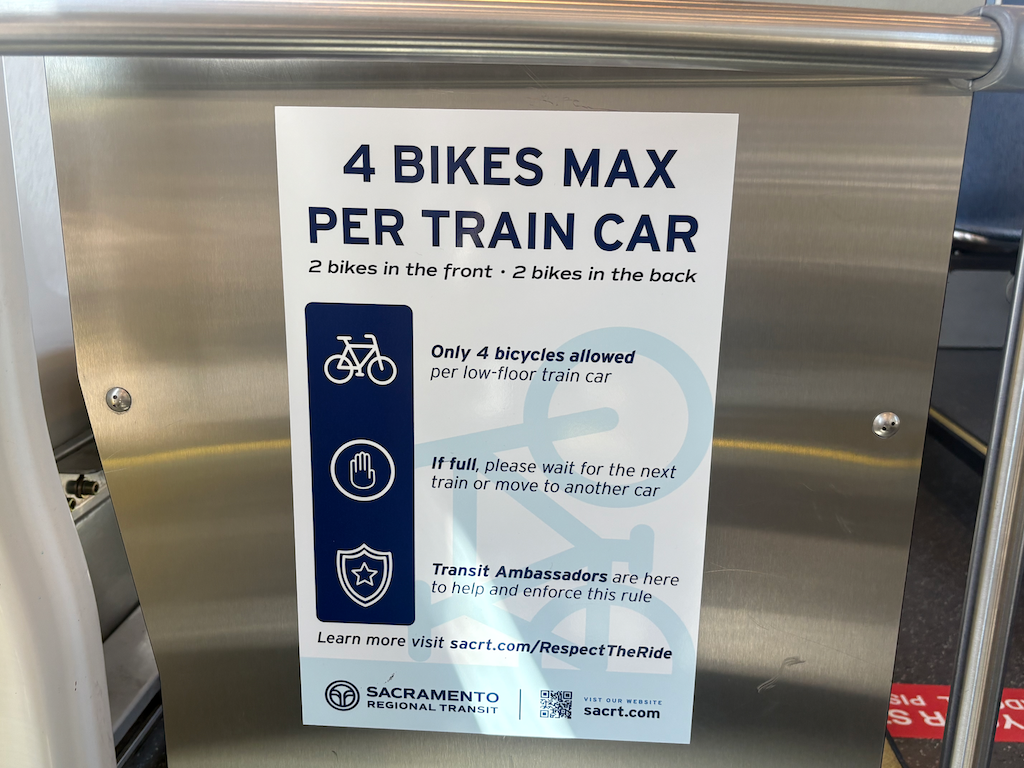
The new Siemens S700 light rail cars, in service on SacRT Gold Line and eventually on SacRT Blue Line, have very limited bicycle space. SacRT’s policy is that there can be four bicycles on each rail car, in the corner by the regular (not handicapped) doors. This policy was unchanged from that for the old light rail cars, so SacRT claimed there was no issue, however, the amount of space available is quite different. Most of the older cars had seats removed to provide additional bicycle space, in addition to the bike hooks on the 200 series cars. The practical bicycle space on these old rail cars was essentially 10 per car. The model of S700 that SacRT has purchased is designated by Siemens as ‘US’, meaning ultra-short. The cars are much shorter than the standard S700, with less space for passengers, wheelchairs, and bicycles. That mistake is not something that can be corrected – the cars are in service, and more are on order, and the light rail system will eventually be exclusively S700 ‘US’ cars.
SacRT bicycle sign four bikes per car
There are conflicts between passengers and bicyclists, and in particular with wheelchair users who have priority access to the ‘priority seating’ area of fold-down-fold-up seats. There have been incidents of bicyclists who were using the ‘priority seating’ area refusing to move. There have been times when so many bicyclists have been on board that it was difficult for other to maneuver around them.
So, what can be done? Two partial solutions:
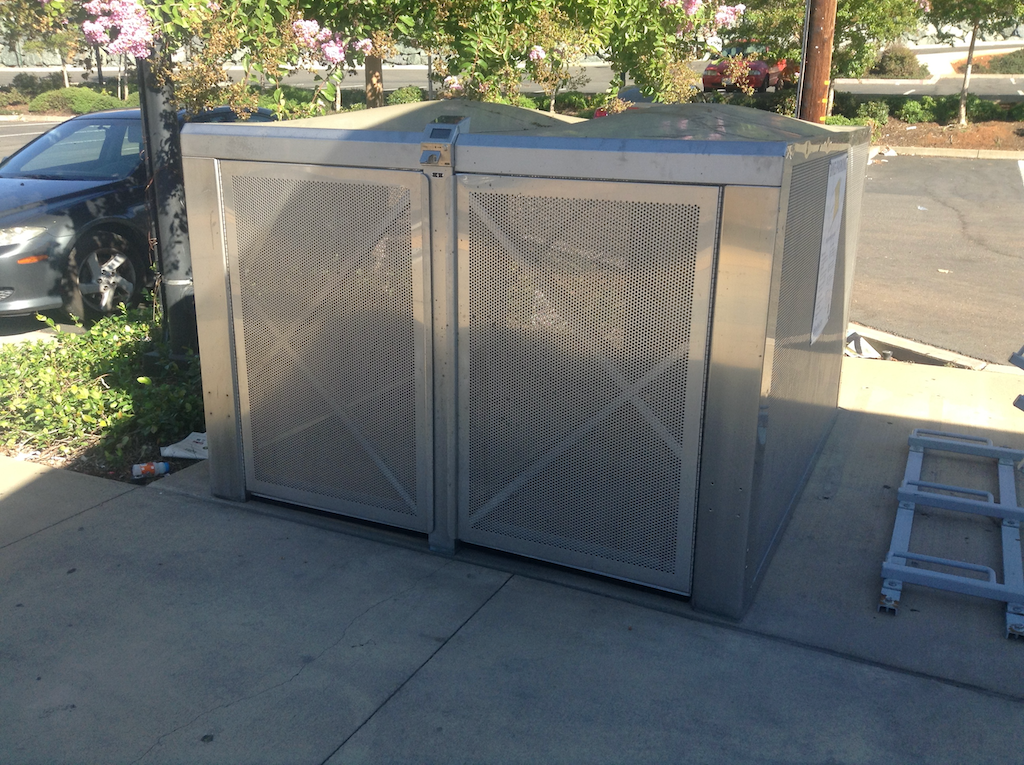
On-demand secure bicycle storage lockers at stations frequently used by bicyclists. Some bicyclists insist on bringing their bicycle on board, either because they need it at the destination, or because there is no secure bicycle storage at the station. Providing secure lockers would allow some bicyclists to leave their bike at the station, rather than bringing it on board. The standard secure bicycle storage solution is BikeLink lockers. Lockers provided by the City of Folsom at Historic Folsom, Glenn, and Iron Point are shown below. No other light rail stations have on-demand storage.
Way back in 2021, Sacramento Transit Advocates and Riders (STAR) made a formal request to SacRT that they provide on-demand secure bicycle storage lockers at light rail stations (secure bike parking). STAR had been talking to SacRT for several years before this on the same issue. The rental lockers provided at some stations were mostly not in use, and the public had no access to them except through a month-to-month rental. At that time, SacRT said they were ‘studying’ it. Meaning they weren’t actually doing anything. Bicyclist transit advocates have over the intervening years continued to ask SacRT about lockers. The answer is always the same – it is being ‘studied’. Nothing has happened. There is nothing related to the ‘study’ on the SacRT website. There is nothing in the board agenda. There is nothing in the budget.
The SACOG Mobility Zones program, which might site hubs at or near light rail stations has identified the Ben Ali/Swanston, Florin, and Rosemont/Western Rancho Cordova mobility zones. However, the zones so far defined do not guarantee co-location with stations. Note that the SACOG Mobility Zones map does not indicate light rail locations, so it is unlikely that it is a central part of site selection. The mobility hub diagrams show regular (unsecured) bike racks but do not show bike lockers.
SacRT is undertaking an apparently separate SacHub: Mobility Hubs Project for three light rail stations: Marconi/Arcade, Globe, and LaValentina/Alkalai Flat. There is no mention on the sparse page of secure bike storage, or even bike racks, for these hubs.
City of Folsom BikeLink lockers at Iron Point SacRT Gold Line station
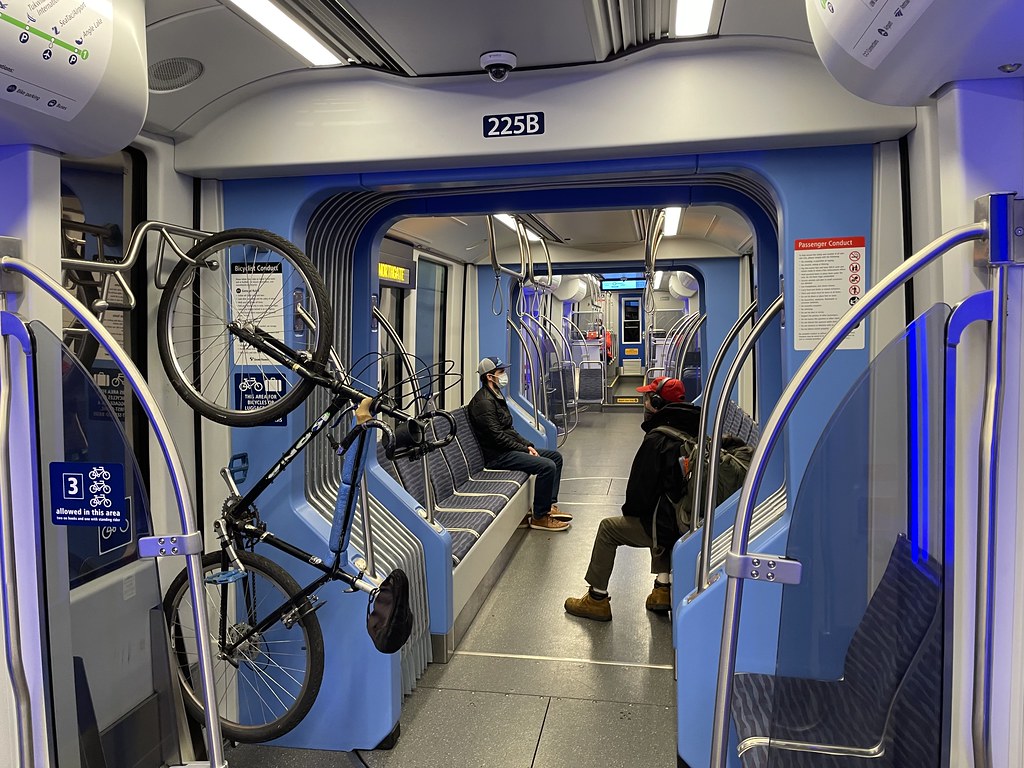
Add a bicycle hanging location in place of a seat on the S700 cars. The seat location is between the handicap ramp door and the accordion section. This would change the allowable bicycles from four to six per car. The photo below shows the bicycle hanging area on a Seattle area Sound Transit S700 light rail car. These are full size cars with more space, but the smaller space on the SacRT S700 cars would probably only allow one bicycle hook per location, or two per car. It is true that some bicyclists cannot lift their bicycle to the hook, but the on-floor locations would still be available for those people. I have been on some light rail vehicles that had bicycle storage in the middle section, between the accordion sections, but it was poorly designed and awkward to use.
Sound Transit LINK 1-Line bicycle hanging storage area
In August of 2024, bicyclists at the light rail demonstration of the new S700 cars indicated that bicycle space was insufficient, and there needed to be more space to accommodate bicyclists. SacRT decided not to add this capability to the new cars.
My conclusion is that SacRT does not take the bicycles on light rail issue seriously, and does not intend to solve the problem.
Enough posts on SacRT and transit, for now, after 10 in the last two weeks. On to other transportation topics!
Total travel time matters, not just in-vehicle time: Not sure how the Green Line measures up, but it is indicative that the Green Line to Township 9 (the current destination) runs on an infrequent schedule (60 minutes) during a small part of the day, because it is beyond the area where most people travel. The airport would also be beyond where most people travel, so is likely to have infrequent and short hours service.
Combine air travelers and airport employees on the same train/bus: The Green Line might do OK on this, though light rail already suffers from the perception of higher income people (which is mostly who flies rather than takes the bus or train) that light rail is only for poor people.
Connect the airport to lots of places, not just downtown, by providing a total network: Since the SacRT network fails pretty badly on connectivity already, it is likely that the Green Line will suffer from the same issue.
Don’t interfere with the growth of other services: The Green Line is definitely a negative on this issue. The Green Line to the Airport would gobble up all the construction funds for years, as well as a large slice of operating funds. Fare recovery on the network is 23%, somewhat below average, but the extension would likely reduce this significantly. If distance-based fares (which SacRT has talked about but done no real planning towards) are implemented on the light rail system, the operating subsidy might be less, but it will still compare poorly with the rest of the system.
If you can afford it, go via the airport instead of terminating there: Not applicable to the Green Line because there is nothing beyond the airport except agricultural fields, and a bit further out, sprawling suburbs that would never generate ridership.
I think the right solution for airport access is frequent bus service (15 minute frequency) from downtown to the airport, from 5:00AM to 12:00 midnight, for travelers and airport employees, and less frequent service from midnight to 5:00AM, for employees. The current Yolobus 42A/42B provides infrequent (60 minute) service from 5:30AM (6:30AM on weekends) to 10:00PM. In addition, there would need to be service from eastern Sacramento/Roseville, but I’ve thought less about how that would work.
Save our infrastructure funds for more productive routes!
SacRT is holding community open houses on the Green Line to the Airport in early December. December 1 in North Natomas, December 2 in Sacramento, and December 3 in South Natomas. Details are at http://www.sacrt.com/glopenhouse.stm.
As I’ve written before, I don’t think that an extension to the airport makes economic sense, with likely low ridership and high costs to get to the airport. But there are real opportunities for South Natomas, which is very much underserved by public transit.
I encourage you to attend one of the open houses, make your own decision, and then get involved to make sure that SacRT makes decisions that support transit access for lower income communities and economic development, connecting jobs to homes.
I attended the Blue Line extension to Cosumnes River College (CRC) Grand Opening this morning at Meadowview station and then at CRC station. It was a lot of fun. There were more politicians in one place that I think I’ve seen, and they were justifiably proud of their part in supporting this extension, some having worked on it for years. [Photos on Flickr]
A number of speakers talked about linking the colleges, in this case Sacramento City College and Cosumnes River College. An increasing number of students apparently take classes at more than one campus in order to get the ones they need, so this extension is expected to help them, whether they don’t have a car or just choose to get around in a more convenient and more responsible way. Folsom Lake College’s Rancho Cordova Center is very close to the Mather/Mills light rail station. The Cosumnes River College’s Elk Grove Center will be on light rail if the Blue Line is extended to Elk Grove (Blue Line Phase 3). American River College’s Natomas Center will be on light rail if the Green Line is extended to Natomas. All of these connections are great, for students and for the community.
Unfortunately, American River College’s (ARC) main campus in North Highlands was barely mentioned. Brian King, Chancellor of Los Rios Community College District, said that ARC was served by a robust bus system. Unfortunately, that is not true. ARC is served by Route 1 (Greenback) on a 15 minutes frequency, and Route 82 (Howe-65th) on a 30 minute frequency, which is hardly robust service. Route 82 only runs until 9:30PM, missing students with later classes or who are staying to study, and who need to make connections to other buses or light rail to get back home.
SacRT is considering a number of extensions to the light rail system, beyond the opening of the Blue Line extension from Meadowview station to Cosumnes River College, which will occur August 24.
These are:
Green Line to the Airport, also known as DNA (Downtown, Natomas, Airport). This project is likely in two phases, first from the current end at Richards Blvd to somewhere in North Natomas, and second the rest of the way to the airport. Information on this project is on the SacRT website. This project is furthest along, and the draft EIS/EIR is now being prepared. The map of the “locally preferred alternative” is at right, and this links to the larger map on the SacRT website.
Blue Line to Elk Grove. This project has been talked about, particularly as the line to CRC has approached completion and generated discussions of whether or not Elk Grove residents will be willing to change from bus to light rail at CRC. So far as I know, there are no publicly available documents on this extension, but it is included in the 2009 Transit Action Plan updated Scenario C (below).
Blue Line Northeast Corridor. This project would extend the line to the northeast, to American River College, Citrus Heights, or Roseville. Though this project was part of the original vision of the light rail line when constructed back in the 1970s, it has not received much notice while I’ve been in Sacramento. So far as I know, there are no publicly available documents on this extension, but it is included in the 2009 Transit Action Plan updated Scenario C (below).
Each of these extensions are worth exploring in detail, but for now I’m posting because I have two ideas I want to share.
In the recently announced round of grants under the CalSTA Transit and Intercity Rail Capital Program, SacRT received funding to refurbish the remainder of light rail vehicles from San Jose. The money is from the Greenhouse Gas Reduction Fund using proceeds from the state’s cap-and-trade auctions. The statewide total was $224M.
7. Sacramento Regional Transit District (RT) – Refurbishment of Seven Light Rail Vehicles
Award: $6,427,000
Refurbishment of the last 7 of 21 vehicles acquired from Santa Clara Valley Transportation Authority in order to support 15 min peak hour service frequencies throughout the RT light rail system and enable future limited stop service on the RT Gold and Blue Lines during the next 15 years. The project will result in increased ridership, eliminate impacts from the overhaul program needed on the rest of RT’s fleet, and connect residents in disadvantaged communities to jobs. Improved service on the system also increases the attractiveness of connectivity to Amtrak services and future High Speed Rail service at the Sacramento Intermodal Facility.
Everyone these days seems to want a better transit system. The problem is that no one wants to pay for a better transit system. The business leaders who suddenly want a modern, appealing, well-maintained light rail are the same ones that have worked over the years to suppress efforts at increasing the tax base for operation of the system.
SacRT has joined the 20th century! There are now twelve fare vending machines that accept credit and debit cards for purchasing tickets. Though the machines are all located at light rail stations, the tickets can be used on SacRT buses as well. Most months I buy a monthly pass, but since in February I am gone about half the days, I decided to buy by the day, and it has been very convenient to have these machines. Though two of my most commonly used stations don’t have them. There are 52 stations on the light rail system, and each has one or more fare vending machines.
When I moved to Sacramento nearly three years ago, I was frustrated that the machines, which were clearly designed to accept cards, did not. Every other transit system I used in my travels did accept cards at some to all stations, and having a system that dealt only in cash was a disappointment.
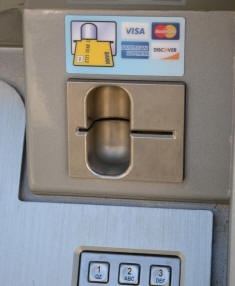
the credit/debit card slot and stickers
There will eventually be a region-wide fare card, similar to the Clipper card used in the Bay Area, for Sacramento. I don’t know whether this capability will be added to the existing machines, or whether new machines will be installed.
 SacRT is holding community open houses on the Green Line to the Airport in early December. December 1 in North Natomas, December 2 in Sacramento, and December 3 in South Natomas. Details are at