concern about SacPD enforcement against bicyclists and walkers

Update/correction: The grant was apparently approved by city council and awarded by OTS, so the program is in effect. Transportation and equity advocates are recommending that the city council advise city manager and police that the bicyclist and walker enforcement portions of the project not be carried out, and funds diverted to more effective uses.

In an April 14, 2025 SacBee article by Ariane Lange, she expressed concern about an upcoming Sacramento Police Department program to enforce and educate about dangerous roadway behaviors: Sacramento police will ticket cyclists and pedestrians with safety grant money. I had noted this grant earlier, and figured it was not focused on enforcement against bicyclists and walkers, but concern by Lange and the local transportation and equity organizations now has me concerned.

The the grant application text:

“Similar to the “Know Your Limit” program is the “Wait for the Walk” campaign. The activities include informal contact with citizens and enforcement operations where officers saturate high-density intersections, educate pedestrians about the dangers of jaywalking, and reinforce safe pedestrian habits. The message we spread is that pedestrian-related collisions can be avoided, and we should always use crosswalks and sidewalks and always wait for the walk signals. Pedestrians should stay off their phones and pay close attention to approaching traffic when crossing streets.”

Though this is not the major part of the grant, it is concerning. Law enforcement, including but not limited to SacPD, knee-jerk blames crashes involving bicyclists and walkers hit by motor vehicle drivers as the fault of the bicyclist or walker. Even when the driver is drunk or high, it is often still blamed on the victim. This world view is so deeply embedded in law enforcement thinking that most officers never overcome it. OTS (California Office of Traffic Safety) grants, which use pass-through money from NHTSA (National Highway Traffic Safety Administration), have often been used as stings against bicyclists and particularly walkers, targeting and ticketed them for behavior that may be against the law but does not endanger anyone. There is no guarantee that this grant will not be used in the same way.

The text uses the term ‘jaywalking’, which is a throughly repudiated term in the transportation advocacy community, indicating a deep-seated bias against people walking. Though crossing the street outside a crosswalk is still illegal in California, it is not an citable offense unless the walker interferes with traffic or otherwise endangers other people. The reason this law was passed is that police in Los Angeles, as well as other place, were targeting people crossing the street, for no other reason than they were people of color. Law enforcement bias shows up so often that the legislature spends a lot of time trying to improve law enforcement behavior, often with insufficient impact.

Common knowledge among transportation advocates, but apparently unknown among law enforcement, is that it is safer to cross the street between intersections because there are only one or two directions of motor vehicle traffic to pay attention to, whereas at intersections, there are sixteen different directions and possible threats to people walking. Certainly, ‘pedestrian related collisions’ can be avoided, but it is by controlling driver behavior and redesigning streets, not by enforcing against or ‘educating’ people walking.

Lastly, I’ll note that the bulk of the grant is towards overtime for law enforcement training, which should be happening under the regular (bloated) police department budget, not with grant money.

Apparently there is no city council meeting this week (today, April 15), so I don’t know when approval of the grant application will be on council agenda. The council should send this back to PD for a re-write that focuses solely on dangerous driver behavior, with automated enforcement, not with in-person enforcement which is frequently biases and frequently leads to escalation and harm to the person bicycling and walking.
how to stop red light running

I’ve posted about the red light running epidemic: red light cameras and law enforcement; the end of red light enforcement; how do we get more red light cameras?; red light running consequences; SacCity red light cameras and crashes; Sac Vision Zero intersections & red light cameras; red light cameras; pandemic of red light running; and red-light-running bullies.

Of all the traffic violence occurring on our roadways, this is the one that concerns me the most. When one driver runs a red light and hits another driver going on the green light, the result is almost always serious injury and sometimes fatality. It is a particularly high impact crash because the driver running the red light is often accelerating into the intersection, because they have decided (consciously or not) that they are going to run the light, and want to get through as quickly as they can. T-bone crashes, which red light running crashes almost always are, are especially damaging.

The red light running epidemic started with the pandemic, in my observation, though it has always been present. I’ve seen multiple explantations of why this is, but the relative lack of cars on the road, and the resulting perception that the road belongs to the driver alone, is one common explanation. But as the pandemic has faded, red light running has not faded, it has increased month over month. If you observe any moderately busy intersection, you will see drivers run red lights on nearly every signal cycle. Other drivers, and people walking and bicycling, have responded to this lawlessness by not going on the green. People now expect someone to be running the red light, and pause until all the vehicles have stopped. Green lights and pedestrian signals were never a guarantee of safety, but now they are a guarantee of danger.

I have said before, and continue to strongly believe, that automated red light enforcement is the top solution to this behavior. I believe that most drivers would stop doing it if they were ticketed a few times. Some would not, or course, because there are drivers on the road for whom the cost of a ticket is meaningless, and their consideration of other people’s lives is nil. Such drivers will create a pattern of law breaking that can be identified and stopped by suspension of drivers license, and more importantly, confiscation of their vehicle. In my observation, most of the red light runners are driving high value cars. Tickets mean nothing, but loss of their expensive car will get their attention.

Red light running is the traffic violence issue probably least amendable to infrastructure solutions. It is a choice by drivers, and one not primarily induced by poorly designed roadways.

There are research papers from the 1990s through early 2010s that suggest changes to the signals to reduce red light running. Bigger and brighter signals. larger brighter reflective backplates around the signals (these have been common recently with the yellow reflective backplates). Changing the all-red interval to a longer period, or the yellow signal to a longer period, but drivers adjust to this and increase their risk behavior to compensate. Placing advance warning signing or flashing lights, more appropriate for rural situations than cities. I don’t believe that any of these have a significant impact. Horizontal rather than vertical placement of the signal heads may have some beneficial effect.

Moving signals to near-side locations of the intersection is the solution in many parts of the world. Near-side signal placing does reduce red light running because the driver is responding to the signal on the close side of the intersection, not the far side. Research supports this, but the US refuses to make this change.

And of course education, encouraging drivers to follow the law and to cease actions that endanger others. I’m pretty cynical about education. Education works when someone does not know the consequences of their behavior. But drivers do know the consequences of their red light running. They’ve gotten away with it so far, but I doubt that any of them think they will get away with it forever.

Redesigning roadways and intersections to create more friction, such as narrower lanes and curb extensions to slow drivers, reducing the energy of crashes, but neither prevent red light running. Protected intersections reduce the hazard for bicyclists and walkers, by better separating movements and shortening crossing distances, but they don’t prevent red light running.

Though research clearly supports daylighting for increasing visibility between drivers and walkers, it may also increase red light running because drivers do, or think they do, have a better view of the intersection and whether approaching vehicles are going to cause them problems. I’m all for daylighting, but this issue must be acknowledged.

I believe automated red light running enforcement is the most effective solution, but others should be considered in addition to, not in place of, automated enforcement.

I searched for but did not find any research or even preliminary information on red light running and solutions since the beginning of the pandemic. It is possible some is underway. It is not the sort of thing that would be funded in the current administration, but it might not be rescinded.

red light cameras and law enforcement

Earlier posts on red light running and automated enforcement are available at category: automated enforcement.

The City of Sacramento has a crisis in biased law enforcement against people of color and low income, and also has a crisis of red light running.

The city had red light cameras at eleven locations, part of a program managed by Sacramento County Sheriff’s Office. The county dropped the program in early 2024, and all cameras were removed. The county claimed that the fines from red light running were not paying the cost of the program, and of the contractor. The City of Sacramento therefore dropped its program and has made no effort to restart it. At the dollar value of human life being $10M or more, it is hard to understand how the county saw this program as too costly. City of Sacramento paid $27M in traffic crash lawsuits over five years. The county information does not seem to be available, but it would likely be larger due to higher population, more road miles, and more poorly designed roadways and intersections.

The nature of red light running is that a motor vehicle driver T-bones someone, impacting other motor vehicles, walkers and bicyclists at a perpendicular angle at high speeds, frequently resulting in a fatality. This is not the leading cause of fatalities, but it is significant.

There are reasonable objections to any law enforcement of traffic laws. Traffic stops are often pre-textual, intended to discover illegal activity or warrants that have nothing to do with traffic law, and to oppress people of color and low income. Law enforcement officers not infrequently escalate interactions, resulting in intimidation, unlawful arrest, and death. Law enforcement often focuses on communities with people of color and low income, both because of the pre-textual nature of stops and intended intimidation of people in those communities. Even when justified, tickets for traffic violations have an outsized impact on lower income people because fines are a flat amount no matter the income of the violator, so are strongly regressive. Court fees add a great deal to the cost of a ticket, often sending low-income people in a downward economic and legal spiral. 

Automated enforcement of traffic law removes some of these concerns, but not others. By removing the interaction with officers, law enforcement intimidation and violence is eliminated. But the issue of outsized economic impact remains.

If a red light camera program were to be restarted in the City of Sacramento, it would have to have these characteristics:

  1. The program would be operated by Public Works as part of their transportation management responsibilities, not by the Police Department.
  2. Camera locations would be selected based on traffic crash location hot-spots, but adjusted so that low-income communities do not have a higher number of cameras per-capita than other areas 
  3. For camera locations with a history of traffic crashes resulting in fatalities and severe injuries, and with a higher than average number of citations issued, the city would commit to making changes to that intersection to reduce the incidence of red light running and crashes.
  4. The fines for red light running would be reduced for low-income people. The reduction could be a) across the board for income levels below a certain set percentage of the median household income, or b) based on the value of the vehicle driven by the violator. Alternatives to fines could also be implemented. Though income based fines are often mentioned, and are used in other countries, concerns about privacy and availability of the data make this impractical. The value of a vehicle is easily available, and does track to some degree with the income of the owner. It is not certain whether these options could be implemented by the city now, or if changes in state law would be required, but the city should commit to exploring options and committing to a solution.

Two other types of automated law enforcement have been discussed. Automated speed cameras are legal under a pilot program for several cities, but Sacramento is not one of them. It is unlikely that other cities would be added, or statewide implementation would occur before the pilot is completed. It is possible that active intelligent speed assistance will become law in California, and obviate the need for automated speed enforcement, at least in urban areas.

Automated enforcement of ‘failure to yield’ to walkers (pedestrians) law would be very useful. Failure to yield sometimes results in fatalities and severe injuries, but it always results in intimidation of people walking by people driving, reducing the frequency and comfort of walking trips. The technology for detection of ‘failure to yield’ is not well developed, but has been implemented in some cities and is practical. ‘Failure to yield’ is another crisis on our roadways.

This recommendation to restart the red light camera program in the city does not indicate that it is the primary solution to the traffic violence crisis. It is one among many tools. Changes to the roadway, temporary (quick-build) or permanent, are by far the most effective solution and should be the lead action by the city.

SacCity pedestrian safety emergency: enforcement

The draft City of Sacramento emergency declaration on pedestrian safety: ‘Declaring a state of emergency regarding pedestrian safety in the City of Sacramento and calling for immediate action to address pedestrian injuries and fatalities’ is available (pdf of text, 2 pages, 68KB) (pdf of attachments, 28 pages, 26MB).

This post focuses on the enforcement item.

3. “The City Manager is further directed to work with the Sacramento Police Department to ramp up enforcement of traffic laws that protect pedestrians, including speed limit enforcement, crosswalk violations, and distracted driving. The City shall prioritize enforcement in high-injury corridors and areas with frequent pedestrian activity.”

Three advocacy organizations specifically commented about the draft that it must focus on ‘equity and mobility justice’, as did most of the people who spoke at the city council meeting.

I’ll be blunt. There is a deep and well justified mistrust of Sacramento Police Department (SacPD) among people of color and low-income, particularly among, but not limited to, blacks. SacPD has a history of oppressing black people, and has often used traffic stops as a pretext to harass people. Many of these have escalated into arrest, beatings, and even death. I have seen no real evidence that SacPD has changed their stripes. They are not people that I want interacting with the public about traffic law. And, apparently, they don’t want to either. SacPD has reduced its traffic officer group to almost nothing, and does little traffic enforcement by traffic officers or any officers. It is time to move past the idea that law enforcement has much to contribute to reducing traffic violence.

At the same time, no enforcement of any sort is not the answer. People are dying when drivers violate traffic law, and these deaths are unacceptable. Speed is a contributing factor to all traffic crashes, and is sometimes the primary factor. Driving too fast for conditions, and these conditions include walkers and bicyclists on and close to the roadway, is always wrong, even though road design encourages it.

Automated enforcement is a partial answer. It avoids the pretextual stops, avoids harassment of people of color and low-income by police, at least over traffic law, avoid the escalation that police engage in, and is much less expensive than police officers.

The three main traffic violence issues to be addressed, at least at this time, are:

red light running: Red light cameras and automatic ticket issue to the owner of the vehicle are a partial solution to red light running. Of course some drivers will always run red lights, will always endanger others, and will not be deterred by tickets. But most drivers will notice that tickets are being issued, and will change their behavior. Red light running does have infrastructure solutions, including changing from far-side signals to near-side signals, and raised crosswalks and raised intersections. But there are not easy or inexpensive fixes, so automated enforcement is a good interim solution. When the county ended its red light program, which operated the red light camera in the City of Sacramento, the city made no effort to replace that program, and at least some city staff celebrated it (the red light runners?). The city should create a red light camera program of its own. It should be administered by Public Works, not by SacPD. There are equity issues, since the wide, high speed arterials that most encourage red light running are in low-income communities. Two solutions are to distribute cameras across the city in locations where red light running might occur, and not just those locations with a history. The egregious violators, which are who we really want to target, will be receive tickets eventually. The second is to adjust violation fees (and court costs) to a factor related to income. It would be awkward and perhaps invasive to base it on income, but it could easily be based on vehicle value.

failure to yield to walkers: Drivers have been trained by roadway mis-design to not yield to people in crosswalks. The recent SacPD, OTS funded, sting on J Street demonstrated how common this is. But again, as drivers have been trained to do this, they can be untrained. There are options for automated enforcement of failure to yield, but it requires more complicated and less widely used technology. The city should be experimenting with this technology (they are not), but in the meanwhile, this may be one situation in which in-person enforcement, on a limit basis and with close attention to equity concerns, may be justified. Any in-person enforcement by SacPD raises issues of police violence and over-reaction, including high-speed chases of violators. One solution is to ban high-speed chases. With technology such as helicopters (which the police love) and drones, there is no reason to endanger the lives of violations, bystanders, or officers themselves with high speed chases. Too many cops have watched too many movies with the thrill of high-speed chases. The practice must end.

speeding: There is available and highly reliable technology for automated enforcement of speeding. There is a state-authorized pilot program of speed camera enforcement in six cities and part of Pacific Coast Highway. Sacramento is not among them. To its credit, City of Sacramento asked to be part of this pilot but was not included. The city should strongly lobby the next legislative session for inclusion, and should have a program designed and ready to go when authorized. Speeding is the most common concern of the public, and it is true that speed is a factor in every crash, I’m doubtful that it is the biggest concern. I’d rather see a focus on red light running and failure to yield.

I believe that item 3 should be deleted for its likely failure on equity and mobility justice.

I have not yet written about the other six items, and don’t know when I’ll be able to get to it. However, I will say now, in case you were wondering, that by far the most effective city response is temporary (quick build or tactical urbanism) and permanent changes to roadway design. And what it will take to accomplish those changes is funding, from the city general fund. The seeking of grants, and waiting years or decades for the funding to address traffic violence, is only part of the solution. If this is truly an emergency, and it is, the city must spend significant funding to act on it, and act now.

what is public safety?

This post is a response to the Sacramento City Council meeting last Tuesday on the FY 2024-2025 budget adoption.

A number of people spoke on the budget, the majority of them downtown power brokers who were adamant that the police department budget not be reduced. They painted a picture of lawlessness in the central city that could only be reversed by not only not reducing, but increasing the police budget. Most of the problem was blamed on unhoused people, who were presented as violent drug addicts and criminals (never mind the white collar crime going on inside the buildings). Mayor Steinberg right off the bat said that the police budget was being increased, not reduced, but that did not prevent the speakers from claiming that it was being reduced. Several speakers used the term ‘defund the police’, which was originally an effort to reduce police budgets to force the police to be more accountable to the people, but has now been weaponized by pro-police people to suggest that every effort to hold police accountable is an effort to defund the police. One speaker attacked Councilmember Valenzuela, suggesting that she was personally responsible for all the problems in the central city.

To say the least, I was very disturbed by these messages. These are people of great privilege, asking that the city elevate their privilege over other citizens.

Not one of these central city people spoke about the epidemic of traffic violence that is harming people more than traditional crime. Several city council members did speak about this, but none of the downtown power brokers.

None of the power brokers even mentioned other parts of the city. Were they concerned about crime elsewhere? Apparently not.

Only one of the people who spoke in favor of the police budget appeared to be a person of color. He was not from the central city, and expressed ambivalence about police, acknowledging that he was concerned about crime related to his business, but also that many people were uncomfortable about the police.

Not one person from the low-income parts of the city spoke in favor of the police, or the police budget. There is a deep, and well deserved, distrust of the police in large parts of the city. Police have served as oppressors and killers in many, many incidents. Take a moment to think about all the incidents where the police escalated the situation, and then started shooting. Think about the incidents where they showed up and started shooting before they even knew what was going on, and killed innocent people. Think about the incidents where an unarmed person was running away ‘resisting arrest’ and the police shot them in the back. This is a reality that low-income people of color live with and are traumatized by.

In my view, police do not keep us safe. They respond to incidents involving bullets and knives. They often don’t respond to other incidents, or respond very slowly. And it is always response, never prevention.

What does this have to do with traffic violence and safe streets?

The police budget takes a large and growing part of the city budget. These are dollars that could be spent on solving problems, making the city a safer place, but instead they go to the police, who have only one solution, themselves. Councilmember Valenzuela made an effort to keep personal in internal affairs, the police who investigate police malfeasance and crime, but was rebuffed by Police Chief Kathy Lester who doesn’t believe internal affairs is important. Several times the issue came up, as it has many times before, about transferring a small part of the police budget to efforts that actually make a difference, such as Department of Community Response, but no action was taken.

The number of deaths in the city from traffic violence is larger than the number from homicide. Yet the city has only eight traffic enforcement officers. Eight, out of nearly 700 sworn officers (there are others who work for the department but are not officers). This understaffing is a choice that the police department makes, it was not forced on them by anyone else. It reflects their attitude that people who die by guns and knives are worth notice, but people who die by traffic violence are not. It also reflects their attitude that it is better to respond to violence than prevent violence.

I am not in favor of direct traffic enforcement by police. Of the few stops that occur, they are almost all pretextual, meaning that the police officer has stopped the person for a traffic violation, but really is seeking other violations. Most stops are of people of color, as documented by the police’s own data. These stops not infrequently escalate, escalation as often on the part of the officer as the person stopped. Some of these stops result in death.

Automated enforcement is the answer to most traffic enforcement. The city had a red light camera program, but when the county dropped it, so did the city. The police made no request to continue to program. Though the city has encouraged the legislature to pass and the governor to sign automated speed enforcement, the police have been silent. Again, an attitude that only an officer can enforce the law, technology cannot.

I have watched police officers routinely ignore traffic violations, just sitting around waiting for something ‘important’ to happen.

So what is public safety? Public safety is when:

  • resources are spent equally on protecting all citizens, not just the privileged
  • police and the city as a whole focuses on reparation, reinvestment, and dialog to heal the trauma created by police oppression
  • police allocate their officers and other resources based on actual threats to the public safety, not on outmoded perceptions
  • the city reallocates budget to those programs that are making a positive difference in people’s lives, not just increasing the budget of the loudest voices

I know I’ll lose some readers with this post. I know that some people concerned about traffic violence and safe streets are also supporters of the police and of direct traffic enforcement. Sorry to see you go. But I can no longer be silent when I see police and pro-police people claiming the right to use the term ‘public safety’ for their own benefit, to the detriment of others.

the end of red light enforcement

A SacBee article today notes the end of the red light camera program in City of Sacramento, which was part of Sacramento County’s program: Sacramento’s red light camera program has been shut down by the Sheriff’s Office. Here’s why. (sorry about the firewall)

This is very sad news, given the epidemic of red light running in the City of Sacramento (and elsewhere). I’ve written about this before: how do we get more red light cameras?, red light running consequences, SacCity red light cameras and crashes, Sac Vision Zero intersections & red light cameras, red-light-running bullies, and pandemic of red light running. It has only gotten worse over time, and will continue to get worse unless the city takes action to reduce it.

A quote from the Sacramento County Sheriff’s Office is particularly galling: “Gandhi said the Sheriff’s Office wants to focus on its mission of suppressing violent crime and other criminal activity.” Apparently, in the view of law enforcement, traffic violence is not a violent crime. Apparently, the fact that red-light runners kill and injure walkers, bicyclists, passengers, and other drivers is of little concern. Sadly, this is a very common law enforcement attitude.

If cost-cutting were an appropriate response to criminal activity, it would be reasonable to just eliminate law enforcement. Law enforcement responds to criminal activity; it does little to nothing to prevent criminal activity. Automated red light enforcement is an effective response to criminal activity, and it does reduce future criminal activity. Why is the Sheriff’s Office and the City of Sacramento not interested?

If you think that direct law enforcement of red light running is a good replacement, you would be wrong, for two reasons. One, almost no enforcement of motor vehicle violations occurs anymore, other than some enforcement of speeding. Two, the law enforcement practice of pretextual stops, stopping people of color for traffic violations to search for other violations, and to intimidate people of color, results in law enforcement violence against drivers of color.

One of the useful things the city was doing to reduce traffic violence is no longer. Don’t you feel safer now? You can visit the city’s Red Light Running Program page, in case you wish to leave condolences, remembrances, or flowers.

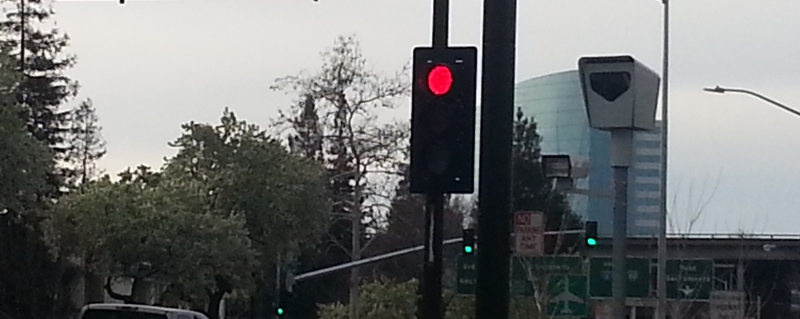
photo of red light camera, from City of Sacramento
red light camera, from City of Sacramento

how do we get more red light cameras?

I live close to Fremont Park in Sacramento’s central city. I walk through the park every day I’m in town, often multiple times. That means I’m crossing through the bounding intersections of P Street & 15th Street, Q Street & 15th Street, Q Street & 16th Street, and P Street and 16th Street, multiple times a day. I also spend a lot of time at Naked Lounge on the southeast corner of Q Street and 15th Street, and some time at Karma Brew on the northwest corner of P Street and 16th Street. That gives me a front row seat to watching the behavior of drivers at these intersections. On nearly every signal cycle, I seem a driver running the red light at each of these intersections. This is not a the exception, it is the rule. By running the red light, I don’t mean entering the intersection on yellow and finishing on red, I mean entering the intersection on red. I mean drivers that are intentionally endangering themselves, other drivers, bicyclists, and walkers. Every signal cycle.

Though I’m an able-bodied and aware walker, Fremont Park is also used by a lot of homeless individuals, families using the playground, people sitting on the benches and reading, people lying on the grass and enjoying the sun (finally) and enjoying the shade (now), people participating in a number of organized recreation activities such as yoga, and of course the festivals such as Chalk It Up. This is a place that should be safe to get to for everyone. It is not currently.

I wrote about a crash at P Street and 15th Street. I’ve written multiple times about red light cameras, pandemic of red light running, red-light-running bullies, and SacCity red light cameras and crashes.

Let me state up front that I am NOT in favor of the enforcement of traffic laws by armed police officers. I have seen first-hand the way in which traffic stops are used to harass and oppress people of color and low income. I have read and seen innumerable accounts of officers murdering the people they stop on pretext. Armed law enforcement is the problem, not the solution. On the other hand, I am strongly in favor of automated enforcement. It is my theory that most serious traffic violations are by a small number of egregious drivers. Automated enforcement can ticket these drivers, which will change the behavior of some of them, but not of many of them who are high income drivers of high end vehicles. It does, however, allow law enforcement to identify repeat offenders and hold them accountable with vehicle confiscation and drivers license suspension.

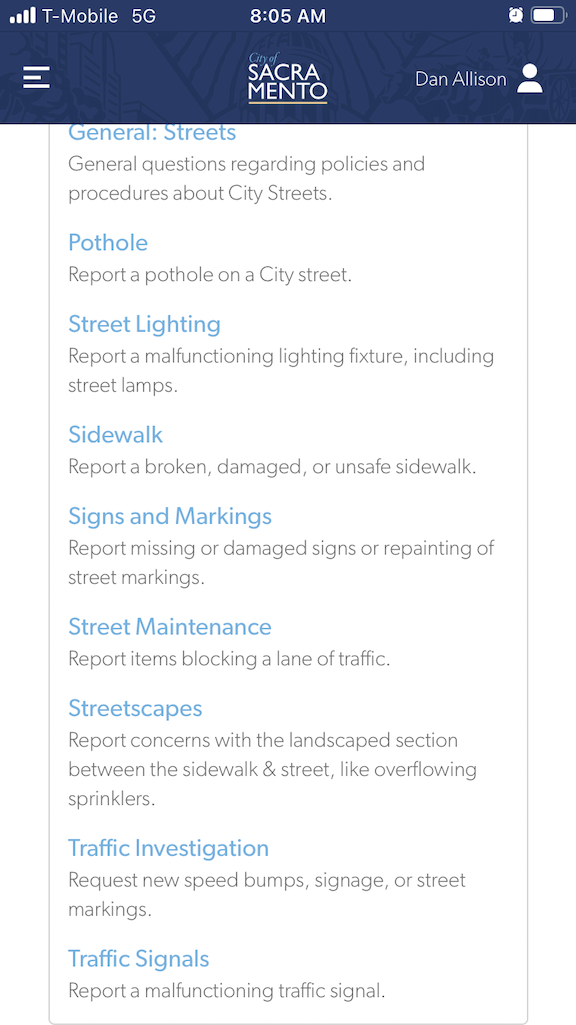
I want there to be red light enforcement cameras installed on at least one of the four intersections at Fremont Park. My observations indicate that the intersection of Q Street and 15th Street is the worst. I looked on the city’s Red Light Running Program page to see if there was a mechanism for submitting requests. No. I looked at the city’s 311 app to see if there was a place to submit a request. Not really. The closest I could find was to select Streets > Traffic Investigation, and then Signals (see screenshots below). I’ll update this when I get a response (though these days most 311 reports get no response at all).

The other way of request that might be effective is to directly contact city council members.

support AB-645 speed camera bill

California Assembly Bill ‘AB-645: Vehicles: speed safety system pilot program‘ is going to be before the Assembly Appropriations Committee shortly. Though it breezed through the Assembly Transportation Committee, it faces challenges in Appropriations. Chair Rendon is rarely a supporter of safe streets, and has killed a lot of street safety bills in his committee, so it is important that the public make it clear how important this bill is.

Walk San Francisco is sponsoring a letter writing campaign to Anthony Rendon and Chris Herndon (as are many other organizations, you can check your favorite walking/bicycling advocacy organizations) at https://walksf.org/2023/05/04/the-speed-safety-camera-bill-ab-645-faces-its-next-hurdle-what-you-can-do-now/.

The bill would establish a pilot program in six cities. The City of Sacramento is not part of the pilot program (I think because the city did not request that it be), but the pilot results will be critical to implementing the program statewide. There are a tremendous number of privacy protections built into the program, far beyond those required for other motor vehicle code violations, but at least it stands to move forward in this legislative session.

Law enforcement has in the past opposed this legislation because it reduces the number of pretextual traffic stops they can make, though these stops often lead to the dead of motorists and even law enforcement officers. They apparently are not opposing this bill, at least not publicly.

Please check it out and support!

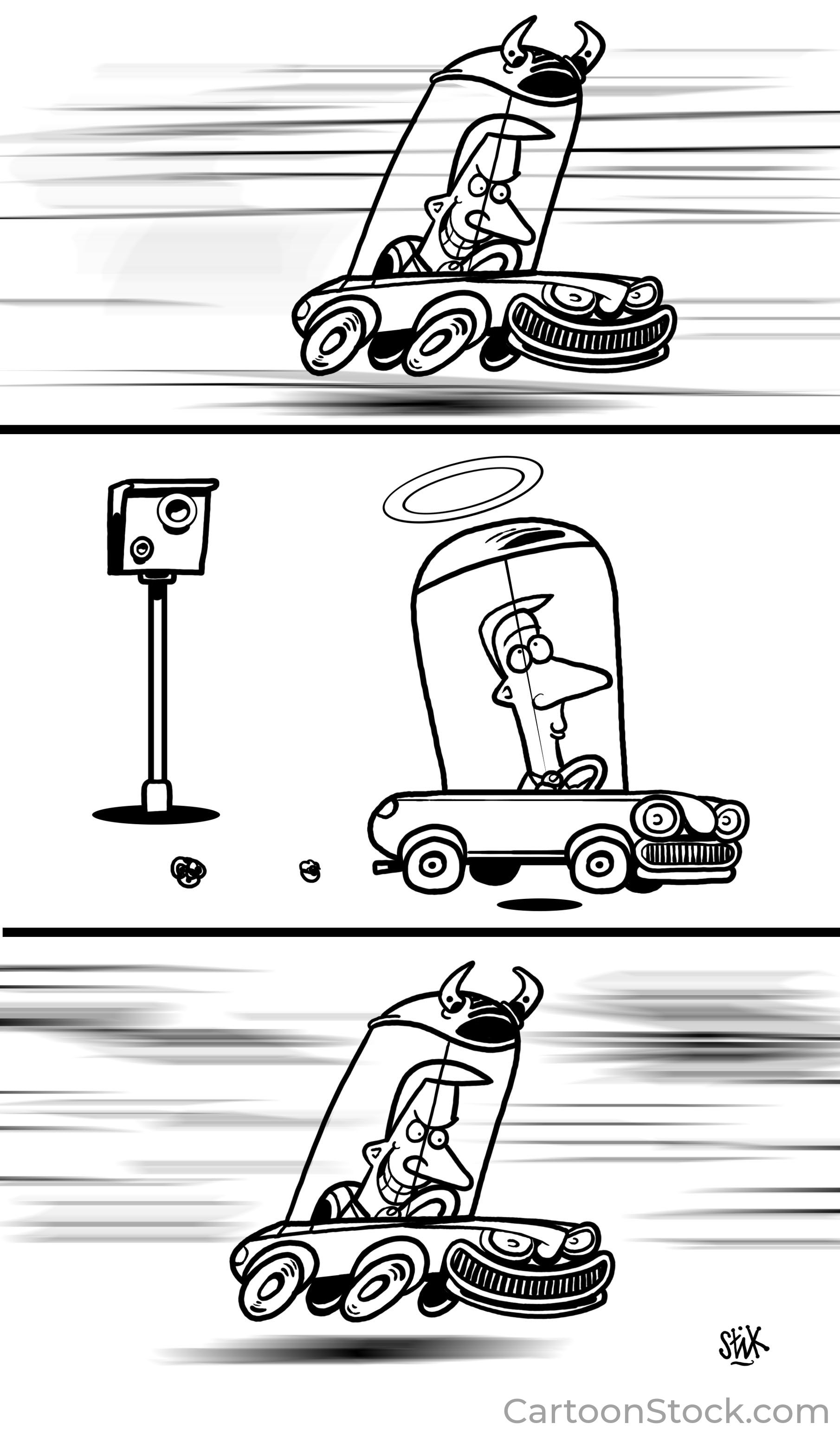
cartoon with speed camera and driver

bicycling on sidewalks

The release yesterday of the report Arrested Mobility: Barriers to Walking, Biking, and E-Scooter Use in Black Communities in the United States demonstrating that tickets for riding on the sidewalk are one of the ways in which laws and law enforcement discriminate against black bicyclists, and Latinx bicyclists as well.

Let me say that I am not in favor of bicyclists on sidewalks, but the conflict between bicyclists and walkers is often exaggerated, and bicyclists are making the best decision they perceive to keep themselves safe from traffic violence. I don’t do it, but I understand why other people do.

So what is the situation in the Sacramento region?

City of Sacramento code 10.76.010 Riding bicycles on sidewalks prohibits bicycling on sidewalks only where signed and where in-street facilities are provided. The code says:

  •  A. No person shall ride a bicycle on a sidewalk where a sign is posted indicating that bicycling is prohibited. The city manager shall designate sidewalks where such signs are posted upon a finding that:
    • 1. The sidewalk abuts a road that is designated a “Low Stress Bikeway” using the criteria for the Facility Selection Guidelines in the City of Sacramento Bicycle Master Plan; and
    • 2. There is either a demonstrated or probable conflict between pedestrians and bicycles. This may be shown by information including, but not limited to: 311 reports, incident data, or estimated high pedestrian activity determined by counts or adjacent land uses and densities.
  • B. Subsection A of this section does not apply to the following persons:
    • 1. City employees acting within the course and scope of employment, including but not limited to:
      • a. Peace officers, as defined in California Penal Code section 830.
      • b. Emergency medical personnel as designated by the fire chief of the city.
      • c. Parking enforcement officers.
    • 2. Children under the age of 18 years old and an accompanying adult.
  • C. Where bicycling on a sidewalk is permitted, the following apply:
    • 1. Bicyclists must yield the right-of-way to pedestrians by slowing down, stopping, or dismounting, as needed.
    • 2. Before passing a pedestrian traveling in the same direction, bicyclists must give the pedestrian an audible warning.
  • D. The city manager or designee shall report to the city council annually regarding the impacts of sections 10.76.010 and 10.76.030. (Ord. 2019-007 § 2; Ord. 2017-0033 § 1; Ord. 2016-0024 § 1; prior code § 25.05.070)

There are some designated bike routes on sidewalks in the City of Sacramento, which were designated before this code came into effect and are still valid. N Street between 8th Street and 15th Street, and the area through the convention center/performance center between 13th Street and 14th Street.


SABA has a summary of sidewalk riding rules, on Sharing the Road page, scroll down to ‘Is it legal to ride on the sidewalk? This page may be out of date.

Note that the County of Sacramento, Elk Grove, and Rancho Cordova code sections are identical, and the Folsom and Galt code sections are identical, examples of mindless copying of code from other locales.

I do not have any information on whether these codes are being enforced in a discriminatory way, but given the almost universal pattern of law enforcement oppression of people of color, I’d not be the least surprised.


On the positive side, AB-825 Vehicles: bicycling on sidewalks (Bryan) has been introduced which would prohibit sidewalk prohibitions except where there are high quality bicycle facilities available on the street,  invalidating all of these code sections except, perhaps, the City of Sacramento. The relevant paragraph is: Notwithstanding paragraph (1), a local authority shall not prohibit the operation of a bicycle on a sidewalk adjacent to a highway or corridor that does not include a Class I, Class II, or Class IV bikeway, as defined in Section 890.4 of the Streets and Highway Code.

I hope readers will support this legislation. The bill passed the Assembly Committee on Transportation on March 20, 2023, and was referred to Assembly Committee on Appropriations, but not yet scheduled. See also Streetsblog CA Traffic Safety Bills Pass First Committee.

If passed, the legislation might well cause cities and counties to accelerate projects to add safe bicycling facilities to streets, in order to reduce sidewalk riding. One can hope.

SacCity red light cameras and crashes

A follow on to red-light-running bullies. I’ve created a map that shows the eleven right light camera (automated enforcement) locations under the City of Sacramento’s Red Light Running Program. The city has 907 signalized intersections. These locations are (listed alphabetically by the intersection entry in the Traffic Signals GIS layer):

  • 16th Street & W Street X
  • 21st Street  & Broadway X
  • 5th Street & I Street X
  • Alhambra Boulevard & J Street
  • Arden Way & Challenge Way X
  • Arden & Exposition Boulevard & Ethan Way X
  • El Camino Avenue & Evergreen Street X
  • Fair Oaks Boulevard & Howe Avenue X
  • Folsom Boulevard & Howe Avenue/Power Inn Road X
  • Mack Road & Center Parkway X
  • Mack Road & La Mancha Way/Valley Hi Drive X

The map (pdf) shows each location, with the red signal icon, and a heat map of the crash severity for crashes occurring at intersections. Yellow means high collision severity, with severity being a weighting of the individual types [1 – Fatal; 2 – Injury (Severe); 3 – Injury (Other Visible); 4 – Injury (Complaint of Pain)]. But it does show the pattern, and you can clearly see the intersections along arterial roadways, where most crashes occur. The crashes are not necessarily red light running crashes. There is a PCF Violation category (VIOLCAT) 12 – Traffic Signals and Signs, and another Intersection (INTERSECT_), but that would not distinguish red light running from stop sign running. It might take looking at individual incident reports, but that is beyond my capacity.

There are certainly high crash severity locations in the city that are beyond the map coverage area, and there are plenty of locations without cameras.

It would be interesting to know if these red light camera locations have a lower rate of red light running crashes that comparable intersections without cameras, but that will require quite a bit more thinking an analysis.

Read More »