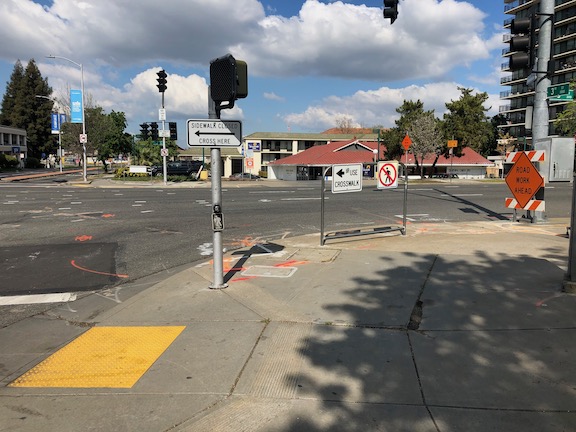
Since there will likely be a long string of posts on construction zones done wrong, I want to point out that they can be done right. This is one from yesterday. Though the crosswalk closure here was less than one day, it was signed properly, and the detour was very short, about 30 feet west to the next crosswalk.
N Street at 12th, clear construction zone signingN Street at 12th, clear detour signing
Construction projects all over the city of Sacramento continue to bias motor vehicle travel over walkers and bicyclists. This has been going on for a long time, and it has not gotten any better. A few construction projects handle it appropriately, most do not.
One issue that I ran into yesterday is particularly galling because of the long detour it takes to bypass the construction site at the corner of J Street and 4th Street, at the California Fruit Building (not sure if it will have the same name after reconstruction). From the southeast corner of J Street & 3rd Street to the southeast corner of J Street & 4th Street is 380 feet, along a sidewalk which has been closed by construction. The detour is 785 feet, but the important issue is not the distance but the time. The detour requires pressing five beg buttons and using five crosswalks, a walk of 7.25 minutes, most of that time waiting for the pedestrian signal to change. A direct route would be just over a minute.
J Street south side, eastbound past 3rd
This map (Google) shows the detour.
What are the alternatives? One is that a travel lane could be removed from J Street. Both a pedestrian walkway and a bicycle lane could be temporarily installed in this section past the construction. Another is to install a crosswalk on the east leg of the J Street & 3rd Street intersection. Pedestrian crossing is currently prohibited (by signing and guard rail) at this location, but the prohibition is solely for the flow of motor vehicle traffic and the convenience of drivers, it has nothing to do with pedestrian safety. The crosswalk need not be temporary, it could be a permanent installation. Of course this crosswalk would require two crossings, but two is better than five.
Short of these two real fixes, the signing could be better. In the photo below, there is an unobvious sign indicating a detour to the west, but it doesn’t say which sidewalk. I did not understand what it meant until I had walked down to the construction fence. On the sidewalk that is closed, there is no indication until reaching the construction fence that the sidewalk is closed. There should be some indication of how long, or how many crossings, for the detour. A person might decide to turn around and head south to L Street, or to the access points to K Street, if they had more information. This photo also shows the pedestrian prohibition established for traffic flow rather than pedestrians safety.
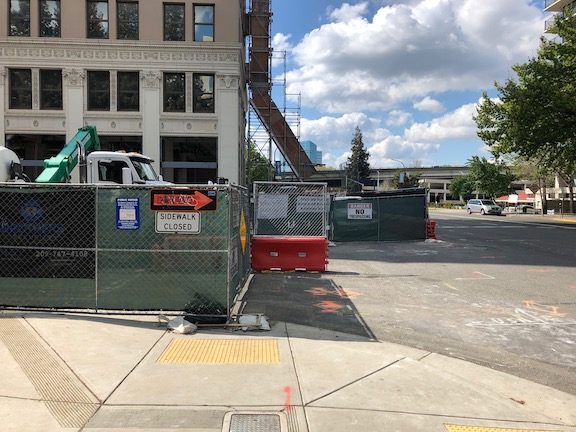
In the westbound direction, there is even less information. The sign says sidewalk closed, and there is a vandalised construction arrow, which might or might not indicate the detour route.
J Street south side, westbound at 4th
I don’t blame most of this type of issue on the construction companies. The construction company has to get a permit from the city, which includes a traffic plan. The city is accepting, and in some cases encouraging, traffic plans with no, or insufficient, accommodation for pedestrians and bicyclists, and insufficient signing. Of course the construction company wishes to minimize the work and the signing, but it should be the city’s responsibility to ensure good traffic plans. It rarely does. I will remind readers again that the city employee who supervises this permitting process said that pedestrians and bicyclists would be accommodated if it did not interfere with traffic flow.
Since I have time on my hands, I’ve been walking a lot more in downtown/midtown, with social distancing of course, so I hope to add additional posts on this topic.
Sacramento City continues its practice of approving construction projects that do not consider the needs of walkers and bicyclists. Here is the latest I ran across, on Folsom Blvd between Santa Ynez Way and 39th St. The construction on the south side appears to be installing cable or fiber. At the west end, there is a sudden ‘sidewalk closed’ sign. There is no prior warning, there is no ramp or marked crosswalk for crossing Folsom to the north side (it requires crossing an offset intersection diagonally to go from one ramp to another, an exceptionally long distance), and there is no indication about how long the detour is.
At the other end, there is the same sort of signing without any prior warning or information provided.
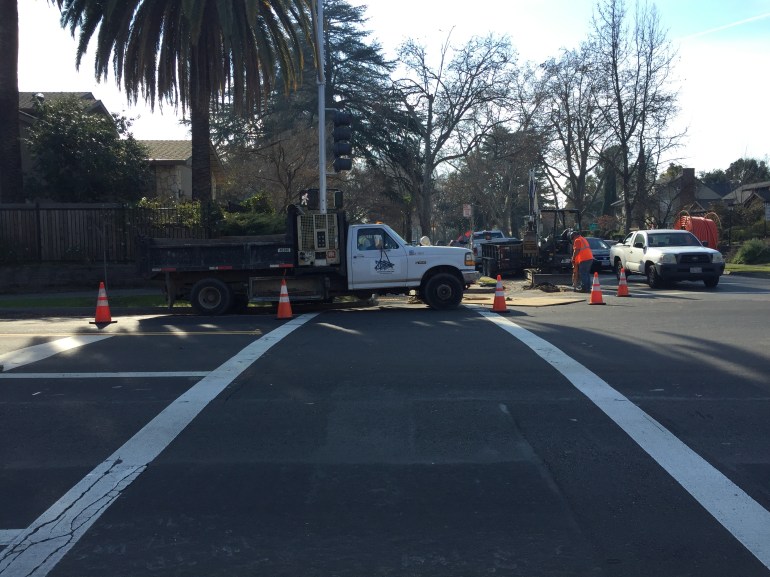
At this location, 39th St, there is a marked crosswalk with traffic signal which could allow people to cross Folsom, but just to make sure the message that pedestrians are unwelcome here is clearly received, a construction truck was parked across the crosswalk. When I asked the construction crew to move the truck, they refused. I reported it to parking enforcement but am not sure of the outcome.
Of course there is a bicycle lane along this section of Folsom Blvd, which is also blocked by the construction. That may be justifiable, but you would think that forcing bicyclists to share the general purpose traffic lane would justify a reduction of the speed limit from 35 mph to 25 mph, but no, that that would inconvenience drivers and in the city, that is not to be considered.
This kind of bias against walkers and bicyclists should be unacceptable in the city. And it would be if the staff of Construction Services were not biased against walkers and bicyclists. Time to replace that staff with people who care about all modes of travel.
Sacramento central city is booming with construction, which I consider to be a wonderful thing. Mixed use buildings, single lot apartments andhomes, state office buildings. But the construction is having a serious impact on walkability, and often bikeability. (Note: this post is not about road construction or about temporary closures, which also need to be addressed, but not today.)
Two examples, both of state developments, but with principles applicable to private developments, will illustrate the issues. For the new California Natural Resources Agency building between O and P, and 8th and 7th, the sidewalk, parking and one travel lane on the south side (P St) were removed from service. These are not being used in any way for the project. Perhaps they will be eventually, but in the meanwhile, presumably for the entire life of the construction project, they are just sitting empty and unused. For the new O Street office building at O and 12th, the sidewalk and parking were removed from the east side of 12th between the N-O alley and the O-P alley. The section to the north, where the building is being constructed, needs closure, as the underground level is being dug and the sidewalk will be replaced. But on the section to the south, which is being used for storing construction materials, do not need to be closed. There is plenty of space on this former parking lot.
12th Street construction closure
For some of the private construction going on, of which there are many examples, some closures are no doubt necessary. But the closures seem to be occurring from the very first day of construction to the very last day of construction, even though it is needed for only part of the time.
Construction companies are doing this because they can, out of convenience or laziness. And the city is allowing them to. Each construction project requires a traffic control plan, and the permit specifies allowable areas and time frames.
When I questioned the closure on the southern section of 12th Street, Matt from Construction Services in Public Works argued that since parking was removed, it was only fair that the sidewalk access be removed. His thinking was that fairness required making everyone lose something, and that the loss of parking was equivalent to the loss of sidewalk access.
This of course is a ridiculous argument. Parking is in no way equivalent to access. And priority must be given on all roadways to the most vulnerable users, which are in order of importance, pedestrians, bicyclists, and motor vehicle drivers.
At the recent Sacramento Active Transportation Commission meeting, Jennifer said that she though there might be guidance on access restrictions, but wasn’t sure, and would look into it.
In the meanwhile, let me propose:
For any roadway with more than one lane in a direction, space will be taken from a general purpose travel lane:
If a sidewalk or informal walking path is present, pedestrian access will be preserved by the creation of a temporary sidewalk protected by delineators or barriers.
If a bike lane or separated bikeway is present, access will be preserved by the creation of a temporary bike lane protected by delineators or barriers.
For any roadway with a single lane in a direction, space will be taken by closing the general purpose lane in one direction, with appropriate detours for motor vehicles:
If a sidewalk or informal walking path is present, pedestrian access will be preserved by the creation of a temporary sidewalk protected by delineators or barriers.
If a bike lane or separated bikeway is present, access will be preserved by the creation of a temporary bike lane protected by delineators or barriers.





 Getting Around Sacramento