SacCity LPI background

Previous posts on Leading Pedestrian Interval (LPI), in the City of Sacramento and more generally, at available at tag: LPI.

The Strong SacTown Street Design Standards Working Group has a team working on Leading Pedestrian Intervals (LPI) at traffic signals. If LPI grabs your interest, I encourage you to join the working group. Meetings are posted on Luma, a calendaring application. Go to Luma (app or website: https://luma.com/strongsactown). The next working group group meeting is not listed there yet, but it is normally on the third Sunday of the month at 1:00 PM. Meetings are open to the public; one need not be a member of Strong SacTown or Strong Towns to join in (though you should be!).

The City of Sacramento has a Traffic Signal Operations and Standards page. The prose is garbled, to say the least. The linked documents have nothing to do with operations. It does not include a Traffic Signal Operations Manual (TSOM). Though the plan is supposed to be updated, it is not clear if it even exists.

Streets for People Active Transportation Plan (2025-08, page 105): “An evaluation of best practice to establish guidelines for leading pedestrian intervals (LPIs) at signalized intersections is currently (2025) underway and will be included in the updated City of Sacramento Traffic Signal Operations Manual (TSOM). The TSOM and the guidelines for LPIs will be presented to the Active Transportation and Disability Advisory Commissions to allow for public discussion of the proposed standard practices.”


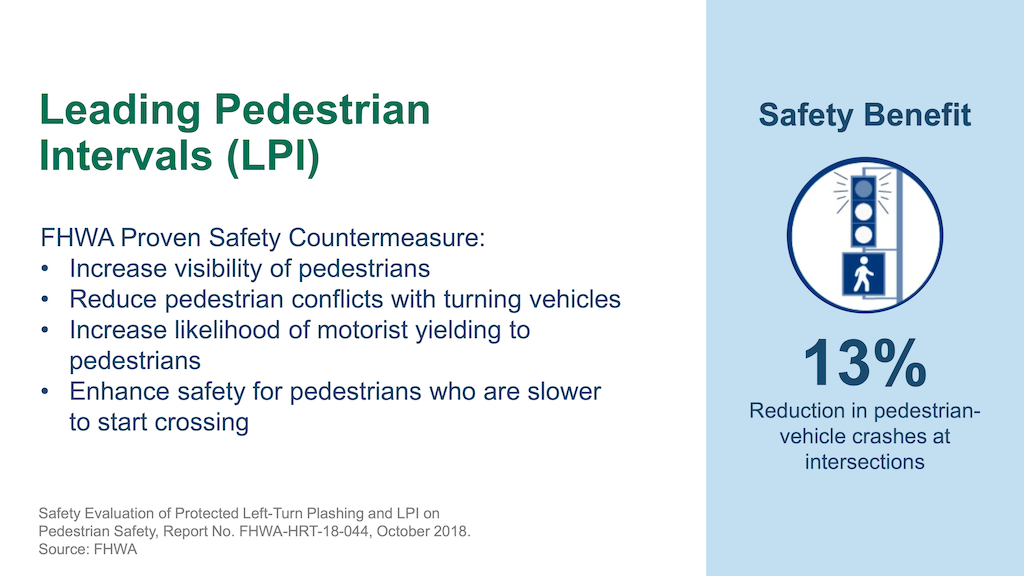
Vision Zero Action Plan Update Safety Improvement Strategies presentation includes the following graphic:

graphic for Leading Pedestrian Interval (LPI)
SacCity Vision Zero Action Plan Update, Safety Improvement Strategies, presentation, page 48

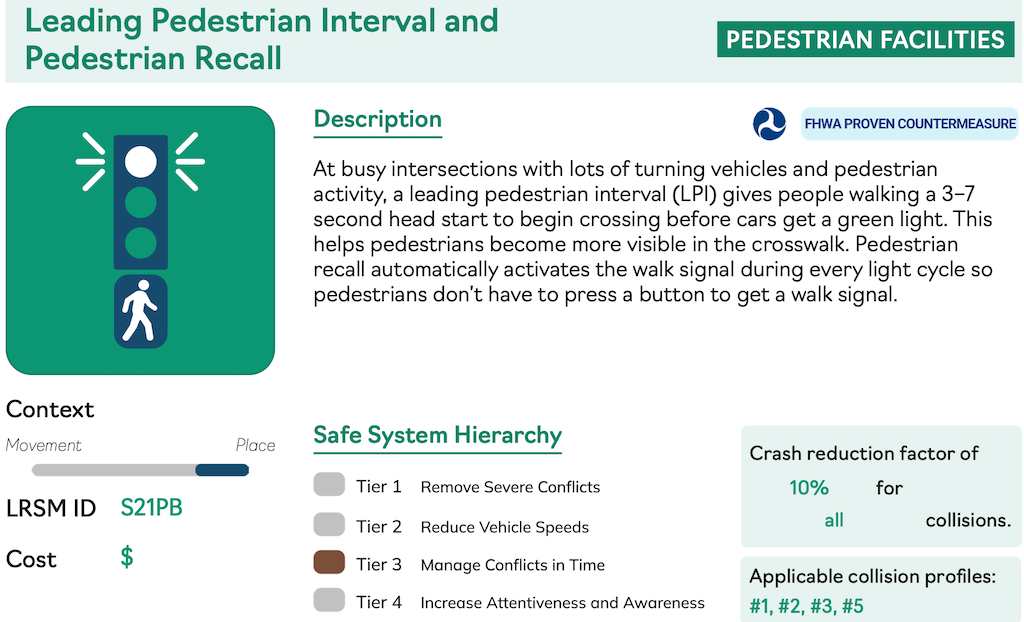
The Vision Zero Action Plan Update Top Collision Profiles and Countermeasures memo includes the following graphic, which has more detail. It is identified as Tier 3, Engineering Countermeasures, Managing conflicts in time.

SacCity Vision Zero Action Plan Update, Top Collision Profiles and Countermeasures, memo, Leading Pedestrian Interval (LPI), page 44

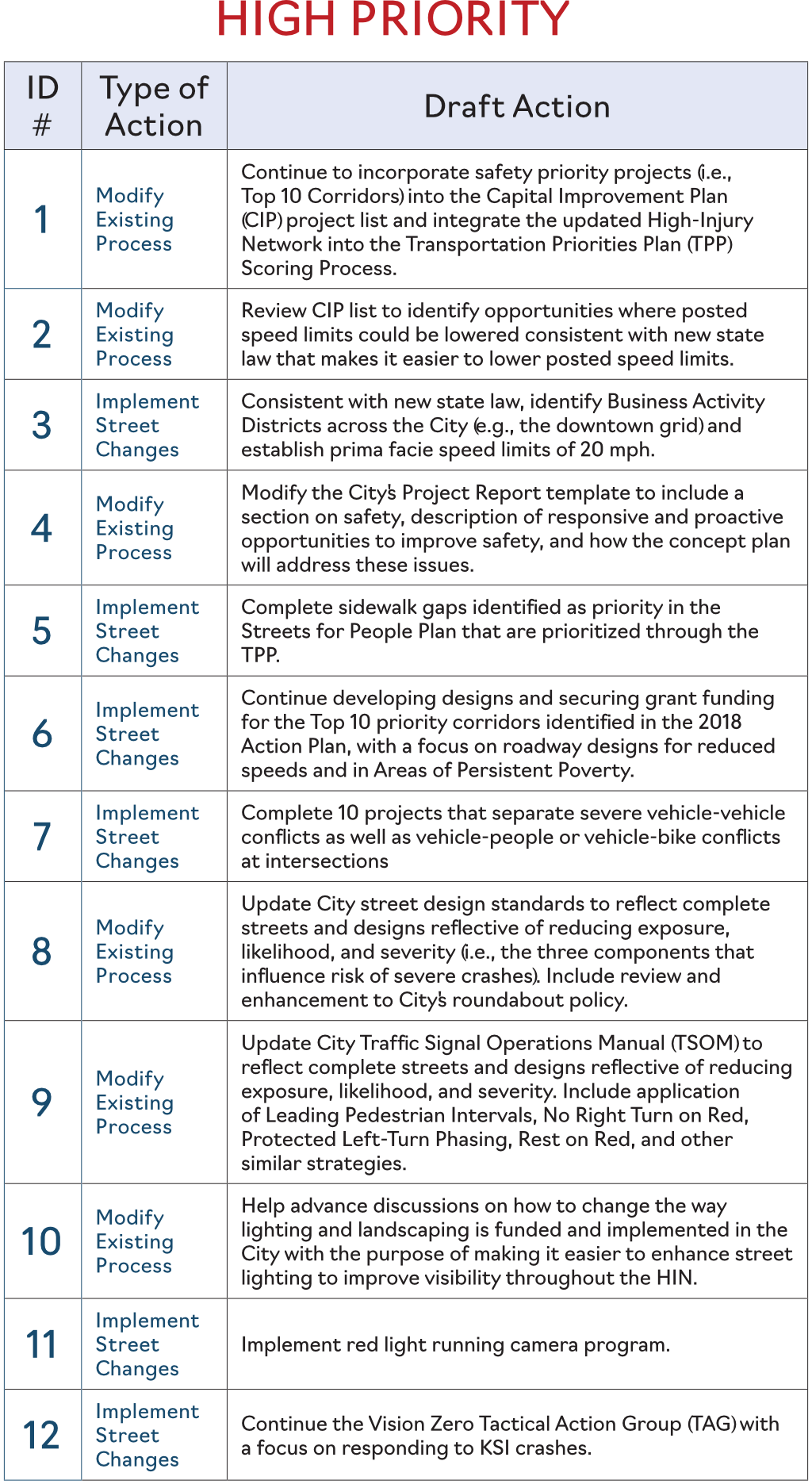
The Vision Zero Action Plan Update draft recommendations includes #9: “Update City Traffic Signal Operations Manual (TSOM) to reflect complete streets and designs reflective of reducing exposure, likelihood, and severity. Include application of Leading Pedestrian Intervals, No Right Turn on Red, Protected Left-Turn Phasing, Rest on Red, and other similar strategies.” Items 19 and 26 might also include LPIs, though they are not called out there.

SacCity Vision Zero Action Plan update: draft recommendations

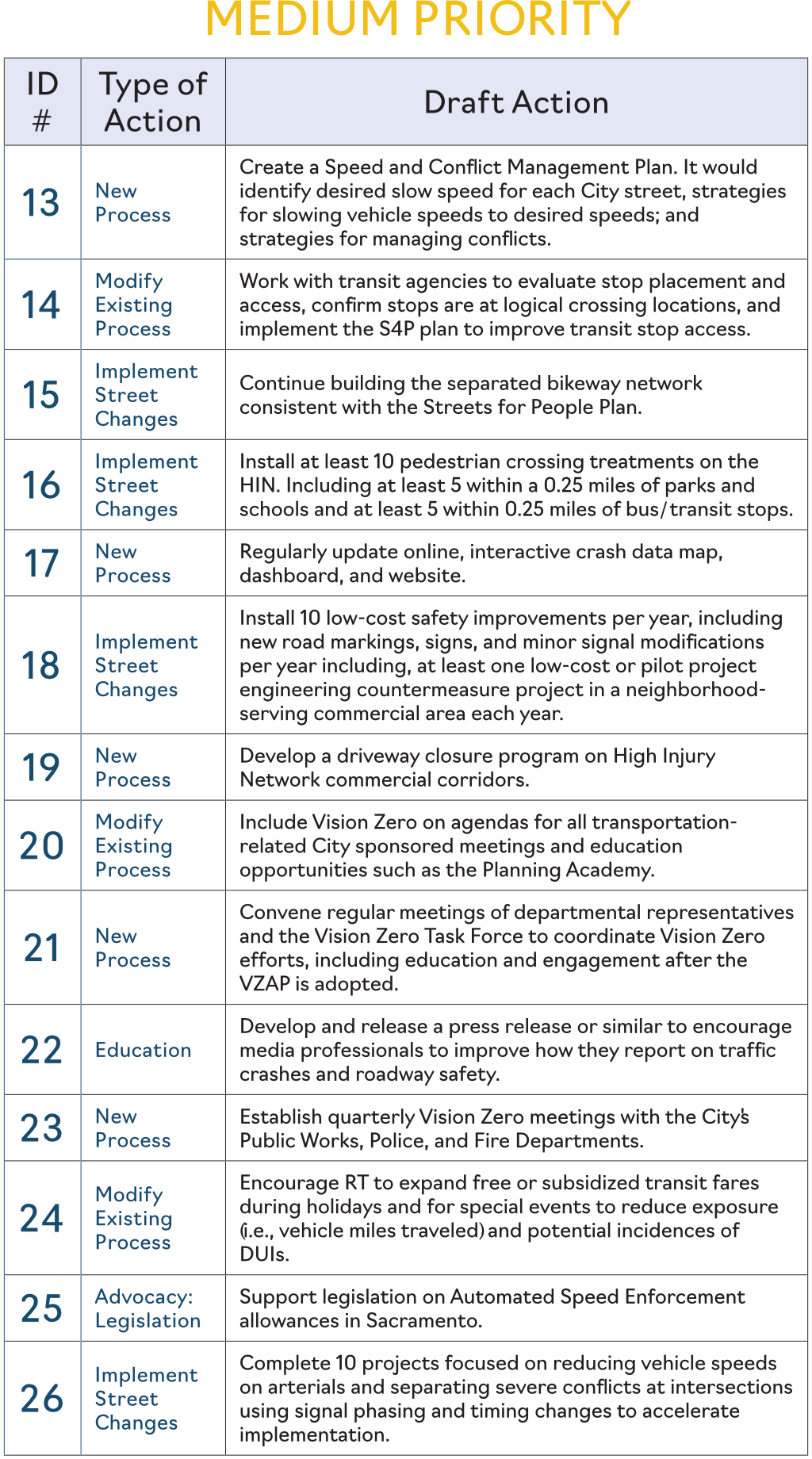
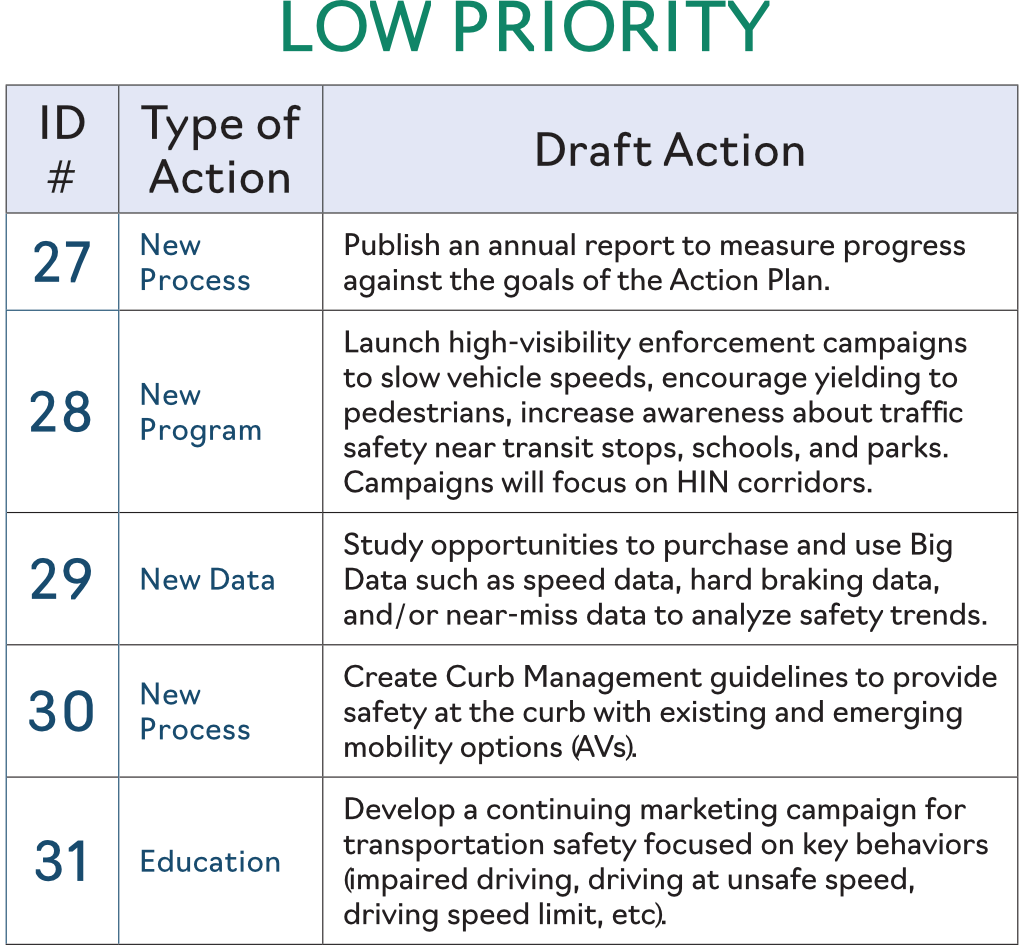
The recent City of Sacramento meetings on the Vision Zero Action Plan update, both virtual and in-person, included slides with draft recommendations for the Action Plan. This same information is also available as a chart (pdf). The three categories, high priority, medium priority, and low priority, are presented below.

Each of these items deserves discussion, and possible movement from one category to another. The one item that I would add to the high priority list, consistent with item 11, is ‘implement speed camera program’ when authorized by state law. I feel strongly, and hopefully, that the state will include Sacramento in the pilot program, and will authorize a permanent program within the span of the Action Plan.

chart of High Priority draft recommendations for Vision Zero Action Plan

chart of Medium Priority draft recommendations for Vision Zero Action Plan

chart of Low Priority draft recommendations for Vision Zero Action Plan

SacCity Vision Zero funding

The approach of the previous Vision Zero Action Plan (2018, with minor update 2023) was to seek grants from federal, state and regional (SACOG) sources to implement complete streets projects on corridors. For some corridors, grants were received and implemented, or are in progress. For other corridors, the grants were not received and nothing has occurred. As presented in previous posts (category: Vision Zero), I believe this approach is why Vision Zero has failed in the city. We have far too many dangerous roadways to ever fix, with grants or without. We must use other methods, though continuing to implement major projects, so long at they don’t take away a focus on what can be done now, and best use of staff time (it takes hundreds of hours of staff time to write and submit a grant application).

Instead, the city must fund Vision Zero directly. A good start would be an allocation of $20,000,000 in the 2026-2027 budget. That amount would be increased every budget cycle until there is a documented downward trend in fatalities and serious injuries of at least 10% per year.

Where would the money come from, in this time of budget deficits? Let me be blunt. Out of the police department budget.

The police department received $256,280,944 in the 2025-2026 budget, including $9,156,810 from Measure U, which should have been spent on other priorities. This is more than the entire Public Works budget of $237,586,768, which includes everything the city does to maintain and enhance the transportation network, including efforts to improve the safety of our roadways. Fatalities related to violent crime, and fatalities related to traffic violence, are about on parity in the city, competing for the top spot, with traffic violence usually coming out on top. We should be investing just as much to reduce and prevent traffic violence fatalities as we do to respond to – not prevent – violent crime. Is a life claimed by mis-designed and unsafe roadways, particularly of vulnerable users, walkers and bicyclists, of less value than a life claimed by violent crime? I don’t think so, but our existing budget priorities say yes.

A shift of $20,000,000 from the police budget to Public Works, specifically allocated to Vision Zero, would be a minor reduction of the police budget but a major step towards reducing traffic violence and fatalities.

City Council has consistently increased the police department budget while reducing the budget of other departments. That seems to be the politically expedient thing to do, but it is not the courageous action necessary to address our real problems in the city.

From the 2025-2026 budget: “The Public Works Department is dedicated to maintaining safer streets, sustainable infrastructure, and innovative mobility solutions. Over the past year, we have implemented tens of millions of dollars in transportation improvements, expanded electric vehicle charging and transit access, enhanced traffic safety, and completed critical road and facility upgrades. Additionally, the department has strengthened parking management through expanded permit programs and automated enforcement, while continuing to improve operations at the Sacramento Marina to better serve the boating community.”

SacCity Vision Zero priorities: 80% quick-build

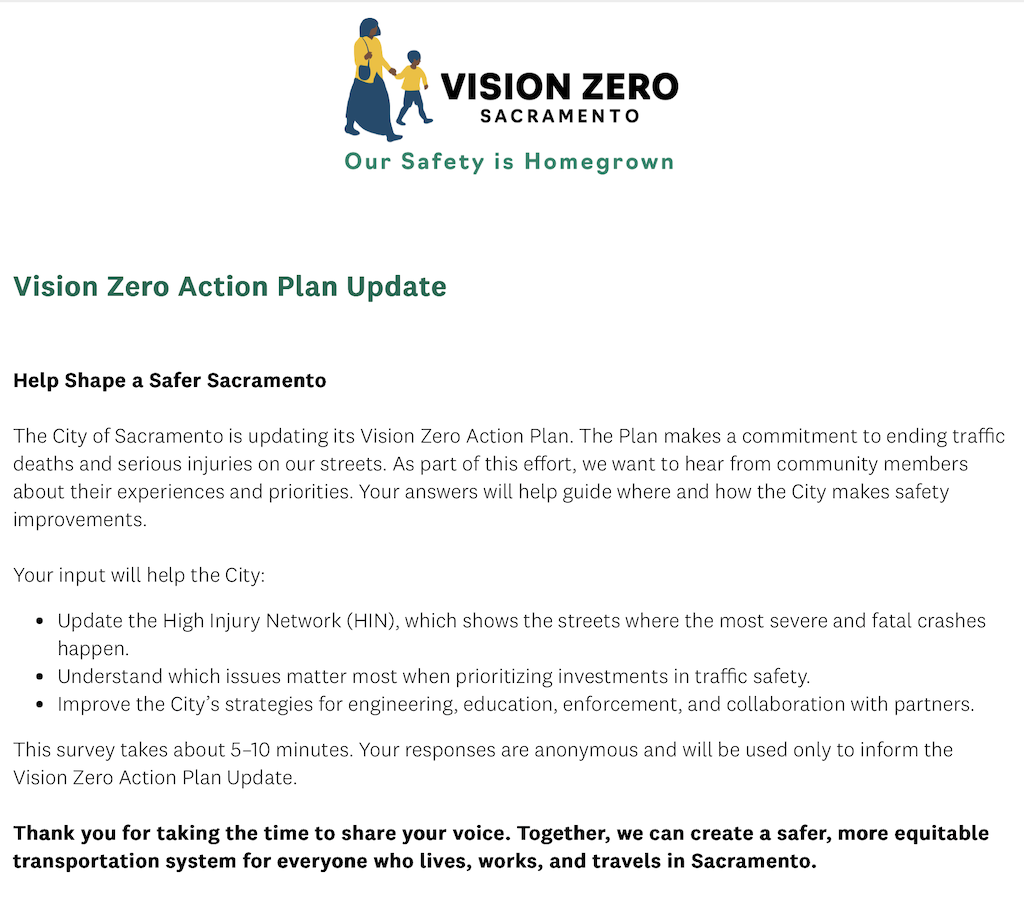
The City of Sacramento is updating its Vision Zero Action Plan. Both the in-person and online meetings have passed, but the survey is still open through Sunday, February 22. See SacCity Vision Zero Update for my comments on the survey, as well as other posts on vision zero (category: Vision Zero).

I believe that the most effective short term approach for reducing fatalities is quick-build projects at locations which have seen fatalities, or are likely to have fatalities based on poor roadway design and driver behavior. The city has implemented a quick build program, with a transportation safety team and some funding. Still no webpage that I have been able to find.

This is not to say that other elements should not be included in the action plan, but I believe that 80% of the funding, and 80% of staff time, should be devoted to quick-build.

What should not be included is education and in-person law enforcement. However, given that we have an epidemic of fatality-inducing red light running and failure to yield to people in crosswalks in the city (and the county, and the region, and the state), a limited period of in-person enforcement of these violations, with strict guardrails to prevent pretextual stops and law enforcement bias, may be appropriate. Research has proven that education is ineffective, though a favorite of people who don’t really want to solve problems.

I am not sure what the other elements of the action plan should be. Therefore, I’d want to see a commitment to minor updates to the plan on a frequency of about every two years, to reflect lessons learned and evolving legislation about what cities are permitted or required to do to reduce fatalities and address traffic violence.

traffic diverters for the best traffic calming

The City of Sacramento is updating its Vision Zero Action Plan. I believe that the focus of the plan should be quick-build fixes to locations where fatalities have occurred or are likely to occur. These locations are primarily intersections of arterial streets. Local streets, and to some degree collector streets, if they were not designed for more traffic and higher speeds, are mostly not the location of crashes, and even less likely fatalities because motor vehicle speeds are lower. Arterials are the problem to be solved.

That said, I want to speak up again for an infrastructure fix that has the greatest potential for reducing motor vehicle traffic. Traffic diverters would usually be on local streets, sometimes on collector streets. As such, they don’t prevent serious crashes. But they do discourage driving, and so would indirectly reduce crashes on arterials, as there would be fewer motor vehicles on all roadways. Anything that can be done to reduce the number of, and length of, car trips, will reduce fatalities.

I’ve written about traffic diverters (which are technically called modal filters, but are commonly referred to as traffic diverters) before: Strong SacTown Street Design: Modal Filters, Streets for People traffic calming, walking policies for SacCity, and many other mentions in posts.

The diagram below is the the City of Sacramento Neighborhood Connections Plan, which includes the first photo. Though permanent traffic diverters, with concrete curbs and planting, are the desired state, quick-build temporary diverters have most of the safety and traffic calming effect at a fraction of the cost. Constraints: Since quick-build placement can be easily removed if they don’t work, a traffic study is NOT required. Emergency vehicles can easily and safely go around the diverter. Cost: The cost shown is for a permanent installation. A quick-build installation could probably be installed for $1000-2000.

diagram of Traffic Diverter from City of Sacramento Neighborhood Connections
Traffic Diverter diagram from City of Sacramento Neighborhood Connections

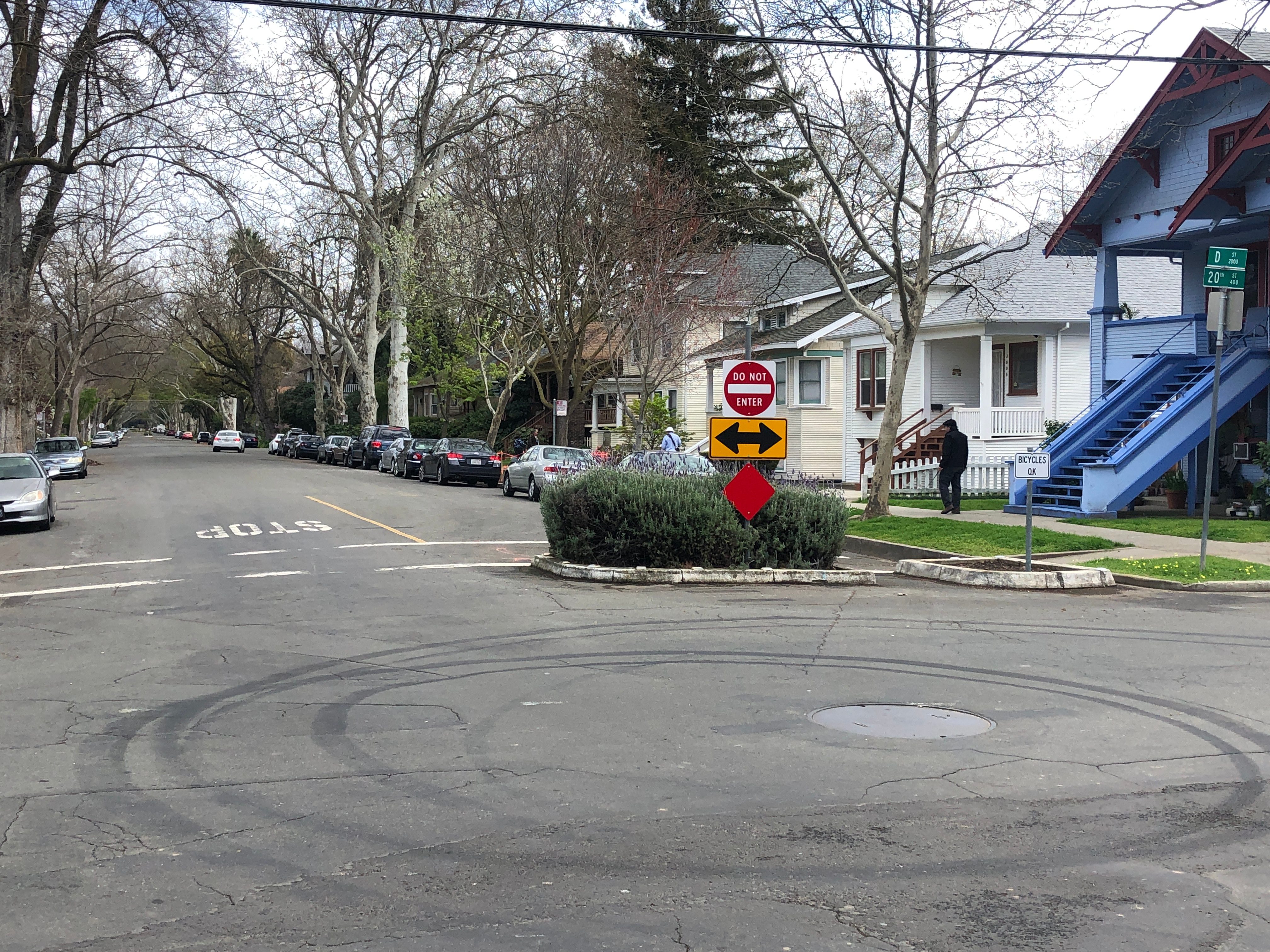
The second photo is of a traffic diverter in the northeast section of the central city, on D Street at 20th Street. The diverter allows bicyclists to pass through, which is why it is also called a modal filter. Note that it doesn’t prevent reckless driver behavior in the intersection (donuts), but it does filter reckless drivers out of D Street.

photo of SacCity traffic diverter on D St at 20th St
traffic diverter, D St at 20th St

SacCity VZAP update: stacked bar charts hide information

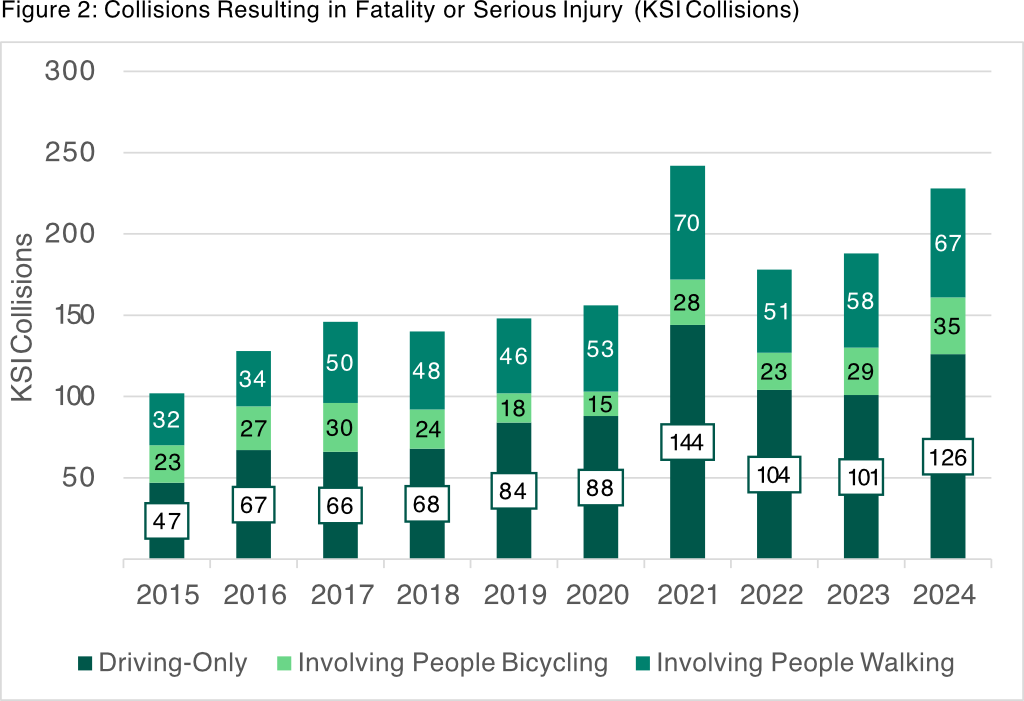
One of the City of Sacramento Vision Zero Action Plan Update documents, Collision Landscape Summary and Collision Profiles, on page 4, uses a stacked bar chart to graph ‘Driving-only’, ‘Involving People Bicycling’, and ‘Involving People Walking’ data. The chart obscures rather than illuminates the data. The chart from the document is below. It shows the overall trends for KSI (killed or serioiusly injured). Useful, but hides trends for each category. Though dozens of charts follow in the document, not a single one breaks out the basic data by category alone.

Below is a graphic with the data, and each category separated out. This is what should have been in the report. This is not in particular a criticism of this report or the report authors, but of the use of stacked bar charts in general. See Stacked Bars Are the Worst and many other posts on the weakness of stacked bar charts.

I think the charts below are actually useful to understanding collision trends.

SacCity vision zero action plan update survey

It is apparent that the City of Sacramento’s Vision Zero Action Plan has overall been a failure. Traffic fatalities in the city have increased, and Sacramento remains among the most unsafe cities in the state. I have written recently about the action plan update process (SacCity Vision Zero Update) and longer ago all the way back to the inception of the program (category: Vision Zero).

I believe that the failure is in large part due to the focus on improving corridors rather than specific points of concern which are mostly intersections, and a reliance on getting grants from federal, state or regional (SACOG) sources to accomplish these projects. The assumption was, and is for all transportation projects, that outside grants rather than the city’s general budget, will be the source for transportation infrastructure. The city spends very little of its own budget on transportation, beyond some basic maintenance and required grant matches. The recent quick-build program is the first time significant money has been dedicated to traffic calming and safety.

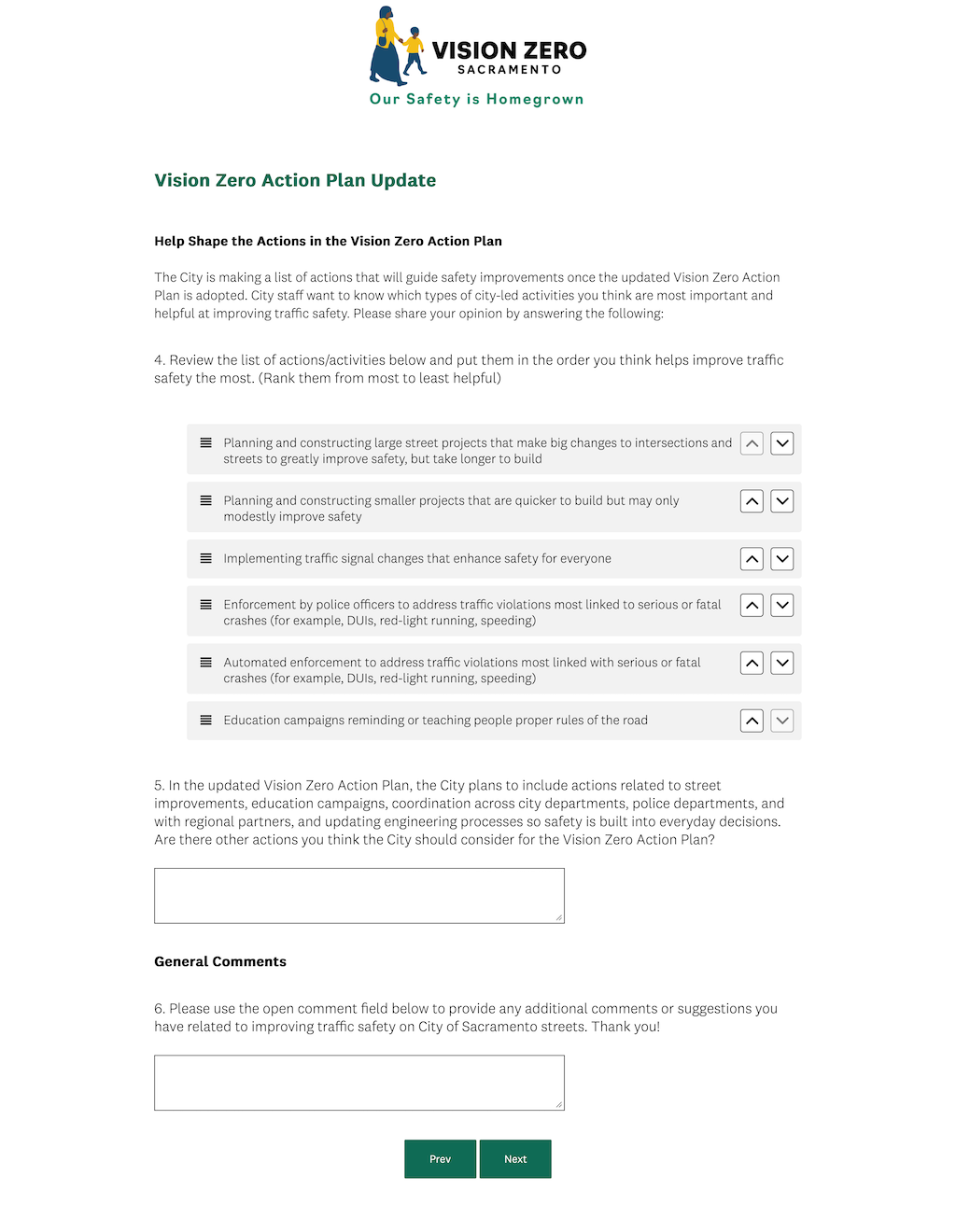
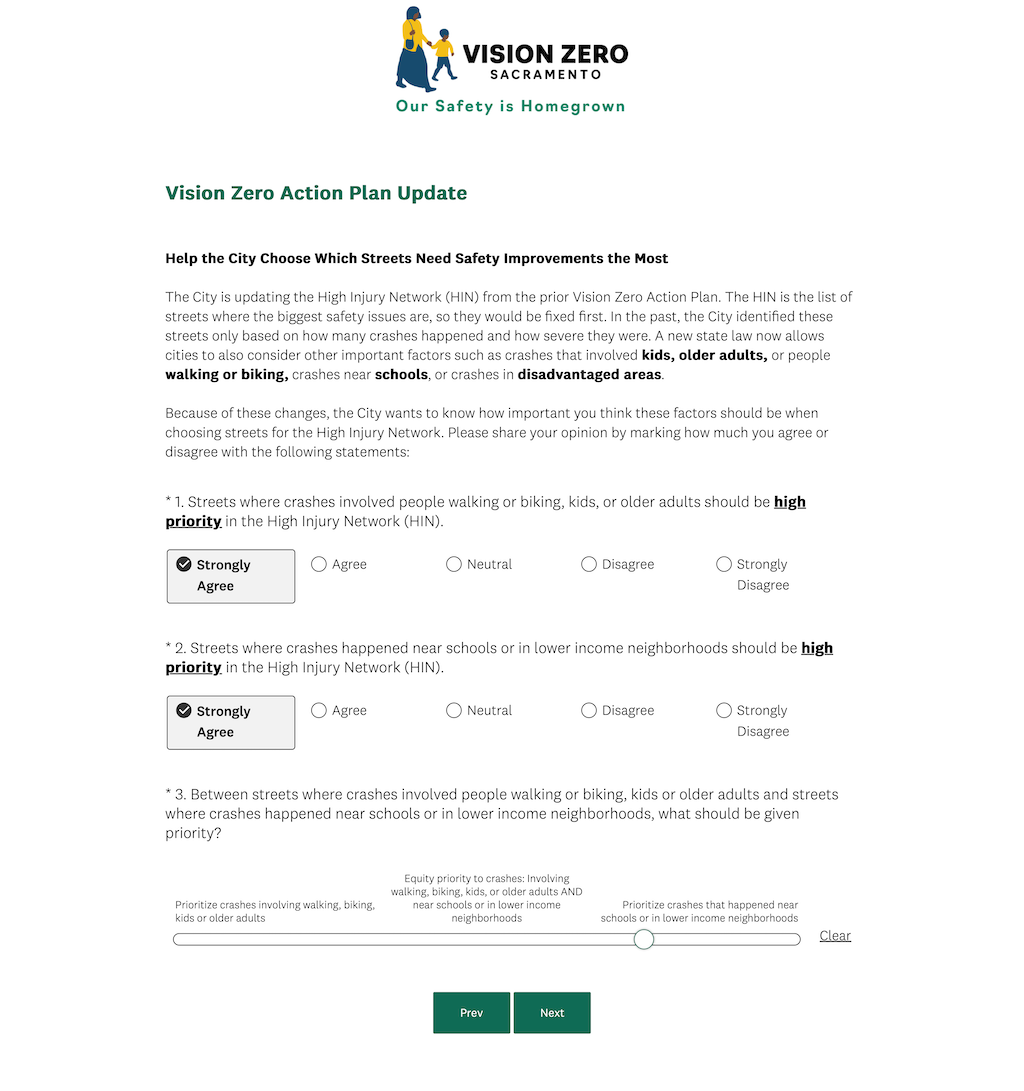
The city is offering a survey to gather community input on the action plan update, open through February 22. I just took the survey, and some screen captures are below, but I want to focus on the third page (the others are below). The top of this page offers a chance to rearrange actions in order of importance. Since these are screen captures, the six items in text are:

  • Planning and constructing large street projects that make big changes to intersections and streets to greatly improve safety, but take longer to build
  • Planning and constructing smaller projects that are quicker to build but may only modestly improve safety
  • Implementing traffic signal changes that enhance safety for everyone
  • Enforcement by police officers to address traffic violations most linked to serious or fatal crashes (for example, DUIs, red-light running, speeding)
  • Automated enforcement to address traffic violations most linked with serious or fatal crashes (for example, DUIs, red-light running, speeding)
  • Education campaigns reminding or teaching people proper rules of the road

My ranking of these is:

  1. Planning and constructing smaller projects that are quicker to build but may only modestly improve safety
  2. Automated enforcement to address traffic violations most linked with serious or fatal crashes (for example, DUIs, red-light running, speeding)
  3. Implementing traffic signal changes that enhance safety for everyone
  4. Education campaigns reminding or teaching people proper rules of the road
  5. Enforcement by police officers to address traffic violations most linked to serious or fatal crashes (for example, DUIs, red-light running, speeding)
  6. Planning and constructing large street projects that make big changes to intersections and streets to greatly improve safety, but take longer to build

Why?

  1. These small projects are in line with the city’s new Traffic Safety Initiative (quick-build) program. Though there does not seem to be a webpage for this program yet, an article in City Express summarizes the program. It is still not fully staffed and fully active. This kind of program has proven to be effective in many cities, including ones that have achieved vision zero no fatalities or greatly reduced fatalities.
  2. Automated enforcement is the best solution for speeding and red light running. Red light running is particularly epidemic in Sacramento, though a problem everywhere. There are no widely available methods for automated enforcement of failure to yield to pedestrians (people walking in the crosswalk), but this is something that could be piloted and implemented.
  3. On roadways with frequent traffic signals, traffic can be significantly slowed by setting signal timing to award safe speeds and make unsafe speeds awkward. It can even be set to a ‘green wave’ where the signals are timed to the speed of bicyclists, about 12 mph. This would be higher on my list except that the city has, to this point, demonstrated that they use signal improvements not to improve safety for walkers, but to ease traffic flow. They are claim that the entire intersection must be upgraded, at a cost approaching $1 million per intersection. That is a complete waste of taxpayer dollars.
  4. Education does not work. Of the millions of dollars spent on ‘education’ programs, there are almost no studies indicating that these programs are effective. They are feel good, but worthless.
  5. Law enforcement bias, which in integral to officers and very very slow to change, makes this an unacceptable solution in nearly all cases. In-person enforcement is as likely to result in officer escalation and harm as to preventing unsafe driver behavior. Particularly in the past, but true today, many ‘safety’ enforcements have actually been stings targeting people walking and bicycling rather than driver behavior. There may be situations in which enforcement is the last but only solution, but it should definitely not be part of the program design.
  6. Large projects are what the city has been doing, and it hasn’t worked. The city has a backlog of poorly designed and unsafe arterial roadways that will take decades (or more) and hundreds of millions of dollars (or more) to fix. We can’t wait that long, or until we find the money, to save lives. That is why small projects are the answer. Of course the projects are nice when complete, and the city has done as well as most cities its size in getting grants for these big projects, but we need to save lives tomorrow, not ten years from now. Writing grants for large projects takes an inordinate amount of staff time.

The city seems to be OK with a focus on small short-term projects, and these have been promoted by the city’s consultant (Fehr & Peers). But the public will need to support this approach, particularly against pushback from the cars-first lobby and individuals.

If you have the time and inclination, reviewing the seven documents on the city’s Vision Zero Action Plan Update page will deepen your understanding of the issue and possible solutions. If you have time for only one, the Safety Strategies (2025.06.18) is probably the most valuable.


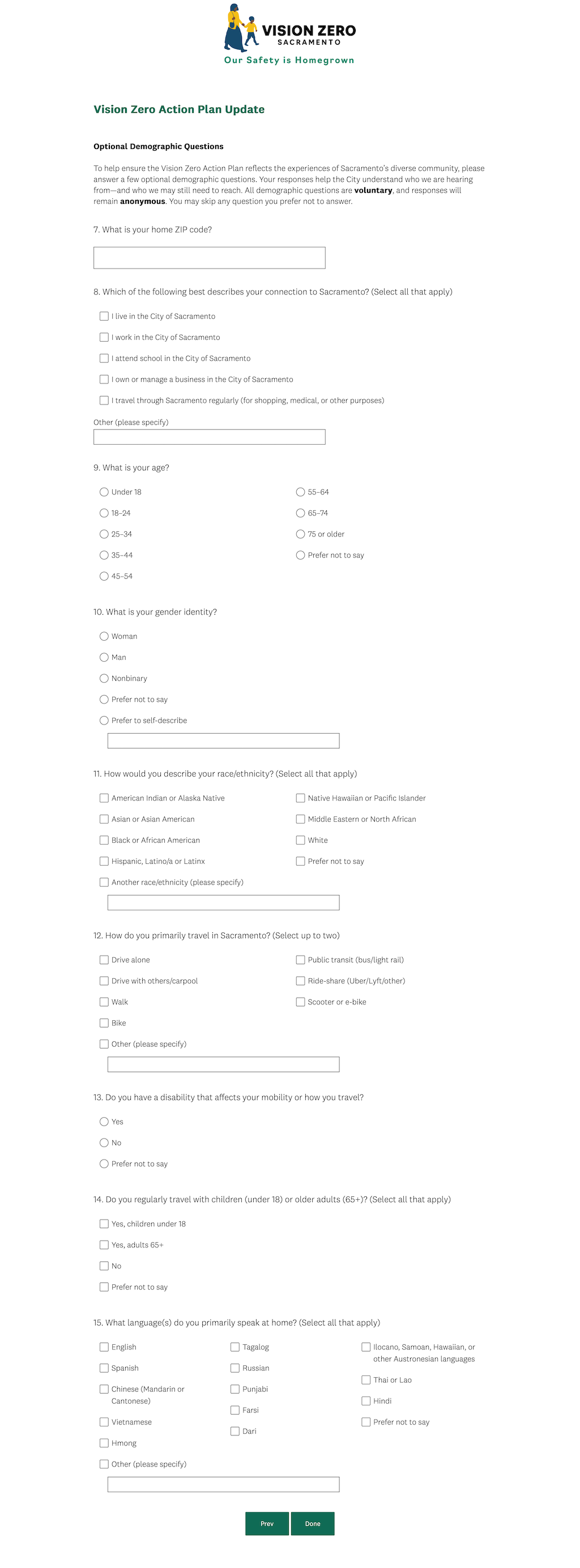
The other pages. Note that I sometimes had started to fill out a page before capturing it.

SacCity Vision Zero Update

There are three opportunities for commenting on the City of Sacramento Vision Zero Action Plan update.

In person: Vision Zero Action Plan Community Workshop Thursday, January 29 at 5:30 pm, Sacramento City College, 3835 Freeport Boulevard registration

Virtual: Vision Zero Action Plan Virtual Workshop, Wednesday, February 4 at 5:30 pm registration

Survey

The city’s Vision Zero webpage for general information, and links for the above.

For prior Getting Around Sacramento posts on Vision Zero, see category: City of Sacramento: Vision Zero, and the more general calegory: Vision Zero.

The city’s Vision Zero effort has failed. We are still the highest traffic fatality city in the state. I believe the reason to be primarily that there were flaws in the original approach to Vision Zerio. Though I’ve written about this before, I will post again, soon.

If you are not already following Slow Down Sacramento, please do. It is the best source of information on safety from traffic violence and the city’s Vision Zero effort.

City of Sacramento Vision Zero Action Plan update graphic

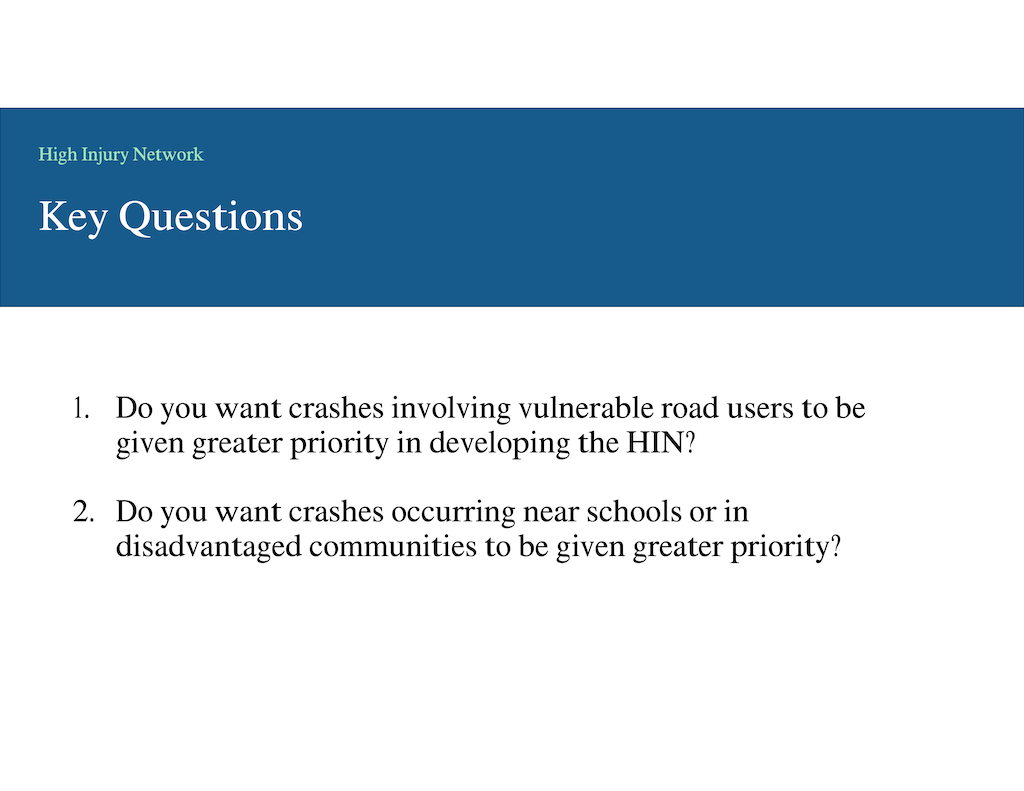
SacCity Vision Zero Action Plan update

The City of Sacramento is undertaking an update of the 2018 Vision Zero Action Plan. A recent Sacramento City Express article, Sacramento begins Vision Zero update, launches crash data dashboard, provides a summary. The dashboard has been available since March (SacCity crash dashboard).

Getting Around Sacramento author Dan Allison is participating in the stakeholder group, wearing the Sacramento Transit Advocates and Riders (STAR) hat. Safety from traffic violence is a key part of encouraging transit use, since people need to walk or bicycle to and from transit stops and stations. Dan has attended three Vision Zero meetings, April 7, 2025 Task Force #1, June 2, 2025 Task Force #2 (the stakeholder group), and June 18, 2025 Working Group (combined Task Force and Technical Advisory).

The slides from these meetings are presented below as slideshows.

Vision Zero Action Plan update intro

Safe Systems Approach

Benchmarking & Crash Analysis

  • gallery of slides from Vision Zero Action Plan update Task Force #2
  • SacCity Vision Zero Action Plan update, Benchmarking & Crash Data Analysis presentation

Safety Improvement Strategies

SacCity crash dashboard

Corrections: Crash data is from Sacramento Police Department, not SWTRS, but does use the SWITRS selection categories. Demographic data is from the Transportation Priorities Plan.

The City of Sacramento has released a VZ Crash Dashboard with an interactive map and charts. The dashboard apparently uses data from SWITRS for crash data (which means that it will never be up-to-date, as SWITRS is never up-to-date, but patterns don’t depend on up-to-date data), but is selected for the City of Sacramento, and also has demographic data layers for ‘SB 535 disadvantaged communities’, ‘neighborhoods that lack transportation infrastructure’, and ‘communities that have been recipients of racism and bias’. You can turn on and off layers, and can select for crashes on a wide variety of criteria, such as ‘severity’ (fatality, severe injury, etc.) and ‘involved with’ (bicycle, pedestrians, etc.), which are criteria from the SWITRS database.

I have only explored the data in a superficial manner, but noticed some interesting geographic patterns. If you look at crash density, the central city looks bad, but for fatalities only, it looks better than many parts of the city. There are several arterial roadways that were identified as high injury network (HIN) corridors but were not in the Vision Zero Action Plan. However, a visual representation does not necessarily reflect the details of data.

What patterns do you see in the crash dashboard?

VZ crash dashboard map, selected for severity = fatal