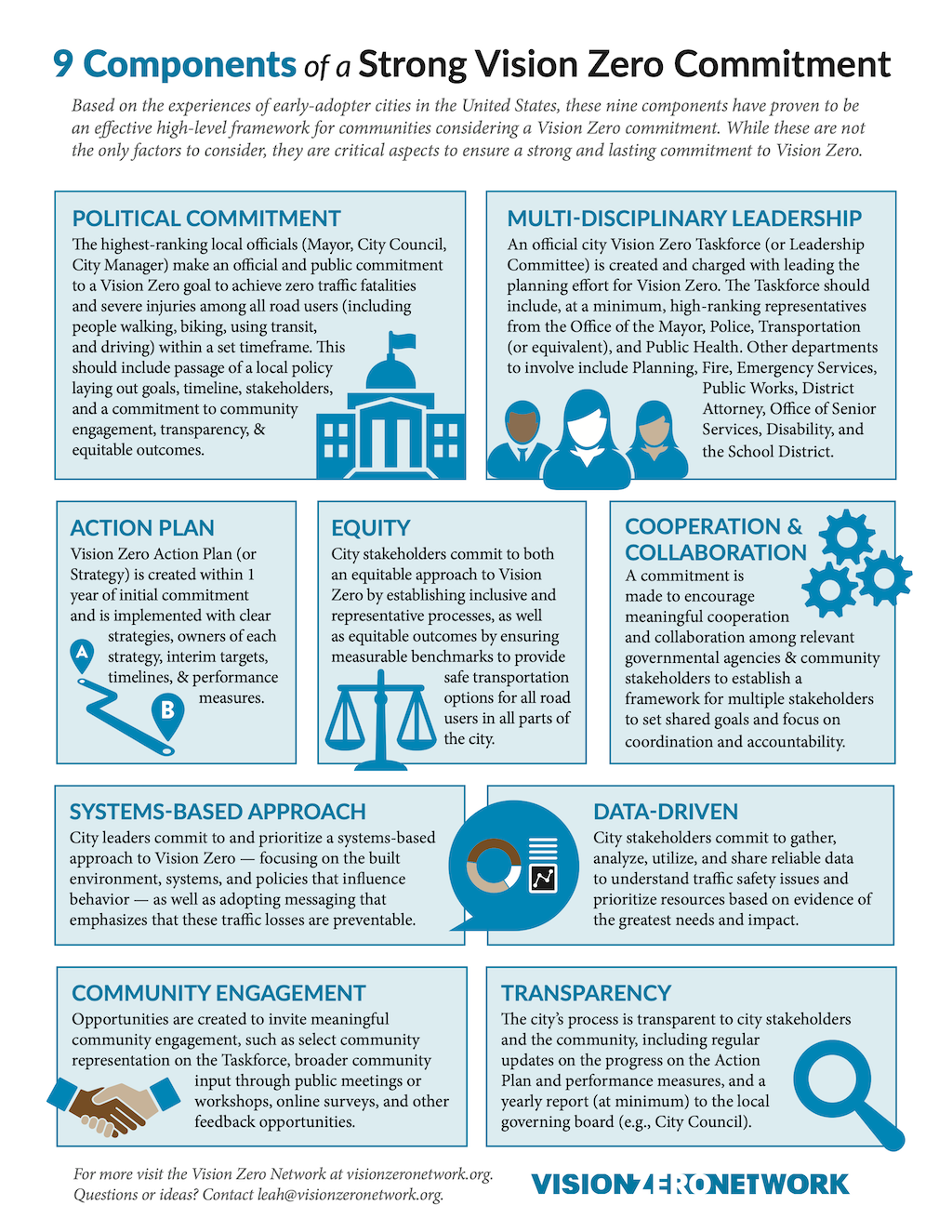
SacCity Vision Zero Update

There are three opportunities for commenting on the City of Sacramento Vision Zero Action Plan update.

In person: Vision Zero Action Plan Community Workshop Thursday, January 29 at 5:30 pm, Sacramento City College, 3835 Freeport Boulevard registration

Virtual: Vision Zero Action Plan Virtual Workshop, Wednesday, February 4 at 5:30 pm registration

Survey

The city’s Vision Zero webpage for general information, and links for the above.

For prior Getting Around Sacramento posts on Vision Zero, see category: City of Sacramento: Vision Zero, and the more general calegory: Vision Zero.

The city’s Vision Zero effort has failed. We are still the highest traffic fatality city in the state. I believe the reason to be primarily that there were flaws in the original approach to Vision Zerio. Though I’ve written about this before, I will post again, soon.

If you are not already following Slow Down Sacramento, please do. It is the best source of information on safety from traffic violence and the city’s Vision Zero effort.

City of Sacramento Vision Zero Action Plan update graphic

SacCity Vision Zero Action Plan update

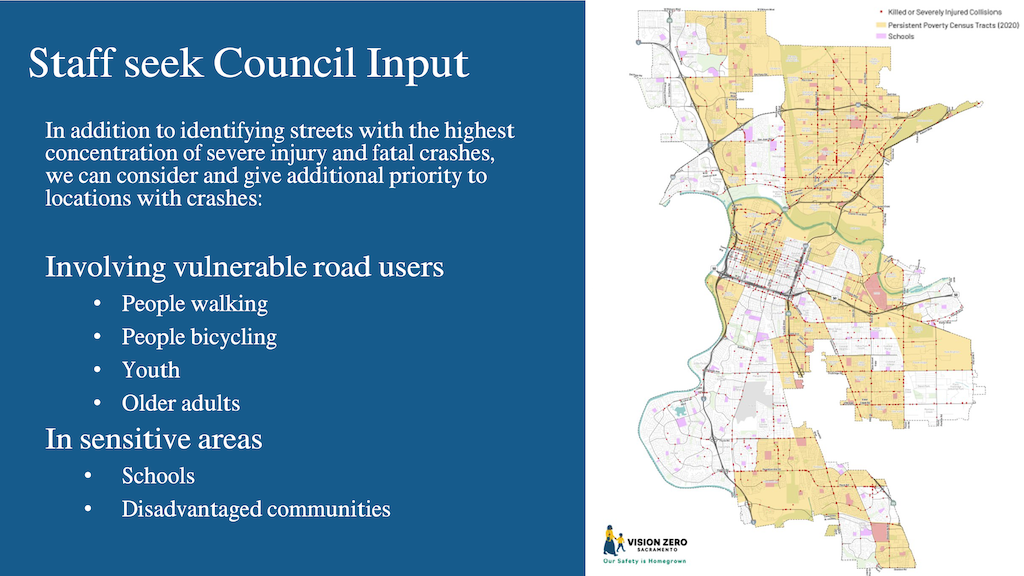
The City of Sacramento is undertaking an update of the 2018 Vision Zero Action Plan. A recent Sacramento City Express article, Sacramento begins Vision Zero update, launches crash data dashboard, provides a summary. The dashboard has been available since March (SacCity crash dashboard).

Getting Around Sacramento author Dan Allison is participating in the stakeholder group, wearing the Sacramento Transit Advocates and Riders (STAR) hat. Safety from traffic violence is a key part of encouraging transit use, since people need to walk or bicycle to and from transit stops and stations. Dan has attended three Vision Zero meetings, April 7, 2025 Task Force #1, June 2, 2025 Task Force #2 (the stakeholder group), and June 18, 2025 Working Group (combined Task Force and Technical Advisory).

The slides from these meetings are presented below as slideshows.

Vision Zero Action Plan update intro

Safe Systems Approach

Benchmarking & Crash Analysis

  • gallery of slides from Vision Zero Action Plan update Task Force #2
  • SacCity Vision Zero Action Plan update, Benchmarking & Crash Data Analysis presentation

Safety Improvement Strategies

SacCity crash dashboard

Corrections: Crash data is from Sacramento Police Department, not SWTRS, but does use the SWITRS selection categories. Demographic data is from the Transportation Priorities Plan.

The City of Sacramento has released a VZ Crash Dashboard with an interactive map and charts. The dashboard apparently uses data from SWITRS for crash data (which means that it will never be up-to-date, as SWITRS is never up-to-date, but patterns don’t depend on up-to-date data), but is selected for the City of Sacramento, and also has demographic data layers for ‘SB 535 disadvantaged communities’, ‘neighborhoods that lack transportation infrastructure’, and ‘communities that have been recipients of racism and bias’. You can turn on and off layers, and can select for crashes on a wide variety of criteria, such as ‘severity’ (fatality, severe injury, etc.) and ‘involved with’ (bicycle, pedestrians, etc.), which are criteria from the SWITRS database.

I have only explored the data in a superficial manner, but noticed some interesting geographic patterns. If you look at crash density, the central city looks bad, but for fatalities only, it looks better than many parts of the city. There are several arterial roadways that were identified as high injury network (HIN) corridors but were not in the Vision Zero Action Plan. However, a visual representation does not necessarily reflect the details of data.

What patterns do you see in the crash dashboard?

VZ crash dashboard map, selected for severity = fatal

whither Sacramento Vision Zero?

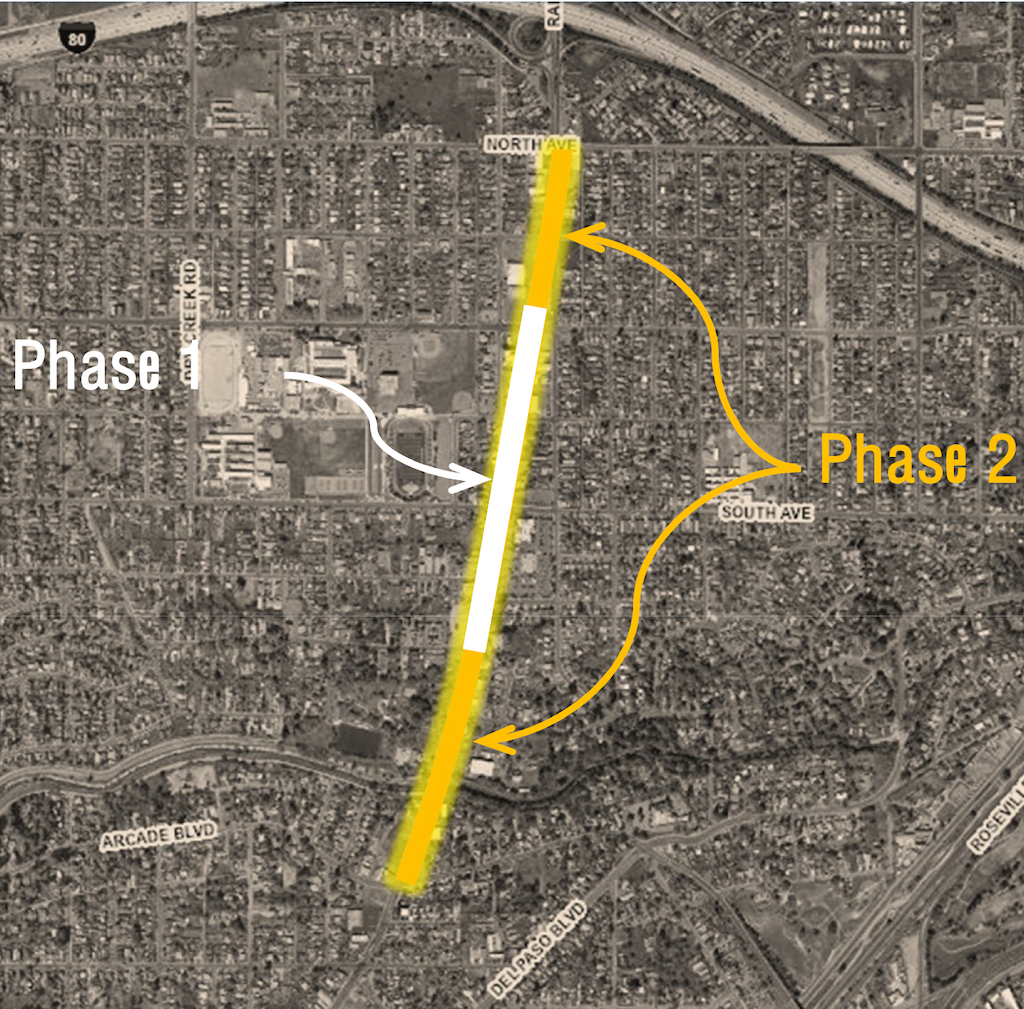
The City of Sacramento adopted Vision Zero in 2017, and developed a Vision Zero Action Plan in 2018. The plan identified five high injury corridors for projects to slow traffic and increase safety for walkers and bicyclists. The city then developed a plan for these five corridors in 2021. The city has obtained grants for some of these corridors, and will apply for more. The city lowered speed limits in a number of schools zones (though street design, drop-off/pick-up procedures, and motorist behavior are the issues in most school zones, not speeding). The city also developed a public outreach education program, though there is no evidence of such programs having any effect on driver behavior (NHTSA and California OTS have thousands of programs with no demonstrated success). So far, so good.

But…

  • The city has intentionally ignored high injury intersections, unless they are on one of these corridors. No grant applications have been made to fix intersections, though intersections are where most fatalities and severe injuries occur. No non-grant actions have been taken to fix high injury intersections.
  • The city has failed to set up a crash investigation team to determine causes and solutions for every fatality. The police department (or CHP if the crash occurs on a state highway) will do an investigation, and sometimes involve traffic engineers, but never involves planners, never involves experts in nonprofit organizations (who have as much if not more expertise than city staff), and never involves citizens who walk and bike.
  • The Vision Zero Task Force, which met in 2016 and 2017, has never met since. That means there is no community guidance for the Vision Zero program. City staff is making all the decisions on Vision Zero.
  • The city has ignored all the low cost options for reducing motor vehicle crashes. As just one example, the city has been asked to remove pedestrian beg buttons and create leading pedestrian intervals (LPIs) at all signalized intersections, but did only a small beg button set to auto-recall on five crosswalks, and have not increased the number of LPIs in years.

Solutions?

  • The city should create an effective crash investigation team, composed of law enforcement, city traffic engineers, city planners, nonprofit experts, and citizens who walk and bike, and perhaps a representative of the neighborhood association in which the crash occurred. The team should never be led by law enforcement, which has an anti-walker and anti-bicyclist windshield bias. It has been suggested that streets where fatalities have occurred be shut down until the investigation and resulting fixes are in place, which is an idea worth considering.
  • The city should identify the top five high injury intersections, and commit to significant changes to eliminate crashes at those intersections, within three years. And then move on to the next five. The corridor projects and intersection projects should be considered co-equal in city funded projects or grant applications.
  • The city Active Transportation Commission should take on a strong leadership role in advising the council on the Vision Zero program. It may also be appropriate to re-convene the task force to provide more detailed guidance to staff.
  • The city should implement a Vision Zero project to change all traffic signals in the entire city to auto-recall (with removal of the physical beg buttons as staffing allows) and leading pedestrian intervals.
  • The city should undertake a review of peer cities that have reduced speed limits city-wide, to determine whether to implement this change and how to learn from the experiences of other cities. If the review indicates that speeds can be reduced by as little as 3 mph by a reduction from 25 mph to 20 mph, the city should implement it city-wide. Similarly for higher speed streets.

Sac Vision Zero intersections & red light cameras

I’ve written previously about Vision Zero high injury intersections in the City of Sacramento: Sac Vision Zero new intersections map, Sac Vision Zero top intersections all modes, Sac Vision Zero top ped intersections, Sac Vision Zero Top 5 Corridors and top intersections, and Sac Vision Zero flaws.

The City of Sacramento has red light cameras at the following locations:

  • Mack Road & La Mancha Way/Valley Hi Drive
  • El Camino Avenue & Evergreen Street
  • Howe Avenue & Fair Oaks Boulevard
  • Mack Road & Center Parkway
  • Exposition Boulevard & Ethan Way
  • Broadway & 21st Street
  • Folsom Boulevard & Howe Avenue/Power Inn Road
  • Arden Way & Challenge Way
  • 5th Street & I Street
  • 16th Street & W Street
  • Alhambra Boulevard & J Street

The top injury intersections are:

  • Stockton Blvd & Broadway
  • Stockton Blvd & Lemon Hill Ave
  • Stockton Blvd & 47th Ave & Elder Creek Rd
  • Watt Ave & Auburn Blvd
  • Del Paso Blvd & Evergreen St & Lampasas Ave
  • Julliard Dr & Kiefer Blvd & Folsom Blvd
  • Power Inn Rd & Fruitridge Rd
  • Freeport Blvd & Florin Rd
  • Center Pkwy & Cosumnes River Blvd
  • Bruceville Rd & Cosumnes River Blvd
  • Franklin Blvd & Mack Rd

Notice there is no overlap. One could optimistically say that the presence of red light cameras may be making drivers safer and reducing the crashes at these locations. But I doubt it. More likely, the city is just not prioritizing high injury intersections. Of course high injury intersections change over time, as traffic patterns change, and as the city redesigns intersections to be safer, so red light camera locations need not remain static.

I ask that the city install red light cameras at all the high injury intersections. I am not asking that the city move the existing cameras to the new locations. If someone thought a red light camera was necessary at an intersection, it probably still is, and should continue unless evidence indicates otherwise.

A lot of driver-apologists claim that red light cameras are not fair, that they are installed mostly to gain ticket revenue, and that they aren’t accurate anyway. Yes, some places have installed cameras for funding, but Sacramento is not one of them. Yes, sometimes the camera systems flag a vehicle that is not running a red light, but the photos are reviewed. Even if the city were making $1M a day on red light cameras, that would be just fine with me if it prevents one death. I value life more highly than do many drivers.

I worked in Citrus Heights for several years, which has a much higher percentage of traffic signals complemented by red light cameras. My perception is that it really did make a difference. I saw very little red light running in Citrus Heights. Other violations, sure, but not red light running.

photo from City of Sacramento Red Light Running Program page

Sac Vision Zero new intersections map

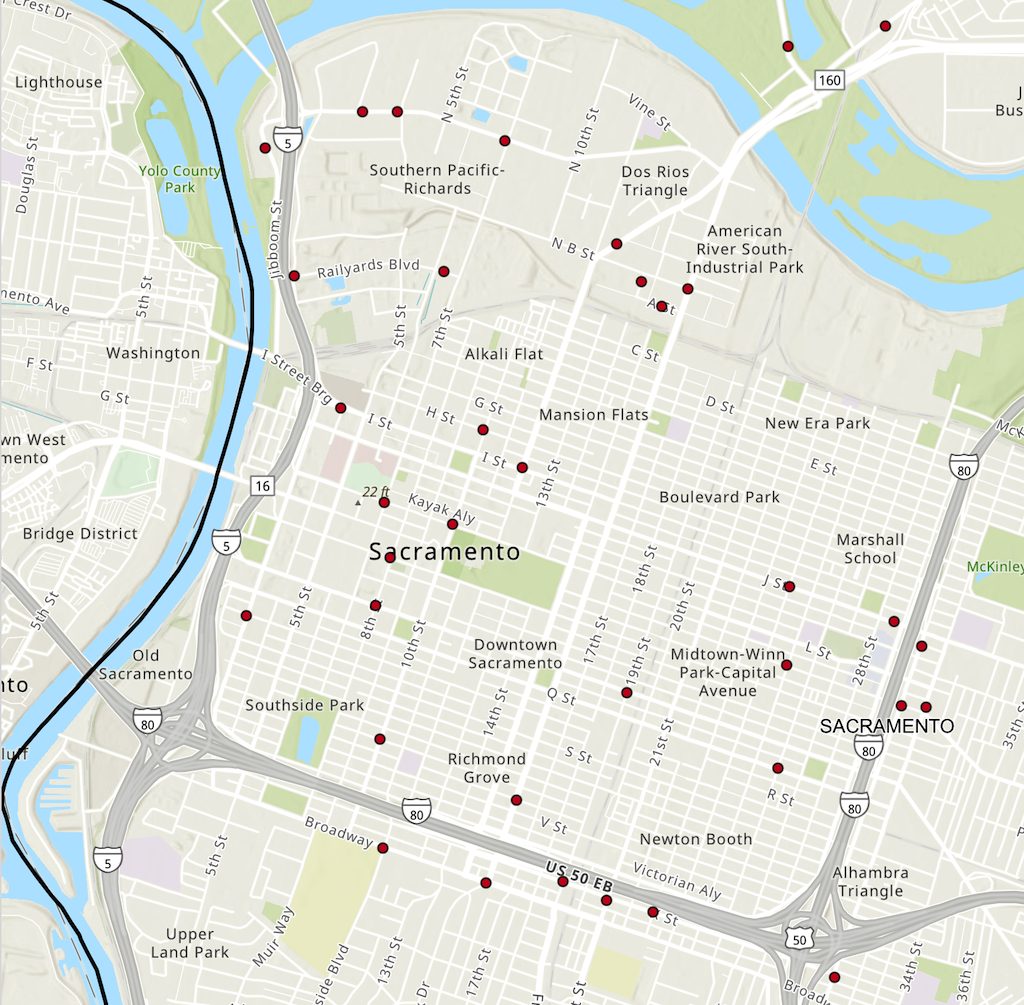
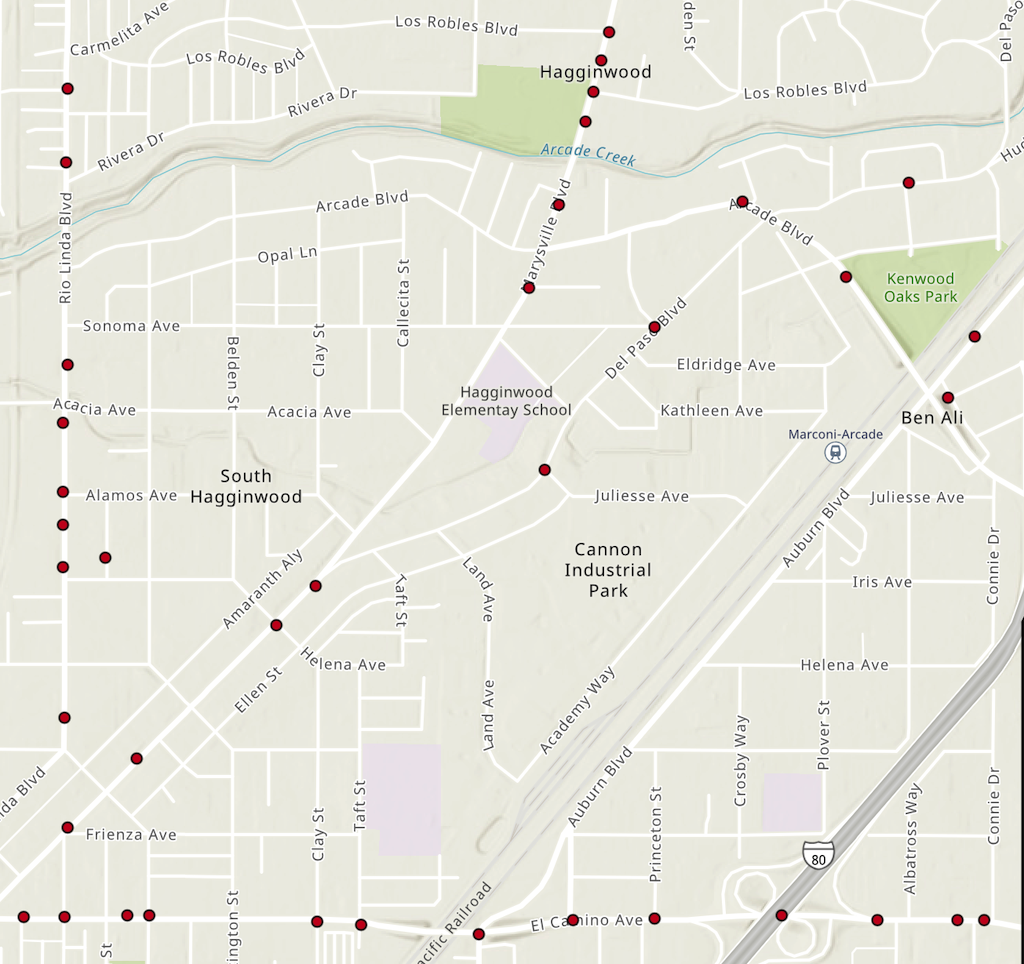
Thinking about the intersections maps and what they show (Sac Vision Zero top intersections all modes, Sac Vision Zero top ped intersections, Sac Vision Zero Top 5 Corridors and top intersections), I thought it might be interesting to present the data in a different way. The two maps below show all of the top intersections identified in the all-modes, pedestrian, and bicycle data. They are divided into a north section and a south section so that the intersections and their labels are visible. The maps are available as pdfs (north, south).

legend for intersections on maps below
Sacramento top collision intersections, north section
Sacramento top collision intersections, south section

The intersection data is in the table below.

What’s next? I’ll take a closer look at some of these intersections. For people who follow traffic engineering, it will probably be immediately obvious why these intersections are dangerous. A detailed analysis requires looking at each collision record individually, which I don’t have time to do. The city did make use of incident reports, which contain more information than the data in SWITRS, in developing the Vision Zero Plan.

Sac Vision Zero top ped intersections

As promised, a follow-on to my post on the top bicycle collision intersections in Sacramento (Sac Vision Zero Top 5 Corridors and top intersections), here is the same sort of analysis for pedestrian collisions. I used a somewhat different data set, this time only killed and severe injury crashes (KSI), for the years 2009-2017. This mirrors the data the city used in the Vision Zero Top 5 Corridors document, and so is not directly comparable to the different criteria I used on the bicycle post.

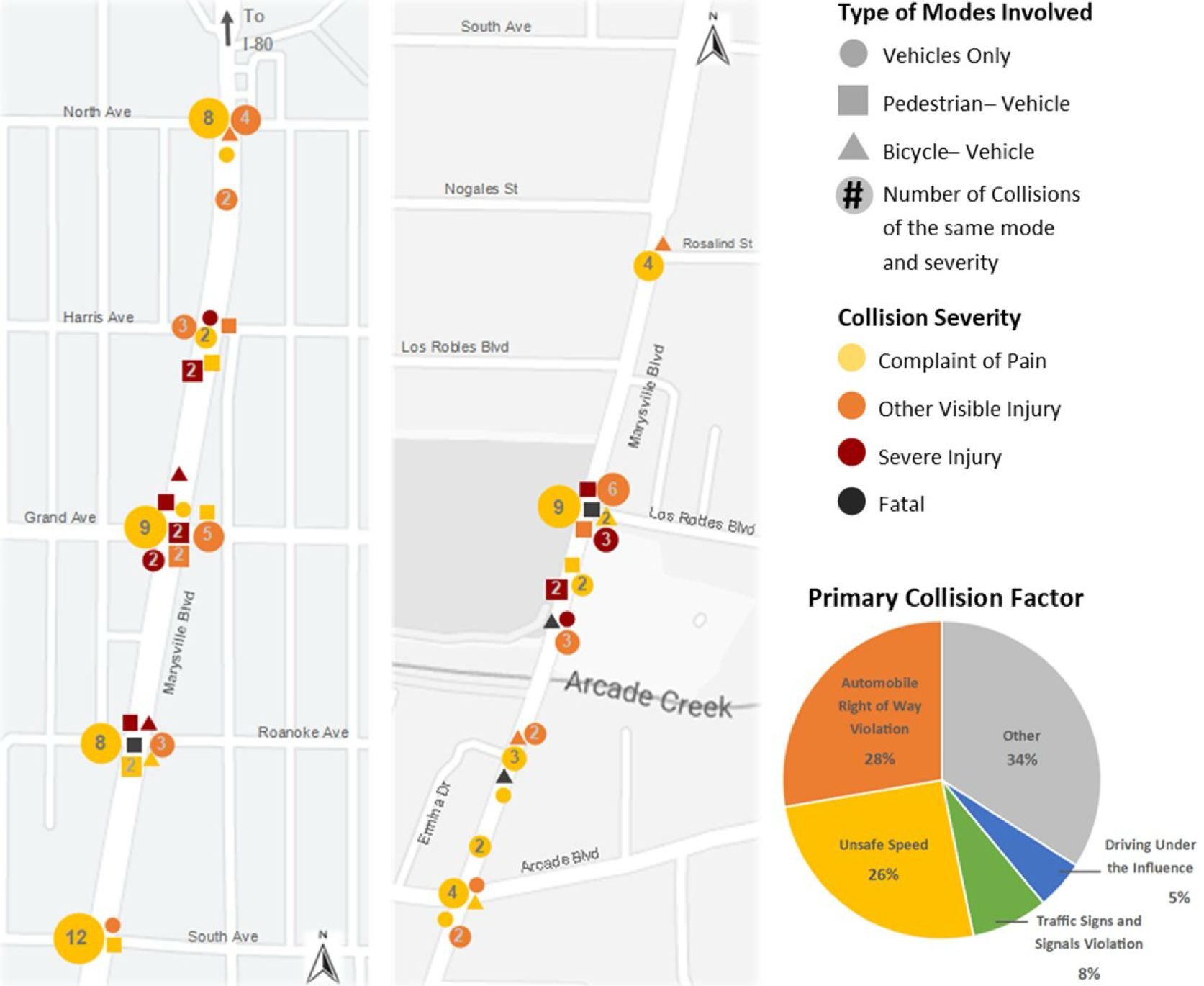
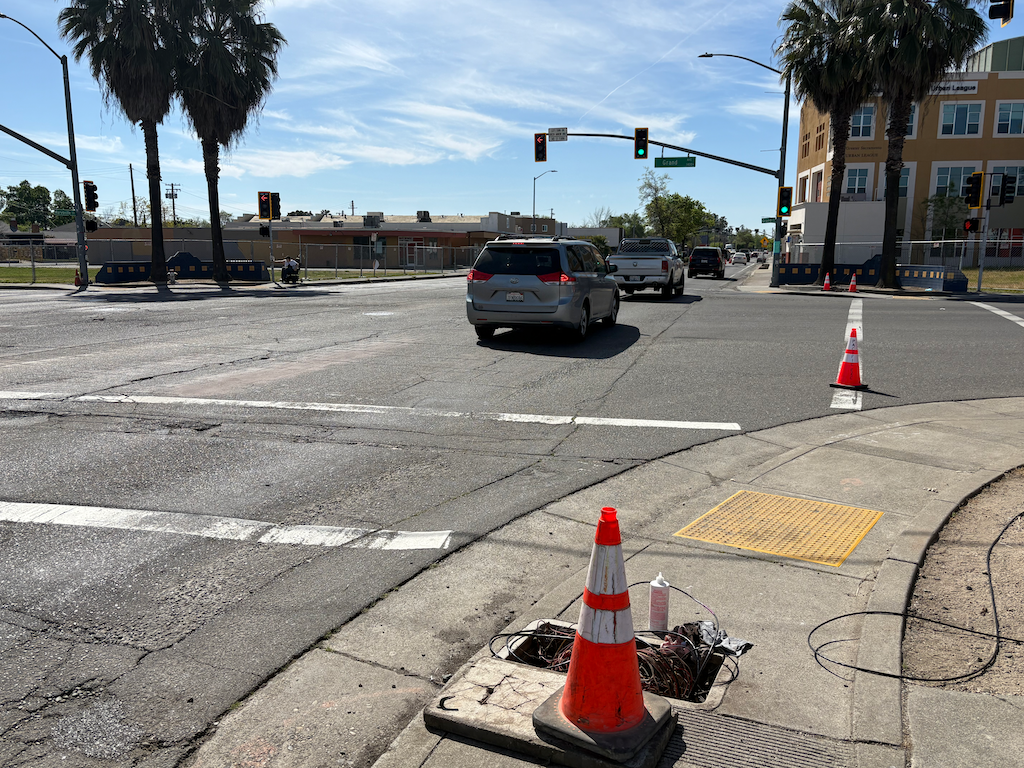
Pedestrian (walker) collisions are more dispersed that bicycle collisions, fewer occurring at intersections and more in between. Of the 408 collisions, 70 were at intersections, 17%, compared to 69% for bicycle collisions. Of these 408 collisions, twelve intersections stood out: Amherst St & Florin Rd, Marysville Blvd & Grand Ave, and Watt Ave & Auburn Blvd, each with three; and 15th St & Capitol Mall, 29th St & Florin Rd, 5th St & N St, 7th St & J St, Stockton Blvd & Broadway, Stockton Blvd & Lemon Hill Ave, Riverside Dr & X St, and Julliard Dr & Kiefer Blvd & Folsom Blvd, each with two. Of these 12 intersections, 4 are on Top Five corridors: Marysville Blvd & Grand Ave on the Marysville corridor, Stockton Blvd & Broadway on the Stockton-Broadway corridor, Stockton Blvd & Lemon Hill Ave on the South Stockton corridor, and 29th St & Florin Rd on the Florin corridor.

The map belows shows the city corridors and the twelve intersections, with the number of collisions and intersection name labeled. There is also a pdf available.

map Vision Zero top pedestrian intersections
Sacramento pedestrian collision top intersections, with Vision Zero corridors

There is a better alignment between the five designated corridors and pedestrian collision intersections than was true for bicycle collisions.

I will point out that the Julliard Dr & Kiefer Blvd & Folsom Blvd intersection is the site of three pedestrian collisions and four bicycle collisions, which is higher than any other intersection in the city. It should really be a focus for the city.

Addition 2021-03-02: Someone asked how the pedestrian collision locations relate to disadvantaged communities. Below, a map with CalEnviroScreen 3 2018-06 (CES) layer, with red end being higher pollution, green being lower, and weighted with income. CES is not the only measure of disadvantage, but it is one commonly used.

Sac Vision Zero Top 5 Corridors and top intersections

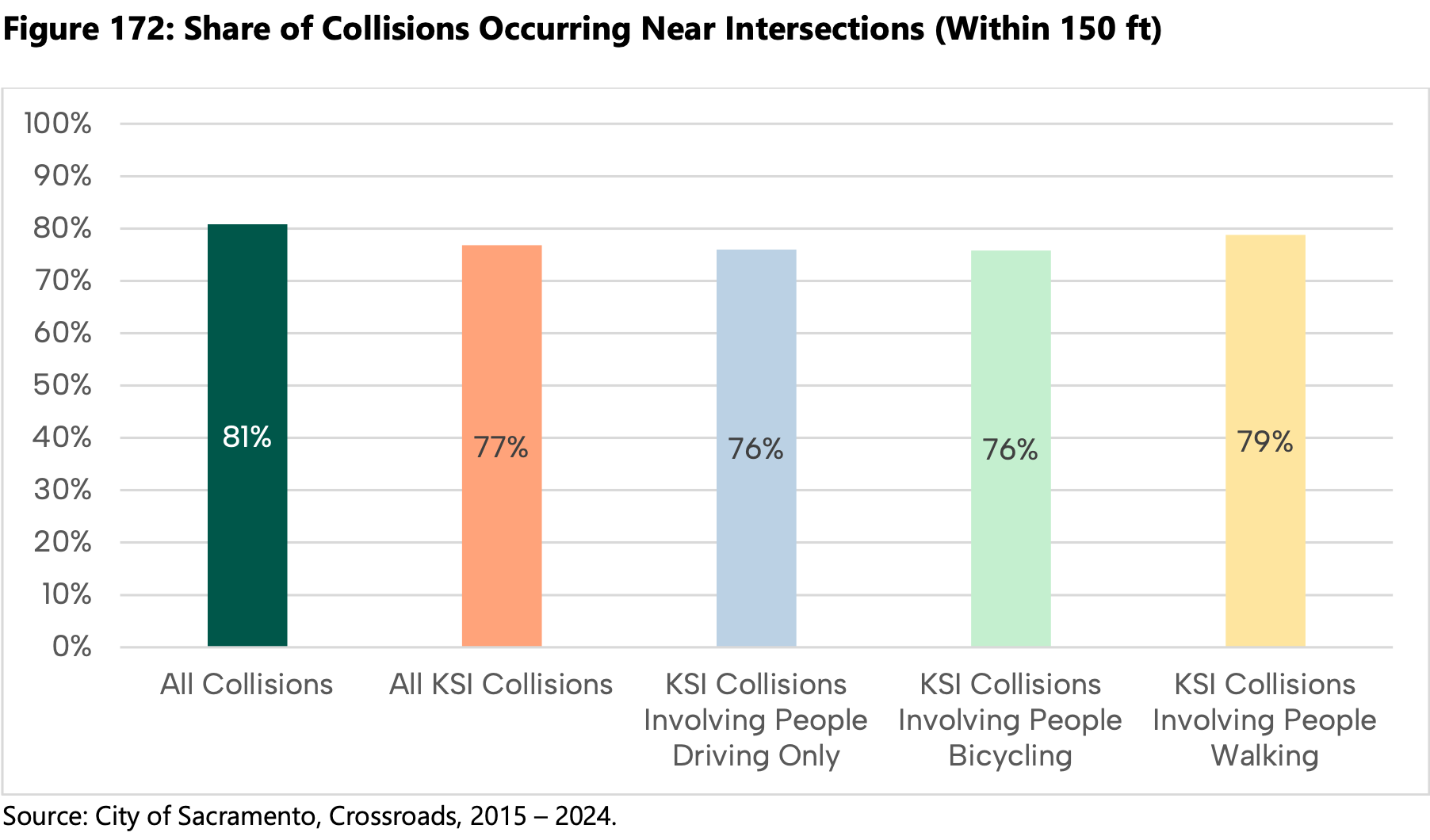
As promised in my previous post, Sac Vision Zero flaws, here is a limited analysis of high injury network intersections in Sacramento. I used bicycle crashes for 2014 through 2018 from the SWITRS crash database, and matched these to intersections of arterials and collectors in the city. It is known that most crashes occur at or near intersections, not in between. Of the 1112 crashes in this time period, 763 occurred at intersections, or 69% (for all crash types, the city said it is 78%). I selected eight intersections to highlight, which had 4, 5, or 7 crashes at the intersection or within 120 feet of the intersection, meaning on the approach or departure from the intersection. The other 590 intersections had 3, 2, 1, or no crashes. I did not analyze the crashes for fatality or serious injury, but that would be a useful.

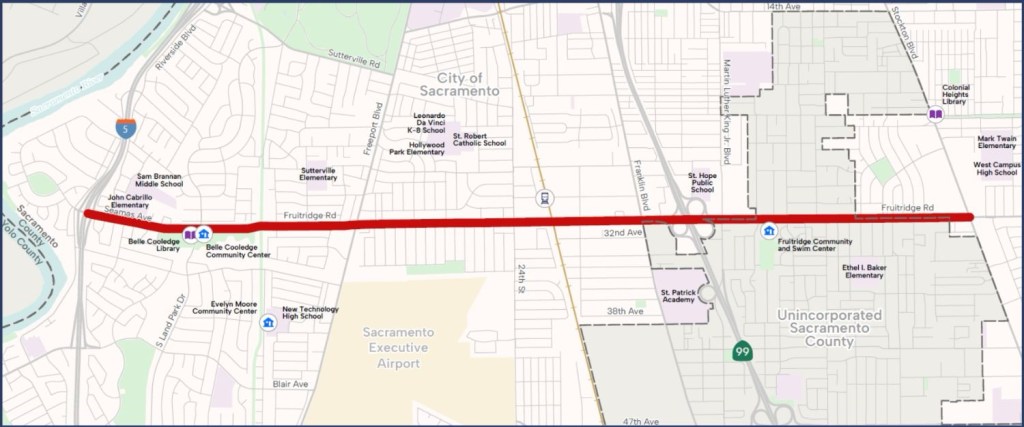
The map below shows the Sacramento Vision Zero Top 5 Corridors, in red, and the top eight crash intersections with a bicycle symbol. The number to the right is crashes, and the location is labeled with cross streets. This is also available as a pdf.

Of the eight intersections, one is part of the Florin corridor, at 24th Street and Florin Road. The other seven are not.

I ask that the city revise its Vision Zero program to include high injury intersections. The number might be as many as 10, and selection should include the same equity criteria used to select the corridors. That means that the three central city locations might not be selected, or might be lower on the priority list, and that is good. The challenge of the Stockton Blvd & Fruitridge Road intersection is that it is on the city/county boundary, so complete treatment of the intersection would require some cooperation with the county. But with seven bicycle crashes in the time period, it is a very important intersection.

A strong advantage to giving high injury intersections recognition and attention is that they could receive near-term safety improvements that require only reallocation of roadway width and new paint. Full safety improvements probably would require redesign of the intersection.

Again, I fully support the city’s Vision Zero efforts, and want to see them be the best they can be. That means including high injury intersections.

Addition 2021-03-02: Someone asked how the bicycle collision locations relate to disadvantaged communities. Below, a map with CalEnviroScreen 3 2018-06 (CES) layer, with red end being higher pollution, green being lower, and weighted with income. CES is not the only measure of disadvantage, but it is one commonly used.

21950 and Vision Zero

California Vehicle Code 21950, failure to yield to pedestrians, is in my opinion the most important violation as it applies to implementing Vision Zero in Sacramento. The Vision Zero Sacramento Action Plan (draft) says “Launch high-visibility enforcement campaigns against speeding, failure to yield to pedestrians, distracted driving, and impaired driving. Campaigns will focus on HIN corridors.” The state code says:

21950.
  (a) The driver of a vehicle shall yield the right-of-way to a pedestrian crossing the roadway within any marked crosswalk or within any unmarked crosswalk at an intersection, except as otherwise provided in this chapter.
(b) This section does not relieve a pedestrian from the duty of using due care for his or her safety. No pedestrian may suddenly leave a curb or other place of safety and walk or run into the path of a vehicle that is so close as to constitute an immediate hazard. No pedestrian may unnecessarily stop or delay traffic while in a marked or unmarked crosswalk.
(c) The driver of a vehicle approaching a pedestrian within any marked or unmarked crosswalk shall exercise all due care and shall reduce the speed of the vehicle or take any other action relating to the operation of the vehicle as necessary to safeguard the safety of the pedestrian.
(d) Subdivision (b) does not relieve a driver of a vehicle from the duty of exercising due care for the safety of any pedestrian within any marked crosswalk or within any unmarked crosswalk at an intersection.

VEHICLE CODE – VEH, DIVISION 11. RULES OF THE ROAD,CHAPTER 5. Pedestrians’ Rights and Duties; http://leginfo.legislature.ca.gov/faces/codes_displaySection.xhtml?lawCode=VEH&sectionNum=21950; retrieved 2018-12-15

So, how is the Sacramento Police Department doing on enforcing this code against drivers who fail to yield to pedestrians in the crosswalk? Well, from the ‘Sacramento Police Vehicle Stop Data’ (http://data.cityofsacramento.org/datasets/sacramento-police-vehicle-stop-data) of the last two years, there were 101 violations of 21950 recorded, out of 61,151 violations. This is 0.17 percent, or, other violations were 582 times more common.

Anyone spending more than 10 minutes standing on the corner of any busy pedestrian intersection could count a hundred violations of this law. I know this because I do it. It is part of my job and it is also part of my advocacy. In two years the police only wrote 105 citations? I will also add that I have seen Sacramento Police Department officers in motor vehicles violating this very code hundreds of times, on myself and on others. Even the bicycle mounted officers are frequent violators. I will say that officers have yielded to me in the crosswalk, but it is much more common that they don’t. I’m not saying that they are trying to run me down, rather than they don’t wish to be slowed or inconvenienced, and so will cross through the crosswalk when I’m in it. They are, in this sense, just like other drivers.

So what is this disconnect between what is important and what officers do? I’m going to be blunt here. The police not partners in achieving Vision Zero, in fact they are the main impediment to Vision Zero. If they persist in their windshield perspective that pedestrians are the problems and drivers don’t mean to cause harm, pedestrians will continue to die, and drivers will continue to not face consequences for their violations, for their assaults, for their murders.

If you wish to reply that we all need to work together, and consider perspectives, well, please present evidence that this has worked in the part, or some construct that says it will work in the future. I’m not seeing it. In case you think I am picking on Sac PD, things are actually worse in other jurisdictions, but since this is where I live and observe the issue every day, it is the place I focus on.

By the way, thank you Don Kostelec @KostelecPlan for getting me fired up about all the ways in which our entire system is biased against pedestrians, and that those people whose job it is to consider and act on safety are mostly only concerned about drivers and traffic flow. I encourage you to follow his ‘The Twelve Days of Safety Myths‘ series.

Sacramento Vision Zero Top 5 outreach

This information from the City of Sacramento via email.

Vision Zero Top 5 Corridors Banner

We have added and updated upcoming outreach events for the Vision Zero Top 5 Corridors.

Join us to learn more about the Vision Zero Top 5 Corridors Study and share your experience biking, walking and driving along these streets at one of the following events:


Date and Time Event Location Corridor of Interest
Monday, November 5th

5:00-7:00 p.m.

Community Workshop Peter Burnett Elementary School

6032 36th Ave.

South Stockton Blvd.
Wednesday, November 7th

Noon-2:00 p.m.

Pop-up Event Transit stop at Broadway and Stockton near Food Source (4401 Broadway) Broadway/Stockton Blvd.
Saturday, November 10th

9:30-10:15 a.m.

Old North Sacramento/Dixieanne Community Association GraceCity

701 Dixieanne Ave.

El Camino Ave.
Thursday, November 15th

5:00-7:00 p.m.

Community Workshop Luther Burbank High School

3500 Florin Rd.

Florin Rd.
Thursday, November 15th

6:30-8:00 p.m.

Gardenland/Northgate Neighborhood Association Stanford Settlement Conference Room

450 W. El Camino Ave.

El Camino Ave.
Friday, November 16th

4:00pm-6:00 p.m.

Pop-up Event Grocery Outlet

2308 Del Paso Blvd.

El Camino Ave.
Wednesday, December 5th

6:00-8:00 p.m.

Hagginwood Community Association William J. Kinney Police Facility

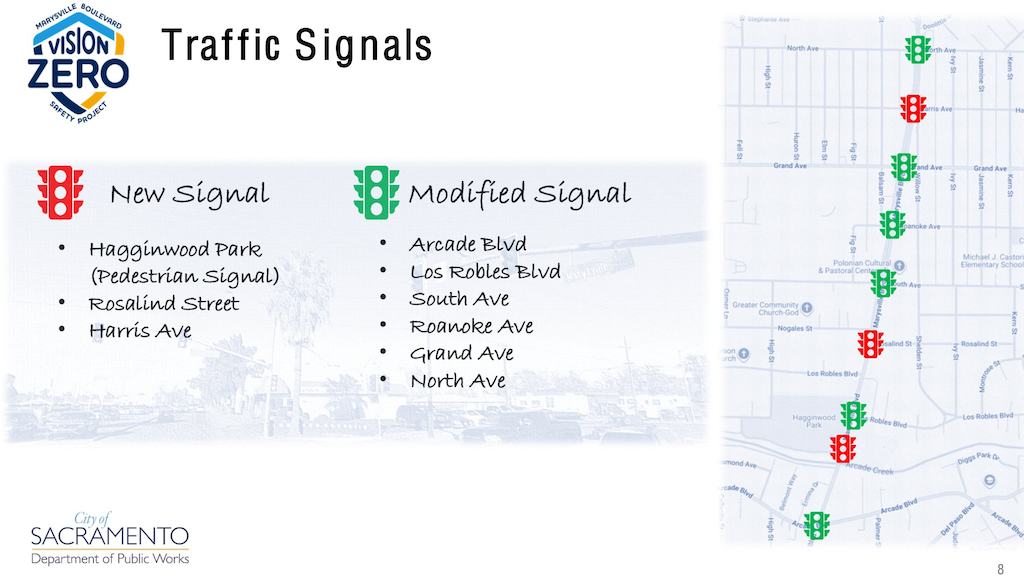
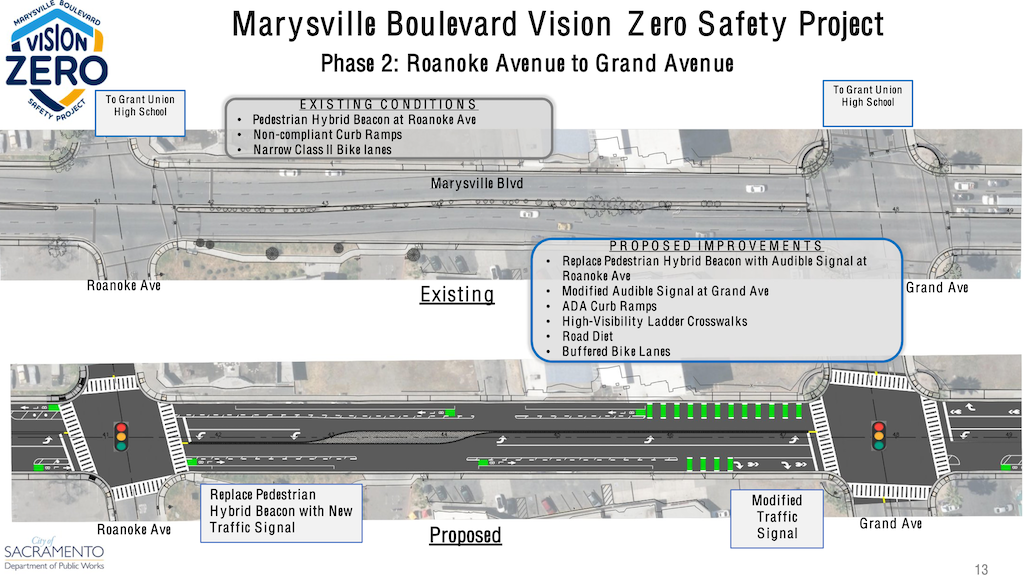
3550 Marysville Blvd.

Marysville Blvd.


About the Study


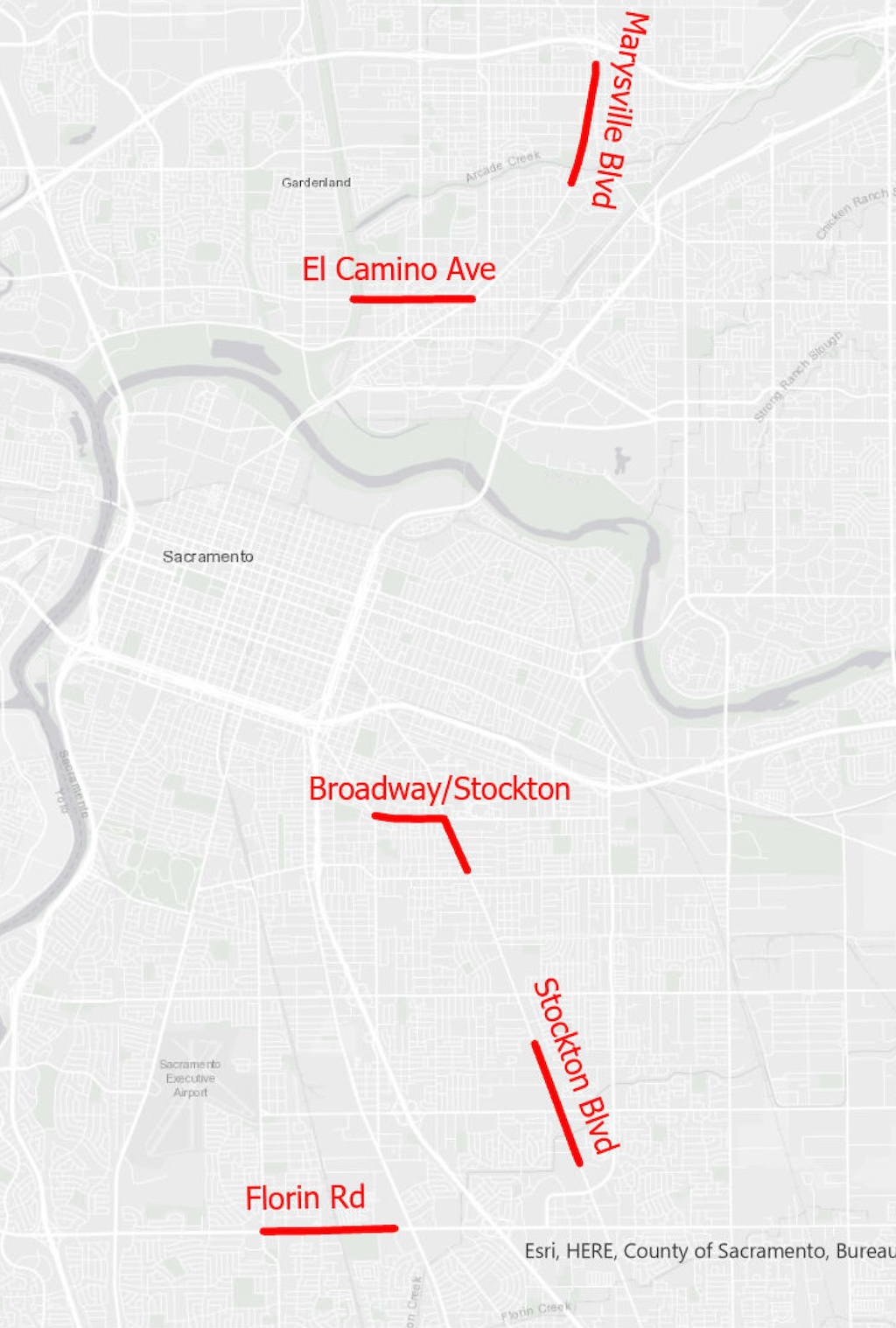
In 2017, the City of Sacramento identified the five corridors in Sacramento with the highest numbers of fatal and serious crashes involving pedestrians, bicyclists, and motorists.

The Vision Zero Top Five Corridor Study will analyze the factors that contribute to these corridors’ high crash rates.  Based on technical analysis, community input, and best practices in roadway safety and design, the study will identify improvements for each of these corridors that can be implemented in the near-term.

More information about the project is available at http://visionzerosac.org