The City of Sacramento’s Vision Zero Action Plan Update process has produced a Draft Actions chart. Item 9 in the high priority list is:
“Update City Traffic Signal Operations Manual (TSOM) to reflect complete streets and designs reflective of reducing exposure, likelihood, and severity. Include application of Leading Pedestrian Intervals, No Right Turn on Red, Protected Left-Turn Phasing, Rest on Red, and other similar strategies.”
Sounds great. The problem is, the TSOM apparently does not exist. I did a PRA (Public Records Act) request with the city for the existing document. The city first referred me to the Traffic Signal Operations and Standards webpage. That page contains links to short documents that might or might not be part of the manual, but the manual does not exist on that page.
So I submitted another PRA, stating that the document I wanted is not on that page, and again requested it. The city’s response was that the document does not exist.
I suspect the document does exist, but the city is unwilling to admit it. But it is also possible that the city has been managing signals based on whim, not on documented policy and guidelines. A lot of the signal work the city does, including new signals, tends to support the second explanation.
It might be challenging to update something that doesn’t exist (snark).
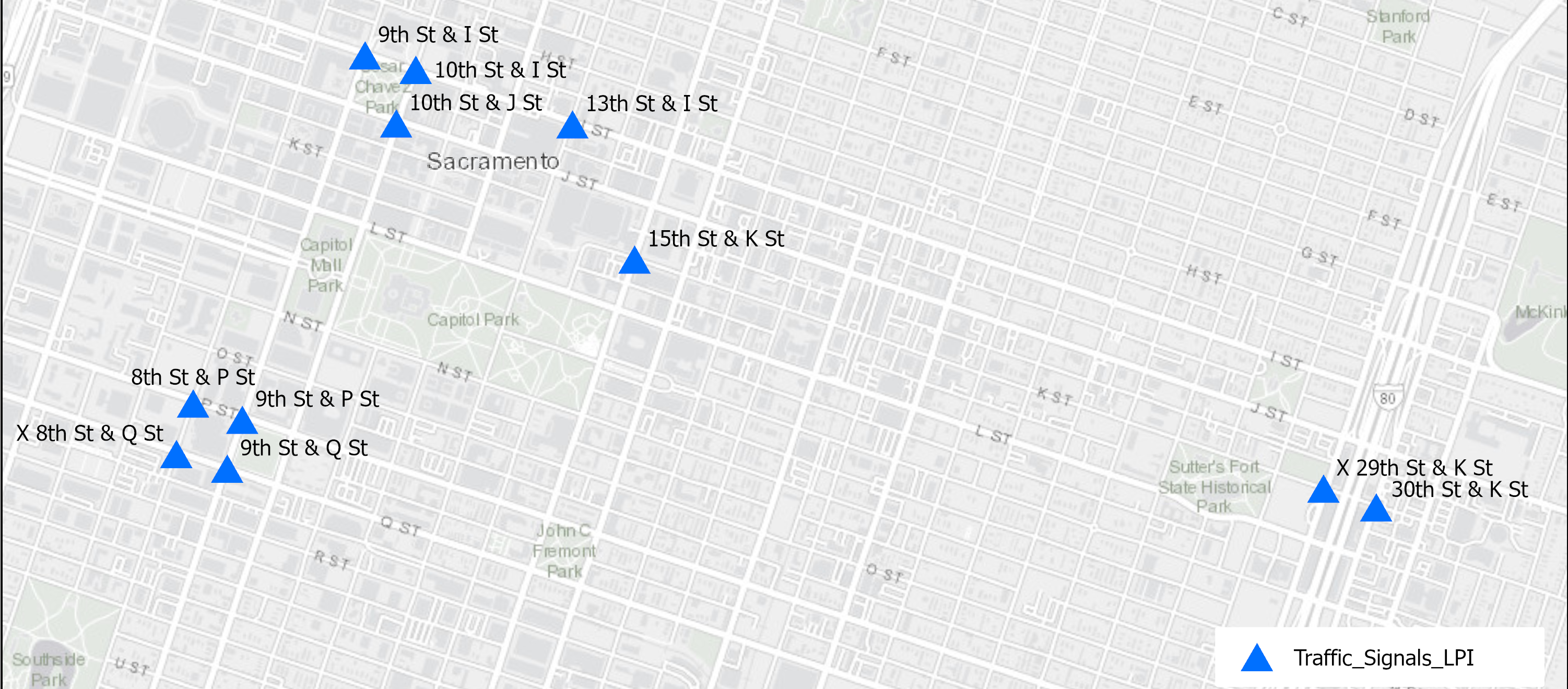
In 2018, I posted a list of leading pedestrian interval (LPI) locations (Leading Pedestrian Interval (LPI) signals), which were provided by the city. Today I field-checked those locations.
Two locations have apparently been removed, 29th & K, and 8th & Q. Six of the locations where I only indicated ‘and’ have LPIs on only one of the cross streets, and I have changed those to ‘at’, 9th at I, I at 10th, J at 10th, I at 13th, 15th at K, and Q at 9th. Three locations have LPIs for both cross streets, 10th & K, 9th & P, and 8th & P.
9th Street at I Street: across 9th only
I Street at 10th Street: across I only
J Street at 10th Street: across J only
I Street at 13th Street: across I only
15th Street at K Street: across 15th only
29th Street and K Street: removed
30th Street and K Street: both directions
9th Street and P Street: both directions
Q Street at 9th Street: across Q only
8th Street and P Street: both directions
8th Street and Q Street: removed
The intersection of J Street at 13th has LPI across J. However, this intersection is unsafe for walkers since the signals allow southbound drivers on 13th Street to turn left across the sidewalk while the walk sign is on. This is the most common vehicle movement, and this is one of the most heavily used crosswalks in the central city since the convention center is on the southeast corner. This must be fixed. I have written before about this intersection (13th & J intersection), but nothing has been improved.
Other intersections of note are
29th Street and K Street which has ‘wave or press’ pedestrian signing, but pedestrian signal is on auto-recall, which it should be.
L Street and 29th Street has no LPIs, but it does have an exclusive pedestrian phase on north leg only.
The Pocket Greenhaven Transportation Plan (2023-11) recommends three LPIs
Florin Rd & Rush River Dr
Greenhaven Dr & Rush River Dr
Pocket Rd & Little River Way
I don’t know the status of this project. It is odd that only three locations were recommended, out of dozens of location with new or modified traffic signals.
If readers know of other locations with leading pedestrian interval (LPI) signals, please comment on this post or email allisondan52@icloud.com.
Previous posts on Leading Pedestrian Interval (LPI), in the City of Sacramento and more generally, at available at tag: LPI.
The Strong SacTown Street Design Standards Working Group has a team working on Leading Pedestrian Intervals (LPI) at traffic signals. If LPI grabs your interest, I encourage you to join the working group. Meetings are posted on Luma, a calendaring application. Go to Luma (app or website: https://luma.com/strongsactown). The next working group group meeting is not listed there yet, but it is normally on the third Sunday of the month at 1:00 PM. Meetings are open to the public; one need not be a member of Strong SacTown or Strong Towns to join in (though you should be!).
The City of Sacramento has a Traffic Signal Operations and Standards page. The prose is garbled, to say the least. The linked documents have nothing to do with operations. It does not include a Traffic Signal Operations Manual (TSOM). Though the plan is supposed to be updated, it is not clear if it even exists.
Streets for People Active Transportation Plan (2025-08, page 105): “An evaluation of best practice to establish guidelines for leading pedestrian intervals (LPIs) at signalized intersections is currently (2025) underway and will be included in the updated City of Sacramento Traffic Signal Operations Manual (TSOM). The TSOM and the guidelines for LPIs will be presented to the Active Transportation and Disability Advisory Commissions to allow for public discussion of the proposed standard practices.”
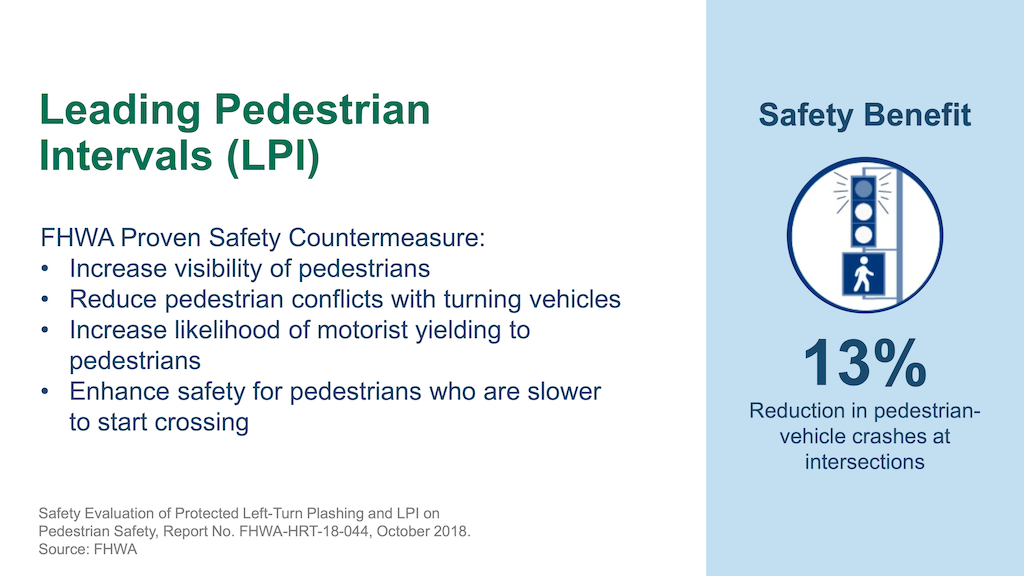
Vision Zero Action Plan Update Safety Improvement Strategies presentation includes the following graphic:
SacCity Vision Zero Action Plan Update, Safety Improvement Strategies, presentation, page 48
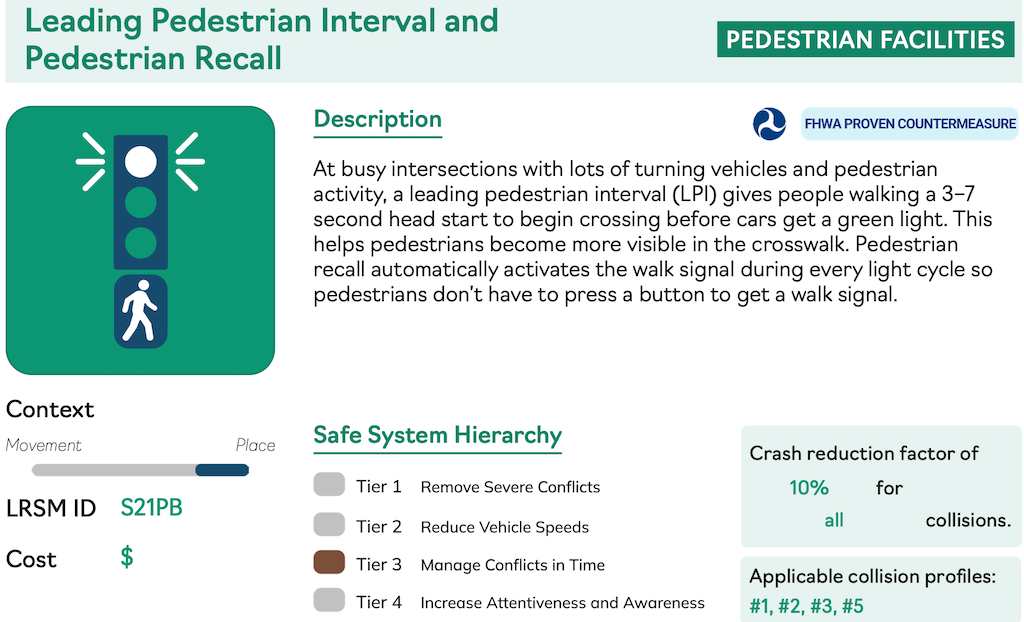
The Vision Zero Action Plan Update Top Collision Profiles and Countermeasures memo includes the following graphic, which has more detail. It is identified as Tier 3, Engineering Countermeasures, Managing conflicts in time.
SacCity Vision Zero Action Plan Update, Top Collision Profiles and Countermeasures, memo, Leading Pedestrian Interval (LPI), page 44
The Vision Zero Action Plan Update draft recommendations includes #9: “Update City Traffic Signal Operations Manual (TSOM) to reflect complete streets and designs reflective of reducing exposure, likelihood, and severity. Include application of Leading Pedestrian Intervals, No Right Turn on Red, Protected Left-Turn Phasing, Rest on Red, and other similar strategies.” Items 19 and 26 might also include LPIs, though they are not called out there.
I had hoped to observe bicyclists reacting to the signal, but unfortunately there were no bicyclists. Despite the city devoting much of the street right-of-way to bike lanes (not protected, on only sometimes buffered), it appears that no one is riding their bicycle on Broadway. I’m not surprised. Broadway continue to be an unpleasant place for bicyclists and walkers, and regular bike lanes are unlikely to change that.
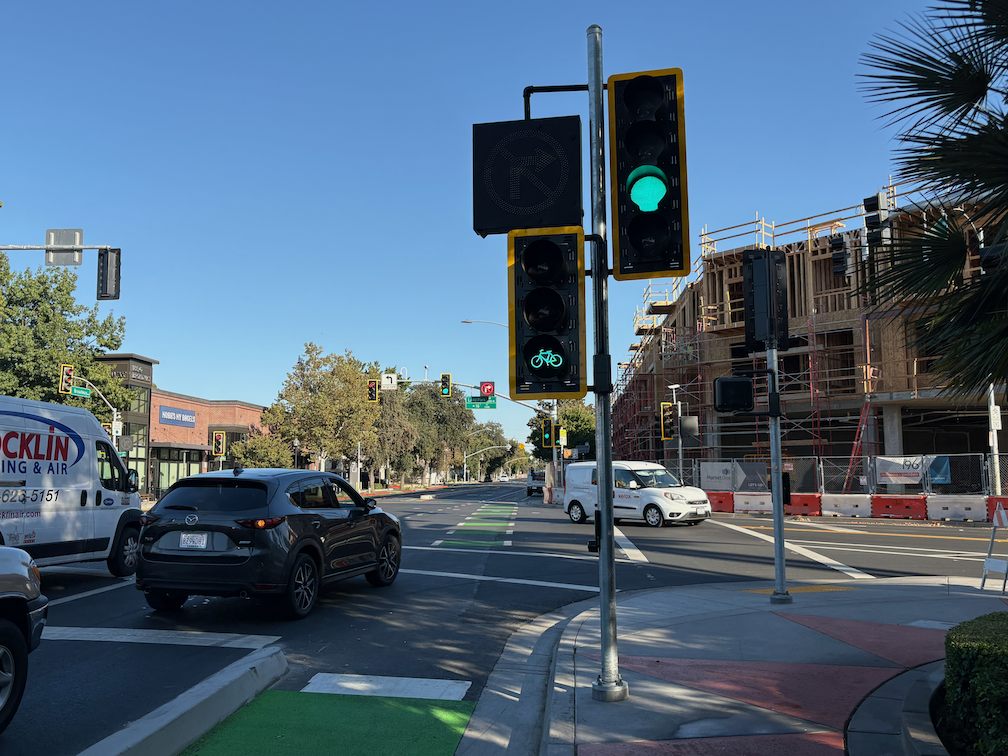
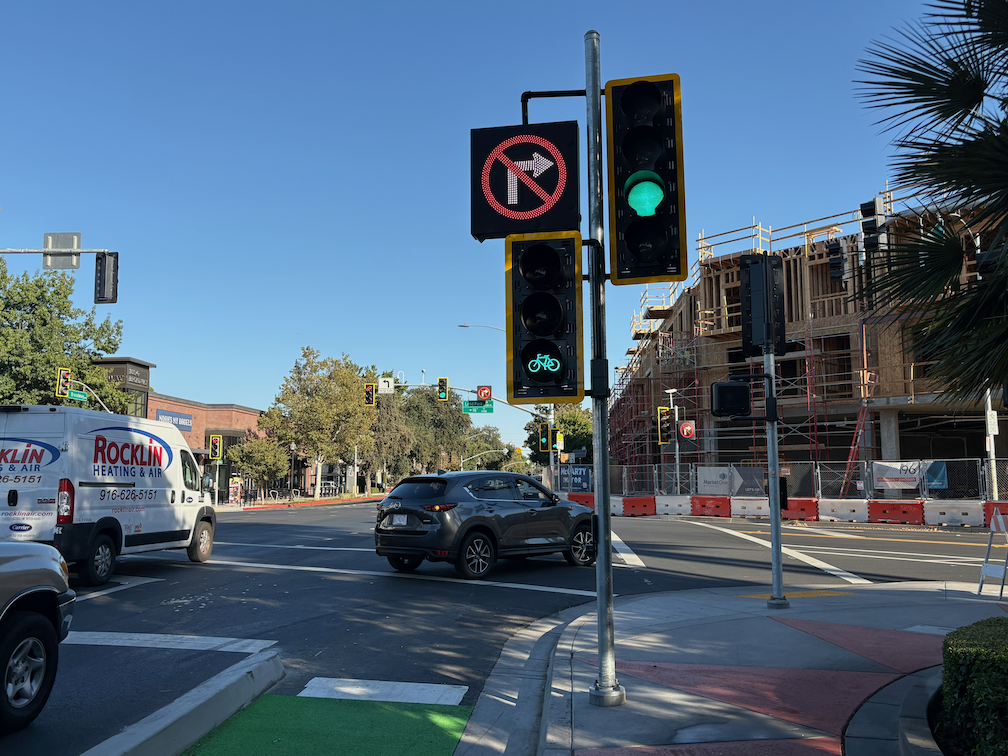
The last post I had noted that there was a required beg button for bicyclists to trigger the bike signal, but had failed to look up and notice that there was a complete set of regular signal, bike signal, and blank-out no-right-turn sign on the same post. It looks like:
Broadway eastbound at Land Park Dr, signal, bike signal, blank-out no right turn
For those unfamiliar with the blank-out signs, which are relatively uncommon in the city, it illuminates when turns are prohibited, and is blank when not prohibited. See photo below for the blank-out phase.
This signal array is definitely mis-communicating to drivers. When the bicycle signal is on, the no-right-turn sign should be on, and the regular signal red. This is mounted close to the right hand turn lane, and drivers see it as applying to that lane.
Most of the time, it is necessary to press the pedestrian beg button to trigger the bike signal. But then sometimes it is triggered without any press, and not due to the presence of bicyclists, as there were no bicyclists. Most signal cycles the bike signal remains red.
When the bike signal is on, there is a period of time when the no-right-turn sign is not on (blanked out), as below.
Broadway eastbound at Land Park Dr, signal, bike signal, blanked-out no-right-turn
Do drivers follow the no-right-turn sign? In an hour of observation, I did not see one driver follow the sign. Every driver turned across the no-right-turn sign and across the green bike signal. Every. Though I did not observe it at this time, I have experienced drivers yelling at me, and other bicyclists have reported being yelled at, by drivers who think they have the right of way and wonder why bicyclists are proceeding and interfering with cars. The photo below shows just one of about 70 drivers who turned against the no-right-turn sign.
Broadway eastbound at Land Park Dr, driver turning against no-right-turn sign
Solutions
The regular signal should remain red while the bike signal is green. The placement of this signal is interpreted by drivers as applying to the right hand turn lane, so it must be red.
The bike signal must have an exclusive phase where all other vehicle movements are prohibited. A properly designed intersection with a properly designed signal system probably would not need an exclusive phase, but this is NOT a properly designed intersection and NOT a properly designed signal system.
The pedestrian beg button should be removed from the bike lane, and automatic detection of bicyclists installed. The city knows how to do this, and has done it at a few other intersections, but chose not to here.
Bicyclists will be fatally or severely injured here, and the cause of the crash will be mis-designed roadways, for which city engineers are directly responsible. Drivers are just responding to a mis-designed roadway, the guilty party is the traffic engineers.
The design document for Broadway Complete Streets, and as built, has a through lane, a dedicated left hand turn lane, and a dedicated right hand turn lane. This right hand turn lane is the source of the conflict, the source of the danger. The roadway as built prioritizes motor vehicle throughput over safety.
Additional posts on Broadway Complete Streets are available at category ‘Broadway Complete Streets‘.
On Broadway eastbound at Land Park Drive, there is a bicycle signal face, shown below. The signal is permanently red, it never changes to green. The presence or absence of bicyclists makes no difference; it does not change from red. This is confusing both motor vehicle drivers and bicyclists. Bicyclists wait for it to change, and it never does. Drivers wonder why bicyclists are proceeded along Broadway with the green ‘car’ light when the signal clearly says that they should not be proceeding. I have seen drivers yelling at bicyclists for going when it is not their turn, and this has been reported to me by a number of people.
This issue has been reported to the city, twice by myself, and multiple times by other people. It has been this way for at least two weeks, perhaps longer. The city has decided to ignore these reports and to not fix the issue. The city is endangering bicyclists, and is in fact legally liable for knowing that a safety hazard exists and doing nothing to respond. This is criminal behavior on the part of the city. Sorry to be so blunt, but when city employees, or contractors acting on behalf of the city, ignore a known and easily solvable safety problem, that is criminal behavior. Period.
This would be so easy for the city to temporarily solve, by covering the bicycle signal face so that it is not visible. The pedestrian crossing sign over Broadway at the east side of the intersection is covered, due to the construction on the corner closing the crosswalk. Beyond a temporary fix, the city needs to determine why the bicycle signal face is not working, and make it work.
I was a strong supporter of RRFBs (rectangular rapid flashing beacon), where a safer crossing of the street is intended mid-block. I worked with transportation agencies in a number of locations to get them installed, and was very happy to see them go in.
They are used where multi-use trails cross roadways, and at intersections where additional traffic calming and safety are needed, but where the transportation agency does not want to add stop signs, or is unwilling or financially unable to install a traffic signal. The cost savings of an RRFB over a traffic signal are significant, about $25K for a RRFB, and upwards of $1M for a full traffic signal.
But…
Driver behavior has rendered RRFBs untenable for protecting people walking. I have observed a number of RRFB locations over the last few months. All of them are failing. Between 25% and 50% of drivers are failing to yield to people using these crossings, bicyclists or walkers. I have seen several people almost get hit by car drivers. Some drivers are slowing but failing to stop, or yield, and some drivers are not even slowing. Apparently the attitude of many drivers is that the RRFBs are only advisory and do not require yield to people in the street. Of course the law requires yielding to people crossing the street in a crosswalk, whether there is any type of signing or signaling, or not. But drivers don’t see it that way.
So, I find myself having to withdraw support for RRFBs. I will not support them as freestanding safety improvements, not as part of project. It is sad that driver behavior has erased the benefit of a safety enhancement, but it is a fact, and driver behavior gets continuously worse, never better.
Update: I was incorrect that a ban citywide would not require signing. See below for more information. Thank you, Matt, for the heads up.
Many places throughout the United States are considering banning turns on red signals. Permitting turns on red was a fuel-saving practice implemented in the 1970s, though there is little evidence it actually saved fuel. There is considerable evidence that it decreases safety for walkers and bicyclists, and perhaps motor vehicle drivers and passengers. Though turns on red signals are not the greatest danger walkers and bicyclists face, banning the practice would have safety benefits. It is a partial protection against oversized SUVs and trucks, which have large blind zones that contribute to striking walkers and bicyclists. Though people think of this as no-right-turn-on-red, in Sacramento central city with its overabundance of one-way streets, it may also be no-left-turn-on red.
San Francisco is considering an expansion of its no-turn-on red zones from the Tenderloin, where it has increased safety and calming traffic, to more of the downtown area. Washington DC has banned turn-on-red, though it doesn’t take effect until next year. Chicago and Seattle have considered bans.
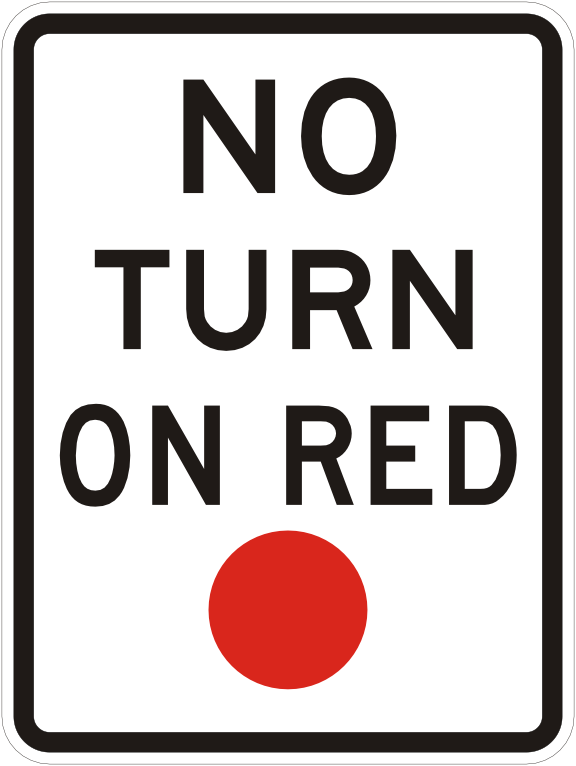
The signs used to indicate no turn on red are:
MUTCD R10-11a No Turn on RedMUTCD R10-11 No Turn on RedNo Right Turn on Red blank-out sign
How should the City of Sacramento, and the rest of the counties and cities in the region respond? The options are:
ban citywide: Turns on red would be illegal throughout the city (or county). The advantage is that no signing would be needed since it would apply to all signalized intersections. However, this may not have as great a safety benefit as a more targeted approach.
ban at locations of crashes involving turning vehicles: This is a no-brainer. Turn on red should be banned at any intersection where there is a history of crashes caused by vehicles turning on red. This should be city policy, to install signs at any location where SWITRS indicates there is an issue, or immediately after any crash.
ban at intersections with a high walker count: This is probably the most beneficial for safety. The problem is that the city does not collect data on the number of walkers using crosswalks (marked or unmarked), so it would not know where to start. The lack of data collection is a failure on the part of the city, but it is nevertheless a fact.
ban at separated bikeway locations: A ban at the intersections with separated bikeways (also called protected bike lanes, parking-protected bikeways, or cycletracks) would protect bicyclists and give them a head start over motor vehicles. Leading pedestrian intervals (LPIs), which bicyclists can also use, can offer even better protection.
I have resisted turn-on-red bans in the past because I thought they had a lower safety benefit than many other measures that could be taken, but traffic violence has become such an issue that any action to reduce death and injury for walkers and bicyclists may be worth taking, and taking now.
As an alternative to bans, yield-to-pedestrians (and bicyclists) signs can also be installed. Two versions are shown below, on the left, the approved MUTCD R10-15R sign, and on the right, the bicyclist and pedestrian version with interim approval in California, and in use in many locations. My observation is that these signs are widely ignored by drivers, but of course, they do help those drivers who are willing to follow the law.
MUTCD R10-15RMUTCD R10-15b (California interim)
California Vehicle Code (CVC) 21453
CVC 21453: (a) A driver facing a steady circular red signal alone shall stop at a marked limit line, but if none, before entering the crosswalk on the near side of the intersection or, if none, then before entering the intersection, and shall remain stopped until an indication to proceed is shown, except as provided in subdivision (b). (b) Except when a sign is in place prohibiting a turn, a driver, after stopping as required by subdivision (a), facing a steady circular red signal, may turn right, or turn left from a one-way street onto a one-way street. A driver making that turn shall yield the right-of-way to pedestrians lawfully within an adjacent crosswalk and to any vehicle that has approached or is approaching so closely as to constitute an immediate hazard to the driver, and shall continue to yield the right-of-way to that vehicle until the driver can proceed with reasonable safety. (c) A driver facing a steady red arrow signal shall not enter the intersection to make the movement indicated by the arrow and, unless entering the intersection to make a movement permitted by another signal, shall stop at a clearly marked limit line, but if none, before entering the crosswalk on the near side of the intersection, or if none, then before entering the intersection, and shall remain stopped until an indication permitting movement is shown.
Under section (b), signs are required, even if the ban is citywide. Section (c) does allow use of red arrows, but the red arrow signal would be more expensive than a sign, so only used in a few situations. The blank-out sign, shown above in the set of three, is probably the most effective, but again, more expensive that a regular sign.
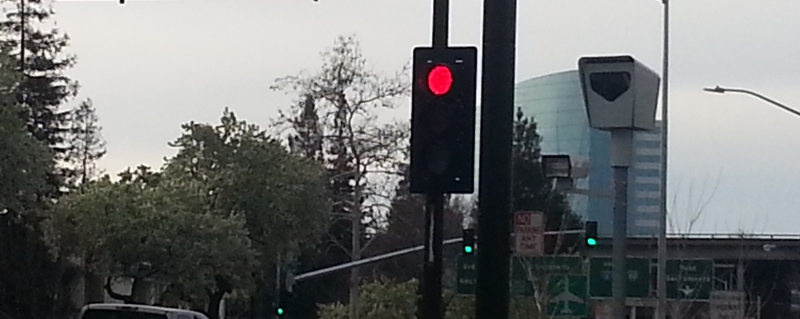
A SacBee article today notes the end of the red light camera program in City of Sacramento, which was part of Sacramento County’s program: Sacramento’s red light camera program has been shut down by the Sheriff’s Office. Here’s why. (sorry about the firewall)
A quote from the Sacramento County Sheriff’s Office is particularly galling: “Gandhi said the Sheriff’s Office wants to focus on its mission of suppressing violent crime and other criminal activity.” Apparently, in the view of law enforcement, traffic violence is not a violent crime. Apparently, the fact that red-light runners kill and injure walkers, bicyclists, passengers, and other drivers is of little concern. Sadly, this is a very common law enforcement attitude.
If cost-cutting were an appropriate response to criminal activity, it would be reasonable to just eliminate law enforcement. Law enforcement responds to criminal activity; it does little to nothing to prevent criminal activity. Automated red light enforcement is an effective response to criminal activity, and it does reduce future criminal activity. Why is the Sheriff’s Office and the City of Sacramento not interested?
If you think that direct law enforcement of red light running is a good replacement, you would be wrong, for two reasons. One, almost no enforcement of motor vehicle violations occurs anymore, other than some enforcement of speeding. Two, the law enforcement practice of pretextual stops, stopping people of color for traffic violations to search for other violations, and to intimidate people of color, results in law enforcement violence against drivers of color.
One of the useful things the city was doing to reduce traffic violence is no longer. Don’t you feel safer now? You can visit the city’s Red Light Running Program page, in case you wish to leave condolences, remembrances, or flowers.
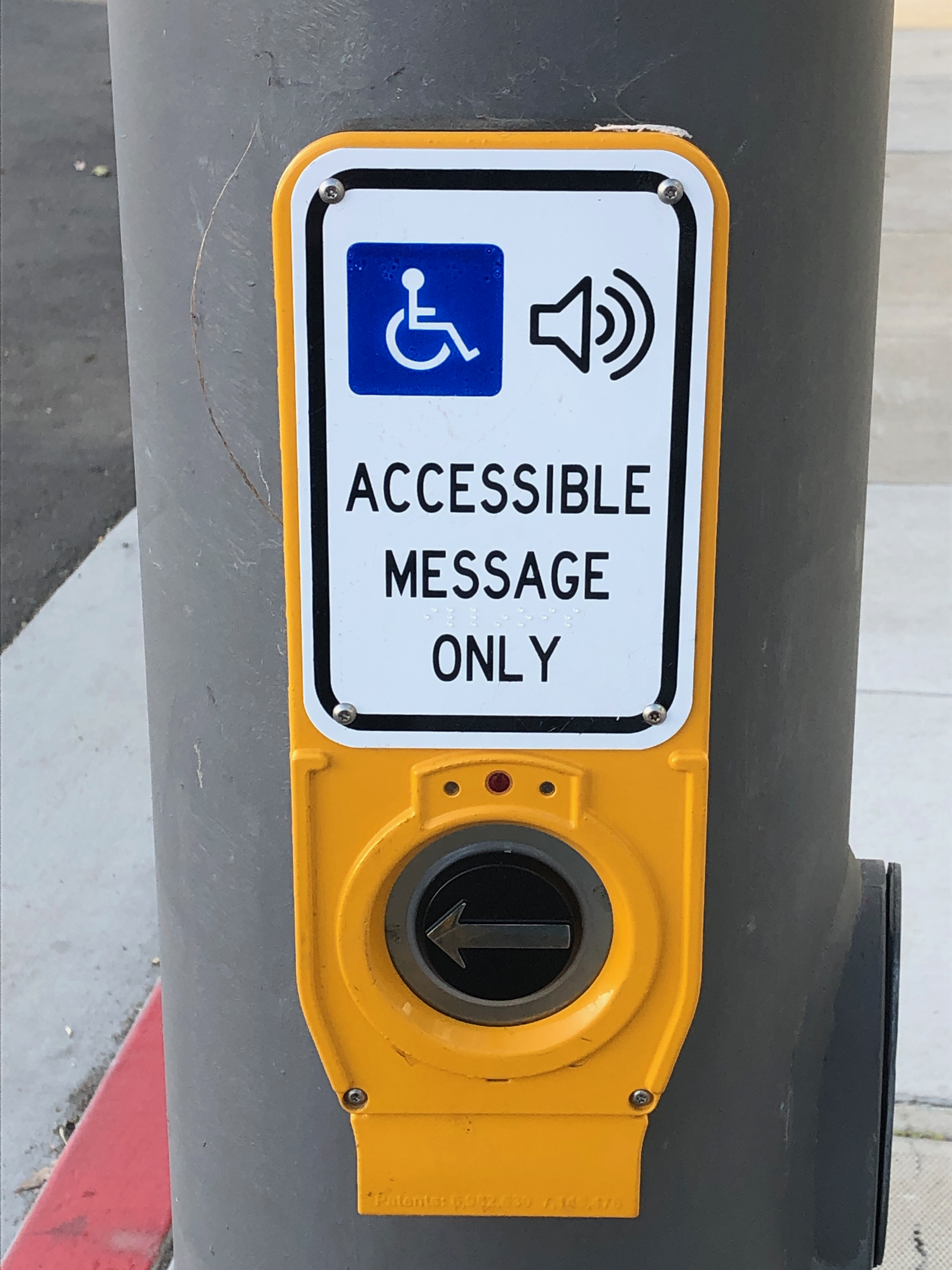
A previous post about new beg buttons on Alhambra Blvd noted that there are now beg buttons where there used to be auto-recall pedestrian crossings. I walked Alhambra this week, and noted that there are eight intersections with these new beg buttons (technically called pedestrian actuators or Accessible Pedestrian Signals APS). At auto-recall crosswalks, the pedestrian signal comes on at every signal cycle. At beg button crosswalks, the signal comes on only if requested by the pedestrian. The city has many of both types of crosswalks, but these particular locations are new. The intersections are Alhambra and: J Street, K Street, L Street, Capitol Avenue/Folsom Blvd, N Street, P Street/Stockton Blvd, Q Street, S Street. At each intersection there are eight of these new beg buttons on new posts, for a total of 64 new beg buttons.
No one seems to know who authorized this project, nor what funds were used to pay for it. I have confirmed that the project never came before the Active Transportation Commission (SacATC). All significant pedestrian projects are supposed to come before SacATC, and the fact that this one did not probably indicates that the staff in Public Works knows that this is a motor vehicle project, and not a pedestrian project. Though it is a good bet that pedestrian safety funds were used to pay for it.
Though these beg buttons are not signed with the ‘wave at’ sign R10-3j(CA) that the new ones at 21st Street and I Street, they do seem to have the same function, that they detect people, waving or not, up to about 18 inches. It seems odd that the city would have purchased these infrared detector actuators, which must be more expensive than plain touch buttons, but then did not indicate them as such. Installation of new accessible pedestrian signals is about $70K per intersection, though replacement of buttons at existing locations is only about $14K per intersection. I have been unable to find costs for passive detection systems (they all seem to require a quote process).
A reminder, if one is needed, that beg buttons have no safety benefit for people walking. They are a motor vehicle device, meant to reduce the length of signal cycles so that more cars can go faster.
The solution to this is to prohibit the use of pedestrian beg buttons throughout the city. Existing locations can be converted to the audible crossing signals that are now required by PROWAG. The relevant sections of PROWAG are R307 Pedestrian Push Buttons and Passive Pedestrian Detection and R308 Accessible Pedestrian Signal Walk Indications. Unfortunately PROWAG does not have a definition for ‘passive detection’ to specify what the detection radius or functionality is. It might be presumed this is the same at automated pedestrian detection, but not certain. Under PROWAG, new or changed locations require audible signals, but this can be met by audible/tactile push buttons or passive detection.
San Francisco is replacing the signing on their pedestrian actuator locations with the signing below.
The bike signals and related signaling is now installed at the intersection of 21st Street and I Street, where the northbound 21st Street separated bikeway ends, and the westbound I Street separated bikeway begins. East of this intersection, I Street is two-way. The I Street bikeway is on the north side, right side, so bicyclists must transition from the southwest corner to the northwest corner. Bicyclists continuing north on 21st Street must also transition from the left side bikeway to the right side general purpose lane.
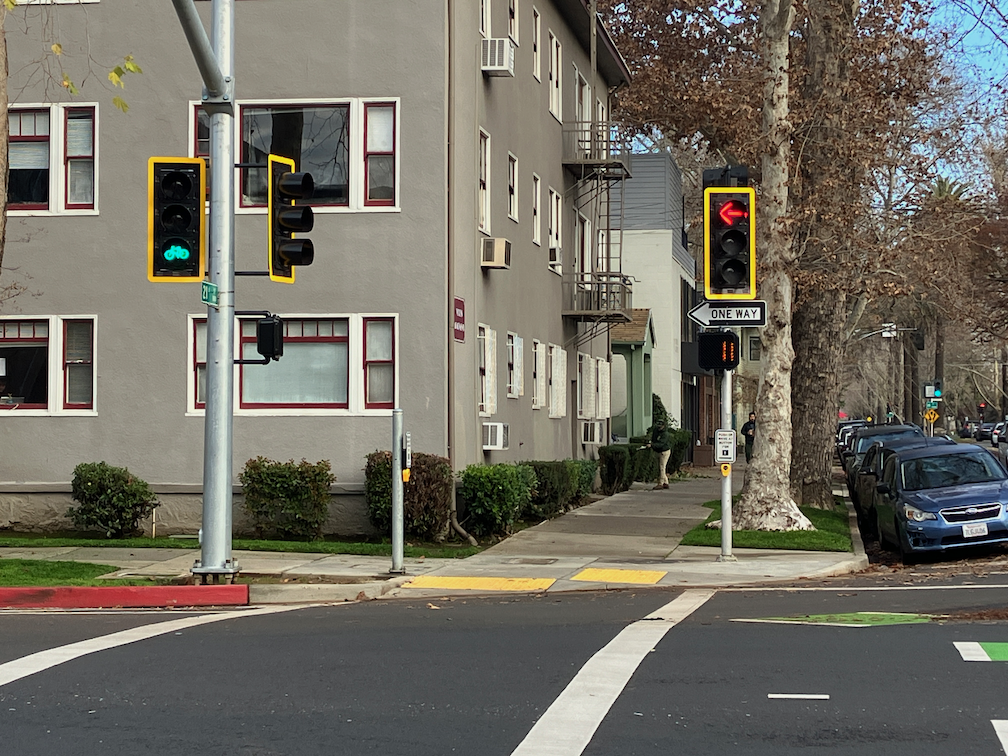
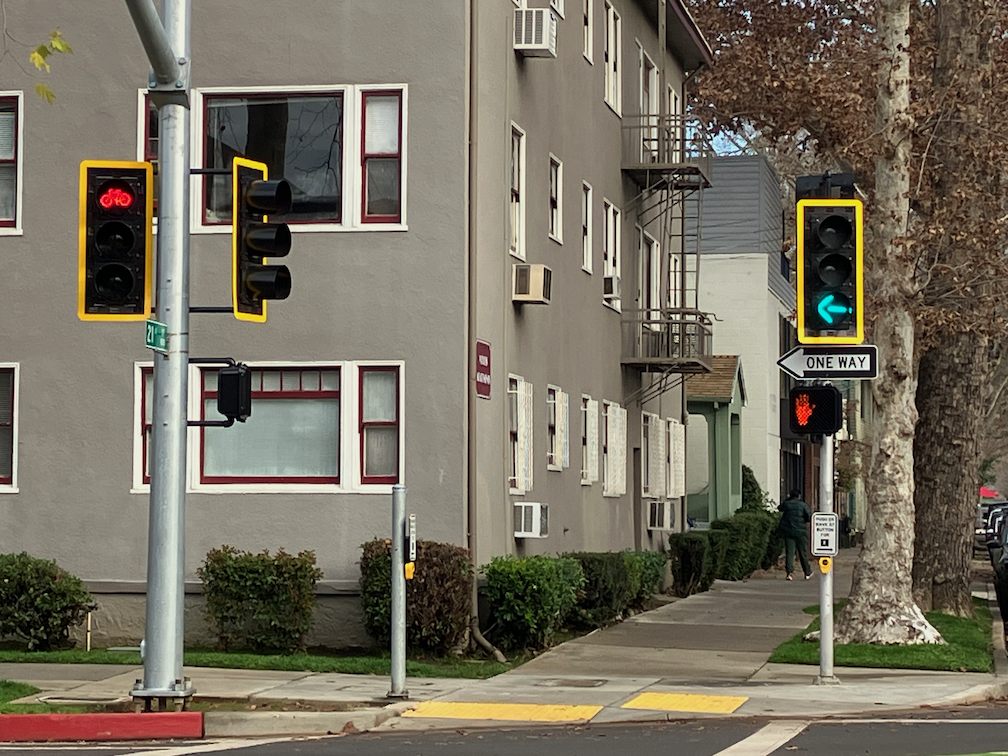
The city has attempted to solve this problem by installing bicycle signal faces on the northwest corner, for bicyclists turning left on I Street, and the northeast corner, for bicyclists going straight on 21st Street. The photos below show the northwest corner bicycle signal green and turn arrow red, bicycle signal red and turn arrow green, and the bike signal on the northeast corner.
21st & I St, bicycle signal green and turn arrow red21st St & I St, bicycle signal red and turn arrow green21st & I St, bike signal on the northeast corner
The signals are set up so that bicyclists, and walkers on the west leg of the intersection, have an exclusive phase, meaning that no cars are supposed to be moving when the pedestrian signal shows walk, or the bike signal is green. Actually, triggering the bike signal also triggers the pedestrian signal, and vice versa, they are ganged together.
The problem is that drivers are turning left from 21st Street to I Street against the red arrow, endangering bicyclists going west and north, and walkers in the crosswalk. In about 30 minutes of observation over the last few days, I saw drivers turning left against the red about half of all signal cycles. Once the front driver decides to turn, all other drivers follow. I did not see any drivers turning from the right hand left-turn-straight lane.
California Vehicle Code (CVC) 21453 says: (c) A driver facing a steady red arrow signal shall not enter the intersection to make the movement indicated by the arrow and, unless entering the intersection to make a movement permitted by another signal, shall stop at a clearly marked limit line, but if none, before entering the crosswalk on the near side of the intersection, or if none, then before entering the intersection, and shall remain stopped until an indication permitting movement is shown.
So, every single one of the drivers who turned left on the red arrow was breaking the law. Sadly, the city has designed an intersection that assumes drivers will not break the law, but as every bicyclist and walker knows, drivers do so pretty much continuously. I do not know what the solution is for this intersection. It is difficult to control driver behavior. In any other situation than roadways, the behavior of routinely breaking the law is called lawlessness.
Signal actuation (beg buttons)
In addition to the new signals, there are signal actuators, generally called beg buttons. Nothing here is on auto-recall, meaning there is not a bicyclist and pedestrian phase on every signal cycle, but only when requested.
The actuator for the pedestrian signal is shown below. This is first placement of this technology in the city, so far as I know. The sign is CA-MUTCD R10-3j (CA). The ‘wave at’ function is an infrared proximity detector, that works for up to about 15 inches, and also works for standing as well as waving. An example commercial product is WiAPPS Wave, though I don’t know what vendor the city used. It is not automated pedestrian detection, which would cover the full width of the sidewalk.
pedestrian actuator (beg button), 21st St & I St
Strangely, the bicyclist actuator (beg button) does not have this technology; the bicyclist must actually touch the button.







 Getting Around Sacramento