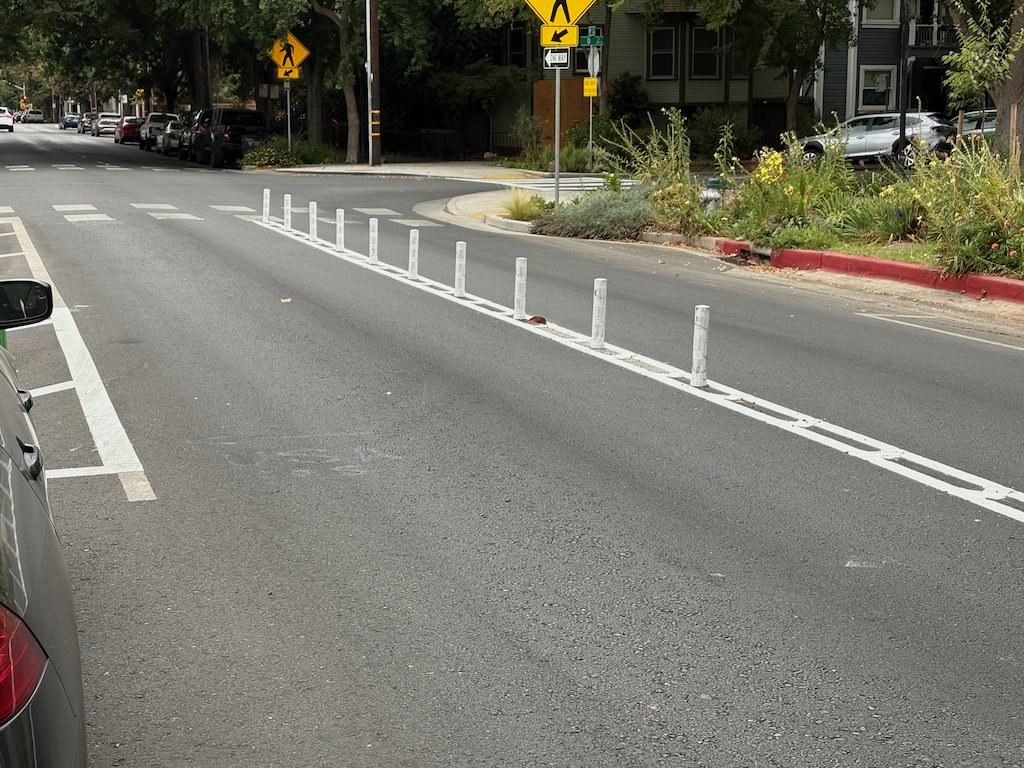
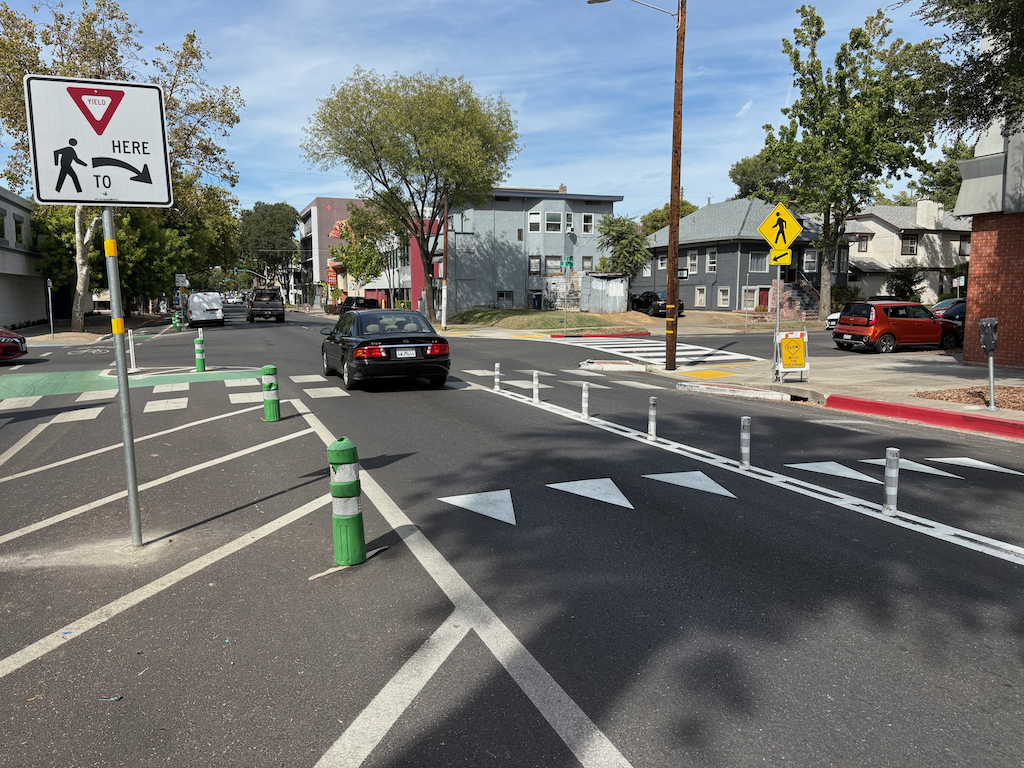
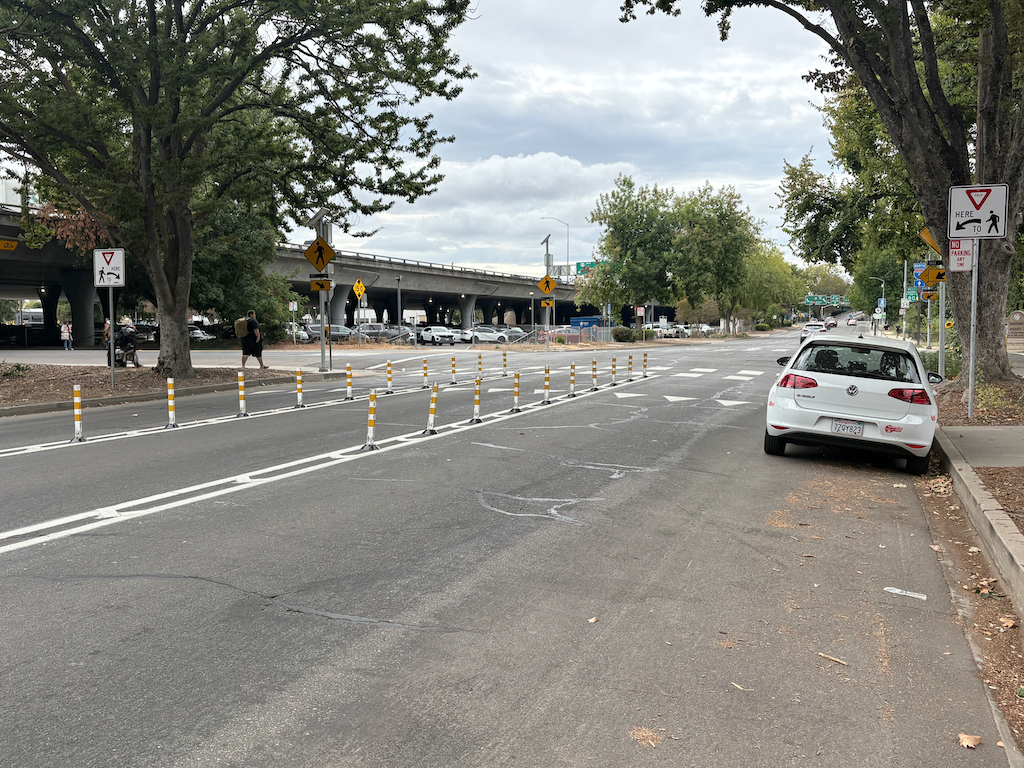
The City of Sacramento has recently installed lane channelizers at new locations in the central city. The three I’ve noticed are shown below. If you are aware of others, please let me know. The four locations that have been in place for several years are 15th Street (southbound) at O Street and at R Street, and 16th Street (northbound) at R Street and O Street. See Strong SacTown: Things that work: traffic posts and traffic calming measures, Lane Channelization, for these older locations. There are other locations where vertical delineators separate opposing lanes of traffic, which I call centerline hardening; for another post.
19th St at O St, channelization with vertical delineators21st St at O St, channelization with vertical delineators, also yield markersW St at 8th St, channelization with vertical delineators, also yield markers
The City of Sacramento has been installing temporary curb extensions, with vertical delineators mounted on bases, at intersections. The extension is ‘temporary’ in the sense that it is not a concrete or hardened extension, though in most cases they will not be replaced with ‘permanent’ due to the expense of permanent installations. These curb extensions slow turning drivers, and reduce the crossing distance for people walking, or rolling. These are an effective countermeasure that increases safety, and I am very happy to see them being installed. In the photo below, on the northeast corner of S Street and 27th Street, the crosswalks have also been freshly painted in a high visibility pattern. The marked crosswalk over 27th Street may be new, and seems to be a new pattern for the city to use.
This particular installation also serves as daylighting, by preventing parking in the daylighting area approaching the intersection. I did not measure it, so am not sure if it meets the legal 20 foot requirement, but it does serve the purpose of increasing visibility by precluding parking. However, many of the installations do not set off the daylighting area, for example the northwest corner in the photo. I do not know why the city has decided in some cases to include daylighting in the curb extensions, and in other cases, not.
Though it would increase the materials cost of installations, requiring more delineators, all curb extension installations should also include daylighting, unless the location already has red curbs and/or signing for daylighting. AB 413 (2023), the daylighting law, does not require red curbs, signing, or delineators, however, the city’s intent is to ticket only where there is an indication for drivers of the law.
It appears that these vertical delineators are Pexco FG 300 Turnpike Grade Curb System. The bases discourage but don’t prevent motor vehicle drivers from running over the delineators ‘just for fun’, and provide more visibility than simple vertical delineators. I have so far not seen any curb extension locations where the delineators have been damaged by drivers. Delineators on the bikeway turn wedges have definitely been damaged by motor vehicle drivers.
I wonder if the lane channelizing vertical delineators on 15th Street and 16th Street should be replaced by this type (Hmm. 16th St traffic calming). These installations really do reduce lane changes at the last moment, which endanger walkers using the crosswalks, the ‘multi-lane threat’ that kills people. They are a success story for Sacramento, and should be used in more locations.
temporary curb extension at S St & 27th St, northeast corner
Note: Added letters of support from four organizations, below.
The Budget & Audit Committee of the Sacramento City Council meets tomorrow (!) Tuesday, February 25, 2025, 11:00 AM in city hall council chambers. The Budget & Audit Committee members are Roger Dickinson, Chair, District 2; Karina Talamantes, District 3; Caity Maple, District 5; and Eric Guerra, District 6.
On the agenda is item 10 SacATC 2024 Annual Report. The discussion, however, will include more than just the annual report. It will include the city’s proposed quick build program. Quick build, sometimes called tactical urbanism, is a concept related to Vision Zero, that rather than just accepting traffic violence, the city would take action to reduce or prevent future crashes at that location. What makes it unique, and different from the long term roadway redesign that the city undertakes when they can get grant funding, quick build analyzes the issue now, and takes action soon to correct it.
The city is calling this effort TAG Team (tactical action group), and it would be implemented from existing budget and staffing limits with six staff dedicated to the project.
If you can’t make daytime meetings, you can submit an eComment on the city meetings page. The earlier you submit eComments, the more likely committee members are to see them before the meeting.
Three examples of quick builds: the street closure and bikeway improvement at Broadway and 2nd Avenue and 34th Street, with yellow vertical delineators; the corner curb extensions that have been installed at some corners with paint and/or white vertical delineators, and lane channelization delineators on 15th and 16th Streets. Vertical delineators are much less expensive, and also somewhat less effective, than concrete curbs, but they do reduce the likelihood and/or severity of crashes.