A workshop on the H Street Bikeway was held Thursday, February 26. There were at least 30 members of the public who attended, which is pleasantly surprising, indicating strong public interest in the project. Most workshops have far less participation.
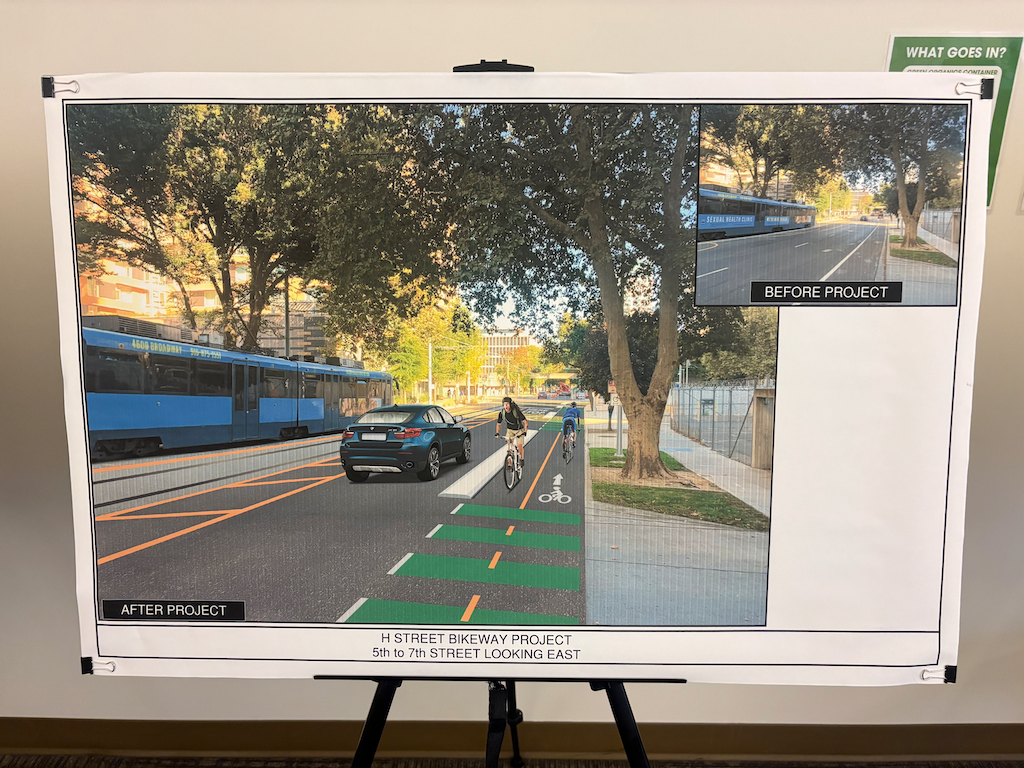
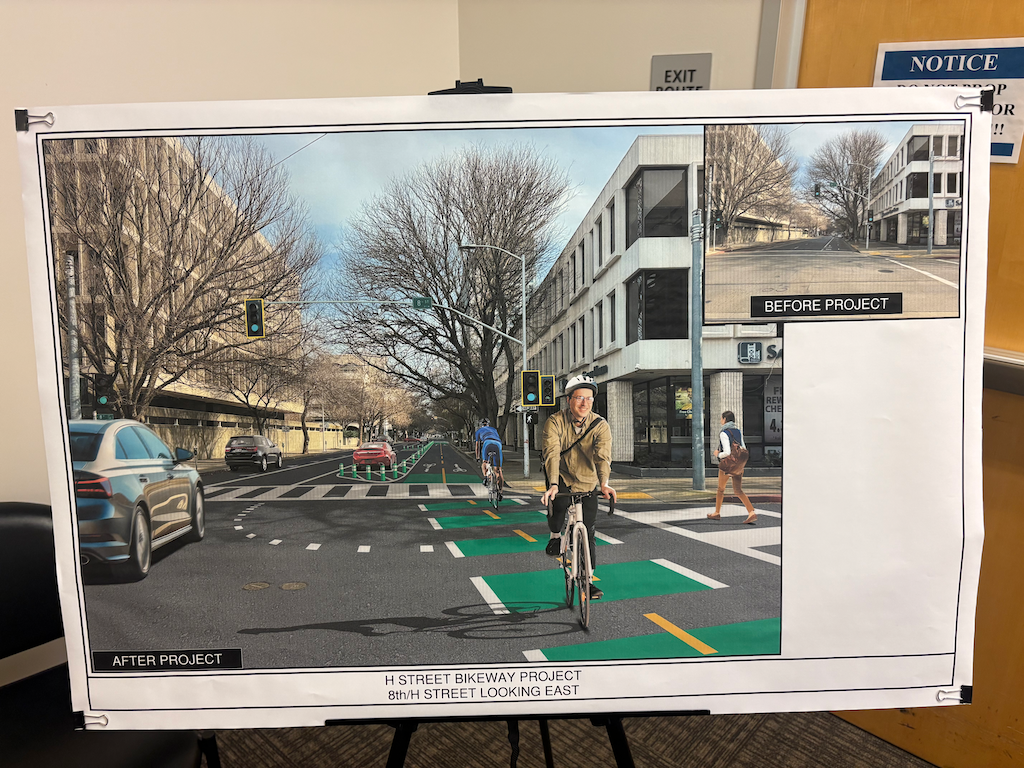
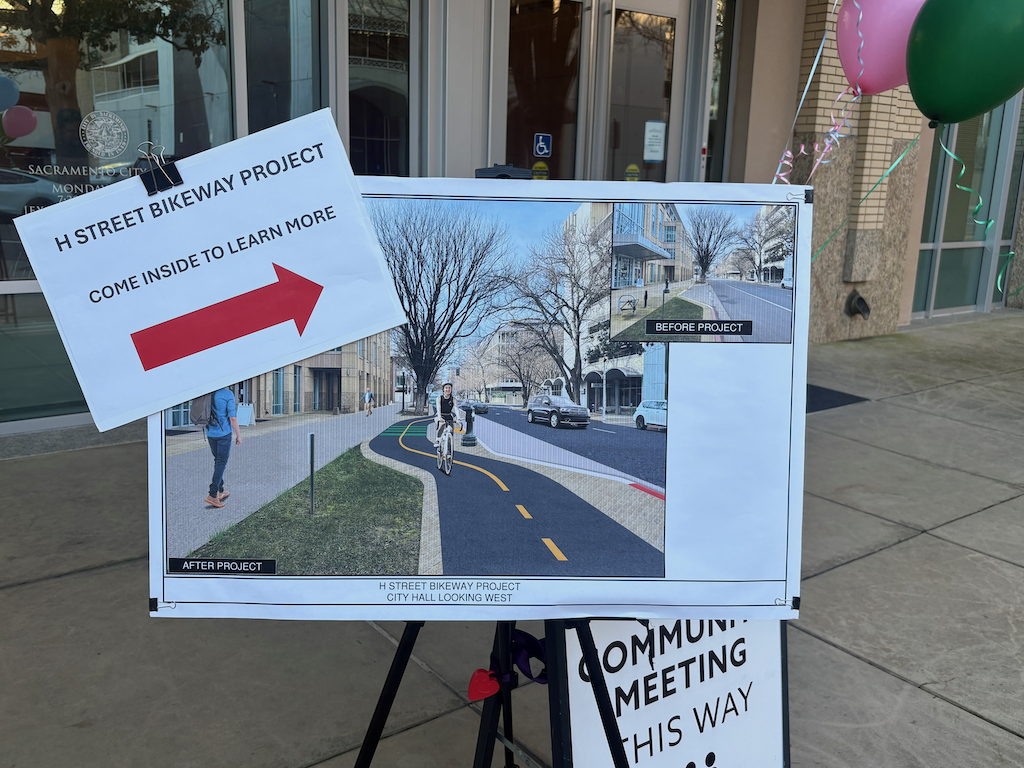
The group presentation was brief. Most of the discussion was with city staff and consultants at the display boards. There were some renderings which I had not seen before, below. None of these three is the same as the rendering shown at the top of the project page.
I did not capture the display boards showing each block segment. They are very similar to the ones presented at the SacATC meeting, but some corrections and enhancements were made after feedback from that meeting. Among them:
A 10 foot width will be maintained throughout the project, except 9th to 10th Streets, where the bikeway is at the level of and within a pedestrian area, where a narrowing may help maintain lower bicyclist speeds.
Every intersection will have bicycle signal faces; this was an oversight in the images.
An alternative was proposed for 10th Street, narrowing the east side parking in order to create a buffer on both sides of the bike lane. The option to place the bikeway against the curb, for parking protection, was much discussed but is so far not the option being presented.
There are other details. Hopefully the brief presentation and the updated images and cross-sections will be posted to the webpage.
A lot of discussion between the public and the staff and consultants revolved around the issue that a clear design criteria was the preservation of parking. The lead consultant, Mr. Wright, mentioned a number of times how they had managed to preserve parking. This is sad. The purpose of the TIRCP grant is to enhance transit and active transportation access to the station. Preservation of parking is not one of the criteria. I don’t object to street parking. It has the safety problem of vehicles entering and leaving, but also has the safety benefit of slowing traffic due to the perceived friction. However, when roadway width is needed for other purposes, such as sidewalks and bikeways, it should be removed or reduced.
The primary reason for the right turn lanes at 7th Street and 9th Street is so that bicyclist can move while the straight through motor vehicle traffic is moving, but not when right turns are prohibited. The city feels that creating an exclusive bicyclist phase, where only bicyclists are moving and motor vehicles are stopped in all directions, would slow traffic too much.
For these two right turn situations, blank-out no right turn signs will be used. The city recognizes that regular no right turn on red signs don’t have much effect on driver behavior, but the blank-outs do. See no turn on red for Sacramento? for more info on blank-out signs. One is installed on Broadway at Land Park Drive (more on Broadway-Land Park bike signal).
To everyone who came, asking questions and providing opinions and experiences, thank you! Improvements may be incremental, but without you, they would be none.
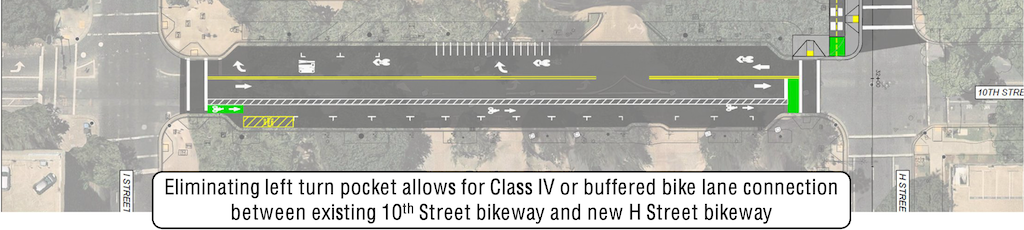
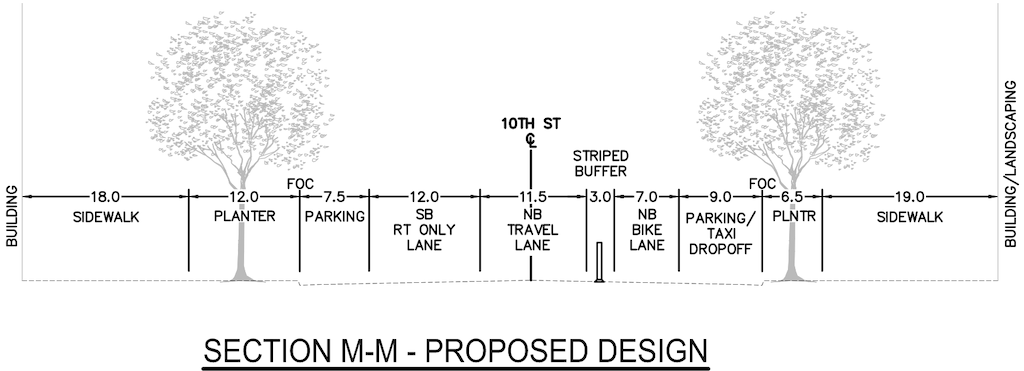
The 30% design for the 10th Street connection to the H Street Bikeway is shown below (these were also in the overview post H Street Bikeway: overview). The overall width of the roadway is 105.5 feet, and the ‘FOC face of curb’ width is 50 feet. The street narrows to 34 feet at the curb extensions at I Street and H Street.
H St Bikeway 10th St section, proposed (from SacATC presentation)H St Bikeway, 10th St section, proposed, 105.5 feet (from SacATC staff report)
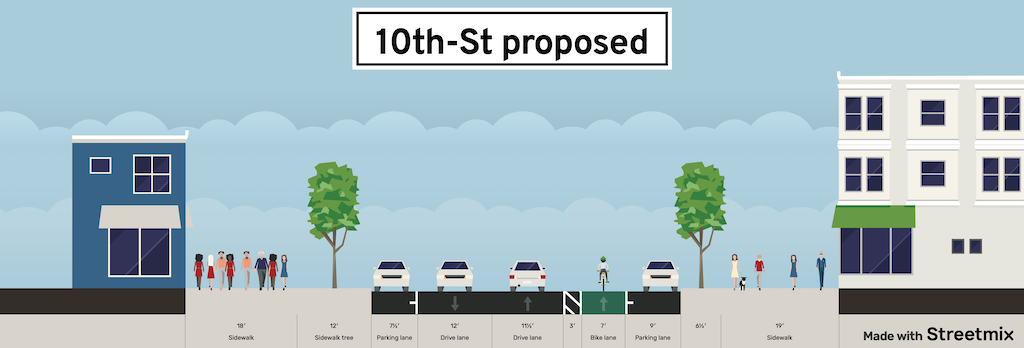
I have created a StreetMix cross-section duplicating the design cross-section so that it can be compared to an alternative recommendation.
H St Bikeway, 10th St cross-section, proposed (StreetMix created by Dan Allison)
The design proposes a 7 foot bike lane northbound, with a 3 foot stripped buffer, and a parking lane to the right against the curb. Despite the cross-section showing a vertical delineator in the buffer, this is not possible with a parking lane to the right of the bike lane. The bike lane continues the separated, mostly parking-protected, bikeway from the south, which is a good thing. But a buffered bike lane is less safe than a separated bike lane, so detracts from the safety and low-stress goals of the project. The design encourages drivers, whether parking or drop-off/pick-up, to cross the bike lane, a poor practice.
Instead, the design should create a parking-protected separated bikeway. This reduces the utility for drop-off/pick-up, but an larger area could be set aside in the parking lane for this purpose, and the conflict zone crossing the bikeway can be clearly marked. Bikeways that swing into the curb past curb extension, and out again past curb extension, feel awkward for bicyclists, but they have been installed in several locations along the separated bikeway network, and don’t seem to engender safety issues.
The design also proposes sharrows within a southbound general purpose lane. You will have to look closely at the image to see the sharrows, but there are there. They are placed far to the right, in the door zone. This is a very poor design. New sharrows should not be installed, as they don’t decrease crash risk over unmarked routes. If they were there, they should be placed in the exact middle of the travel lane, and supplemented by ‘bicycles allowed use of full lane’ signing (MUTCD R9-20). to make is clear that drivers should not be passing bicyclists in this block. It is particularly likely that drivers will squeeze out bicyclists against the curb extension at I Street. An alternative is to stripe a narrow 5 foot bike lane, without buffer or protection, marked with green. Not ideal, but better than sharrows.
The design retains existing parking. Though it is not clear that removing parking would allow a better design, this should always be a consideration. There is ample and never-full parking in the city garage on the south side of I Street between 11th and 10th Streets. The curb extensions at I Street and H Street are critical features for the safety of walkers, but they do constrain design in this block.
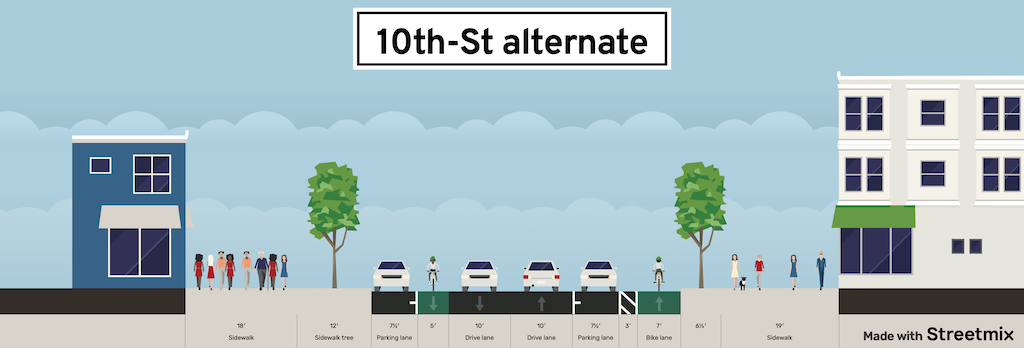
My suggested design is below.
H St Bikeway, 10th St cross-section, alternative design (StreetMix created by Dan Allison)
I do not have the time it would take to create an image of the street with the new design, but I think the cross-section will communicate clearly enough.
What is different? A southbound traditional bike lane (Class II) has been added. Both general purpose lanes have been reduced to 10 feet. There is no reason for over-wide lanes in this section. No buses, no delivery. The east side parking lane, an over-generous 9 feet, has been reduced to 7.5 feet. And the parking-protected separated bikeway is up against the curb, still with a 3 foot buffer from parked cars.
The H Street Bikeway project extends from 5th Street to 10th Street along H Street, and along 10th Street from I Street to H Street. It is intended to improve transit connectivity by double-tracking two blocks of light rail between 5th Street and 7th Street, and to improve bicycle access by providing a two-way separated bikeway (cycle-track) on H Street, which links to bikeways or bike lanes on 9th Street (southbound) and 10th Street (northbound). The project provides a reasonable solution, though it could be improved in a number of details (see H Street Bikeway: overview).
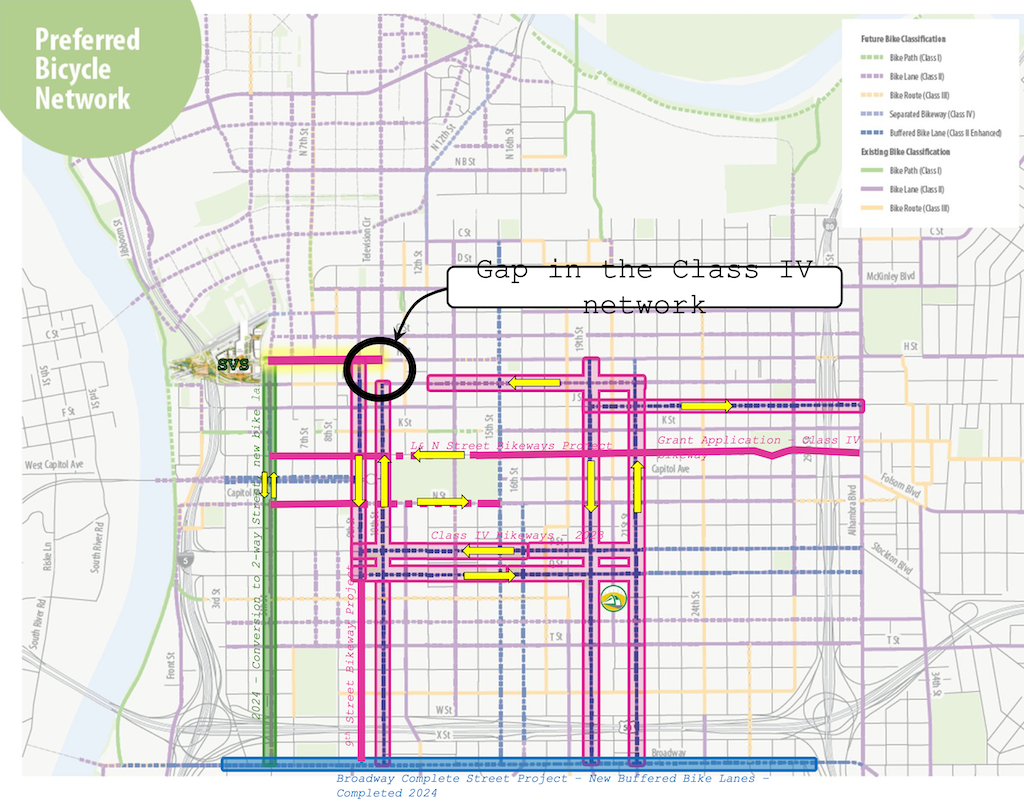
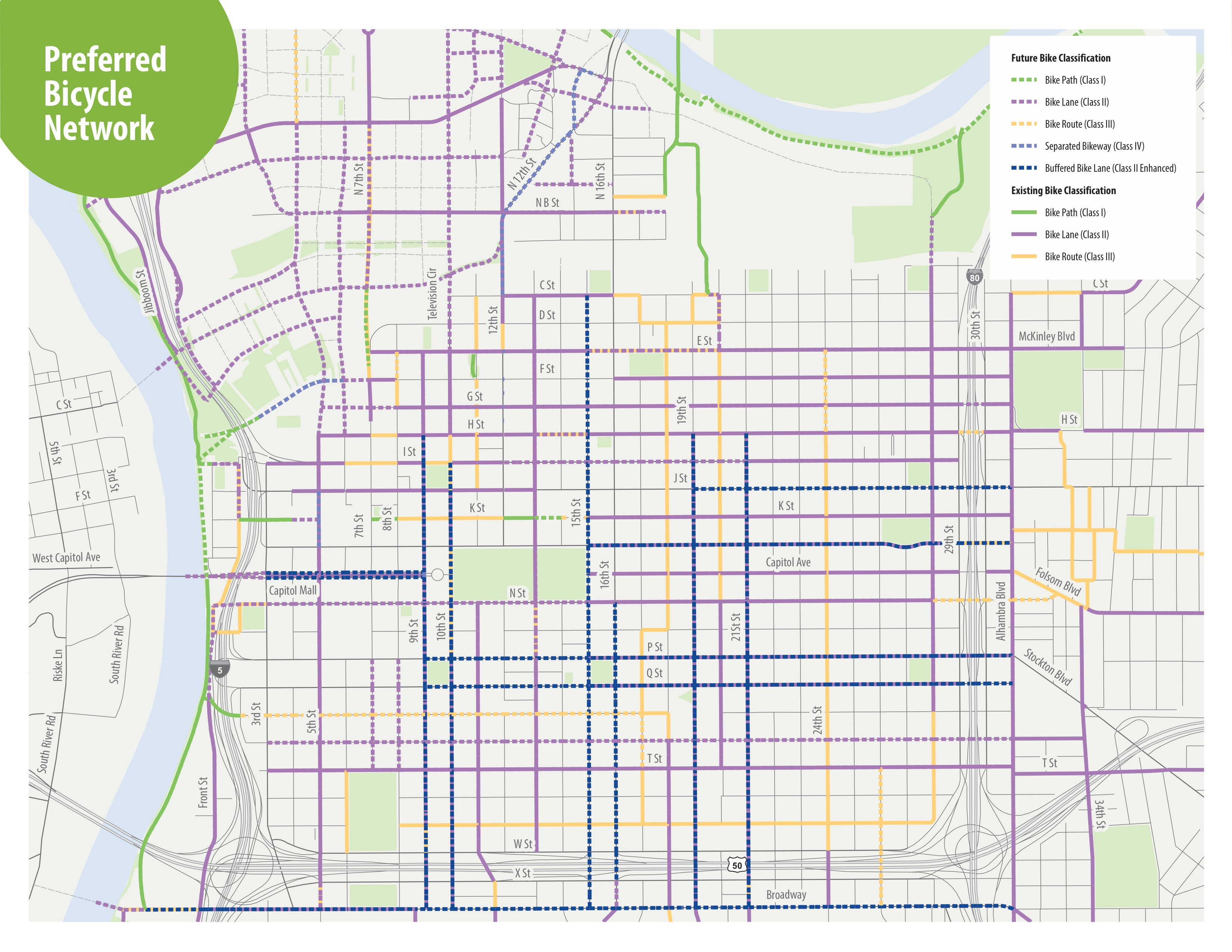
A map in the SacATC presentation shows the bikeway network in the central city, highlighting the gap on 10th Street from I Street to H Street.
Preferred Bicycle Network, showing gap on 10th St between I St and H St (from SacATC presentation)
It does not highlight the glaring gap on I Street between 12th Street and 10th Street. The separated, parking-protected bikeway on I Street, that starts at 21st Street, ends at 12th Street (it is just a bike lane in front of the fire department just west of 13th Street, but resumes further west).
For a bicyclist wanting to access the proposed two-way separated bikeway on H Street, they must use regular Class II (paint only) bike lanes from 12th Street to 10th Street, then proceed north one block in a buffered bike lane to H Street. I Street between 12th Street and 10th Street is three general purpose lanes. As it typical of any three-lane one-way street, motor vehicle speeds are well above the posted speed limit of 25 mph, except when congested. By the way, it is not posted at all in this section, though the change from two lanes to three lanes at 12th Street would make posting logical if not imperative.
There are other gaps, including 9th Street south of Q Street, and L Street and N Street. The map refers to a L & N Street Bikeways Project, but neither the planning or engineering sections of Public Works seem to have a webpage on that project. Strangely, the streets adjacent to Capitol Park are shown as Class II, paint only bike lanes, though these two sections without mid-block driveways are the most logical place for separated bikeways in the entire city.
The map from the H Street Bikeway project presentation at SacATC was adapted from an old Grid 3.0 map (2016), below.
Grid 3.0 map of central city preferred bicycle network
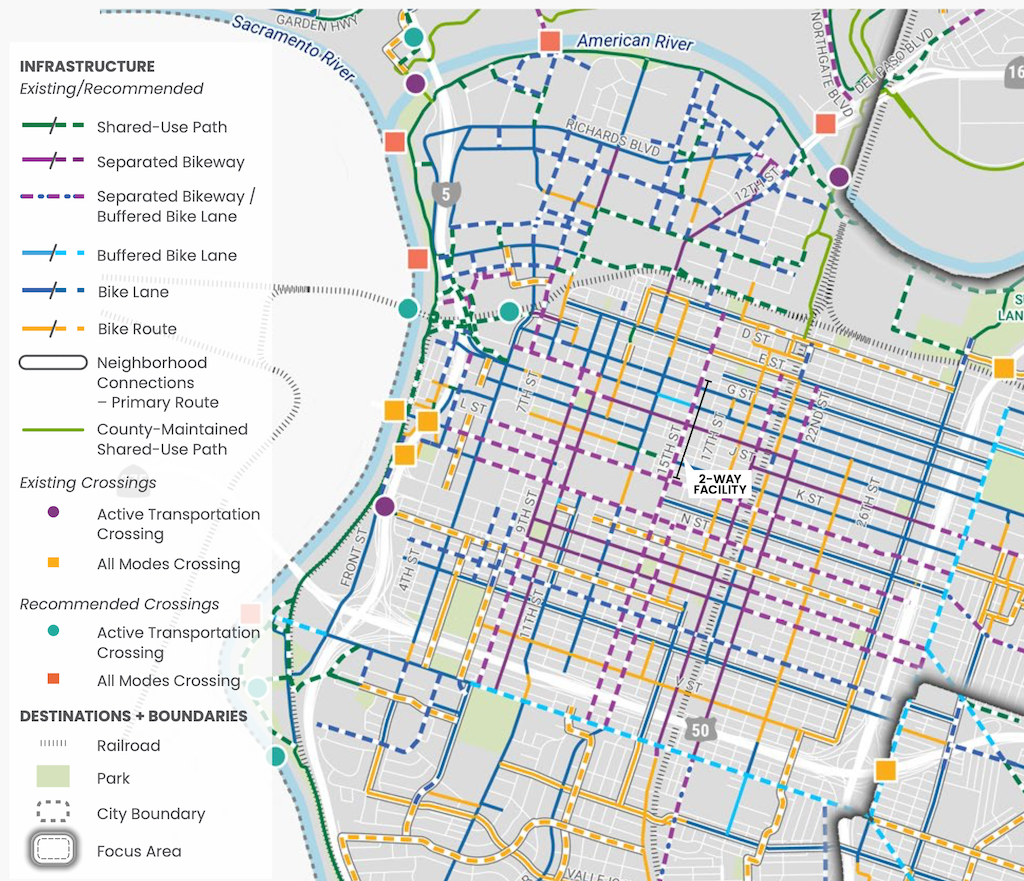
A more up-to-date map, with legend, is in the Streets for People Active Transportation Plan, page 80, ‘Figure 30 – Recommendations for People Biking in Central West Sacramento’, excerpted below. This map shows a separated bikeway (purple) continuing from 21st Street to 9th Street.
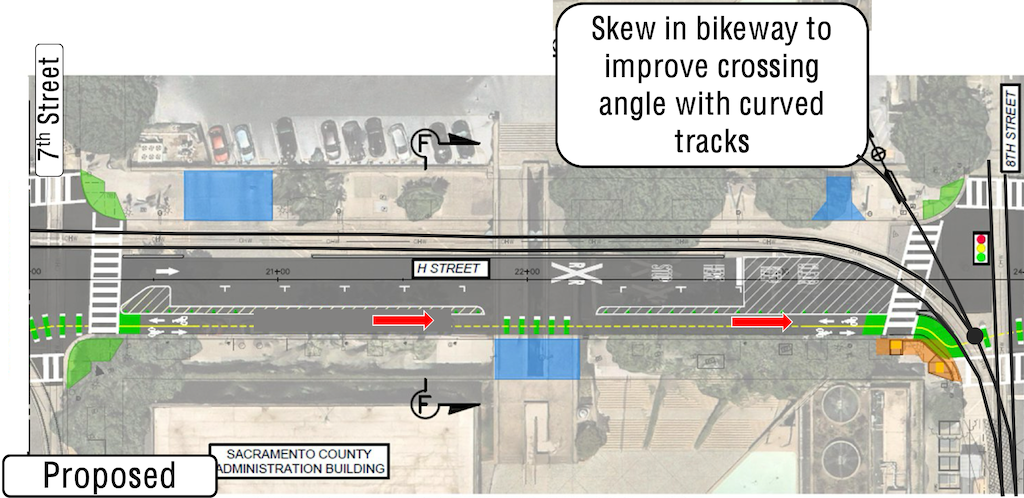
In designing a safe and welcoming two-way bikeway (cycletrack), design of intersections is critical. This post highlights the intersection. Both the staff report and presentation diagrams split the roadway at the intersections, obscuring the intersections themselves. The diagrams below show the intersections, and not the blocks in between the intersections. The diagrams are from the presentation, which offer more details about the intersections than the staff report. The images are rough because I glued together two parts which were not the same pixel resolution, but they provide a good idea of the intersections.
Key points:
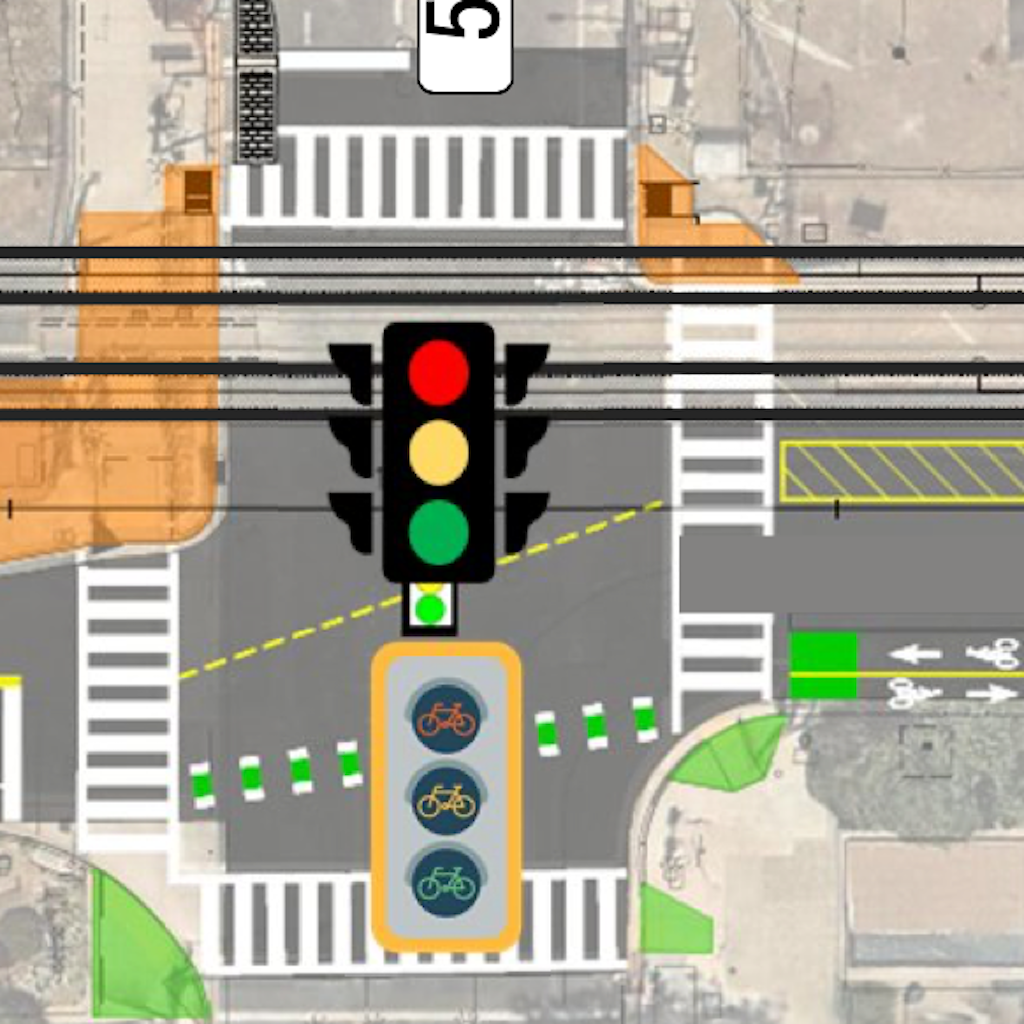
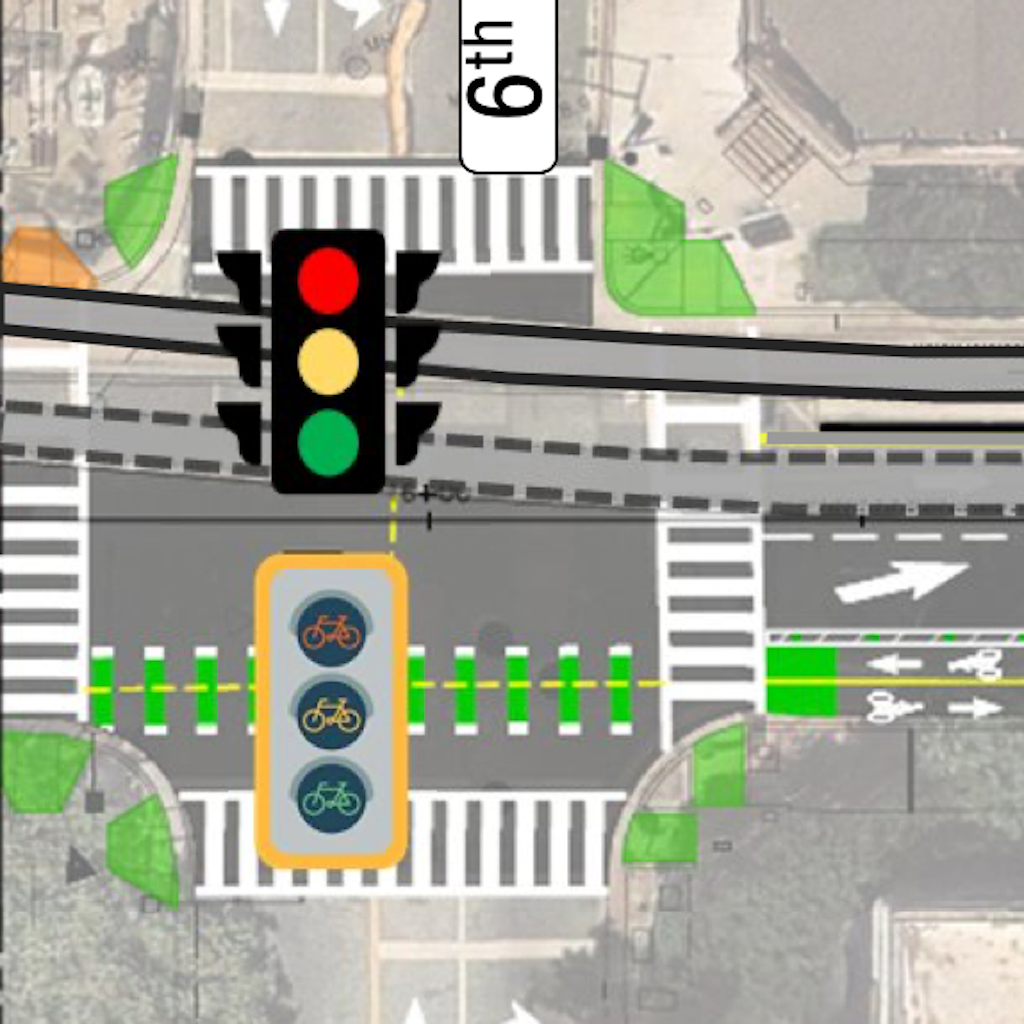
bicycle signal faces are required at every intersection from 5th Street to 9th Street, but are indicated only at 5th Street and 6th Street
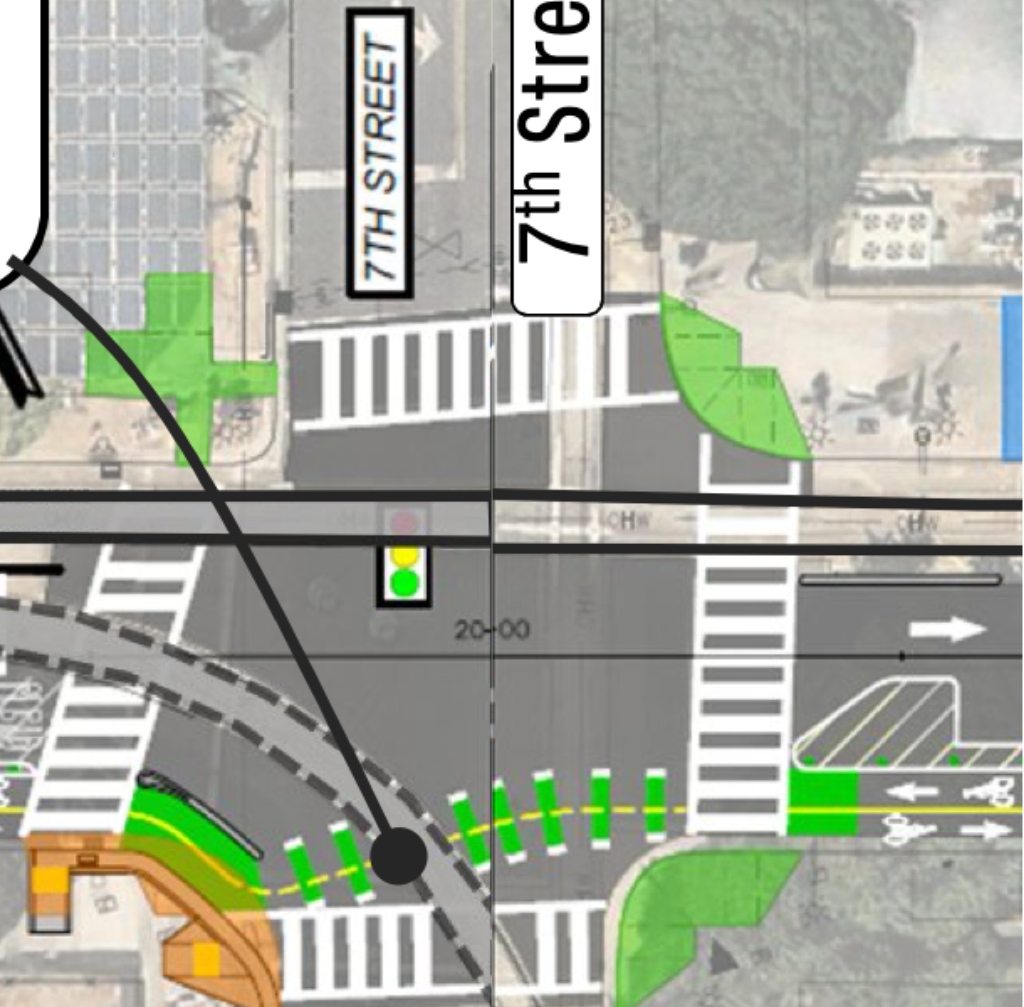
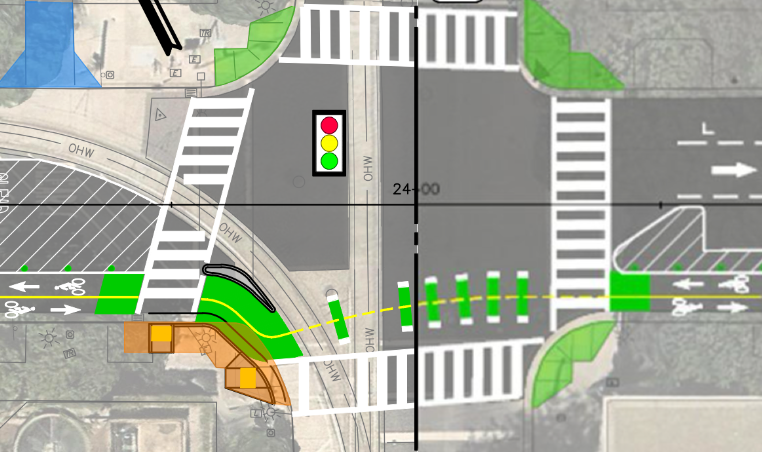
protecting bicyclists is particular critical at 7th Street and 9th Street to guard against right turning drivers heading southbound onto these one-way streets
5th Street: This intersection has a bicycle signal face for the two-way bikeway. The transition from the bikeway to Sacramento Valley Station looks awkward, and will be until the station itself is revised, which is also part of the TIRCP grant project.
H St Bikeway, 5th St intersection, proposed (from SacATC presentation)
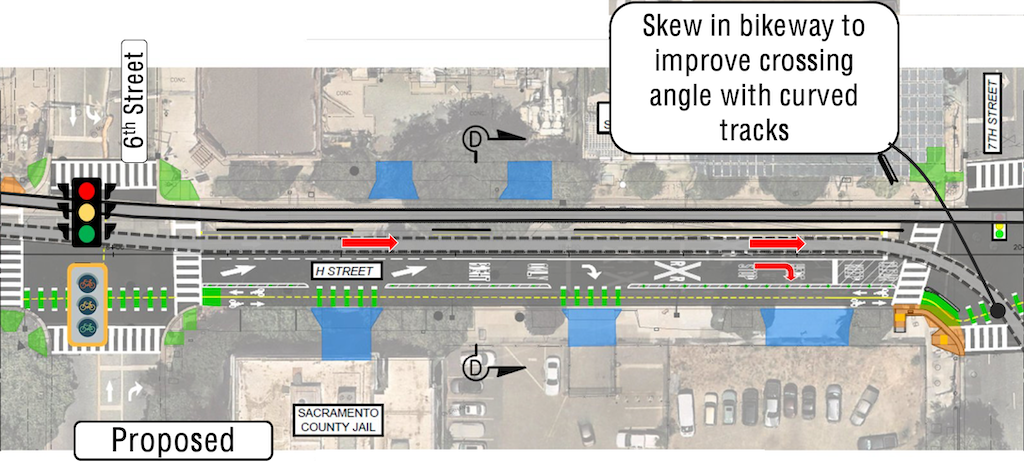
6th Street: This intersection has a bicycle signal face for the two-way bikeway.
H St Bikeway, 6th St intersection, proposed (from SacATC presentation)
7th Street: This intersection does not have a bicycle signal face. It is particularly required here to protect bicyclist against drivers turning right onto 7th Street. No turn on red signing would not protect bicyclists on the two-way bikeway. 7th Street is one-way southbound south of H Street, and two-way north of H Street.
H St Bikeway, 7th St intersection, proposed (from SacATC presentation)
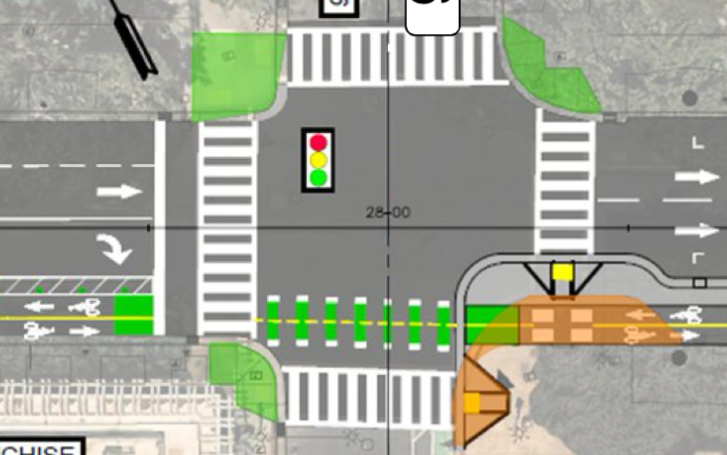
8th Street: This intersection does not have a bicycle signal face. 8th Street is one-way northbound.
H St Bikeway, 8th St intersection, proposed (from SacATC presentation)
9th Street: This intersection does not have a bicycle signal face. It is particularly required here to protect bicyclist against drivers turning right onto 9th Street. No turn on red signing would not protect bicyclists on the two-way bikeway. 9th Street is one-way southbound to the south of H Street, but two-way to the north of H Street.
H St Bikeway, 9th St intersection, proposed (from SacATC presentation)
The H Street Bikeway design has 6 driveways crossing it, 2 on 5th Street to 6th Street, 3 on 6th Street to 7th Street, 1 on 7th Street to 8th Street, and none on 8th Street to 10th Street. Though none of these driveways are heavily used, all are potential conflict points for the bikeway. The 30% design diagrams do not detail how these driveways crossing the separated bikeway will be handled. It is imperative that motor vehicles using the bikeway are moving slowly enough that drivers will see and yield to bicyclists, and bicyclists have time to avoid collisions with drivers who do not yield.
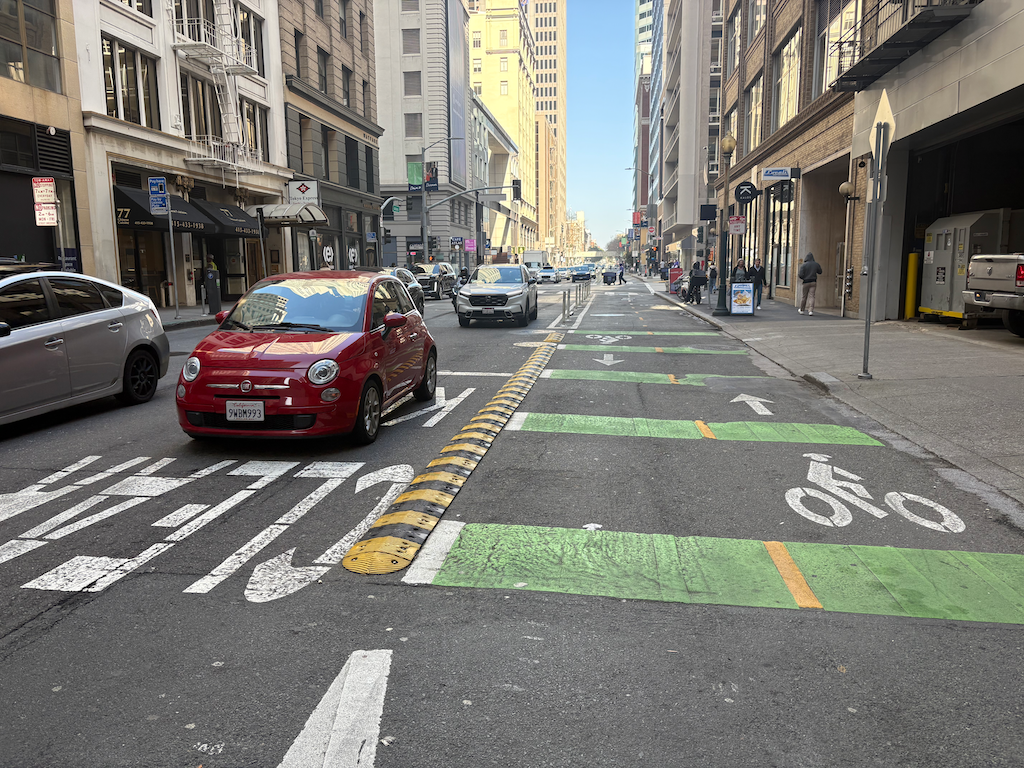
San Francisco has a two-way separated bikeway (cycletrack) on Battery Street in the financial district. Each driveway has speed control devices to ensure that drivers are moving slowly entering and exiting the driveways. The photo below shows one installation, between Pine Street and Bush Street. As a frequent user of this bikeway, I can attest that they are a critical safety feature.
A note about speed bumps. Speed bumps are illegal across roadways in the US. They are most often seen in parking lots, where they are still legal. This use across driveways, and not streets, is legal. The traffic calming devices that are legal across roadways are speed humps, speed cushions, and speed tables.
speed bumps across driveway on Battery St two-way bikeway, San Francisco
Update: Edited to add more accurate segments and cross-sections, make additional comments on design, make clear that the 6th-7th cross-section should be similar to the 5th-6th cross-section, with light rail tracks in their own right-of-way rather than the southern one (Line 1) being in a shared or mixed use lane with private motor vehicles.
Note: I realized last night in thinking about H Street that I had accepted too much of the city’s compromise to prioritize motor vehicle traffic and preserve parking. This section of H Street could be a model for how to do streets right, but the 30% design presented is not that. I’ve changed some recommendations and reorganized the post content.
Key points:
Mixed use transit lanes prioritize motor vehicle traffic over transit safety and efficiency. The mixed use lane between 6th Street and 7th Street must be changed to a dedicated transit lane.
The two-way bikeway must be a minimum of 10 feet in width (5 feet each direction) in order to provide safety, usability, and maintainability. This will require changing parking and/or general purpose lanes widths.
Two-way bikeways must have bicycle signals at every intersection. This design does not.
Where there are two general purpose travel lanes in same direction, as between 9th Street and 10th Street, only one lane needs to be 11 feet, while the other must not be more than 10 feet. This is generous, as most modern recommendations are between 9 and 10 feet. The safety advantages of narrower lanes are well documented.
Maintenance of on-street parking is clearly a priority in this design. While on-street parking can slow traffic, and is appropriate in retail and residential areas, here it is for the convenience of workers who could park in the ample parking garages and lots along and near H Street. Where roadway width is needed for safe and high quality bikeways, on-street parking can and should be removed.
The H Street Bikeway to Sacramento Valley Station project is presenting at the SacATC meeting this week, Thursday, February 19, starting at 5:30 PM. A community workshop will be held Thursday, February 26, starting at 5:30 PM at city hall, room 1119. This project is part of a large grant-funded project (TIRCP – Transit and Intercity Rail Capital Program) to improve Sacramento Valley Station. H Street is the main access route from the station for bicyclists. There are no safe routes to the station, at this time.
The project will create a two-way separated bikeway (also called a cycle-track) on H Street between 5th Street (the station) and 10th Street and 9th Street with existing bicycle facilities.
For the segment images, I have used the SacATC presentation. For the segment cross-sections, I have used the diagrams from the SacATC staff report, as they include measurements, which are critical for determining the safety and usability of the bikeway. StreetMix diagrams usually include measurements, but the ones in the presentation do not.
Transit priority
The TIRCP grant of which this project is a small part, is intended to support transit use to and from Sacramento Valley Station, to ensure that the station is the effective transit and rail hub that the city, region, and state want.
I support the double-tracking of light rail in the segment between 5th Street and 7th Street. Single-track light rail segments create pinch points where one train may need to wait for another, slowing the entire light rail system. The diagrams also seem to indicate a crossover between 5th Street and 6th Street, which is valuable for routing trains when there are blockages.
Segments
Bicycle facilities within Sacramento Valley Station, west of 5th Street, are not part of this project. I have not seen any recent information on how bicyclist circulation will be handled within the station area.
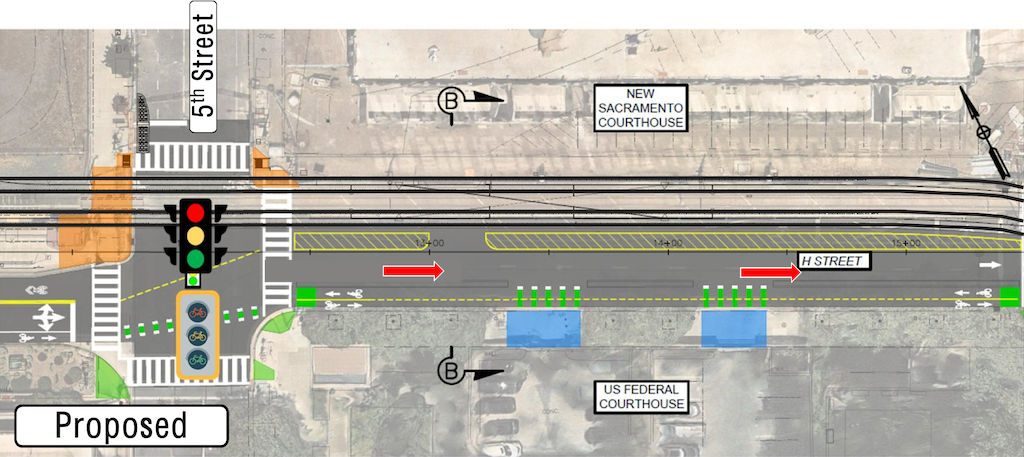
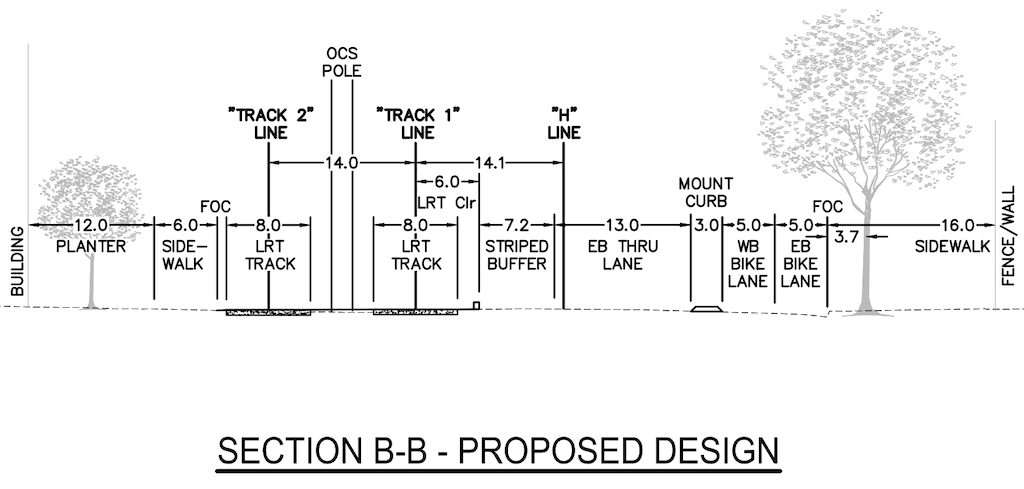
5th Street to 6th Street
This segment is reasonably well designed but could be improved. Double-tracking of light rail removes a bottleneck for the Gold Line/Green Line.
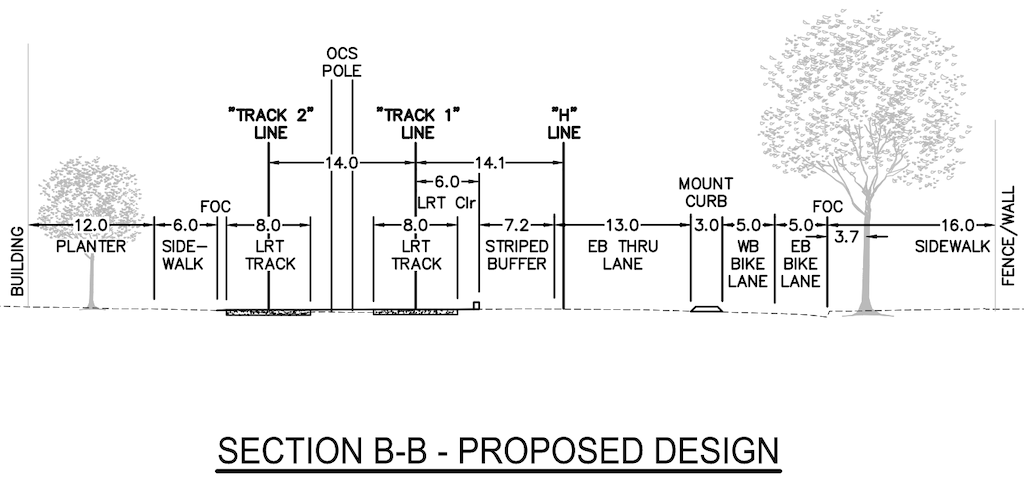
H St Bikeway between 5th St and 6th St, proposed (from SacATC presentation)
The buffer between light rail and general purpose lane (7.2 feet), and the overly wide general purpose lane (13 feet), totaling 20.2 feet, waste roadway width that could be devoted to the two-way bikeway. A better allocation would be, from right to left, 12 foot bikeway, 3 foot mountable curb, 3 foot buffer, 11.2 feet general purpose lane, and 4 foot buffer.
H St Bikeway from 5th St to 6th St, proposed cross-section, 92.5 feet ROW?, 52.5 feet FOC (from SacATC staff report)
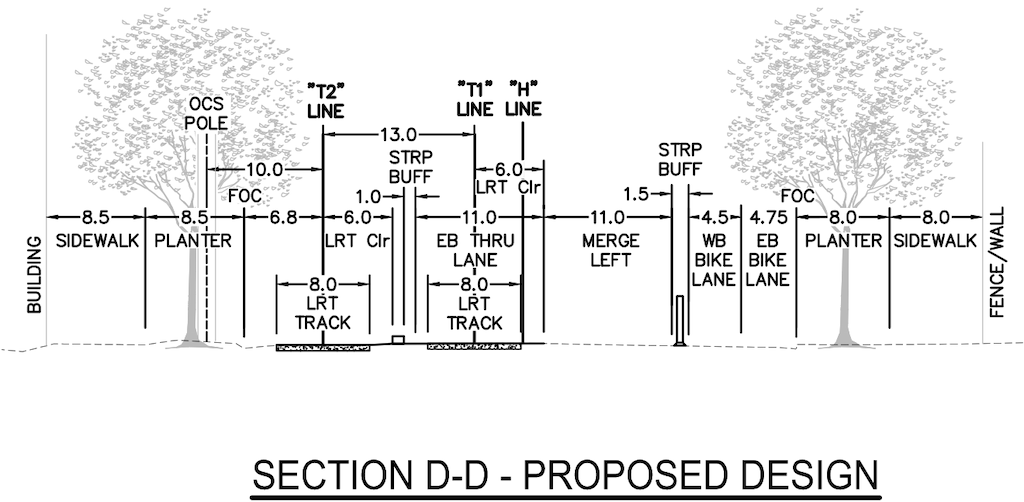
6th Street to 7th Street
The segment shows a light rail track sharing with motor vehicle traffic. This is inappropriate, and removes the advantage of double-tracking, since trains can be stuck in congested motor vehicle traffic. The southern or right hand lane should be a combined through and right turn lane, and the northern or left hand lane should be eliminated. The design constrains the bikeway to 4.5/4.75 feet, rather than the minimum of 10 feet. Diagrams below.
H St Bikeway from 6th St to 7th St, proposed (from SacATC presentation)H St Bikeway between 6th St and 7th St, proposed cross-section, 80.5 feet ROW?, 47.5 feet FOC (from SacATC staff report)
The 6th Street to 7th Street cross-section should be designed similarly to the 5th Street to 6th Street cross-section, shown below, with the suggested modifications to roadway allocation, as above in 5th Street to 6th Street segment.
H St Bikeway between 5th St and 6th St, proposed cross-section(from SacATC staff report)
7th Street to 8th Street
The preservation of parking in this segment is ridiculous. There is a parking garage of large capacity directly north across the street, so there is no reason for on-street parking here. The city’s desire to maintain parking in this section is in fact the reason why the existing Class III (sharrows only) bike facilitiy on H Street is dangerous and unpleasant. Again, retention of parking constrains the bikeway to 4.0/5.0 feet rather than the minimum 10 feet. Diagrams below.
H St Bikeway from 7th to 8th, proposed (from SacATC presentation)H St Bikeway from 7th St to 8th St, proposed cross-section, 83.3 feet ROW?, 48.6 feet FOC (from SacATC staff report)
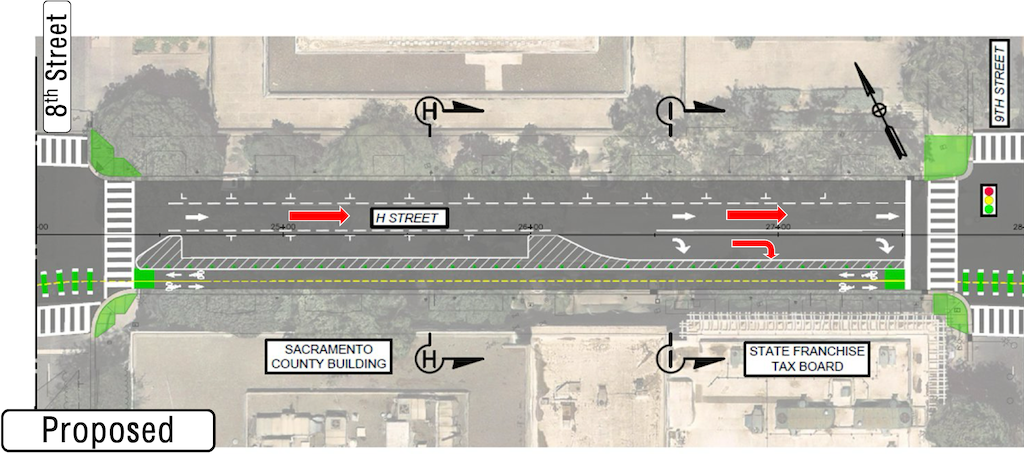
8th Street to 9th Street
The segment design is reasonable.
H St Bikeway, 8th St to 9th St, proposed (from SacATC presentation)
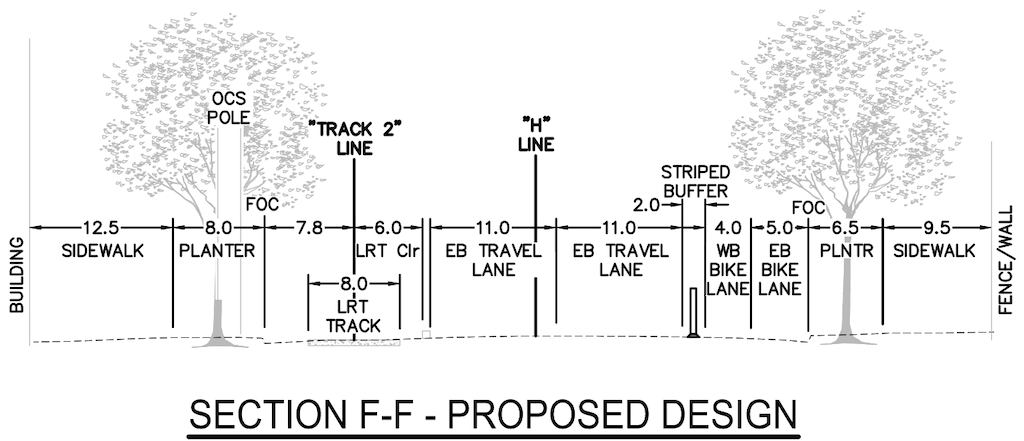
However, since there are no driveways in this block, the separation between motor vehicles and bikeway should be a hard concrete curb, not a stripped buffer. The 10 foot bikeway is the minimum width, however, narrowing the parking lanes to 8 feet would provide space for a desired 12 foot bikeway.
H St Bikeway from 8th St to 9th St, proposed cross-section, 79.6 feet ROW?, 47.6 feet FOC (from SacATC staff report)
9th Street to 10th Street
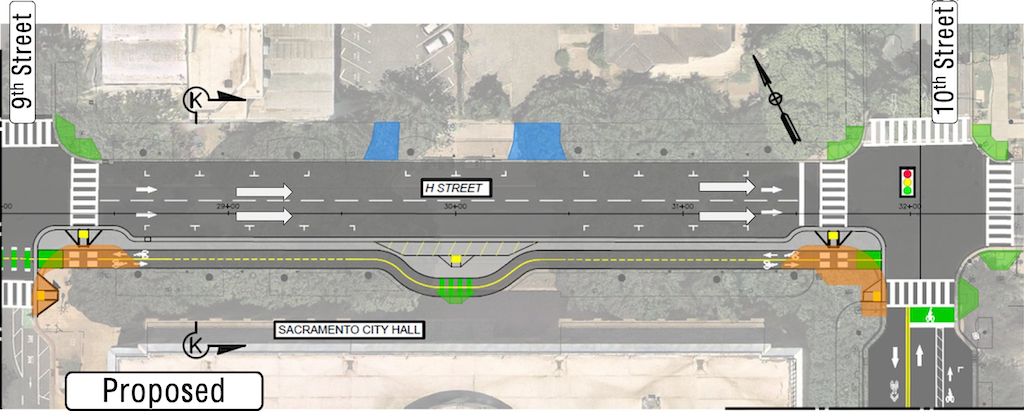
I like the design of the segment, a sidewalk level completely separated bikeway.
H St Bikeway from 9th St to 10th St, proposed (from SacATC presentation)
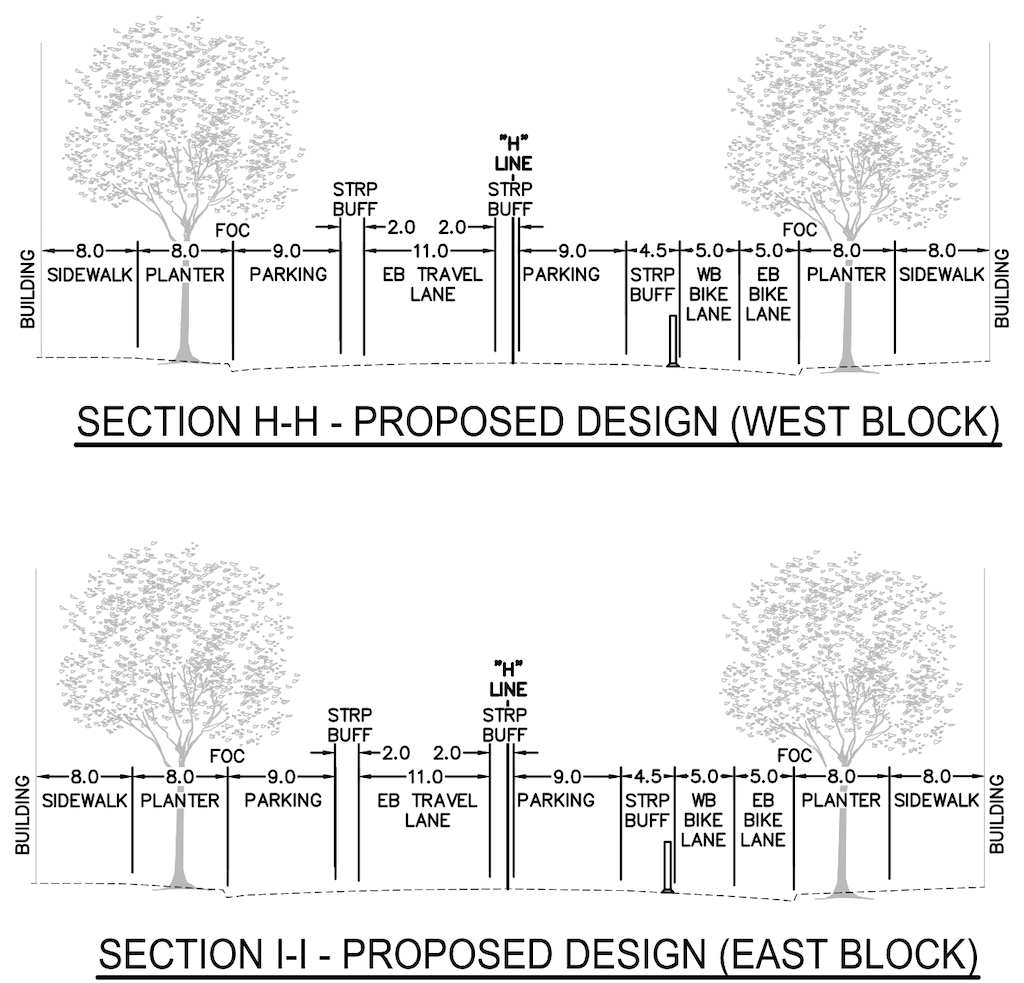
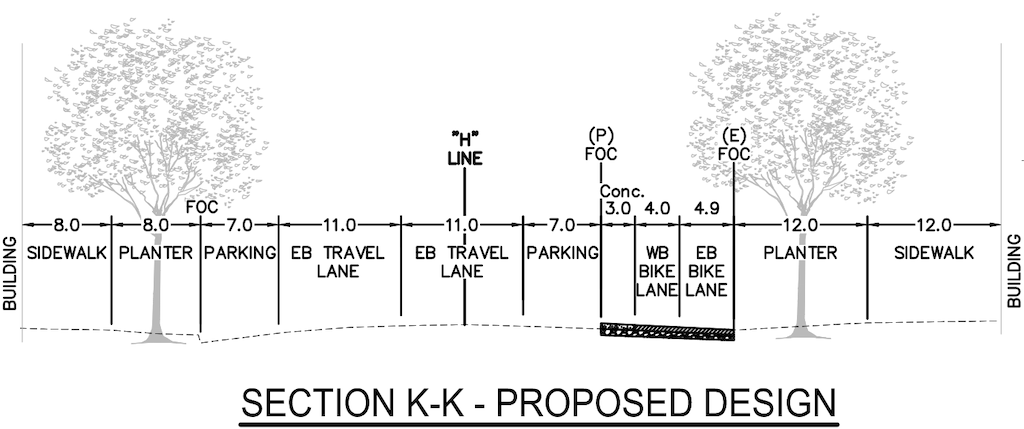
The width of the bikeway is 4.0/4.9 feet (8.9 feet) rather than the minimum of 10 feet. It is not clear how to reallocate roadway width to accomplish this, but it must be done.
H St Bikeway from 9th St to 10th St, proposed cross-section, 87.7 feet ROW?, 47.7 feet FOC (from SacATC staff report)
10th Street from I Street to H Street
This segment design is reasonable, given the curb extensions (bulb-outs) present at the bounding intersections. This project probably does not have the funding to reconstruct the street to create a separated bikeway, though this should be done in the long term. A separated bikeway would complete a buffered or separated bikeway on 10th Street all the way from Broadway to H Street. Despite the call-out on the image below, this is just a buffered bike lane, not a Class IV (separated) bikeway. Parking is not needed on both sides, as ample parking is available on nearby streets and in the city parking garage on the southeast corner of I Street and 10th Street.
H St Bikeway, 10th St from I St to H St, proposed (from SacATC presentation)H St Bikeway, 10th St from I St to H St, proposed cross-section, 105.5 foot ROW?, 50 foot FOC (from SacATC staff report)
Signals
The staff report diagrams use the phrase ‘Traffic Signal (Eastbound/Westbound) to be Modified or Replaced’. I am very concerned with ‘replaced’. The city has a penchant for replacing signals, and controller boxes, that do not need to be replaced, raising the cost of projects or wasting money that could be better spent on other parts of the project.
The presentation diagrams show bicycle signal faces at 5th Street and 6th Street, but not 7th Street, 8th Street or 9th Street. Bicycle signals are necessary at every intersection for the safe operation of two-way separated bikeways. It is possible they were neglected on the diagrams, but they cannot be neglected in the project.
Signal timing should be set to a ‘green wave’ of about 13 mph, to allow bicyclists continuous movement through the five blocks. If signal timing remains the same, bicyclists will encounter red light at every intersection, making the bikeway much less useful.
Every pedestrian signal in this section should include a leading pedestrian interval (LPI). Though valuable to enhance transit and bicycling, the design must not disadvantage people walking along or across the corridor.
Speed
The posted speed limit in this section is 25 mph, but observed speeds are higher. This section seems to serve, since the conversion of 5th Street to two-way traffic, as a cut-through from 5th Street to 16th Street, and the design of the intersection of H Street at 16th Street, three dedicated left turn lanes, supports this use. The speed should be reduced to 20 mph, in part to reduce the differential between motor vehicles and bicyclists. Though the bikeway separates these two uses, bicyclists will need to use the general purpose lanes at some points to enter and exit the bikeway, reaching other destinations in addition to the end points. If the posted speed remains 25 mph, and the actual speeds higher, drivers will be encouraged to speed in order to hit green lights. In the central city, many signals are set to 28 mph, encouraging drivers to speed.
Bikeway design
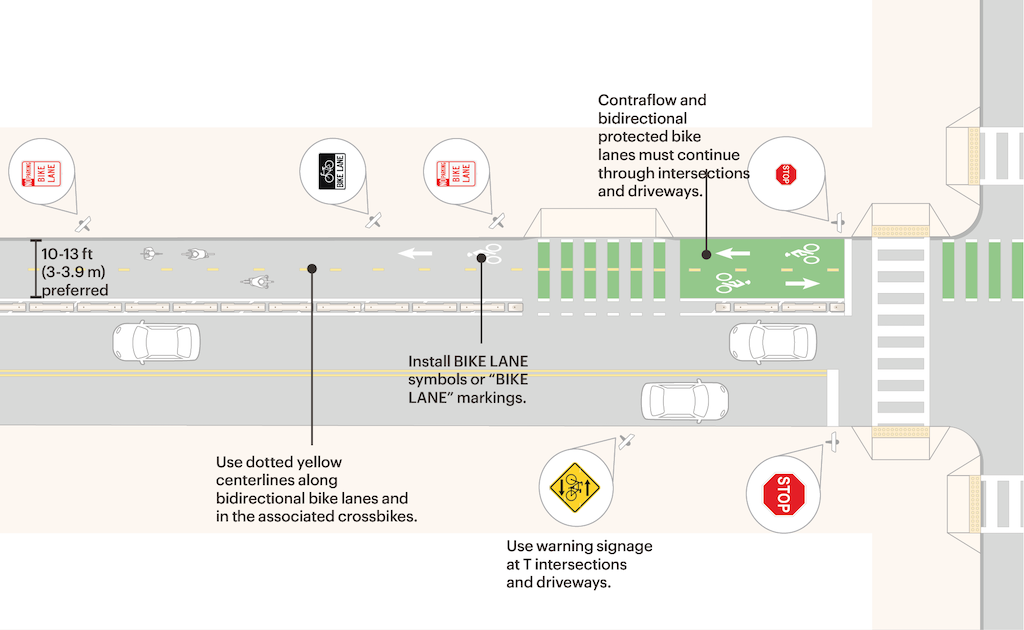
The width of the two-way bikeway in this five block section varies from 8.9 feet (4.0 + 4.9) to 10 feet (5 + 5). The smaller width is not enough to provide safe passage for two larger bikes, such as three-wheel bikes, cargo bikes, and bikes with trailers going in opposite or the same direction. The minimum width throughout must be 10 feet. NACTO’s Urban Bikeway Design Guide says: Two-way bike lanes should be at least 13 ft (3.9m) wide to accommodate all types of bicycles, side-by-side riding, platooning, and passing. A consistent width also allows for bikeway sweeping by devices which cover the full width of the bikeway. The City of Sacramento is deficient is maintaining its existing separated bikeways free of leaves and trash, so future bikeways must be designed for ease of maintenance.
Bikeways should be designed for maximum protection against errant motor vehicles. In blocks without driveways, a concrete curb should be installed, with small gaps for bicyclists to enter and exit. The segment between 8th Street and 9th Street is one such segment. The design with a buffer from parked cars is only effective when parked cars are present. A dedicated motor vehicle right turn lane is adjacent to the bikeway with only a very narrow buffer. The segment from 9th Street to 10th Street seems to have this protection by design. Mountable curbs, as shown for 5th Street to 6th Street may also be appropriate for parts of the 6th Street to 7th Street and 7th Street to 8th Street segments.
NACTO Urban Bikeway Design Guide
The page on ‘Designing Protected Bike Lanes‘ provide guidance on three situations, including two-way (bi-directional) bikeways. The diagram below is from that page. The page includes guidance on dimensions, marking, signs, and intersections.
My previous posts on Vision Zero cover many topics related to it, and make some recommendations. A draft plan will be available in the spring, at which time I’ll no doubt have many comments. If you haven’t been following the Action Plan update process, this is a good chance to catch up.
This is the first time preliminary plans for creating a safe bikeway on H Street, leading to and from Sacramento Valley Station, have been presented to the public. I will take a closer look and perhaps post again before Thursday.
High Injury Network Key Questions, slide from Vision Zero Action Plan update presentation

 Getting Around Sacramento