Freeport & Fruitridge intersection

Another post on the Freeport Blvd Transportation Plan. See the category Freeport Blvd for others.

The plan states, page Appendix A-9, “Fruitridge Road: The left turn from Freeport Boulevard to Fruitridge Road includes two left turn lanes, which may not be needed given the turn volumes. U-turns are moderately used at this location.” Despite this statement, the plan for this intersection is to leave it essentially unchanged. The diagram from Appendix F Design Layout is below.

Freeport - Fruitridge intersection design
Freeport Blvd Transportation Plan, Freeport-Fruitridge intersection design

The same seven lanes across for the north side of the intersection (to the right in the diagram), 86 feet for a person using the crosswalk, with no pedestrian refuge in the middle. Long crosswalks like this require a long pedestrian signal to meet federal standards, which of course slows all other movements in the intersection. In an effort to ease motor vehicle traffic by maintaining unneeded lanes, the city is actually slowing down everyone at the intersection, and making traffic worse rather than better.

The same dedicated double left turn lanes southbound (from the left). The same dedicated right turn lanes which require right turning traffic to conflict with the bike lane as they merge (out of the diagram left and right). The same free-right, high-speed slip lane from Fruitridge westbound to Freeport northbound which presents a tremendous hazard to walkers, bicyclists, and drivers traveling on Freeport.

Again, the city has released a final draft plan which fails to meet the needs of the community, fails to calm traffic, and fails to keep people (walking, bicycling, and driving) safe.

make Freeport 3 segments

Another post on the Freeport Blvd Transportation Plan. See the category Freeport Blvd for others.

I rode Freeport Blvd today to refresh my memory of the roadway and surrounding, and to take photos to illustrate points I want to make. Photos to come.

What was clear to me is that the part of Freeport Blvd from Claudia Dr to Blair Ave is completely different in character from the rest of the ‘south’ segment identified in the Freeport Blvd Transportation Plan. Starting just south of Fruitridge Rd, the east side is the Sacramento Executive Airport, a long stretch of chainlink fence all the way to almost Blair Way. The west side is a mix of businesses and empty lots, but about half of the businesses are closed. The Sacramento Safety Center, just south of Claudia Dr, offices for police and fire, is a one-story building surrounded by a sea of parking, the worst sort of suburban form that doesn’t even generate any property or sales tax. Nor, I’m pretty sure, does it generate any walkers or bicyclists.

Freeport Blvd south of Fruitridge is a different sort of roadway that deserves to be treated as such in the plan. But it is not. This section also has a significantly lower ADT (average daily traffic) count that much of the rest of the plan area.

Yet another flaw in the plan that should be corrected before it is adopted.

wide lanes on Freeport

Another post to criticize the City of Sacramento’s Freeport Blvd Transportation Plan. See Freeport Blvd category for earlier posts.

The city has designed Freeport with four lanes, each 11-feet wide. NACTO (National Association of City Transportation Officials) and FHWA (Federal Highway Administration) recommends 10-foot lanes for urban areas. The city says 11-feet is necessary for buses and commercial vehicles, and insists on that width in all designs for arterials and collector streets (otherwise known as stroads), or which Freeport is one.

The diagram below, from the plan document, shows the 11-foot lanes. Even if one assumes that the outside lane (called number 2 lane in engineering parlance) needs 11 feet to handle buses and commercial vehicles, the inside lane (called number 1) does not need to be any more than 10 feet, and in fact could probably be 9 feet. The widest common vehicles are 6.5 feet wide, and most 6 feet, so 9-10 feet is plenty. The city is wasting two to four feet of roadway width on extra-wide lanes. That wasted width could instead be used for sidewalks and trees shading sidewalks.

The center median is 20 feet wide, for unknown reasons. Maybe to accommodate left hand turn lanes, perhaps pedestrian refuge medians, or trees. Trees certainly need 8 plus feet, but not 20 feet. But even an 11-foot lane plus 6 feet for a refuge median is only 17 feet, but the city has designed 20 feet. Maybe to accommodate the double left hand turn lanes southbound at Fruitridge Rd? Double left hand turn lanes have no place in an urban setting like Freeport, they just increase the crosswalk distance and engender greater hazards for everyone, including drivers. It is almost as though the city is trying to waste roadways width.

Note that the sidewalks would be as narrow as 5 feet in some locations, and never wider than 9 feet or 11 feet. Note that there are no trees adjacent to the sidewalk. The next post will be about trees.

The city’s blockheaded insistence on 11-foot lanes means that they have designed a roadway which will encourage higher speeds, which are hazardous to everyone, walkers, bicyclists, and drivers. Why? Because the city’s primary design criteria is to maintain vehicle volume (VMT) and speed. This is not what the community wants, as is made clear in the workshops and surveys the city did. The city ignored community input because it did not match their preconceived notions about what kind of roadway they wanted.

City of Sac blind adherence to ADT

Another post on the Freeport Blvd Transportation Plan. See the category Freeport Blvd for other posts.

“We are designing for the traffic we have, not for the traffic we want.”

Ali Doerr Westbrook, Chair of Sacramento Active Transportation Commission

I could stop at that, but perhaps you’d like some more detail. This comment was made during the Sacramento Active Transportation Commission (SacATC) meeting on January 18, 2023. The context was the admission by the two city planners, Leslie Mancebo and Jennifer Donlon Wyant, that the city eliminated the possibility of a road diet (roadway reallocation) before even starting planning for Freeport Blvd. The reason expressed is that the ADT (Average Daily Traffic count) is above 20,000 for Freeport, and that requires more than two lanes (one each direction). Interestingly, ADT counts for various locations along Freeport are nowhere to be found in the plan or appendices. In a different location on the City of Sacramento website, Traffic Counts, the ADT for various locations along Freeport Blvd, rarely exceed 20,000, and have not exceeded 20,000 since 2011. There is no indication that the city even did new traffic counts in preparation for this planning effort. So far as can be determined, they just decided to not consider a road diet from four lanes to two lanes, or two+one lanes, 3/2 configuration) because they wanted to prioritize motor vehicle traffic over all other uses of the roadway.

The city planners also acknowledged that a road diet was a prominent request of the community during the planning process. But, community input be damned, the city is going to serve car drivers before anyone else.

A reduction of lanes from four to two is the single most important traffic calming effort that can be made on a roadway. That does not mean it is the appropriate solution for Freeport Blvd, or for all of Freeport Blvd in the planning area. What is does mean is the that city should have considered it in the planning process.

Back to Ali’s comment. The city is planning for a roadway configuration that should have already been in place years ago, before the city over-widened the roadway, and in several cases narrowed sidewalks to accommodate the widening. They are not planning for a roadway which would reduce vehicle miles traveled (VMT) or increase safety and access for those outside cars. The city’s responsibility, under the Mayors Commission on Climate Change report, is to reduce VMT in order to reduce greenhouse gas emissions (GHG), not to maintain VMT at current levels. But this Freeport plan is a plan to guarantee current VMT for at least 30 years in the future, which is about the length of time before the city will be able to reconstruct the roadway again, and correct the mistakes they made this time around.

The intent of the city in this plan is made very clear in the common design principles: “10. Maintained necessary travel lanes, turn lanes, and parking: Maintaining travel lanes and turn lanes ensures that drivers traveling along the corridor will not be compromised, and preserving parking spaces where 5 the utilization is higher so it serves better adjoining businesses.” Though this is the last item in the list of ten, it is clear that this is the highest priority for the city.

The refusal to consider a road diet/lane reduction/roadway reallocation is a fatal flaw in this plan. The effort should be sent back to staff to re-do. It should not be adopted by city council. If the city council does not reject this kind of flawed planning, city staff will continue to make the same mistake, again and again and again.

I’ll post on some of the other flaws in the plan, but this is the most important, not just because it misses the best opportunity for traffic calming, but because it retains roadway width for the exclusive use of motor vehicles that could be better used for walking, bicycling, trees, and even parking for businesses.

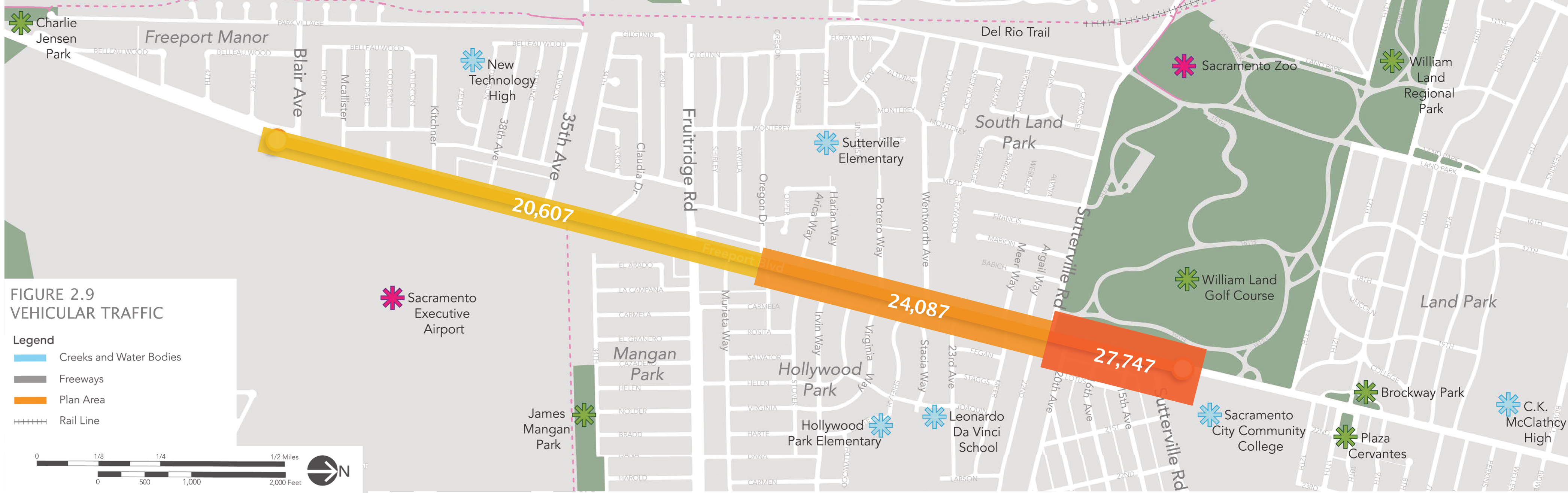
Added graphic below, which I had not noticed in the plan, that documents vehicular counts on sections of Freeport Blvd. Is it suspicious that half of the plan area is ‘just’ over the city’s criteria of 20,000 ADT? Remember, the plan itself and the city’s traffic counts website do not indicate this level of ADT.

Freeport Blvd Transportation Plan

The City of Sacramento has released the final draft Freeport Blvd Transportation Plan. Appendix F Design Layouts is a key part of the document. This post reflects my original comments (Freeport Boulevard Emerging Design Concepts) and the new plan. The city’s plan page is at http://www.cityofsacramento.org/Public-Works/Transportation/Planning-Projects/Freeport-Blvd-Corridor. The plan is on the Active Transportation Commission agenda for January 20, 2023, and will go to the city council within the next two months.

The ten common design elements on page 21 (24 of the pdf) include: “10. Maintained necessary travel lanes, turn lanes, and parking: Maintaining travel lanes and turn lanes ensures that drivers traveling along the corridor will not be compromised, and preserving parking spaces where 5 the utilization is higher so it serves better adjoining businesses.” This is statement is contrary to all walkability, bikeability and vision zero goals. It should be removed from the document, and removed from planning goals. It is offensive. It means that no matter what other improvements to the corridor will be made, cars and motor vehicle drivers will be preferenced over all others.

The ten common design elements do not mention trees. Trees are an integral part of the walking experience, as well as providing climate and heat island benefits. They should be prominently recognized throughout the document, but they are not. The phrase ‘existing trees’ occurs many time in the document, but nowhere are ‘proposed trees’ identified.

Frequent driveways along much of this section present hazards to walkers and bicyclists, and handicap the design of safe streets. It is clear that the city did not consider reduction or narrowing of driveways to address this hazard. If you look at the design layouts (Appendix F), the number of gaps in the bikeway, shown as dashed green, is remarkable. Each of these is a driveway. Again, this is a clear indication that the city intended to maintain the car-dominated character of this street.

All crosswalks at intersections should contain all three or four legs (three for T-intersections). The design leaves many intersections with only one crosswalk over Freeport Blvd, meaning pedestrians must cross three streets in order to reach some destinations, rather than just one. Though not mentioned in the plan, this often means installing pedestrian crossing prohibition signs and barriers. These should be outlawed, not encouraged.

North Section

pages 25-26 (28-29 in the pdf)

The intersection of Sutterville Road to the east with Freeport Blvd is shown with a two-lane roundabout. Two lane roundabouts have almost none of the traffic calming and safety benefits of one lane roundabouts, in fact they should not even be called roundabouts, with the implication that they have safety benefits. This roundabout should be redesigned to a single-lane. Traffic levels on Freeport to the north certainly do not justify two lanes, in fact Freeport become single lane each direction a short distance to the north at 13th Avenue.

The dedicated right turn lane on Freeport Blvd southbound at Sutterville Road to the west is not needed and presents an unnecessary hazard to bicyclists. Dedicated right turn lanes should be eliminated from this plan, and from all city roadways. They are rarely justified by traffic volume, create conflicts for bicyclists, and widen roadways and therefore crossing distances for walkers. They also encourage drivers to make right hand turns without looking for people walking.

There should be a crosswalk on the north side of the Freeport-Sutterville intersection. There is no justification for leaving it out, unless an attempt to discourage walkers from accessing the park.

South Section

pages 27-31 (30-34 in the pdf)

The offset crosswalks with median refuge at Oregon Drive and Potrero Way/Virginia Way are a good design, but there is no reason to not provide crosswalks on the other leg of the intersection.

The median gap at Arica Way, with dedicated left turn lanes, is not needed. Arica Way is a low volume street that is a good candidate for right in/right out treatment. The shopping center access can be provided for northbound traffic.

At the intersection of Fruitridge Blvd and Freeport, there should be no dedicated right turn lanes. They create a hazard for bicyclists, that cannot be mitigated by pavement marking, and they lengthen the crossing distance for walkers. In this location, where center refuge medians are not proposed, this is particularly egregious. The dual left turn lanes southbound on Freeport are a hazard to bicyclists and motor vehicles, and should be reduced to a single left turn lane. This intersection, due to long crossing distances, should provide center refuge medians on both the north and south crosswalks.

SacATC meeting Jan 19 with report, Northgate, Freeport

Update: The letter on the status of walking/biking was deferred to the next meeting, where a modified letter will be considered and hopefully passed. The Freeport and Northgate Transportation Plans were forwarded to council. I spoke in favor of Northgate and against Freeport, for reasons I will detail in the near future. The applications for planning grants were supported.

The Sacramento Active Transportation Commission (SacATC) is meeting online Thursday, January 18, 2023, 6:00PM to about 8:00PM, via Zoom. See http://sacramento.granicus.com/ViewPublisher.php?view_id=21 for agenda and eComment.

The three main topics are:

A read of the subcommittee report, formatted as a letter to the mayor since the commission is advisory to the council, is good and should be supported. I particularly like the emphasis on completing the construction detour policy, since city staff otherwise do not care about the safety of walkers and bicyclists in navigating construction projects that close or change sidewalks and bikeways. Two items missing are bike/scooter share, and Vision Zero. These two items may or may not fall under the purview of SacATC, however, the city is not making information available to the public on these efforts, so it seems to fall to SacATC to do so.

In general, the Northgate and Freeport plans are an immense improvement over existing conditions, so meet needs of the moment, but it is less clear they are going to meet the needs of the future, which will be much less private motor vehicle driving, and more walking, bicycling and transit. If time is available to look at the plans more closely, I’ll add posts.

Freeport Boulevard Transportation Plan Emerging Design Concepts

City of Sacramento staff (Drew Hart) presented to the Sacramento Active Transportation Commission last Thursday on the Freeport Boulevard Emerging Design Concepts. The presentation slides are here. The city’s Freeport webpage has a lot of background material. A link to the virtual open house on April 28 (tomorrow!) is available. This project and the Northgate project are being supported by the same consultant, so you will notice similarities in the process and graphics.

The northern section, between Sutterville Road to the east and Sutterville Road to the west, should look exactly like the traffic-calmed, complete street to the north. This project on Freeport was successful. There is no reason for five lanes in this section. One lane northbound, one lane southbound, and one left turn lane southbound is all it needs. If traffic backs up at the Freeport and Sutterville Road to the east intersection, then shorten the signal cycle.

The emerging design document skips over the issue of whether four general purpose lanes are even needed. A concept should be presented that reduces general purpose lanes to two, and reallocates roadway width to other modes.

Dedicated right hand turn lanes should be removed everywhere. Dedicated left hand turn lanes should be provided only where traffic studies have shown a clear need, and should never reduce the roadway width for other uses.

Green lanes are shown behind protection for separated bikeways. Since the protection does or should prevent vehicle incursion, the paint is not needed.

Dedicated transit lanes should be considered. Though SacRT has not identified this as a high frequency route in the High Capacity Bus Service Study (Route 62 is 30-minute frequency), reconstruction of the roadway must consider the possibility of dedicated transit lanes and transit supporting infrastructure. Appendix A, available on the project webpage, provides a lot of detail about existing transit stops, which are mostly quite poor.

Some businesses along Freeport have multiple driveways, more than are justified by the amount of vehicle traffic access. Closure and narrowing of driveways should be considered. Since almost every business has parking fronting the street, no on-street parking is needed anywhere. This is poor urban design, but it is the nature of the corridor and could not be corrected without wholesale reconstruction of the corridor.

While separated bikeways are often a good solution, the frequency of driveways might make for poor quality infrastructure. Unless driveways can be closed or reconfigured, separated bikeways may not be the best solution.

Posted speed AND design speed should be considered for reduction. Posted speed is 30 mph from Sutterville Rd (to the east) to Arica Way, 35 mph from Arica Way to Fruitridge Rd, and 40 mph from Fruitridge Rd to Blair Ave. The section from Sutterville Rd (to the east) to Fruitridge Rd should be posted and designed for 25 mph, in recognition of the density of businesses and driveways. The section from Fruitridge to Blair Ave should be posted and designed for 30 mph, as it has a lower density of businesses and driveways, and is adjacent to the airport for a significant distance.

Prioritization of the modes for Sutterville (to the east) and Fruitridge Rd should be:

  • walking
  • bicycling
  • transit
  • motor vehicle

Prioritization of the modes for Fruitridge Rd to Blair Ave should be:

  • bicycling
  • transit
  • walking
  • motor vehicle

Crash/collision map of the Northgate Blvd corridor for pedestrians (walkers) and bicyclists. Data is from SWITRS for the years 2015-2019. (pdf)

map of Freeport Blvd Emphasis with pedestrian and bicyclist crashes