Sac City abandons separated bikeways

The City of Sacramento has installed a number of separated, parking-protected bikeways, including P St, Q St, 19th St, 21st St, 9th St, 10th St, and J St. It is failing FAILING to maintain these bikeways. They have not been swept by the city since the beginning of leaf season, early November.

You can find several blocks, or portions of blocks that have been cleared, but these have not been cleared by the city. They have been cleared by landscape services contracted by adjacent property management companies, mostly for multi-family housing. It is not the responsibility of these companies to clear the bikeways, but they do so both as a community service, and to maintain a higher level of appearance for their housing and businesses.

The city should be ashamed of itself. It has created a hazard of its own making.

It would probably be better if the city returned these streets to their previous configuartion, with traditional bike lanes. At least these could be swept by the city, and to some degree are swept by the wind of passing motor vehicles.

photo of SacCity P St separated bikeway; yes there is a bikeway under the leaf piles and leaf slime
SacCity P St separated bikeway; yes there is a bikeway under the leaf piles and leaf slime

SacATC 2025-10-16

Yes, very late post, but better late than never.

The Sacramento Active Transportation Commission (SacATC) will meet Thursday, October 16, 2025, at 5:30 PM. The meeting will be at Sacramento City Hall, council chambers. The meeting is livestreamed from the Upcoming Meetings Materials page at the time of the meeting. Comments may be made in-person, or via eComment on the Upcoming Meetings Materials page up to the time of the meeting, but should be submitted well ahead of time if you wish the commission members to see the comment before the meeting. No comments are taken online.


Agenda (pdf)

Open Session Roll Call Land Acknowledgement Pledge of Allegiance Consent Calendar All items listed under the Consent Calendar are considered and acted upon by one Motion.

  1. Approval of Active Transportation Commission Meeting Minutes
  2. Active Transportation Commission Log

Discussion Calendar

  1. SacAdapt Transportation Adaptation Plan staff | presentation
  2. Connecting Howe Avenue: Safety and Mobility Plan Phase 3 Public Engagement staff | presentation
  3. Norwood Mobility Project Phase 3 Public Engagement: Public Draft Plan staff | presentation
  4. Active Transportation Commission 2025 Annual Report staff | report | presentation

Commission Staff Report

Commissioner Comments – Ideas and Questions

Public Comments-Matters Not on the Agenda

Adjournment


9th Street Separated Bikeway at SacATC

At last night’s Sacramento Active Transportation Commission (SacATC) meeting, the 9th Street Separated Bikeway was item 3 on the agenda. As is usual, I did not have a chance to review the item until shortly before the meeting, so did not post comments ahead of time, but did make comments during the meeting. I’ve broken the agenda item into staff report, plans, and presentation slides for easier access.

This was the preliminary presentation on this project, and it will be revised and come back to the commission at least once more.


My comments text, thought some particulars were left out due to the two-minute time limit:

I am glad to see the project, since it closes one of the gaps that makes the existing separated bikeways less useful.

Widths

The six-foot bikeway width does not meet NACTO recommendations (preferred width) of 8 feet or more for separated bikeways. Six feet does not allow for passing or wider bicycles, and is NOT a best practice.

NACTO table of Unidirectional Protected Bike Lane Widths

I support bin/leaf zones, but the entire buffer should be wide enough to accommodate bins, as has been implemented on some blocks of P and Q streets. I am not sure how wide this is, but it is more than 3 feet.

In order to gain the necessary width for bicycles and buffers, the street right-of-way needs to be reallocated:

  • One of the two general purpose lanes should be 9 feet (the left lane), the other 10.5 feet (the right lane), which gains 2.5 feet. The wider lane would be used by buses on SacRT Route 51. The wider lane should be marked as such, with the width painted on the pavement at every intersection to inform drivers.
  • Similarly, one of the two parking lanes should be 7.5 feet, which gains 0.5 feet, and signed or marked as a narrower parking lane. The city does not need to accommodate car bloat on every street and every parking lane.

Bikeway Protection

I support turn wedges, but they should be concrete, not solely paint and posts. Though the paint and post turn wedges provide some safety for bicyclists, and particularly for walkers, they are less safe than concrete, which the city calls ‘rolled curb turn wedge’.

SacCity photo of a rolled curb turn wedge

Any block with only an alley break in the separated bikeway should be protected by concrete curbs, not simply by paint and posts. Where driveways occur, it may be better to use paint and posts.

Marking

Whenever a bikeway crosses general purpose lanes, as it does approaching Broadway, the merge zone must be marked with green backed sharrows. Anything less is unsafe for bicyclists.

Any place where a bikeway transitions from one side to the other side is designed, there must be a bike signal to control motor vehicle traffic. In general, bicyclists need an exclusive bike phase, where no motor vehicles are turning. The side-to-side transitions on 19th Street (from left to right, just past W Street), and 21st Street (from right to left at W Street) are NOT safe for bicyclists, and as a result, there are many fewer bicyclists using these streets than was intended or is desirable. The city has resisted using bike signal faces, though the expense is a fraction of what the city routinely spends replacing functional signals and signal boxes.

Any time a bikeway is between two general purpose lanes, as it is approaching Broadway, the bikeway must be marked with continuous green paint. Somehow the plans dropped green paint between W Street and Broadway, the most confusing and potentially deadly part of the entire project.


Commissioners made a few comments:

  • Generally supportive of the project intent
  • Moore commented on green paint approaching Broadway, and asked if the transition could be earlier to reduce conflicts at the W intersection; staff response it that right-turning vehicles at W Street are the biggest conflict, other than X Street and Broadway
  • Hodel supported the red paint daylighting, and asked for green paint approaching Broadway

Apparently there were a large number of eComments on the agenda items, though I’m unsure how many related to this agenda item or the other three main items. When the meeting is over, all the eComments disappear, apparently into the ether. This is not just a problem for SacATC, but for all city meetings. Unless a citizen takes care to capture the eComments before the meeting ends, they will never know what others commented online.

The NACTO Urban Bicycle Design Guide (3rd edition, 2024) includes the diagram below within the ‘Designing Protected Bike Lanes‘ section.

diagram of NACTO One-Way Protected Bike Lanes Design Guidance
NACTO One-Way Protected Bike Lanes Design Guidance

SacATC 2025-09-18

The Sacramento Active Transportation Commission (SacATC) will meet Thursday, September 18, 2025, at 5:30 PM. The meeting will be at Sacramento City Hall, council chambers. The meeting is livestreamed from the Upcoming Meetings Materials page at the time of the meeting. Comments may be made in-person, or via eComment on the Upcoming Meetings Materials page up to the time of the meeting, but should be submitted well ahead of time if you wish the commission members to see the comment before the meeting. No comments are taken online.


Agenda (pdf)

Open Session

Roll Call

Land Acknowledgement

Pledge of Allegiance

Consent Calendar

All items listed under the Consent Calendar are considered and acted upon by one Motion.

1. Approval of Active Transportation Commission Meeting Minutes

2. Active Transportation Commission Log

Discussion Calendar

3. 9th St Separated Bikeway

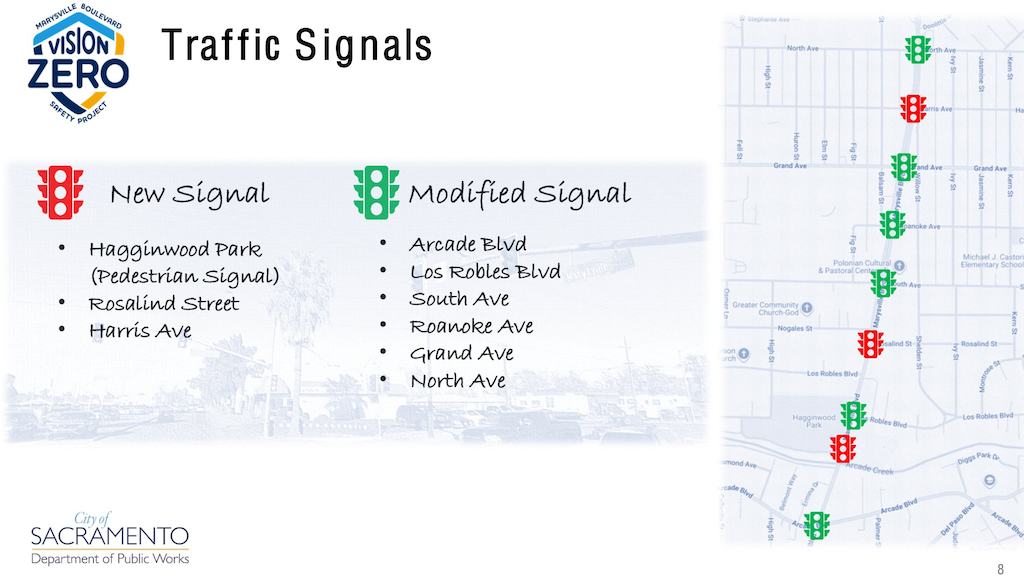
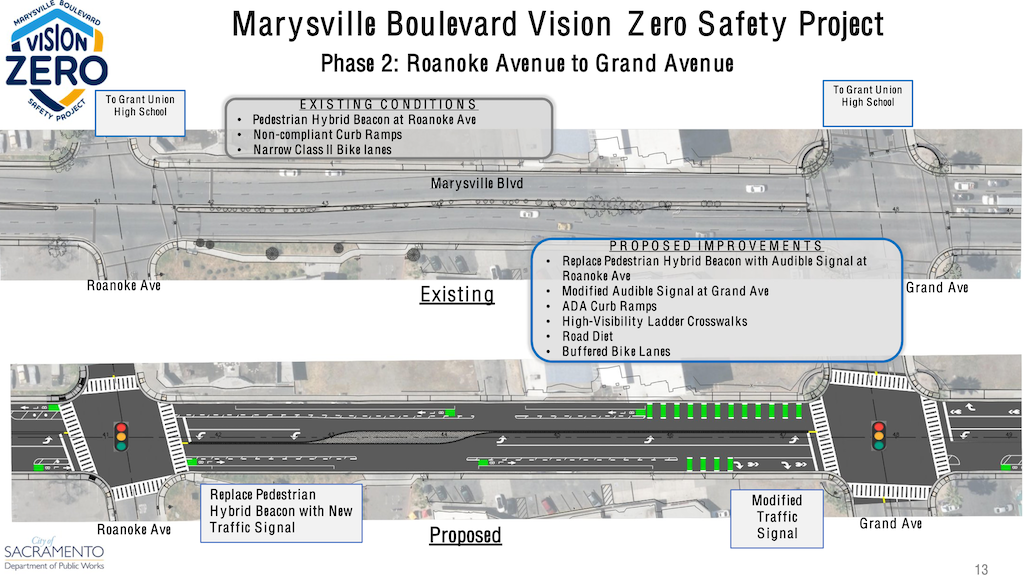
4. Marysville Boulevard Vision Zero Safety Project

5. Fiscal Year (FY) 2026/2027 Caltrans Sustainable Transportation Planning Grant Application

6. Active Transportation Commission 2025 Annual Report

Commission Staff Report

Commissioner Comments – Ideas and Questions

Public Comments-Matters Not on the Agenda

Adjournment


SacATC 2025-08-21

The Sacramento Active Transportation Commission (SacATC) will meet Thursday, August 21, 2025, at 5:30 PM. The meeting will be at Sacramento City Hall, council chambers. The meeting is livestreamed from the Upcoming Meetings Materials page at the time of the meeting. Comments may be made in-person, or via eComment on the Upcoming Meetings Materials page up to the time of the meeting, but should be submitted well ahead of time if you wish the commission members to see the comment before the meeting. No comments are taken online.

This is a big meeting! I hope you can attend and comment, or use eComment. I have not yet reviewed the documents, but may add additions to this post if appropriate.


Agenda (pdf)

Open Session

  • Roll Call
  • Land Acknowledgement
  • Pledge of Allegiance

Consent Calendar

  1. Approval of Active Transportation Commission Meeting Minutes
  2. Active Transportation Commission Log

Discussion Calendar

  1. Streets for People Active Transportation Plan: part 1, part 2
  2. Connecting Howe Avenue: Safety and Mobility Plan Proposed Alternatives: staff report, presentation
  3. The Norwood Mobility Project Proposed Alternatives: staff report, presentation
  4. Active Transportation Commission 2025 Annual Report: staff report, Annual Report, presentation
  • Commission Staff Report
  • Commissioner Comments – Ideas and Questions
  • Public Comments-Matters Not on the Agenda
  • Adjournment

disconnected bike network

A recent article on CapRadio: Sacramento’s bike network received a failing grade. City officials disagree was also reference on Streetsblog California.

The People for Bikes analysis on Sacramento is at https://cityratings.peopleforbikes.org/cities/sacramento-ca. Note that only cities are rated, not counties, so there is no rating for unincorporated Sacramento County. Sacramento’s score was 36, Rancho Cordova’s 29, Folsom 37, Elk Grove 23, West Sacramento 25, and Citrus Heights not scored.

The lead photo on CapRadio is a concrete-separated bikeway on Broadway. But it is only one block long, and is the only one in the city.

A quote from Jennifer Donlon Wyant is revealing of exactly the problem with Sacramento bike facilities:

“M Street from Sac State to Midtown through East Sacramento is known to be an all-ages and abilities bikeway connecting schools and health care and retail, and that is shown as a high-stress facility,” she noted. “When known low-stress facilities like this are showing up as high stress, that concerns me.” 

Yes, parts of M Street are great, and should be recognized with a neighborhood or greenway status. Though it is an overly wide street along much of its length, traffic is slow and light, and it meets the definition of a low-stress bikeway.

However, what happens at either end? Approaching Alhambra, M Street ends, with no bike lanes on Alhambra, and no wayfinding for how to shift to a low-stress route to continue westward. At the east end is Elvas Avenue, one of the most hazardous bike routes in the city. Bicyclists exiting onto Elvas Avenue from 62nd Street must cross four lanes of high-speed, high volume motor vehicle traffic to reach the safety of the Hornet Tunnel and SacState. Most bicyclists cross early and ride against traffic. It is slightly less hazardous to go westbound to M Street. There is no wayfinding for how to best deal with this situation.

The city has been aware of the Elvas problem for years. Nothing has been done. This blog has written about it many times: tag:Elvas-Ave.

All of the parking-protected, separated bikeways in the city are discontinuous:

  • 10th Street northbound: starts at W Street with an awkward transition from east side to west side; ends at I Street
  • 9th Street southbound: starts at I Street; ends at Q Street; design is very inconsistent with bike lane-only blocks
  • P Street westbound: starts at 21st Street; ends of 9th Street
  • Q Street eastbound: starts at 9th Street; ends at 21st Street
  • J Street eastbound: starts at 19th Street; ends at 28th Street
  • 19th Street southbound: starts at H Street; ends at W Street with an awkward transition from east side to west side; at Broadway the route transitions to Freeport Blvd with no bike facilities
  • 21st Street northbound: starts at W Street with an awkward transition from east side bike lane to west side separated bikeway; ends at H Street with a semi-protected bike signal

For few of these routes do the separated bikeways take you to a final destination. There are transitions to regular bike lanes, or no bike lanes at all, at the ends of each segment. That is not a connected network. It is disconnected!

Almost every advocate in the city is supportive of Jennifer Donlon Wyant and all she has accomplished to make the city more bikeable, more walkable, more livable. However, the city policy, by staff at a higher level, and city council, to spend almost none of its general fund on transportation safety, and to rely only on state and federal grants. means that the city will continue to rank low on any assessment of bicycle friendly.

Sacramento needs a connected network, and we are far from that.

Google map of Elvas Ave from 62nd St to Hornet Tunnel

Howe Avenue project

The City of Sacramento is developing a project called Connecting Howe Avenue.

I do not have time at the moment to look in detail, but the lack of lane reduction stands out at a glance. The Designs Considered But Not Included document is a long list of things that can’t be considered because of the prior assumption that lanes cannot be reduced.

Howe Avenue north of Fair Oaks Blvd is in Sacramento County, and plans for the city section should be consistent with plans in the county. Though not the highest crash location, the intersection of Howe Avenue and Fair Oaks Blvd is significant, but does not seem to be part of this project.

Alternative 1 removes the bike lanes, probably in recognition that traditional bike lanes on a high speed arterial are not safe. The posted speed limits are 40 to 60 mph, with actual speeds of course higher. Both alternatives say ‘lower speed limits’ but don’t provide the target.

Strong SacTown is recommending lane reductions and better design alternatives. Their street design team will be analyzing the plan on Sunday, and making recommendations.

There is a last community engagement phase 2 workshop: July 17, 2025, 3:30 – 5:00 PM; Campus Commons Clubhouse, 650 Commons Dr, Sacramento

Comments under community engagement phase 2 are due July 21.

Connecting Howe Avenue map​
Connecting Howe Avenue map

daylighting enforcement?

The City of Sacramento has announced that it will be enforcing the state intersection daylighting law, AB 413 (Lee, 2024), starting today. Tickets will be $25.

Higher income people will of course just see this as the cost of parking, and won’t care. An open spot at every corner, only $25? Yes! With the new parking rates, a person could park in a daylighted space for 8 hours for less than the cost of a metered space.

Daylighting increases safety for people walking by providing increased visibility between drivers and walkers crossing the street. As with all crosswalk laws, it applies whether the crosswalk is marked (painted) or not.

I’m a little cynical about this. Over the years, I have reported about 60 violations of drivers parked ON the crosswalk. Once, the driver was cited. Often I would wait to see if parking enforcement officers would show up, and what they would do. Sometimes, the vehicle was gone. Often, the vehicle was still there, but the 311 report closed without action. Sometimes, it was closed without the officer even showing up.

Traditionally, parking enforcement has only been concerned about drivers overstaying time at parking meters.

Administration of the parking and parking enforcement program has changed, so perhaps the city is serious about enforcing daylighting. Time will tell.

another big day of meetings

Tomorrow, Thursday, June 12, there will be at least three transportation-related public meetings:

SACOG (Sacramento Area Council of Governments) Board of Directors, 10:15 AM to about 12:00 PM, at Conzelmann Community Center, 2201 Cottage Way, Sacramento, CA 95814 (not at SACOG offices on L Street). agenda

Sacramento Transportation Authority (SacTA): 1:30 PM to about 3:00 PM, at the County Board of Supervisors Chambers, 700 H St, Ste 1450, Sacramento. agenda

Sacramento Active Transportation Commission (SacATC): 5:30 PM to about 7:30 PM, at City of Sacramento Council Chambers, 915 I Street, Sacramento. Note, SacATC usually meets on the third Thursday of the month, but the June meeting is on the second Thursday. agenda

Norwood Avenue

The city is asking for public input on a project to increase safety and mobility on Norwood Avenue in north Sacramento. I have not had a chance to look at the details, so for now I’ll just repost the article from the city’s Sacramento City Express. The project web page has more details, including street cross-sections for the three alternatives.


Community invited to weigh in on plan to address safety on Norwood Avenue

Residents in north Sacramento are invited to help shape the future of Norwood Avenue as the next phase of a transportation safety and mobility project gets underway.

The Norwood Mobility Project is focused on a two-mile stretch of Norwood Avenue between Main Avenue and Arcade Creek—an area identified as part of the city’s High Injury Network due to its history of serious traffic collisions.

After initial community engagement beginning last fall, City transportation staff are now presenting a set of proposed design alternatives and gathering public input to develop a final concept that improves safety and mobility for all users, including pedestrians, cyclists, transit riders and drivers.

“We’ve heard from residents about the challenges they face walking or biking along Norwood, especially near schools and bus stops,” said associate transportation planner Charisse Padilla. “This is the community’s opportunity to directly influence the changes we make to the corridor.”

Upcoming public engagement opportunities include an in-person open house on Saturday, June 7, from 10-11:30 a.m. at the Robertson Community Center, and a virtual workshop on Monday, June 9, from 6:30-7:30 p.m. Registration is required for the virtual meeting.

Residents can also share their feedback on the proposed alternatives through an online survey.

The Norwood Mobility Project is funded through a Caltrans Sustainable Transportation Planning Grant. A draft plan is expected this fall, with final recommendations anticipated in early 2026.

Having a Council-adopted plan ensures the City is eligible for competitive grant funding for any next phases such as Preliminary Engineering Design, Environmental Clearance, Final Design and Construction.

For more information or to provide input, visit the Norwood Mobility Project page at norwoodmobility.org.