You might assume from the post title that this is about the climate-killing actions of Caltrans, particularly District 3, which continues to expand highways, with full knowledge of induced demand, and makes life difficult for agencies that would like to improve underpasses and overpasses for walkers and bicyclists. And there is plenty to say about that. But in this case it is literal.
Caltrans is adding capacity to Hwy 50 through Sacramento. In order to do so, they have filled in the space between the two directions of travel. For all the street underpasses, this means that there is now a single bridge rather than two separate ones. There is no longer this gap for daylight to reach the street, so it is much darker. Caltrans could have placed additional lighting in these locations, but they did not. A multimillion dollar project, and they couldn’t afford a few additional lights. They did fix most existing lights, many of which had been out for years, but they did not add any.
This is a big middle finger to people walking, as it is really quite dark under the freeway now.
This really came home to me when I went to the farmers market under the freeway last Sunday. The market is between W and X, and 6th and 8th. It was so dark that it was difficult to see the produce. I had to use my phone flashlight to examine vegetables. The pricing signs were almost impossible to read. One vendor had actually put up lights, and a number of vendors apologized for how dark it was.
Caltrans has essentially killed off this farmers market, because they were too cheap, or too oblivious, or too mean, to install lighting. I won’t be going back. I’m angry, and every person who goes to this market, or pays taxes that Caltrans uses to make things worse, should be angry.
Note: This post was rushed out and not well written, so I’ve revised it.
The Caltrans-led Yolo 80 Managed Lanes Project suggests adding roadway capacity to the Yolo Causeway in a number of different configurations. The project alternatives listed are:
No build: Alternative 1: This alternative does not address the purpose and need of the project by not making corridor improvements and relieving traffic congestion.
Build Alternative 2: Add a High Occupancy Vehicle (HOV) lane in each direction for use by vehicles with two or more riders (HOV 2+).
Build Alternative 3: Add a High Occupancy Toll (HOT) in each direction for use by vehicles with two or more riders (HOT 2+).
Build Alternative 4: Add a HOT lane in each direction for use by vehicles with three or more riders (HOT 3+) Lane in Each Direction.
Build Alternative 5: Add an Express Lane in each direction (everyone using the lane pays to use the lane, regardless of number of riders.).
Build Alternative 6: Add a Transit-only lane in each direction.
Build Alternative 7: Repurpose the current #1 general purpose lane to HOV 2+. No new lanes would be constructed.
Build Alternative 8: Add a HOV 2+ lane in each direction with I-80 connector ramp.
Of these alternatives, the only one which would not increase VMT (vehicle miles traveled) is #7, converting an existing general purpose lane to HOV 2+. Caltrans has on many projects claimed that state law does not allow this, but Yolo County forced Caltrans into including this option. All the other alternatives (except no build) would increase VMT ranging from a little to a lot.
It is true that the bulk of the motor vehicle traffic between Sacramento and Davis is not commuting traffic, but it is also true that the addition of commuter traffic to the background bay area to Sacramento and beyond is what causes the worst congestion episodes. Actually, the worst episodes are caused by traffic crashes, which none of these alternative would address. Caltrans sees traffic crashes as just part of the cost of doing business, and does not see reducing these as their responsibility.
The alternatives identified are missing two important ideas.
One alternative not mentioned is to increase service on Capitol Corridor between Sacramento and Davis to hourly or better, all day, over a longer range of hours. The trip on the Capitol Corridor takes only 15-minutes, about the same as the freeway when it is free-flowing, and far better than the one hour bus trip.
Many people have said that increasing passenger service on Union Pacific-owned tracks is impossible, because UP won’t allow more passenger trains without substantial taxpayer subsidies for track improvements. The Sacramento-Roseville third track project is basically a bribe to UP to allow some more passenger service. I don’t see this as a valid argument. Though freight railroads are regulated by the federal government, not the state, there are dozens of ways in which the state can put pressure on UP by withdrawing support and permission unless there is cooperation. UP net worth is $139B, large for a transportation company but very small in the world of corporations, while California is the fifth largest economy in the world. Are you saying that California has no leverage over UP? California could even buy out all UP tracks in the state, thereby solving the passenger vs. freight issue.
The second missed alternative is to subsidize high frequency bus service, 15-minute or 30-minute, on all weekdays, with a long range of hours, at least 5:00AM to 11:00PM. Service on weekends might be only hourly, but it would be a 30 minute trip without stops, rather than the hour-long Yolobus service. If Yolobus could afford to offer high frequency service between Sacramento, West Sacramento, and Davis, they would already be doing so. High frequency service could be offered for years on the same amount of money that will be wasted on capacity expansion for motor vehicles. The project alternatives do offer some support for buses, as buses can use HOV (high occupancy vehicle) and HOT (high occupancy toll) lanes, and alternative 7 even has dedicated bus lanes. But there is no mention of how this would be taken advantage of. If funding for buses is not increased, buses will not be a significant solution for the corridor.
Caltrans of course has no desire to fund non-motor vehicle transportation, despite slapping the ‘multi-modal’ label on everything they propose. As always in Caltrans District 3, walking, bicycling and transit are an afterthought, crumbs added if it doesn’t seem to interfere with private vehicles and commercial freight, not part of the project design criteria.
The Caltrans presentation on the project does not mention bicycles at all. There is an existing bike route all the way from Davis at Olive Drive offramp to West Sacramento at the Capitol Avenue onramp. There is a 3-mile Class 1 path from Olive Drive to county road 32A, then a shoulder on 32A, then a 4-mile Class 1 path to the edge of West Sacramento. There portion of the path on the elevated causeway bridge is in decent shape, but the asphalt part is seriously deteriorated. Whether the project means to improve the path or not is unanswered. To Caltrans, ‘multi-modal’ is just a catch phrase, not meant to be taken seriously. Even if this path is improved, the ride alongside the freeway will still be very unpleasant. The ultimate solution is to move the path north of the railroad, far away from the freeway.
Check the City of Davis, City of West Sacramento, and Yolo County pages on the project. Note that the alternatives listed, project description, and maps are somewhat different on each of these pages, because they were created at different point in time of the project planning.
It is not clear from any of the pages whether there is a still a chance for public input. Workshops were conducted in 2022. Whether or not there is still an open process, you can email Caltrans (Yolo80corridor@dot.ca.gov), City of Davis, City of West Sacramento, and Yolo County with your opinions.
I attended the SACOG Blueprint Workshop on Friday, June 16, at the Folsom Community Center. So far as I am aware, this was the largest gathering that SACOG has ever hosted. There were electeds, city and county staff, citizens, and a lot of SACOG staff.
I attended because I was concerned that SACOG would be hearing mostly from electeds and staff, and not citizens. SACOG already hears from electeds and staff, too much. But there were enough citizens there to balance things out. The big surprise to me was that nearly everyone in the room came out of the side of the progressive solutions. Two contrasting scenarios for each of five issues (development pattern, types of housing, transportation expenditures, transit frequency vs coverage, and one I’m not remembering; unfortunately I lost track of the printed material provided, so can’t give you the details). In each case, the consensus of the people in the room was for the progressive idea: infill development, mixed use with multi-family prominent, transportation expenditures on maintenance (fix-it-first; fix the potholes) rather than expansion, investment in active transportation, and better transit frequency. When electeds vote on priorities and projects, they often favor the regressive (low productivity sprawl with a high and unrecoverable investment in transportation and other infrastructure), and many staff support this. But when removed from the direct view of the campaign donor class, it turns out most of them want the right thing. I am hopeful!
When a summary of the workshop becomes available, and/or I get a copy of the printed material, I’ll update this post.
The SACOG Regional Bike Share Policy Steering Committee met this week on Monday (agenda). This was the first meeting of the committee in quite some while, long enough that the staff member did not remember when the last one was. The committee is almost entirely new people since the last meeting. Members are: Alberto Ayala (Sac Metro Air Quality District), James Corless (SACOG), Dawnté Early (City of West Sacramento), Caity Maple (City of Sacramento council member D5), Katie Valenzuela (City of Sacramento council member D4), and Chair Josh Chapman (City of Davis).
There was a presentation by SACOG staff Nicole Zhi Ling Porter on the status of bike share/scooter share (or micromobility) in the region, as well as questions that the policy committee will help answer. The main question is the ownership and operations model, with three options”
privately owned and operated (the current model)
publicly owned and operated
publicly owned and privately operated (under contract)
These are not exclusive categories. Several existing bike share programs have detail models for operations, using some sort of public/private partnership.
The City of Davis and UC Davis are undertaking a study to determine the model they want to use and the operators. They did not rejoin the regional program after the pandemic shutdown. It has apparently not been decided that they will not rejoin the program, but they wanted to consider other options. There may be an announcement about this in the near future.
The current bike share fleet is about one-third the number of bikes that were available before the pandemic, which was about 900. Sacramento was in fact the most successful bike share system in the country, as measured by number of rides per bike per day. The system is now an also-ran.
Several committee members mentioned that rental costs were now much higher, and that was probably depressing use. I have to admit that I am a Lime Access member, meaning that I don’t pay for individual rides of up to 30 minutes, so I have not noticed the per-minute fees.
I was the only public person in attendance in the room. One person spoke on Zoom, but I have not way of knowing if there were more people observing on Zoom. Note that I am a user of the bike share, not of the scooter share, and don’t have much perspective on scooters, I expressed these concerns, which I hope committee will address:
Instability: The unannounced shutdown of the system at the beginning of the pandemic was not the desire of the public, which wanted to continue using the bikes. This type of issue, determined solely on the whims of the operator/owner, is not acceptable to the users, and any new policy must address this issue.
Maintenance: The bikes are not being maintained to an acceptable level of good repair. About 1/4 of the bikes I try to rent are unrideable for various reasons, about 1/4 are rideable but have significant issues, and about 1/2 are more of less OK.
Distribution: The agreement between the operator/owner requires that some bikes be distributed/rebalanced into low income neighborhoods within the service area (many are not in the service area, but some are). My observation, both from being on the streets and checking the app, indicate that this is not being done.
Transit integration: The JUMP bike share system was for a time somewhat integrated with transit. Bike charging stations were located at a number of light rail stations. But when Uber took over the system, these charging stations were removed. So there is no integration at this time. Bike share and transit can complement each other in critical ways, but the current system is operating without that insight. There are a few systems in the country where the transportation/transit agency also operates the bike share system, Los Angeles Metro for example. Though this system is not perfect, the integration is noticeable, and the rental rates are significantly below that of private systems.
I have been irritated by the Caltrans ‘Let’s Change This to That’ advertising campaign for litter pickup and highway cleanup. Certainly litter is a water quality issue, particularly when that litter is washed into the ocean. The really big problem is not the litter, however, but the roads and highways that Caltrans has designed. The highways and wide roadways seem especially adept at accumulating litter, and illegal dumping. Could it be that the highways are such horrible places that people feel compelled to litter them? The highways are overbuilt, incredibly expensive, destroyed and divided neighborhoods, inject air pollution straight into low income communities, and prevent real solutions to climate change and livability. Maybe litter is a comment on all this.
Inspired by the campaign graphics (second below is an example), I’ve created one of my own. I took a shortcut, using something that has already happened (without Caltrans cooperation), the Embarcadero Freeway in San Francisco which was damaged beyond repair in the 1989 Loma Prieta earthquake. When I have the time, I’ll look for other photos to pair, of actual changes or of potential changes. I’ve seen AI transformations that I think could play well for that, but a big part of my purpose here is to call out Caltrans greenwashing.
If this idea inspires you, I’d like to see your campaign graphics for highway removal. My ‘Let’s Change This to That’ graphic is available as a webp. Don’t know how to upload other formats.
‘Let’s Change This to That’ for Embarcadero FreewayCaltrans ‘Let’s Change This to That’ graphic
Brian Schoenfisch of the City of San Diego talked about how they had activated public space downtown by closing streets, liberal implementation of temporary and permanent use for dining and recreation, and new parks. Almost all development in downtown is by-right, which was accomplished by removing regulations and doing a categorical CEQA approval for downtown infill.
Noah Arroyo of the SF Chronicle said that a lot of the homeless issue in SF was more perception that reality. He also said that the many, many layers of development review in SF make it nearly impossible to build affordable housing, or any housing.
Greg Shill of University of Iowa Law School said we need to change cities so people can walk/bike to destinations, that cities actually have a lot of control over what happens there, and that transit is going to be in crisis for at least ten years.
Cornelius Burke of California Building Industry Association said that we need housing of all types and for all income levels.
Questions from the audience largely focused on how we make up for past mistakes like urban renewal and redlining, and how citizens can ensure movement towards building cities people want. Everyone agreed that creating a more successful Downtown Sacramento requires housing, housing, housing, to replace and grow beyond that which the city and state removed during urban renewal.
I had interesting discussions with Greg Shill before and after, and with Brian Schoenfisch after. I think the real benefit of these presentations is the opportunity to bounce ideas and perspectives off of people who have spent a lot of time thinking about these issues.
As I was listening to the lecture and questions, I was also looking out over downtown from the 7th floor Metropolitan Terrace, I came back even more strongly to a key difference between successful midtown and struggling downtown. Almost all of the existing developments and opportunities downtown are quarter block, half blocks, and full blocks. The fine-grained parcels of midtown, which allow and encourage infill development, were erased by the city when they acquired the small parcels and aggregated them into large parcels. So now there are only opportunities for big developments, and big developments are even harder now than they were before. If the city really wanted to promote infill, they would break up the large parcels that are empty or hold surface parking lots into smaller parcels. Infill developers would be asking for these opportunities. Almost no one is asking for the large parcels.
Unlike many events I go to sponsored by the Downtown Sacramento Partnership, at this one I did not know anyone else. That is actually fun, meeting new people.
SACOG is in the process of developing the 2024 MTP/SCS, now referred to as the Blueprint in acknowledgement of the innovative and leading 2004 Blueprint. As part of the process, they have defined three pathways or scenarios, shown below. Pathway one is the vision of more greenfield development, more roadways and expanded roadways, ineffective transit, and neglect of already developed areas. Pathway three is close to the vision of advocates for an effective and equitable transportation system. Pathway two is basically continuing what we are doing, some good things along with many bad things.
Where does the 2022 Measure A transportation sales tax measure, which will lock in a vision of transportation for 40 years while costing taxpayers $8.5 billion, is as close to pathway one as possible. It is a mistake for land use planning, for transportation, for equity, and for climate. Please vote against Measure A in November.
PATHWAY 1: OUTWARD EXPANSION This pathway builds on the land use trends over the last two decades and expands the footprint of the region outwards through significant lower density growth in developing communities and rural residential areas. It will provide the most large lot single-family and rural residential housing and the least amount of infill growth. The Outward Expansion pathway will provide more emphasis on adding roadway capacity to meet mobility needs. Due to this pathway’s more dispersed land use pattern, transit services will focus on geographic coverage rather than frequency of service, and bicycle and pedestrian facilities will focus more on connecting developing communities to existing networks.
PATHWAY 2: COMPACT GROWTH AND PHASED EXPANSION This pathway will use the key land use metrics from the 2020 MTP/SCS to create a land use forecast and will be updated with current conditions. In the 2020 MTP/SCS, roughly 65 percent of new housing and 85 percent of new jobs were in infill areas and roughly 73 percent of new homes were either small lot single-family or attached products. This pathway will maintain the transportation project list from the 2020 MTP/SCS but will include updates based on completed or modified projects in capital improvement programs or planning efforts. New roadways or transportation investments will be included where the growth pattern has shifted. Transit service in this pathway will focus on increasing vehicle service hours for bus and rail projects.
PATHWAY 3: INWARD EXPANSION This pathway will explore a future in which most of the future growth occurs in infill areas such as centers and corridors and established communities. This pathway is intended to explore the performance implications of a future that significantly departs from today’s land use trends. This pathway provides the most new small lot and attached housing and growth in infill areas would consist of already approved projects, vacant lots, and significant redevelopment of underutilized commercial corridors oriented around the transportation investments. In this pathway investments in capacity projects will only be used to address extreme bottle necks and congestion. To meet the region’s mobility needs, this pathway will focus on transit service in corridors with sufficient density and mix of uses needed to generate sufficient ridership to justify higher frequency transit, and fully connect existing communities through an integrated bike and trail network to reach essential destinations within communities.
It is clear to me that the e-bike incentive program rates the lowest priority with California Air Resources Board (CARB). The Clean Cars 4 All program (up to $9500) has been in place since 2015. The Clean Vehicle Rebate Project (up to $7000) has been in place since 2010. The Clean Vehicle Assistance Program has been in place since 2018. It is 2020. E-bike incentives? Nada.
Converting motor vehicle trips to bicycle trips is a top action for reducing greenhouse gas emissions (GHG). The other two are transit and infill housing.
Seeing the failure of the state to act in a timely manner, several locations have created e-bike incentive programs. See E-Bike Incentive Programs for more detail. Alameda, Central Coast, Contra Costa, Healdsburg, and Santa Clara County have a rebate programs. Berkeley, Oakland, San Gabriel Valley, and Santa Barbara have bike lending programs. South Coast AQMD, Bay Area AQMD, San Mateo County, and Santa Cruz have voucher programs.
Sacramento Metropolitan AQMD offers a Clean Cars 4 All program that allows voucher credit to be used for transit rather than motor vehicle purchase, but does not offer e-bike incentives.
As has been posted here, the Scoping Plan is weak, and depends far too much on motor vehicle electrification, so the governor’s letter is a good move. It includes:
Offshore Wind
Clean and Healthy Buildings
Moving Away from Fossil Fuels
Methane
Carbon Removal
Increasing Climate Ambition
What the governor’s letter, and the Scoping Plan, does not include, is bicycling and in particular electric bikes. This is a sad oversight on the part of both. Conversion of motor vehicle trips to bicycle trips and especially e-bike trips, is the shorter and lowest cost pathway to reducing greenhouse gas (GHG) emissions. CARB knows that, the governor knows that, but both are so committed to a windshield perspective and continuation of car dominance of our transportation system, that they ignore the simple steps.
The governor also announced the launch of the Climate Dashboard. On the dashboard, there are only two indicators that are red instead of green, and one is VMT. Yet despite this, the governor and CARB, and many other advocates who should know better, want to just convert fossil fuel motor vehicles to electric vehicles.
CA Climate Dashboard VMT indicator
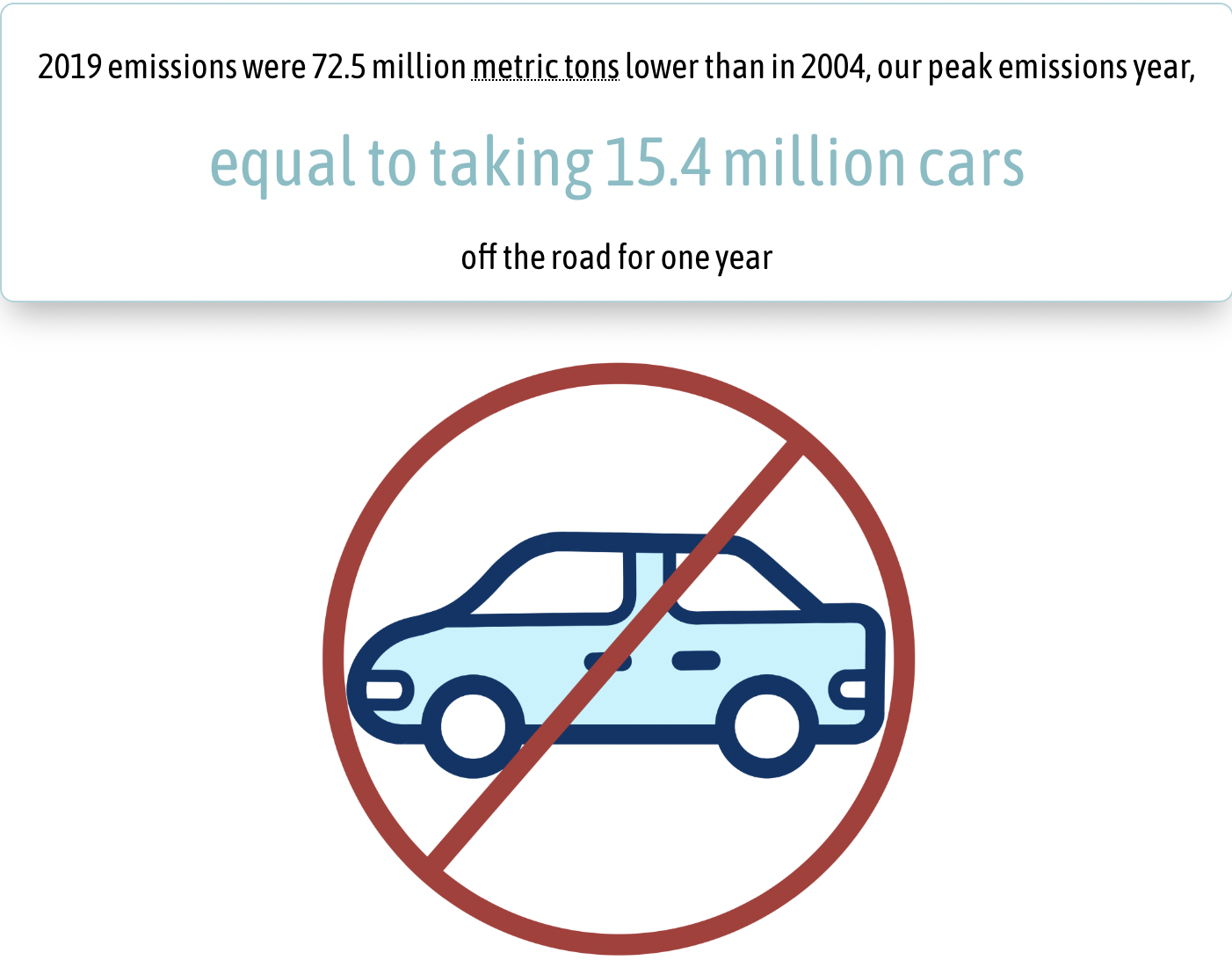
The Climate Dashboard also includes the following graphic, often used in text, as a comparison to show progress being made. The question which logically follows is: Why not just take the cars off the road?
From the Executive Summary: “… rapidly moving to zero-emission transportation, electrifying the cars, buses, trains, and trucks that now constitute California’s single largest source of planet-warming pollution”. Notice that bicycles are not mentioned. Even more worrisome is that one third of the carbon reduction is from actions that capture carbon, including natural environments and as-yet unavailable carbon capture technology.
From the Ensure Equity and Affordability section: “… effective actions to move with all possible speed to clean energy, zero-emission cars and trucks, energy efficient homes, sustainable agriculture, and resilient forests…”. No mention of electric bikes or transit. Unless CARB intends to buy every low income person in the state an electric car, its plan will not meet with needs of low income and disinvested communities. What would meet those needs is a transit-first policy and funding, with significant state investment in making walking and bicycling more welcoming and safer.
In the entire document, there are two instances of ‘bike’ and three of ‘bicycling’ (and none of bicycle or e-bike or electric bicycle). There is one instance of ‘transit’. Six instances of ‘walking’. Ten instances of ‘active transportation’, but 163 instances of ‘transportation’, many of them referring to other documents and programs. In contrast, 157 instances of ‘vehicle’. Not hard to see where the focus is.
Here is a wordcloud of just the Executive Summary section. See if it speaks to your concerns. A wordcloud of the entire document would show vehicle prominently.
CARB seems incapable of imagining a future that is not dominated by cars. They simply intend to replace existing cars with electric cars. Put simply, this is climate arson, by the very agency that is supposed to be working on climate change in a serious way.
Sadly, many of the climate change and environmental organizations seem aligned with this focus on vehicle electrification.
I’ve said it before and will repeat (again and again): electric cars, or any electric vehicles other than bikes, are only a partial solution to the climate crisis. Serious solutions will include and prioritize walking, bicycling and transit. If you are an electric car booster and not working to reduce the dominance of motor vehicles in our cities and lives, you are not serious about climate change. And you are certainly not serious about livable cities.



 Getting Around Sacramento
