Walkable Sacramento wrap-up

I hope that you found the series of posts on Walkable Sacramento useful. The posts received some comments, but not as many as I’d hoped. I’d ask you to go back to them and make comments. Though comments are few, I know that this blog is read by a number of transportation professionals and a few politicians, who could have a major impact in making Sacramento more walkable. Many of them don’t or can’t comment because of their job position, but they do read the posts and do read your comments, so your comments are valuable. The ideas and comments will also be considered as advocacy groups in the city and region develop their own, most likely milder, recommendations for policies and action to enhance walkability and safety for walkers.

I did not address bicyclist concerns and bikeability. That is not because it is not important to me. I bicycle a lot in the city, and do want to improve our streets for bicycling. Though the data is not in yet, I suspect that bike share has increased the rate of bicycling far above that for walking and other modes in the central city. However, the city has done better on providing bicycling facilities, and addressing specific areas of concern, for bicycling, relative to walking. I am also not unconcerned with the safety of people in motor vehicles, but there are plenty of people to advocate for that. As always, the greatest need for improvement in our transportation system is in the low-income neighborhoods which have been traditionally underinvested, and continue to be so.

So, get out there walking, and get out there advocating. Our streets will not get safer unless we all work to force the government to make them safer. The drivers will not help us, except for those more enlightened ones who remember that they walk also, and that the value of a place is determined by its walkability and not its driveability.

one-lane one-way SLO

As you may have read here before, I am opposed to one-way streets, and feel that all or nearly all should be converted back into two-way streets. One way streets exist to speed the flow of car traffic. They do not exist to promote walkability or safety, and in fact are a significant detriment. Multiple-lane one-way streets encourage the multi-lane threat, where a driver in one lane stops, the pedestrian proceeds, and is hit by a driver in the other lane(s) who does not stop. I think one-way streets in Sacramento should be converted. Ironically, so does the city, but it has been reluctant to do so for fear of blowback from the cars-first commuters that use the one-way streets as traffic sewers to and from the freeways.

When there is discussion of one-way streets on the Internet, someone always puts up an example of a one-lane one-way street, either accidentally or purposively not understanding that it is multiple-lane one-way streets that are being talked about. But there are examples of one-way streets that work, if they are one-lane.

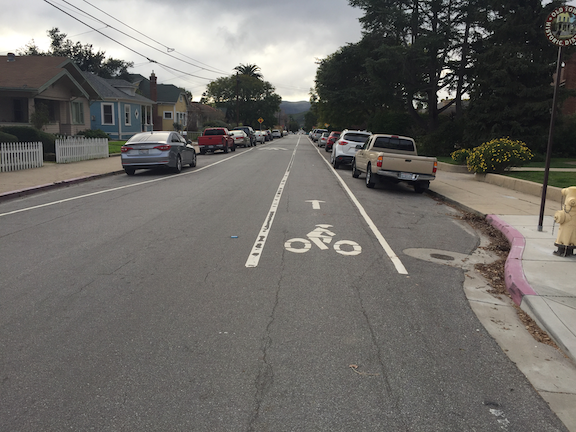
I was in San Luis Obispo (SLO) this last weekend for contra dancing, and had a chance to look again at many of the traffic calming features of that town. SLO has several one-lane one-way streets. Below is Pismo Street, which has a general purpose lane, a bike lane, and parking lanes on each side. The width is probably 28 feet, though I did not have a tape measure with me. I watched this street, a residential street, off and on over a period of three days. I did not ever seen anyone speeding on this street. When crossing the street walking, I had to only look in one direction, not two, and not multiple lanes. Judging from the pavement paint, and my memory of the last 10 years or so, I think this configuration has been in place for some while.

Pismo St, San Luis Obispo; one-lane one-way

This street configuration does not exist in the Sacramento region, so far as I know. The street width of 28 feet is also somewhat unusual. Most streets range upward from 32 feet.

SLO has also recently implemented a traffic calming one-lane one-way on Garden Street. This is a much fancier installation, involving decorative pavement, curb extensions, wider sidewalks, and other features. The drainage channel with different pavement does clearly separate travel from parking, and the handicapped spot is extra wide for loading and unloading from either side. I did not observe this street over a long period of time, but I did not see any speeding. Though the street does not have a posted speed limit, other than the general 25 mph, most vehicles were going well below that. I also saw people comfortably crossing the street mid-block, and drivers yielding to them. This is clearly a street that says ‘slow down’ and ‘stop to enjoy the restaurants and other businesses’, as it should, given the location in the walkable, destination-rich downtown area.

Garden St, San Luis Obispo; one-lane one-way

San Luis Obispo is not a walking paradise. There are multiple-lane one-way streets in the same area, where speeding does occur (note the one-way Marsh Street in the photo above, where speeding certainly does occur on a two-lane one-way street). Once out of the central city and old neighborhoods, it looks just like any place else in California, with wide residential streets and super-wide arterial roads. But it is a good model for the traffic calming that it has done well.

Dangerous by Design 2019

Smart Growth America has released its ‘Dangerous by Design 2019‘ report for 2019. Pedestrian (walker) fatalities have increased 35% over the last decade, becoming a bigger percentage of roadway fatalities, now at 16%. Sacramento (the Sacramento-Roseville-Arden-Arcade Metropolitan Statistical Area MSA) ranks 46 of 100 on the list of most dangerous areas for pedestrians, and the danger increased 4.9% from 2016 (year of the first report they did) to 2019. California ranks 16th on the list of states, and had an increase of 3.8%.

The National Complete Streets Coalition is part of Smart Growth America, so it is expected that the report emphasizes complete streets and roadway design. However, by focusing mostly on that, it misses some important issues. The report acknowledges, on page 7, that the design of vehicles, particularly the explosion of pedestrian-killer SUVs, is important, but then fails to list a significant action related to it. If these vehicles are 2-3 times more likely to cause fatalities, as research indicates, then that could explain more of the increase than many other factors.

Another issue that the report does not even mention is driver behavior. Though an increase in the number of poorly designed roadways could explain part of the overall increase in pedestrian fatalities, I doubt that it could account for all of it. Though most of our roadways are dangerous by design, we are building fewer of the most dangerous ones, and have fixed some of the worst of the worst. I will speculate, without research backing but with anecdotal and direct experience, that a precipitous decline in driver behavior is a significant cause. More pedestrians are being killed because more drivers are killing them. Yes, roadway design is responsible, and is the easier problem to solve in the long run (than human behavior), but if behavior, violation of the law, is in fact a significant contributor, we miss the boat by only talking about design.

Though ultimately, the redesign of our roadways is the best solution, in the meanwhile we need to prevent fatalities, and addressing driver behavior is part of that. This is not a minor issue. This morning, while using a clearly marked crosswalk, I was nearly hit by a driver who passed through the crosswalk without even slowing down. If I had not jumped back, I would not be here writing this post right now.

The report uses the National Household Travel Survey (NHTS) as data for the number of people walking, and says there has actually been a decline in walking over four years and a slight increase over ten years. However, the NHTS only counts commute trips, and assigns all commute trips to the category of the longest leg. Therefore, a transit and walking commute would be classified as transit only. Data about overall walking rates is lacking, and Smart Growth America can hardly be blamed for that. California performed one broad-based survey in 2013, and the results varied significantly from the NHTS data. I realize that Smart Growth America is a nonprofit with limited resources, but at least a small sample analysis using other sources of data would really help illuminate the cause of the increase in fatalities. We can’t adequately assign fatality rates if we don’t really know the rate of walking. It would seem to me that one of the key actions at the federal, state and local level would be better pedestrian trip data, but that does not show up in the report.

As I have said many, many times, here and other places, the model complete streets policies that Smart Growth America and the National Complete Streets Coalition promote do not give sufficient weight to the frequency of safe crossings. As a result, most local policies fail to address this issue at all. If we end up with a national policy that continues this weakness, we won’t really be solving the problem. So I can’t, at this time, support the recommendation, on page 7, for a national complete streets policy. NCSC needs to clean up its act before asking others to clean up their act.

Walkable Sacramento #10: schools

Schools, and the children that attend them, deserve special consideration. The design of our streets and societal trends towards cars-only have left students trapped in the back seats of their parents cars, or for some, trapped in the front seat of their own car once they get their license. The leading cause of death for children 4-14 (some statistics say 1 to 19) is motor vehicle crashes, and most of those occur in their own parent’s vehicles. Better to get students out of vehicles, and vehicles away from schools so that once again children feel safe and welcomed to walk and bicycle (and skateboard and scooter).

Policies:

  • Schools will never be sited unless all neighborhood students can safely walk to school. Though schools have often been sited in the past based only on economics or developer preference, the city must insist that walkability is the primary criteria.
  • Existing schools where neighborhood students cannot safely walk to school will be prioritized for walking improvements, with low-income schools at the highest priority. 
  • The city will fund pedestrian education in every school at one grade level. Additional education and other transportation modes will be the responsibility of the school districts. 
  • The city will proactively work with school districts to consider reduced speed limits on neighborhood streets and in school zones, and closed, restricted or one-way school-adjacent streets during arrival and dismissal times. State law allows cities and counties to set school zone speeds at 20 mph or 15 mph, but no place is the Sacramento region has yet done so. Many places in Europe and a few in the United States close school streets during arrival and dismissal, or for the whole school day (addressing air quality concerns as well as safety concerns). When drivers do not behave, they do not belong around schools, and we must keep them away.

Walkable Sacramento #9: parking

Parking can either support or handicap walking, depending on where it is placed and how it is managed. Parked cars do provide a barrier between walkers and cars, and where a sidewalk buffer is not possible, or not desirable such as in busy retail areas, parked cars are a good. But the imagined need to preserve parking can also harm walkers when it is used to prevent crosswalk daylighting and curb extensions, or to argue against sidewalk widening. Where is works, parking is a good thing, where it does not work, it is a bad thing.

Policies:

  • Parking in such a way as to block a crosswalk, whether marked or unmarked, will be a top priority of parking enforcement, and will be added to the 311 app and website, and recognized by 311 operators.
  • Since surface parking creates more distance between walkable destinations, parking minimums will be eliminated everywhere, parking maximums may be established, and the overall size of surface parking lots will be strictly limited. Big box stores and malls, where they exist, will break up expanses of parking with walkable safe routes, including continuous safe paths from streets to entrances for people who walk. 
  • Though on-street parking (parallel, diagonal, and separated) may create a safer and more comfortable environment for walking and bicycling, preservation of existing parking will never be prioritized over installing or widening sidewalks where needed. 
  • Divert parking revenues beyond those necessary to maintain the program to the neighborhoods from which the income came (Shoup, Parking Benefits District), expended solely on walking infrastructure improvement within 1000 feet of the meter. Lower income areas without meters would be funded at the same level with other funding. 

Walkable Sacramento #8: enforcement

Street redesign is the ultimate solution to the epidemic of serious injury and fatality of walkers, and intimidation of walkers by drivers, however, in the interim, while streets are being redesigned, enforcement can save lives and increase walking.

There are real equity issues with the enforcement of vehicle codes violations. Given that I do not have a way of automating enforcement of failure to yield, that must happen with traffic stops. These stops should be closely monitored to reveal and correct bias.

  • Enforcement will be focused on the three violations that most affect walker safety, in order of priority:
    1. Recognizing that failure to yield to pedestrians both leads to higher serious injuries and driver intimidation of walkers, failure to yield to a pedestrian in the crosswalk (CVC 21950) will be the top traffic enforcement priority for the police department. The goal will be elimination of this violation within three years.
    2. Recognizing that speed directly affects the likelihood of serious injury and fatality, make speed enforcement (CVC 22348) will be the second priority. Use automated speed enforcement whenever possible to eliminate the proven racial and income bias in enforcement.

Walkable Sacramento #7: barriers

There are two major kinds of barriers to walking in the city, natural barriers such as the two rivers, and constructed barriers such as the freeways. Fixing either kind will be quite expensive. I am in favor of pedestrian and bicyclist bridges, perhaps with transit if appropriate, but not motor vehicles. Though a small increase in the number of road crossings is needed, most of these are outside the city in the county.

Policies:

  • Construct safe pedestrian and bicyclist over-crossings of freeways, and rail lines without street-level crossings, at an interval of no less than one-quarter mile, to improve circulation. Work with Caltrans, railroads, and the legislature to ensure that the expense is shared and not the sole responsibility of city taxpayers. Complete within ten years. 
  • Consider safe pedestrian and bicyclist crossings of the rivers (Sacramento and American) at an interval of no less than one-half mile, to improve circulation. Complete within 15 years.
R Street bike bridge over I-5

Walkable Sacramento #6: freeway ramps

Freeway on-ramps and off-ramps are designed solely for the benefit of motor vehicle drivers, with the objective being to allow drivers the maximum possible speed, both entering and exiting freeways. Drivers, whenever possible, accelerate to freeways speeds before even reaching the on-ramp, and often do not decelerate for one or two blocks after leaving the freeway. These are pedestrian killers, and they must be modified. Motor vehicles should either be required to make a 90 degree turn, or stop, before entering and exiting ramps. The ramps allow for the acceleration and deceleration necessary, that does not need to happen on the streets.

You might think that this will require approval from Caltrans, but Caltrans has washed their hands of the freeways over-crossings and under-crossings, except where the intersecting road is also a state highway. These fixes may be quite expensive, as is true of most projects that correct for previous mis-design, but they need to take place.

Policies:

  • All freeway on-ramps and off-ramps will be redesigned to require a complete stop and/or right-angle turn entering or exiting freeways. Pedestrian facilities will be redesigned so that pedestrians receive priority and full safety protection at all on-ramps and off-ramps. Complete within ten years.
  • At completion of the redesign, all pedestrian crossing prohibition at on-ramps and off-ramps, and the intersections associated with the ramps, will be removed. 
I-80 Business off-ramp at N Street; no crossing

Walkable Sacramento #5: speed

This one is pretty simple, but of utmost importance. Speed kills, but the increasing share of fatalities is walkers. The chart explains why.

Though the primary beneficiaries are walkers, bicyclists and motor vehicle drivers will benefit as well. As with many policies and actions related to walking, this is an interim measure to keep people alive until roadways are redesigned. Roadways design should enforce a desired speed, not allow and encourage a higher speed.

Policies:

  • Any roadway with a history of crashes resulting in serious injury or fatality will have the speed limit reduced by 5 mph until this pattern ceases, and each such crash will result in further reduction, but not below 15 mph. 
  • Speed limits on all roadways will be set at the desired speed, not the design speed and not the actual speed. It will be illegal to consider the 85% criteria for setting speeds.
  • Implement a city-wide base speed of 20 mph, and allow higher speed limits only where the roadway design ensures safety at higher speeds. Safety means no fatalities or serious injuries. The sign below is from the UK (United Kingdom), but many places around the world have now made 20 mph (32 kph) the baseline speed.

Walkable Sacramento #4: sidewalks

For a series on walkability, you might think sidewalks would come first, not later. The reason they are not first in the series is that sidewalks, relative to other issues, are in decent shape. Yes, vast areas are missing sidewalks, and in many areas that have them, they are not well maintained. But looking at the whole issue of walking, it is crossing roadways that is most dangerous and unpleasant, not walking along roadways.

I do not believe that low speed, low volume residential streets need sidewalks. It is OK that some have them, and it is OK to require them in new developments (to the degree that it is OK to have new developments, which is to say, this should be irrelevant because there should be no new developments). But to build sidewalks on quiet streets that do not have them is not the best use of funds.

The city has a lot of semi-rural areas without sidewalks. Do they not deserve sidewalks? Where sidewalks would provide a route to key amenities such as grocery stores and schools, sidewalks should be provided, or at least paved asphalt paths adjacent to roadways. Too many people die walking on the shoulders of rural and semi-rural roads, so shoulders are not a solution, there must be either sidewalks or separated paths.

The most important point of all about sidewalks is the first bullet, that it is the responsibility of the city to maintain sidewalks. It is irrational to propose that roadways are maintained by the city, but sidewalks are not. If this belief and legal fabrication persists, Sacramento can never be a walkable city.

  • Recognizing that sidewalks are an integral part of the transportation network, sidewalk repair will be the responsibility of the city and not of property owners, except where trees owned by property owners, or disturbance, change or widening is initiated by the property owner.
  • All streets with an ADT over 5000 will have continuous sidewalks of no less than four feet clear path, within five years.
  • All streets with an ADT over 10,000 will have a continuous sidewalk of not less than six feet clear width, within two years.
  • All streets with an ADT over 20,000 will have a continuous sidewalk of not less than six feet clear width, with a buffer of not less than six feet, within six years. Parallel multi-use paths can be used to meet this requirement.
  • Utility poles and other obstructions will not restrict sidewalk width below the minimums above, and where these exist, will either be removed or sidewalks widened. The expense will be borne by the utilities, not city taxpayers.
  • All sidewalks will be maintained in a state of good repair by the city. Any cracks with a vertical displacement of more than one inch will be fixed within two months. The city will evaluate and implement flexible sidewalks for locations with ongoing tree root heaving issues.
  • Timely leaf removal from sidewalks will be the responsibility of the property owner, except for sidewalks with a daily use of over 5000, which will be the responsibility of the city. 
  • All development which requires new sidewalks (greenfield development) will fund a maintenance fund so that existing city residents are not financially responsible for sidewalk maintenance on new sidewalks. 
  • Sidewalks will be continuous across alleyways, in concrete and not asphalt. Every alleyway that is reconstructed or repaved will have this implemented.