Assembly Bill 825 been introduced to the California legislature by Issac Bryan. The bill would allow bicyclists to use sidewalks where safe street bicyclist facilities have not been provide by the transportation agency. Class 1 separated paths, Class 2 bike lanes and Class 4 separated bikeways are considered safe facilities. Note that Class 3 bike routes, which are only signing and sometimes sharrows, are not considered safe under this bill. It would limit speed on sidewalks to 10 mph and require that bicyclists yield to walkers. The bill passed Assembly Committee on Transportation last week and will go to Assembly Committee on Appropriations.
I posted two day ago about bicycling on sidewalk codes in Sacramento county. The county and all the cities prohibit biking on sidewalks unless they are recognized in the bicycle plan as being bike facilities. There are very, very few such designations. The City of Sacramento takes the reverse approach, that it is legal except where signed against, and there are currently no locations signed against.
Again, I’ll say that I don’t like bicycling on sidewalks, and I don’t do it, but I completely understand why others do. The are making the best decision they can to keep themselves safe from traffic violence. This bill recognizes that reality.
Let me say that I am not in favor of bicyclists on sidewalks, but the conflict between bicyclists and walkers is often exaggerated, and bicyclists are making the best decision they perceive to keep themselves safe from traffic violence. I don’t do it, but I understand why other people do.
So what is the situation in the Sacramento region?
City of Sacramento code 10.76.010 Riding bicycles on sidewalks prohibits bicycling on sidewalks only where signed and where in-street facilities are provided. The code says:
A. No person shall ride a bicycle on a sidewalk where a sign is posted indicating that bicycling is prohibited. The city manager shall designate sidewalks where such signs are posted upon a finding that:
1. The sidewalk abuts a road that is designated a “Low Stress Bikeway” using the criteria for the Facility Selection Guidelines in the City of Sacramento Bicycle Master Plan; and
2. There is either a demonstrated or probable conflict between pedestrians and bicycles. This may be shown by information including, but not limited to: 311 reports, incident data, or estimated high pedestrian activity determined by counts or adjacent land uses and densities.
B. Subsection A of this section does not apply to the following persons:
1. City employees acting within the course and scope of employment, including but not limited to:
a. Peace officers, as defined in California Penal Code section 830.
b. Emergency medical personnel as designated by the fire chief of the city.
c. Parking enforcement officers.
2. Children under the age of 18 years old and an accompanying adult.
C. Where bicycling on a sidewalk is permitted, the following apply:
1. Bicyclists must yield the right-of-way to pedestrians by slowing down, stopping, or dismounting, as needed.
2. Before passing a pedestrian traveling in the same direction, bicyclists must give the pedestrian an audible warning.
D. The city manager or designee shall report to the city council annually regarding the impacts of sections 10.76.010 and 10.76.030. (Ord. 2019-007 § 2; Ord. 2017-0033 § 1; Ord. 2016-0024 § 1; prior code § 25.05.070)
There are some designated bike routes on sidewalks in the City of Sacramento, which were designated before this code came into effect and are still valid. N Street between 8th Street and 15th Street, and the area through the convention center/performance center between 13th Street and 14th Street.
SABA has a summary of sidewalk riding rules, on Sharing the Road page, scroll down to ‘Is it legal to ride on the sidewalk? This page may be out of date.
Note that the County of Sacramento, Elk Grove, and Rancho Cordova code sections are identical, and the Folsom and Galt code sections are identical, examples of mindless copying of code from other locales.
I do not have any information on whether these codes are being enforced in a discriminatory way, but given the almost universal pattern of law enforcement oppression of people of color, I’d not be the least surprised.
On the positive side, AB-825 Vehicles: bicycling on sidewalks (Bryan) has been introduced which would prohibit sidewalk prohibitions except where there are high quality bicycle facilities available on the street, invalidating all of these code sections except, perhaps, the City of Sacramento. The relevant paragraph is: Notwithstanding paragraph (1), a local authority shall not prohibit the operation of a bicycle on a sidewalk adjacent to a highway or corridor that does not include a Class I, Class II, or Class IV bikeway, as defined in Section 890.4 of the Streets and Highway Code.
I hope readers will support this legislation. The bill passed the Assembly Committee on Transportation on March 20, 2023, and was referred to Assembly Committee on Appropriations, but not yet scheduled. See also Streetsblog CA Traffic Safety Bills Pass First Committee.
If passed, the legislation might well cause cities and counties to accelerate projects to add safe bicycling facilities to streets, in order to reduce sidewalk riding. One can hope.
One of the elements of street design is the width of sidewalk buffers, and how these are presented in design standards. The sidewalk buffer is the area between the curb and the sidewalk. The city calls sidewalk buffers ‘planting strips’, and this is often how they are used, but it is not the only use, and in more urban areas, there are often multiple uses of the sidewalk buffer.
I did a sampling of sidewalk buffer widths in the central city, and a few other parts of Sacramento. I am not claiming any insight into the overall pattern. The city does not have a publicly available database or GIS layer of sidewalk locations and widths, let alone locations and widths of the buffers. I have heard rumors that they are developing one, but I have been hearing that rumor for the last ten years, so I’ve become doubtful.
Typical buffer widths in the central city range from six feet to nine feet, with seven feet being the most common. With huge mature trees, the narrower buffers are too narrow of the trees, and the sidewalks have had to be modified. The photo below shows an example, and these situations are everywhere.
sidewalk narrowed for tree roots, Q St near 14th StRead More »
Given the issues raised by the need for wider bikeways to accommodate wider devices and passing, the topic of my bike lane widths post, I am starting to think more and more about sidewalk-level bikeways, where the bikeway is at the same level as the sidewalk, and not at street level. The street-edge curb provides a good separation between motor vehicles and bicyclists and walkers (not perfect, drivers do ‘accidentally’ or intentional cross curbs). I am concerned that as street-level bikeways become wider, there will be more and more motor vehicle intrusions.
Here are are two diagrams from the Portland Bureau of Transportation (PBOT) Pedestrian Design Guide (2022), page 28. The first uses a tactile divider between the sidewalk and bikeway, the second a buffer similar to the regular sidewalk buffer, but with reduced width due to the greater separation from motor vehicle traffic as compared to regular sidewalks. Note that the street classification system that PBOT uses is interesting, but probably more than is needed in Sacramento for the Street Design Standards update.
I just came across the NACTO publication Designing for Small Things With Wheels, released February 2023. I’m still digesting the publication, which is available online for download. Already it has been eye-opening for me, a person who used to keep up with bikeway designs, but hasn’t paid much attention recently.
The working paper’s basic premise is that bikeways must be designed for the modern complement of devices, with widely varying widths, and also that bikeways must be designed so that people can safely and easily pass each other. Bike lanes have gradually evolved from 4 feet to 5 feet to 6 feet, but at least in Sacramento and the region, have not gone beyond that. But the working paper indicates that we need to start with 8 feet, to accommodate cargo bikes which are becoming much more common in the region, and go up from there. A chart from the working paper is below (page 11).
chart for bikeway width, NACTO Designing for Small Things with Wheelschart for two-way bikeway width, NACTO Designing for Small Things with Wheels
Given that I believe that motor vehicle design speeds over 30 mph require separate bikeways to keep riders of all ages and abilities safe, this means future separated bikeways should be a minimum of 8 feet. However, bikeways this wide encourage motor vehicle drivers to use them for travel, and to park in them, ‘for just a moment’ or longer. My take is that this means we must create bikeways that are at the sidewalk level, or if street level, that are completely protected by hard infrastructure such as curbs. Paint and vertical delineators (soft hit posts) will not do it. So, I need to throw out all the previous designs that I’ve suggested for streets with protected bikeways. I also need to give serious consideration to sidewalk-level bikeways that place a curb between any motor vehicle use and users of small wheels. Where does that leave parking protected bikeways that use parked cars as the buffer, at least when the parked cars are there? I’m not sure. Like I said, this is eye-opening and I’ll need to do a lot more thinking and research.
What I still do think is that bike facilities necessary depend on street design speeds (which are not currently but should be the same as posted speeds)
20 mph or less – no bicycle facilities needed
21 to 30 mph – standard bike lanes (Class 2 in California)
above 30 mph – separated bikeways (Class 4 in California)
Yes, this does affect what I was thinking about writing for bicycle facilities in my series on the City of Sacramento update of Street Design Standards.
In the city’s 311 website and app, the following 10 options are listed under Parking: Enforcement Request:
Blocking Alley
Blocking Driveway
Commercial Vehicle in Residential Zone
Parked Beyond Posted Time
Parked in Disabled Space Without Placard
Parked On Unpaved Surface
Parked without Permit
Red Zone
White Zone
Other
Blocking a crosswalk is not listed. Is this a mere oversight? I doubt it. I have reported dozens of vehicles parked blocking crosswalks, and not a single one has resulted in a citation. Apparently the city does not consider this a citable violation. One time I actually waited at the crosswalk where a vehicle was parked in violation. The parking officer drove up, noticed the vehicle blocking the crosswalk, and drove away. The 311 request was marked closed with the note that the vehicle was no longer there. But of course it was, and the parking officer knew that it was.
California Vehicle Code (CVC) Division 11: Rules of the Road, Chapter 5: Pedestrians’ Rights and Duties, paragraph 21970 states:
(a) No person may stop a vehicle unnecessarily in a manner that causes the vehicle to block a marked or unmarked crosswalk or sidewalk.
In addition, paragraph 22500 states:
A person shall not stop, park, or leave standing any vehicle whether attended or unattended, except when necessary to avoid conflict with other traffic or in compliance with the directions of a peace officer or official traffic control device, in any of the following places:
(b) On a crosswalk, except that a bus engaged as a common carrier or a taxicab may stop in an unmarked crosswalk to load or unload passengers when authorized by the legislative body of a city pursuant to an ordinance.
The city should do two things: 1) add ‘Blocking Crosswalk’ to the 311 website and app; and 2) actually enforce this CVC.
This is yet another example of the city’s bias toward motor vehicle drivers and against people walking. Please join me in emailing the city’s Parking Services at ParkingCSR@cityofsacramento.org, and requesting that the city add this violation to the 311 website and app, and that violations be cited when reported or observed.
If you would like some copy and paste text:
I request that the City of Sacramento Parking Services:
Add ‘Blocking Crosswalk’ to the list of parking violations in the 311 website and app. This is a violation of CVC 21970 and CVC 22500.
Issue citations to vehicles blocking crosswalks, in order to protect the safety of walkers using crosswalk.
Before delving into street design, I must come back to the question of whose responsibility it is to maintain sidewalks. I’ve talked about this before, Sacramento and sidewalks, but it bears repeating. It also deserves a citizen movement to force the city to change policy.
deteriorated sidewalk, 24th St near Capitol Ave, Sacramento
Take a look at the city’s Sidewalks, Curbs & Gutters page. Unless you are a confirmed windshield perspectives, cars-first and cars-only person, I think it will strike you as strange.
Start with the opening paragraph, which tells a lie. “Within the City of Sacramento, there are approximately 2,300 miles of sidewalk. Sacramento City Code, section 12.32, and California Streets & Highway Code 5610 requires that the maintenance and repair of public sidewalks be the responsibility of the property owner.” Streets and Highways code does NOT require that maintenance be the responsibility of the property owner. It simple allows a city to try to make it the responsibility of the property owner. Not all cities do that. But Sacramento has decided that shifting responsibility for transportation infrastructure in the public right-of-way to property owners fits the model of car dominance that is essentially city policy.
Let me offer some paragraphs, with the only change being replacement of ‘sidewalk’ with ‘street’.
“…requires that the maintenance and repair of public streets be the responsibility of the property owner.… If the property owner does not take action in one of the above three ways, the City will make repairs under default and the cost will be collected from the property owner. Unpaid collection will ultimately lead to a lien on the property.”
“As the property owner may bear civil liability for a person suffering personal injury or property damage caused by a defective street: it is in the property owners best interest to maintain the street and reduce the risk of a lawsuit.”
“City ordinance requires property owners to take responsibility for street repairs, regardless of whether or not the tree’s roots causing damage is City owned.”
“An owner shall maintain and repair any defective street fronting such owner’s lot, lots or portion of a lot. Where a defective street is caused in whole or in part by a tree root or roots, the owner shall nevertheless have the duty to repair the street.“
Sounds absurd, doesn’t it? And it is absurd. Sidewalks are an integral part of the transportation system in the city. In fact, for people with disabilities who use mobility devices, they are the ONLY way of travel in the city. So trying to force responsibility for sidewalks onto property owners is a violation of at least the intent of ADA regulations, and perhaps the actual legal force of ADA regulations.
Beyond the arguments of fairness in sidewalk policies, there is the real issue that it simply does not work. There are broken sidewalks all over the central city, and the further out one goes, the worse they are. There are sidewalk defects that have been there the entire 12 years I’ve lived in the central city. There is a clear pattern that sidewalks in front of residential property are much more likely to get repaired than in front of commercial properties, reflecting a bias in enforcment.
Some lower income neighborhoods have such poor sidewalks (not to mention narrow sidewalks of 3-4 feet) that everyone walks in the street instead. If the city’s bias against walkers and the disabled is clear, its bias against lower income neighborhoods is glaring.
Even if the city’s policy on sidewalk repair were morally right, which it clearly is not, it is a failure to serve citizens of the city. And it is as clear a statement of bias in favor the drivers of motor vehicles as one can find. It is time for it to end.
As I was walking this afternoon, crossing 19th Street at S Street, with the light, a woman very nearly ran me over. She was looking only at opposing traffic, and decided she could make the left turn if she accelerated. She was not looking at the crosswalk or at me. In fact, I’m pretty sure she would not have seen me until I was on her hood. She only noticed me because I screamed at her as I jumped back to avoid being hit.
This is a story that anyone who walks could repeat, it is not in the least unique. I have probably 150 almost identical instances since moving to Sacramento 11 years ago. And it is not unique to Sacramento. Traffic violence is everywhere, almost all the time.
But as I continued my walk, I wondered what goes through the minds of drivers who almost kill people. In many cases, they blame it on the person walking, for having the effrontery of being on the street in front of their car. I know this because they often start the screaming, directing invective at me.
But what about the others? Do they drive more carefully, with more attention to surroundings? Do they refrain from accelerating into dangerous situations? Do they slow the fuck down? Probably, for a few days. I imagine some of these drivers are actually quite shaken by the realization that they almost killed someone.
I’m pretty sure that it doesn’t last, though. They must slide back into their old reckless ways. If this were not so, there would be much more careful drivers on the road, and much less traffic violence. But there isn’t.
I suspect almost every driver on the road has come close to killing someone before. Some drivers, many times. Some drivers have killed people walking. After all, killing someone with your vehicle is seen by law enforcement and courts as a whoopsie, unless you are very drunk.
Note that I define traffic violence as any driver behavior that intimidates people from walking or bicycling. The driver doesn’t have to actually kill or injure to have the (desired?) effect.
Note: Please see post on City of Sacramento Street Design Standards. It turns out that there are at least two different sets of design standards.
The City of Sacramento has Standard Specifications and Drawings that require certain designs for the public right-of-way. There were last revised April 2020, and are available on the Utilities: Development Standards page. It is not clear why these are part of Utilities rather than Public Works or Community Development, but they are. Though I haven’t done an element by element comparison, they seem to be a considerable improvement over the previous standards, which seem to be June 2009.
There are designs which are not being followed, and others that should be eliminated. Today, I’ll address sidewalks crossing alleys. Alleys are only common in the central city, but they do exist other places throughout the city.
The city design standard is below (pdf of entire page). The detail is hard to see, but the alleyway, sidewalk, and alley driveway are all concrete, none are asphalt. The T-11 Standard Alley Entrance Detail page says “Portland Cement Concrete (PCC) is the city standard pavement for alleys.”
SacCity Specification detail alley entrance
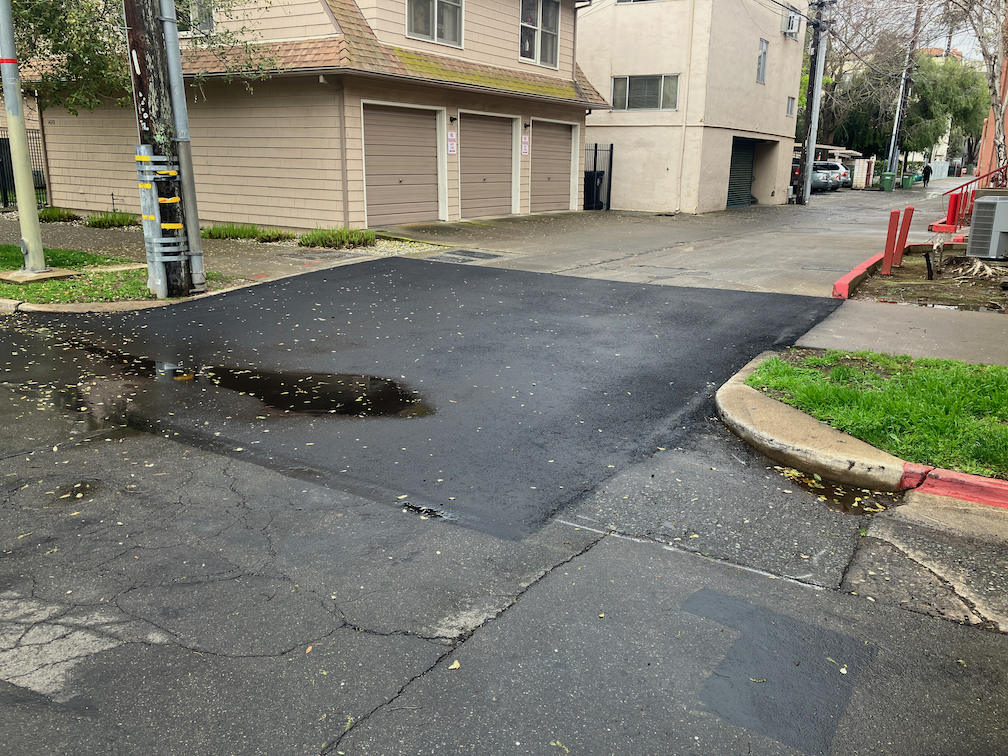
Of course there are many alleyways that are asphalt, and some that are unpaved gravel. I don’t know when the city standards changed to require pavement, or when to require concrete, but those are the current standards. That means that if an alley, or a sidewalk, or the alley driveway is changed, it must meet current standards. Below is a photo of Neighbors Alley at 17th Street, which was just redone within the last two months. It clearly does not meet city standards. Both the driveway and the sidewalk are asphalt, not concrete. Though I noticed this work being done, I failed to notice who was doing it. City? Private? Private utility? Not sure.
This is essentially the second part of my red-light-running bullies post. Except that it applies to every intersection, not just signalized intersections.
This is another driver behavior that accelerated with the pandemic. But it didn’t start there. It primarily started with the election of Donald Trump. There was a noticeable change in driver behavior immediately after the election. Many drivers apparently thought, well if the president can say and do whatever he wants without consequence, so can I. It was really noticeable to me how belligerent drivers became. I’m guessing that it was because many drivers see people walking and bicycling as ‘other’, people with different values and political views. Used to be communists, then it was “lib’rels”, and I won’t use the current round of words here. If you are walking or bicycling, you are ‘other’ and if you are walking or bicycling and black or poor, you are truly the enemy. God meant us to drive, and anyone who thinks otherwise or gets in my way is against both God and me. That may sound outlandish, but it does accurately reflect how many drivers view the world.
But back to the driver behavior. Most drivers no longer yield to people using crosswalks. Of course most drivers are not aware that there is a crosswalk at every intersection, whether marked or not. And the DMV is complicit in this, they make no effort to educate drivers about pedestrian right-of-way. The law doesn’t require a driver to stop until the walker steps off the curb (or ramp) and into the street. Common decency would mandate yielding to waiting walkers, but common decency is not common among drivers. Once the walker has stepped into the street, they have the right of way. But most drivers will not stop. They may change lanes to avoid the blood splat on their car, but they won’t stop.
There are drivers who do stop, but when I look at them, I see the fear in their eyes, that they are going to get rear ended by an inattentive driver, or that on a street with more than one lane in the same direction, another driver in another lane will fail to stop or even slow, and they will have to see someone die right in front of their eyes. I understand that fear, because both these things happen with disturbing frequency.


 Getting Around Sacramento