SacCity sidewalk inventory

The City of Sacramento does not make available to the public an inventory of sidewalks. The city does make available on the Transportation & Infrastructure page: Bike Master Plan, EV Chargers, Off-Street Parking, Signs, Street Lights, Traffic Counts, and Traffic Signals, and other datasets. Sacramento County makes available on the Transportation page: Posted Speed Limits. SACOG makes available on the Transportation page several other transportation datasets. None have sidewalk inventories.

I have heard, unofficially, that the city has a partial dataset of sidewalks, but it is not spatially complete. It may be that it has only more recent installations, or that it focuses on some parts of the city. I have done a PRA for sidewalk inventory, but the city couldn’t figure out what I was asking for, so I will have to determine how to describe the dataset in a way they will understand.

What would a good sidewalk inventory contain?

  • total width
  • unobstructed width
  • sidewalk buffer (planting strip) width
  • available right-of-way
  • condition
  • year of installation, or reconstruction
  • gaps
  • intersection corner design
  • ramps (compliant or not)

The soon to be adopted 2040 General Plan 8-Mobility Element mentions sidewalks a number of times, suggesting widening or improving. Probably the most important are:

M-1.9 Equitable Processes and Outcomes. The City shall ensure that the transportation system is planned and implemented with an equitable process to achieve equitable outcomes and investments so that all neighborhoods one day will have similar levels of transportation infrastructure such as sidewalks, marked low stress crossings, and bikeways.

M-1.14 Walking Facilities. The City shall work to complete the network of tree-shaded sidewalks throughout the city, to the greatest extent feasible, through development project improvements and grant funding to build new sidewalks and crossings, especially within the high-injury network, in disadvantaged communities, near highridership transit stops, and near important destinations, such as schools, parks, and commercial areas. Walking facilities should incorporate shade trees.

However, there is no mention of how locations needing improvement will be identified. Is this guesswork on the part of city staff, or is there a dataset being used but not shared with the public?

My request is that the city make available to the public whatever sidewalk inventory it has, even if it is not spatially complete nor has all the elements a sidewalk inventory should have.

A sidewalk inventory is the first step in meeting the city’s goal of a continuous, high quality sidewalk network. More about that soon.

photo of deteriorated sidewalk on 24th St, near Capitol Ave
deteriorated sidewalk on 24th St, near Capitol Ave

And while we are at it, a crosswalk inventory:

  • marked or unmarked
  • width
  • length
  • design
  • median island
  • material: paint or thermoplastic
  • condition
  • date of placement or refresh
  • traffic control (yield, stop, signal, actuated crossing)
  • crossing prohibition

It should be said that sidewalks and crosswalks in the City of Sacramento are in better condition than many similar sized cities in California, but that does not mean that there isn’t a need for great improvement. Every city and county neglects its sidewalks.

Previous related posts: SacBee: sidewalk repair; SacCity sidewalk design standards; SacCity sidewalk responsibility; Sacramento and sidewalks; Walkable Sacramento #4: sidewalks.

LWV Climate Justice Mayoral Candidates Forum and bike share

The League of Women Voters Sacramento sponsored an online Climate Justice Mayoral Candidates Forum on Monday, January 22. Thirteen local climate and transportation advocacy organizations co-sponsored. Seven questions were asked of the five candidates (Jose Avina, Flo Cofer, Steven Hansen, Kevin McCarty, and Richard Pan). You can view the forum on YouTube.

Questions asked:

  1. In 2019, the city council adopted a resolution declaring a climate emergency, committing to carbon neutrality by 2045 and to accomplishing as much action as feasible by 2030. Would you modify these dates, and if so, how would you do it?
  2. Sacramento is getting hotter each summer, with more and longer heat waves. Other extreme impacts of climate change include flooding and stronger winter storms. These conditions impact our residents and especially our most vulnerable communities and the unhoused. How can the city do better in addressing these impacts for all residents of Sacramento?
  3. Mayor Steinberg has proposed a countywide ballot measure that would establish a one and a half cent sales tax (incorrect) for an integrated approach to housing, safe and complete streets, transit,  and climate innovations. Would you support such a measure in 2026? Why or why not?
  4. Transportation is by far the greatest contributor to greenhouse gas emissions in our region. It is critical that we improve our public transit system and increase ridership. What role do you see the city and mayor playing in making this happen. What type of innovative transit projects would you seek to prioritize, and please include in your answer, the last time you used public transit.
  5. The Mayors Climate Commission completed its work in 2020, and provided comprehensive recommendations for achieving carbon zero by 2045. Many of these recommendations are included in the city’s proposed Climate Action and Adaptation Plan which is scheduled for adoption this spring. The proposed plan has a price tag of over $3 billion, yet the city does not have funding set aside for this purpose. What would you do to ensure that funding and financing are addressed in a meaningful way so that the plan does not sit on the shelf?
  6. Sprawl development continues throughout the region and contributes to increased vehicle miles traveled and greenhouse gas emissions. For example, massive development is proposed for the Natomas basin north of downtown. What is your view on annexing city and county boundaries to facilitate this type of development? How do you balance the arguments that these developments would create new jobs and bring in revenue with the need to prevent further emissions-producing sprawl and encourage infill and urban development?
  7. Active transportation options, walking, cycling and rolling, play an important role in reducing greenhouse gas emissions as well as improving health and quality of life. Safety is a reason often cited for not using these options. What can the city do to improve safety, provide additional opportunities, and encourage and incentivize active transportation? 

As a strong believer in bike share, I note Steve Hansen’s reply that promoted bike share.

I helped work with the city of Davis, West Sacramento, and the City of Sacramento through SACOG to launch our shared mobility program. Our JUMP system before the pandemic before the pandemic hit was as successful as the City of Paris, and what happened, though, is after it was sold to Uber and then Lime, disinvestment happened. We need to get back to likely a publicly owned system where we have connectivity.

N Street & 14th Street construction

At a recent meeting, people asked me about the crossing of N Street at 14th Street, what I thought of the pedestrian prohibition, and why I hadn’t reported it as I do most other construction related issues.

N Street is a three lane one-way street, reduced to two lanes by construction at the state capitol, and the CADA construction project on the southwest corner of N Street and 14th Street. At this construction project, the parking lane and rightmost lane are closed, with a barrier and fence along N Street. The barrier and fence block driver view of the crosswalk on the east side of the N Street/14th Street crosswalk, until just before the crosswalk. This is a situation not addressed by CA-MUTCD, nor the proposed city Draft Criteria and Guidance to Accommodate Active Transportation in Work Zones and at Events, or work zone guide for short.

There are probably ways of safely handling this limited visibility situation, but it is not immediately obvious to me how. So I have not reported the closure of this crosswalk. It is a low volume crosswalk, I believe. Any detour for walkers is an issue, and this one requires a detour of a block to the east or west, because both the east crosswalk and the west crosswalk are closed.

While it is true that this crosswalk closure is no absolutely necessary, it is also true that it would take some sort of traffic control at this location to make it safe for walkers.

photo of N St approaching 14th St, poor visibility
N St approaching 14th St, poor visibility
photo of closed crosswalk over N St at 14th St, east
closed crosswalk over N St at 14th St, east leg, northeast corner
photo of crosswalk closed over N St at 14th St, east, southeast corner
crosswalk closed over N St at 14th St, east leg, southeast corner

SacBee: sidewalk repair

The SacBee published an article in January entitled ‘$20k? Homeowners in some Sacramento neighborhoods are billed more for sidewalk repair‘. The article is about the charges the City of Sacramento has made to homeowners, primarily in low income areas.

City code specifies that property owners are completely responsible for repair of sidewalks adjacent to their property. State streets and highways code seems to allow the city to claim this. The two relevant sections within Chapter 22: Maintenance of Sidewalks are: Article 2. Repairs and Article 3. Collection of Cost of Repair. I have previously made the claim that both state code and city code are unconstitutional, because they make persons responsible for maintenance of property that belongs to the city, not the person. In almost all cases, sidewalks and the land on which they lie is city property, not private property. This is particularly egregious when the sidewalk damage is due to city-owned trees in the sidewalk buffer (which the city calls planting strips).

Therefore, I believe that it is illegal for the city to charge property owners for sidewalk repair.

The major focus of the article is that low income communities are being unfairly targeted for sidewalk repair, with a graph that indicates that. That is one interpretation of the data, and it would not be surprising. The city has always and continues to treat lower income communities and people of color with bias. There is another explanation however. Sidewalks in lower income communities were very likely built to lower standards than in others, and it is likely that the city has never maintained any of them, except in some locations placing ADA ramps at corners. I notice in the central city that many sidewalk cracks are covered with asphalt patches, which were placed by the city. I have not noticed these patches in lower income neighborhoods. It is likely that the city is doing work in moderate and high income areas that they are not doing in lower income areas. The central city has more construction projects than other areas, which often result in the sidewalks being repaired or replaced. The central city has also seen a lot more installation of new corners with ADA ramps that other areas of the city. This makes some sense because much of the central city has higher pedestrian (walker) levels, but this fact does not overcome the fact that there are walkers in disinvested neighborhoods, and in particular, children walking to and from school deserve good sidewalks more than anyone else.

I have been in the habit of reporting sidewalk issues through the city’s 311 app. This article has made me rethink reporting. Am I causing unaffordable repair bills for people who can’t afford it? Is the sidewalk flaw really that bad? I’ve decided to stop reporting sidewalk locations, until these issues are resolved.

My next steps are to make a suggestion for how the city can mitigate these repair costs, and for the city to inventory its sidewalks so that it knows what the situation is throughout the city, rather than a complaint-driven system that is almost certain to have bias. Coming up!

photo of broken sidewalk, V St, Sacramento
broken sidewalk, V St, Sacramento
photo of sidewalk repaired due to damage by a city owned tree in a city owner sidewalk buffer, P St
sidewalk repaired due to damage by a city owned tree in a city owner sidewalk buffer, P St

the long awaited death of ‘share the road’

The ‘share the road’ sign, which has been very popular with traffic engineers, is NOT in the 2023 MUTCD. So this sign is dead, and a well deserved death. The ‘share the road’ sign was often interpreted by drivers to mean, bicyclists must share the road with motor vehicles, or in less polite terms, “get out of my way, the sign says so”. The share the road diamond shaped sign was never a legal MUTCD sign, though they were and are quite common.

W16-1P sign, which used to say ‘share the road’ now says ‘in road’, as in, bicycles in roadway. The left sign is common, the middle sign can be used, and the right sign is for temporary traffic control (TTC). Since this new sign content replaces the old with the same sign designation, I take it to mean that the old sign may no longer be used at all, and must be replaced by the new sign.

The plaque is not used by itself, but with the W11-1 bicycle sign, below. Though the yellow version of the W11-1/W16-1P assembly is permitted, this sign would more likely be used at TTC in a construction zone.

MUTCD W11-1/W16-1P assembly sign 'bicycles in road'
MUTCD W11-1/W16-1P assembly sign ‘bicycles in road’

Outside of construction zones, the preferable sign would be MUTCD R9-20 ‘bikes allowed use of full lane’, below, and this sign can also be used in construction zones. This sign is similar to the old MUTCD R4-11 sign, which is no longer in the MUTCD.

MUTCD R9-20 'bicycles allowed use of full lane'
MUTCD R9-20 ‘bicycles allowed use of full lane’

Only in a few cases does the MUTCD require replacement of existing signs, but does require that the current sign be used in any new installation.

The new MUTCD recognizes the green painted bicycle lanes and green dotted bicycle lanes (often called skip marking) through conflict areas such as merges and intersections. Unfortunately, it did not drop recognition of the ‘sharrow’ shared lane marking. Though the sharrow can be legitimately used to show a bicyclist path in confusing locations, it has generally been used to bias roadways against bicyclists and to encourage motorists to fail to yield to bicyclists in the roadway. Maybe next time!

The MUTCD now has an entire chapter devoted to bicycles, Part 9: Traffic Control for Bicycle Facilities. This is progress, even if less than desired.

update on SacCity new beg buttons on Alhambra

A previous post about new beg buttons on Alhambra Blvd noted that there are now beg buttons where there used to be auto-recall pedestrian crossings. I walked Alhambra this week, and noted that there are eight intersections with these new beg buttons (technically called pedestrian actuators or Accessible Pedestrian Signals APS). At auto-recall crosswalks, the pedestrian signal comes on at every signal cycle. At beg button crosswalks, the signal comes on only if requested by the pedestrian. The city has many of both types of crosswalks, but these particular locations are new. The intersections are Alhambra and: J Street, K Street, L Street, Capitol Avenue/Folsom Blvd, N Street, P Street/Stockton Blvd, Q Street, S Street. At each intersection there are eight of these new beg buttons on new posts, for a total of 64 new beg buttons.

No one seems to know who authorized this project, nor what funds were used to pay for it. I have confirmed that the project never came before the Active Transportation Commission (SacATC). All significant pedestrian projects are supposed to come before SacATC, and the fact that this one did not probably indicates that the staff in Public Works knows that this is a motor vehicle project, and not a pedestrian project. Though it is a good bet that pedestrian safety funds were used to pay for it.

Though these beg buttons are not signed with the ‘wave at’ sign R10-3j(CA) that the new ones at 21st Street and I Street, they do seem to have the same function, that they detect people, waving or not, up to about 18 inches. It seems odd that the city would have purchased these infrared detector actuators, which must be more expensive than plain touch buttons, but then did not indicate them as such. Installation of new accessible pedestrian signals is about $70K per intersection, though replacement of buttons at existing locations is only about $14K per intersection. I have been unable to find costs for passive detection systems (they all seem to require a quote process).

A reminder, if one is needed, that beg buttons have no safety benefit for people walking. They are a motor vehicle device, meant to reduce the length of signal cycles so that more cars can go faster.

The solution to this is to prohibit the use of pedestrian beg buttons throughout the city. Existing locations can be converted to the audible crossing signals that are now required by PROWAG. The relevant sections of PROWAG are R307 Pedestrian Push Buttons and Passive Pedestrian Detection and R308 Accessible Pedestrian Signal Walk Indications. Unfortunately PROWAG does not have a definition for ‘passive detection’ to specify what the detection radius or functionality is. It might be presumed this is the same at automated pedestrian detection, but not certain. Under PROWAG, new or changed locations require audible signals, but this can be met by audible/tactile push buttons or passive detection.

San Francisco is replacing the signing on their pedestrian actuator locations with the signing below.

photo of Accessible Message Only pedestrian button
Accessible Message Only pedestrian button

bike share model for Sacramento

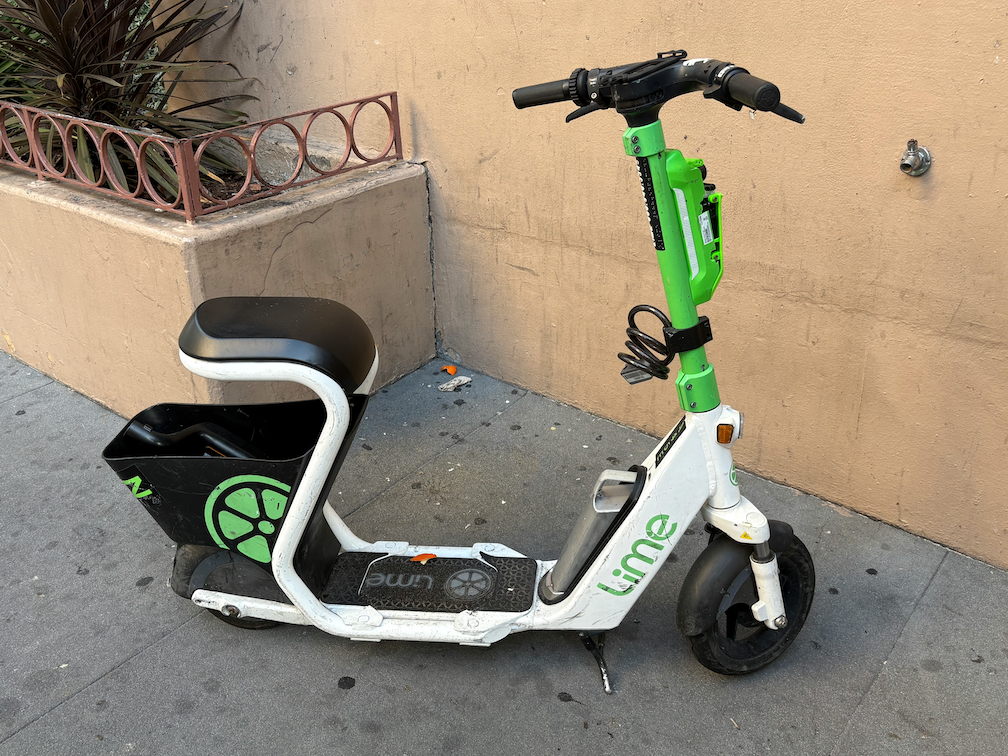
I was recently asked what model for bike share could work in the Sacramento region, given the recent pull-out of Lime, and the small fleet offered by Bird.

The current situation is:

  • SACOG no longer wants to be involved in bike share
  • it is not clear whether Sacramento Metropolitan Air Quality Management District wants to be involved
  • private bike share companies have pulled out of Sacramento twice now, without notice to the permitting agencies nor users
  • privately owned and operated bike share systems are struggling in many cities, and they have either ended or cut back
  • City of Sacramento does not want to be involved in managing bike share beyond issuing permits; it isn’t clear whether West Sacramento wants to
  • Davis, under a partnership between UC Davis and the City of Davis, has a bike share system operated by Spin, and was not part of the SACOG program before it ended
  • when the system was in operation, it covered only parts of Sacramento and West Sacramento, excluding many lower income neighborhoods
  • discount programs offered by Lime, and still by Bird, are important, but are meaningless if bikes are not available in low income neighborhoods

It is clear that the privately owned and operated model is not working, and will not work, for Sacramento and West Sacramento. I believe that bike share is an integral part of our transportation system, and it is the responsibility of the transportation agencies to ensure that there is viable bike share in urban areas. So what model might work? Please understand that I do not have special expertise in bike share programs, beyond having used the local ones extensively, used systems in several other cities, and in fact was a primary enabler of the SoBi and initial JUMP systems by rebalancing bikes when the companies were understaffed to do so. I encourage you to look at NACTO’s Bike Share and Shared Micromobility Initiative and Shared Micromobility in 2022 to educate yourself about bike share.

Note: I am not addressing scooter share. My observation of scooter share is that it mostly replaces walking trips, and therefore has no VMT reduction value. Bike share seems to be used mostly to replace motor vehicle trips. Therefore bike share is the important issue to be solved.

My model

  1. Bike share would be publicly owned, including bikes, bike parking areas and racks, and docks or charging infrastructure if that turns out to be the system model.
  2. Bike share would be privately operated under contract with a public agency. The private company would be required to give a minimum of 60 days notice to terminate the operation.
  3. The best public entity to own and contract the system in the Sacramento region is SacRT. I don’t say this because SacRT has any expertise or competence in bike share, but because they are the one regional entity that covers nearly all of Sacramento County, and might be interested, and through MOU, could cover West Sacramento as well (Yolobus is likely to eventually be annexed by SacRT, but the two agencies already cooperate). There is a nexus between transit and bike share, because bike share fulfills the first mile/last mile needs of many riders. Bike share locations would not be limited to transit stops, but that would be one of the criteria for system design and bike locations.
  4. SacRT, or other entity, would contract with a private company with experience in bike share management to operate the system. It is also possible that a nonprofit might be created to operate the system, as this has been a successful model in several cities, particularly as private systems failed.
  5. The system would be operated in areas with enough residential or commercial activity to justify productive and profitable (for the private operator) operation. Since there are such areas outside of the cities in the county, and since there are also areas within the cities that are too low density to justify bike share, it does not make sense for operations to be contracted by the cities. Criteria for successful areas would have to be developed, and adjusted as appropriate.
  6. There is a role for the cities, and the counties, to fund bike share infrastructure. Though grants are a possibility, there are no existing and reliable sources of funding for the publicly owned system. Either the cities and counties fund it, or it doesn’t happen. Once the system is in operation, there may be enough ‘profit’ to maintain and upgrade the system, so that the cities and counties might not have to supply ongoing funding. Or it may require ongoing subsidy.
  7. The private operator would be subsidized by an amount subject to negotiation, for perhaps two years, but the system should not need ongoing subsidy. The initial subsidy would cover the start up period during which the system would rebuild knowledge and support among the users. The withdrawal of LIme, and JUMP/Uber before that, has certainly damaged the reputation of bike share, and the new system will have to rebuild trust.

There are three types of bike share systems:

  • Docked: Bike must be returned to a dock after use. Docks are provided in areas of higher use.
  • Undocked: Bikes can be parked anywhere, though them must be locked to a rack or within a designation parking area.
  • Hybrid: Bike may be returned to a dock or hub, or parked elsewhere. JUMP had a highly successful hybrid system, where users were rewarded for returning bikes to a charging hub, but could park elsewhere. The bay area Bay Wheels is hybrid for pedal assist e-bikes (not regular bikes) in that they can be parked away from docks for a small fee.

There are plenty of other issues to resolve before we get to which type of system, but I provided that for people who will ask. Each system has its advantages and disadvantages, and its proponents and detractors.

Your thoughts? Have at it.

diagonal ramp corners are now illegal

PROWAG (Public Right-of-Way Accessibility Guidelines) from the US Access Board have now been officially adopted. I’ve only begun to review them, but a few things grabbed my attention right off the bat. From PROWAG:

“At an intersection corner, one curb ramp or blended transition shall be provided for each crosswalk, or a single blended transition that spans all crosswalks at the intersection corner may be provided. Where pedestrian crossing is prohibited, curb ramps or blended transitions shall not be provided, and the pedestrian circulation path shall be either (a) separated from the roadway with landscaping or other non-prepared surface or (b) separated from the roadway by a detectable vertical edge treatment with a bottom edge 15 inches maximum above the pedestrian circulation path.”

This means that the diagonal access ramps at corners, which are common in suburban areas and even a few urban areas, are no longer legal for installation. For any alterations of curbs, sidewalk, or corner, new ramps must be two to a corner, perpendicular, or the ramp must cover the area of both sidewalks. See photo below.

photo of diagonal curb ramp, now illegal under PROWAG, installed May 2023
diagonal curb ramp, now illegal under PROWAG, installed May 2023 by Sac City

Secondly, the pedestrian prohibition signing in common use in the City of Sacramento and many other places is now illegal, because it does not meet the criteria of the bottom edge no more than 15 inches above the sidewalk. See photo below, showing a newly installed curb ramp where the ramp does not extend the full width of both crosswalks. Again, any alteration of the curb, sidewalk, or corner requires compliant design. Of course the majority of these pedestrian crossing prohibitions are unnecessary, and were installed to ease motor vehicle traffic and not to protect walkers, so most should simply be removed, and legal curb ramps installed. The one exception would be freeway on and off ramps that have not been modified to be safe under any conditions.

photo of pedestrian crossing prohibition, now illegal under PROWAG
pedestrian crossing prohibition, now illegal under PROWAG

NACTO shared micromobility report

NACTO released it’s Shared Micromobility in the U.S. and Canada 2022 ‘130 Million Trips’ report in September 2023, and the report has a summary webpage at https://nacto.org/publication/shared-micromobility-in-2022/. The report is interesting throughout, but one paragraph in particular is important for the Sacramento situation in which Lime has removed its bikes from the region, and Bird is offering few bikes. Bike share in Sacramento is more or less dead. It is clear that the model of privately owned and managed bike share does not work here. If we are to have bike share, we need a new model. I’ll have one or more posts on that shortly.

From the report (page 10):

“Shared micromobility systems that see consistent growth and equitable outcomes are typically municipally-owned or closely managed through long-term partnerships with private operators. Long-term contracts have resulted in more sustainable results for ridership and the durability of systems. The enduring viability of private sector operators remains uncertain, especially as companies with short-term permits respond to financial troubles by pulling out of cities–often abruptly–altogether. Shared bikes and e-scooters can and should be integral parts of a city’s transportation network, but that is only possible if they are consistently available and resistant to the volatility of market conditions. Partnership models where local governments have greater involvement in their shared micromobility programs generally lead to better outcomes, like more equitable pricing structures, greater investment in historically underserved communities, and ultimately, a greater likelihood of long-term viability.”

Another issue for the Sacramento area was that rental prices for bikes saw several increases during the JUMP and Uber times, and a huge jump when Lime took over. The system had become unaffordable for many former users. Lime originally offered a free for a low monthly fee rental program for people in CalFresh or similar programs, but this year changed to a half-off discount, helpful but hardly affordable. Bird has a similar half-off program. Again, from the NACTO report (page 14):

“The cost to ride a shared bike or scooter continues to rise in numerous cities, posing a threat to affordability. In a year of widespread consumer price increases–including public and private transportation modes–shared micromobility was no exception. Annual membership hikes, alongside rising e-bike surcharges, led to a 70% increase in average per-trip costs for members of station-based bike share systems from the previous year. Pay-as-you-go trips on e-bikes or e-scooters were the most expensive, with average per-trip costs more than double the typical fare of a one-way trip on public transit in the U.S. and Canada.”

I have not yet used the Spin bike share in Davis yet. I’m always in Davis with my own bike, so haven’t been motivated, but I should test it out.

pedestrian safety countermeasures

As a follow-on to Sac City NEW beg buttons, some background information on pedestrian pushbuttons (beg buttons). The federal government, under the Federal Highway Administration (FHWA) makes available the PEDSAFE: Pedestrian Safety Guide and Countermeasure Selection System. Eleven countermeasures are offered for pedestrian crossing locations:

Note that automated pedestrian detection is among the eleven. Pedestrian pushbuttons are not listed because they are not a pedestrian safety countermeasure.

Now knowing about the Vision Zero update (thanks, Matt), I will see how the city’s list of actions compares to this list of countermeasures.