This weekend in South Lake Tahoe I used the LimeBike bike share for the first time. This system is truly rootless, unlike the SoBi system that allows parking outside hubs but is hub focused. As a result, bikes are everywhere, including out of town. I saw a few parking way out the bike trail northeast of town, on Emerald Bay Rd. I’m not sure if there is some sort of outside geofencing beyond which one can’t ride or leave a bike, but the current use is quite expansive. I don’t know anything about what sort of rebalancing occurs.
LimeBike is app centric, you need an iOS or Anroid phone with the app installed, and an account with credit on it. Each bike has a unique QR code,which is scanned with the app to unlock the bike. The bikes have European style wheel locks, which unlock automatically, but are manually locked at the end of the ride.
The cost is $1 for 30 minutes, not prorated, but a very good deal. The Sacramento Tower Bike Preview is $4 per hour, other SoBi systems $7 per hour, and dock systems like Ford GoBike either are membership based or about $3 for 30 minutes.
The bikes are very simple and inexpensive. The weight is less than half of a typical bike share bike, but that means they are also less robust. I saw several bikes with broken or broken off baskets. The bikes have a rear red reflector, meeting legal requirements, but not what the typical rider would want. Front generator lights are provided, the sort older people will remember from childhood, where power is generated by a wheel that rides on the tire. Some bikes are missing their front light, victims of vandals. Most importantly, the bikes are single speed, no gears to maintain, and no gears to use. Though South Lake Tahoe is flat at least close to the lakeshore, it was challenging heading up a slight hill into a headwind. The bikes have standard disc brakes, that work reasonably well. And a twist bell on the left grip.
Apparently the business model for LimeBike is that by using inexpensive bikes they can offer lower rates, and easily replace bikes when necessary. Regular system bike share bikes cost $1000 to $1600, but I would guess these bikes are about $200.
The Breeze Bike Share in Santa Monica uses the same Social Bicycles (SoBi) bikes that the Tower Bridge Preview in Sacramento does. On a recent four day visit to Santa Monica, I used the system quite a bit, both for transportation and to compare systems. Here is my take:
Breeze Bike Share is operated by a separate company, CycleHop, rather than directly by SoBi as is the Sacramento system. The company also operates systems in West Hollywood/Beverly Hills, Long Beach, San Mateo, and other cities outside California. CycleHop has a major maintenance and storage facility, which I stumbled across, shown in the photo above. They tried rebalancing with bikes for a while but have gone to using vans as they are more efficient.
Breeze bikes are green, and the major corporate sponsor is Hulu. As far as I know, Sacramento is still in search of a major corporate sponsor.
The cost per hour for Breeze is $7, whereas Tower Bridge is $4. This makes a difference! Though I only used up $5 of my initial investment (it costs a minimum of $7 to join), this is only because I spent time every day returning bikes to,hubs in order to gain return credits.
Return to hub credit is $1 in the Breeze system, $1.50 in Tower Bridge. It makes a difference!
Outside-hub fees are $2, and outside boundary (geofenced) is $20, the same as Tower Bridge.
I saw people riding Breeze bikes all over town, at all times of day. I often saw the hub racks fill up and empty out over a short period of time, so I know that bikes in the busiest areas were getting many trips per day, though I don’t have any data. It is rare to see Tower Bridge bikes on the road, and though I think they get used one or two times a day, use per bike is much lower.
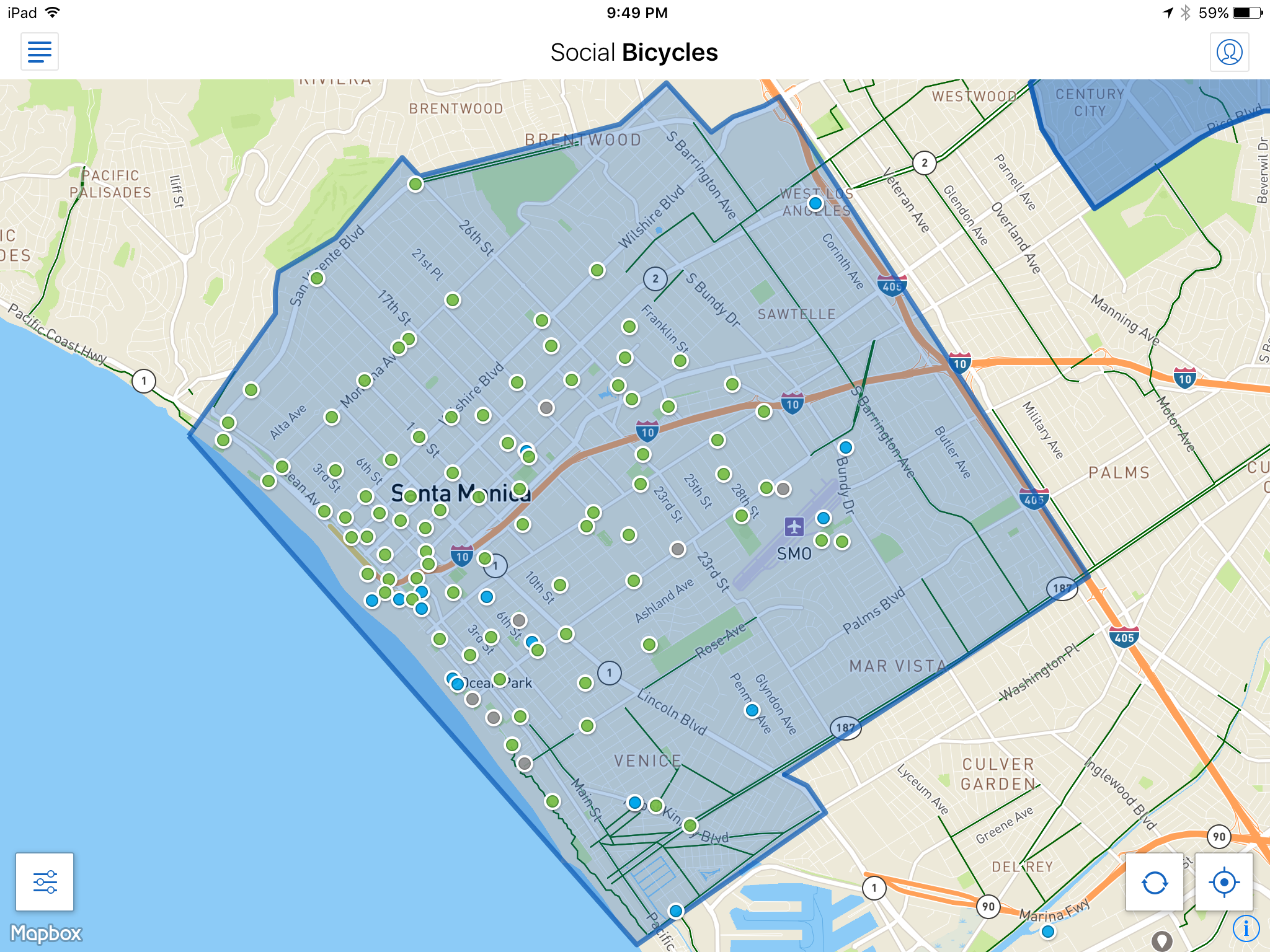
Downtown Santa Monica has a high density of hubs, about every two blocks, but the hubs are much sparser in the more suburban parts of town. The downtown hubs are quite large, up to 16 racks spaces. The advertisement says 500 bikes, 80 stations.
Several of the hubs are sponsored, which is indicated by a different icon for the hub, but I was unable to find out more about these sponsored stations, and it was not obvious who was sponsoring them. Tower Bridge does not have any sponsored stations at this time.
Hubs were located close to each light rail station (Metro Expo Line), and at many major bus stops. Tower Bridge hubs are not.
Breeze has the same problems of geo-location that Tower Bridge has, sometimes bikes shown as in hub were not, sometimes bikes shown as out-of-hub were at a hub, and sometimes the bikes were nowhere to be found at the indicated location. More of an irritant than a major issue, since the next hub or bike is not far away.
Breeze has a low-income program, but details are only available on request, not on the website.
Breeze allows users to unlock bikes with a registered TAP card (similar to Connect Card), but charges are to the Breeze account and not the TAP account. I’m using my Connect Card in Sacramento, and also used it in Santa Monica. Using a card is a slight convenience over entering a six digit number.
Santa Monica has flat areas, and gently inclined areas, similar to Sacramento and West Sacramento, but the rise from beach level to downtown level, and out of the Rustic Creek canyon, is comparable to American River up to Fair Oaks. A lot of bikes get left down by the pier and beach , so I imagine part of the re-balancing effort is getting these bikes back up the hill.
Breeze map below. Green dots are hubs with bikes, grey dots are hubs without bikes, blue dots are bikes parked out-of-hub. You can see the higher density downtown.
The Social Bicycles Tower Bridge Preview is a dockless system. Designated hubs are created both by geofencing (setting up a boundary for hubs and for the system) and designated bike racks, with a $2 penalty for leaving a bike outside a hub, and $20 penalty for leaving a bike outside the system boundary. But it also encourages return of bikes to hubs with a $1.50 credit. These and other issues are discussed in the post, worth a read.
The Tower Bridge Preview bike share is going to have some expansion in about a month, up to five new hubs on the Sacramento side. I had heard previously that there would be no expansion before full roll-out, which is no sooner than November and quite possibly far beyond that since a major corporate sponsor has still not been identified.
The best news is that one of the hubs will be at Sacramento Valley Station, the train station, and it will be a large hub. This is mentioned in Melanie’s StreetsblogCal post: Eyes on the Street: Sacramento’s First Cycle Track Appears Near Amtrak, and I also heard the same when I ran into Phillipe at the 18th & Capitol hub, doing maintenance and re-balancing. It was a major oversight to not include a hub at the station, but that will be fixed!
I talked with the other person who is regularly parking a bike at the station, for a commute into the Bay Area a few days a week. That person said they love the system, use it for this and other trips, but wished there were a regular hub at the station. The bike has always been there at the end of the day to be used for the return trip. I’m parking a bike at the station for nearly every Amtrak trip I take (to the Bay Area, to Truckee, and to South Lake Tahoe). Since I’m often gone more than one day, other people sometimes check out the bike, which is fine with me since I live close enough to walk.
If you are using the system, you noticed a few days ago that the display screens on each bike changed, with some additional information and tips. The ability to unlock a bike with a RFID card, meaning the Connect Transit Card, is prominent. But not yet implemented. SoBi and the ConnectCard are working out the details. Card use will initially just be for unlocking, in the same manner that the Clipper Card can unlock a Ford GoBike in the Bay Area system, but you will have to have a Social Bicycles account and bike use will be charged to the account rather than the card. The display also mentions unlocking with a phone number, but I’m pretty sure that is not implemented either.
Please share stories here about your use of the bike share. Since that company, SocialBicycles, and the partners, SACOG and the two cities, have said next to nothing about the success and challenges of the bike share, it is even more important that we talk with each other.
Oh, and if you are looking for employment, SocialBicycles is hiring an Operations Manager for Sacramento.
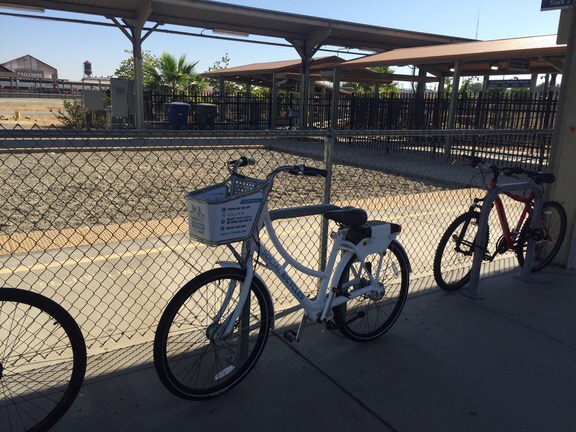
SoBi bike at Sacramento Valley StationThe Tower Bridge Bike Share Preview has been operating in Sacramento central city and part of West Sacramento for two months now. I have been using it from time to time, and have some experiences to share.
These SoBi (Social Bicycles) bikes are a combination of hub bikes and park-anywhere bikes. If you return a bike to a hub, you pay only rental time. If you lock a bike up anywhere within the two geo-fenced boundary areas of Sacramento and West Sacramento, you pay an extra fee of $2. If you Park it outside the geofence, you pay $20. Except for one bike that ended up being stolen, I’ve never noticed a bike being left outside the geo-fence, but bikes are sometimes left outside hubs. This was common in the early days, but seems to have tapered off. It was earning quite a bit of credit on my bike share account returning these bikes to hub, which earns a credit of $1.50, but most days now there are no bikes outside of hubs in the morning, when I look, and return.
One of the cool things about the SoBi system is that temporary geo-fenced areas can be set up at other locations, for special events. The only instance of this that I’ve noticed is when one was set up at the Sunday Street at Broadway open streets event, but the capability is intriguing.
Of the six hub locations in Sacramento, four are located near drinking establishments. Most of the bike share use I observe visually and by watching patterns in the app map is bar-hopping. This is certainly a valid use of the bikes, and I’m glad these people are pedaling instead of driving.
In most bike share cities, a prominent service of bike share is as a transit extender, serving as a “first-mile/last-mile” access to and from transit. None of the hubs in Sacramento were located with that in mind. The greatest shortcoming is that there is no hub at Sacramento Valley Station, the Amtrak station. I have been riding a bike to the station at times, for trips where I’m not taking my own bike with me. Someone else has regularly been leaving a bike at the station on weekdays, presumably commuting on the Capitol Corridor train. The station is at least within the geo-fence, so the charge for doing this is only $2, but I do not understand why the station did not get a hub in the original layout. This is just a pilot, and presumably in the formal rollout in November or beyond, there will be hubs at transit locations. SACOG had said that part of the purpose for the preview was to gather information about patterns of use, but no information is being gathered about transit-related use because none of the hubs were located with that in mind. I asked SACOG about hub locations, and they said these had been determined by the cities, but when I asked Sacramento, they said the locations had been selected by SACOG.
So far as I know, SACOG has not provided any use data for the bike share system, at least it has not showed up on any of the meeting agendas. I look forward to seeing what the system has to say about patterns of use during the preview.
When I’m using the bikes, people often ask me questions about how it works. I tell them how easy it is to download the app and set up an account, and go, but most people seem to think this is too difficult and don’t end up doing it. Even young people who are used to downloading apps don’t seem to want to do it. Once your account is set up, you enter you member number and passcode on the GPS unit located on the bike, in order to unlock. I’m not sure how the system gets over that hump of few members. I have noticed that users of the Bay Area Ford GoBike are mostly using their Clipper Cards (equivalent to the ConnectCard) to unlock bikes, rather than using the application, though the charge is to the GoBike account rather than Clipper. Hopefully the SoBi system can be linked to ConnectCard for unlocking, and maybe even charging.
The Ford GoBike system has created a $5 per year low income membership (regularly $149) in order to encourage use by low income but bike dependent members of the community. It is partnering with the bicycle advocacy groups and low income bicyclist clubs such as the scraper bike folks, in order to sell the benefits of bike share to a wider audience. The locations of the stations (GoBike is a station-based system and the bikes are not designed to leave anywhere other than a station) have also been extended into several low income neighborhoods, though certainly not all of them. I do not know what plans the Sacramento system has for meeting the needs of low income users, but I look forward to finding out.
California Bicycle Coalition (calbike) has announced the 2017 California Bicycle Summit, October 3-6 in Sacramento. Preliminary schedule and content is available, as well as registration and application to present. I encourage you to check it out. I’ve registered.
Broadway was closed to cars and open to people from 8 to noon. The route was on Broadway from Riverside east to 26th St, jogged down to 2nd Ave, and then ended again at Broadway. People were wondering how this would work in Sacramento, the first time, and in a place that is pretty car-centric. Well it worked great! A lot of people came out. I’m sure the city will have an estimate, but the initial answer is, a lot.
If success is measured by smiles, and it should be, this event was a great success. People of all ages were there, people from the neighborhood and the region. A lot of people were bicycling, but a lot were walking, and using other wheeled devices. Slide tricycles, which I didn’t even realize were a thing in Sacramento, were common.
Sacramento Area Bicycle Advocates (SABA) created a separated bikeway (protected bike lane) for people to experience, which attracted a lot of attention and generated a lot of discussion about the state of bicycling in Sacramento. Adjacent, WALKSacramento asked people to add their favorite places to walk to a chalk board, all of which were NOT car-dominated places. Some people prioritized how it felt to walk, others their destination. Ice cream was a popular theme.
Outside food vendors were prohibited in order to highlight local restaurants. For those open, business was booming. Some places missed out, though, by not being open. I’d imagine as word gets around how well it works, food retail along future events will be open and prosperous. Many business owners just assume that most of their customers come by car, but places that encourage and activate walking and bicycling all have increased business. Vintage Bicycle Supply was open and crowded with people not even aware it existed, and fans of the CycleFest cruiser bikes. New Helvetia Brewing was quenching people’s thirst and hosting running clubs. There were a lot of sports and fitness vendors, showing people what they had to offer and just providing fun. The two hula hoop groups were particularly popular with kids, and there were chalk drawings everywhere. Sidewalk chalk may be the single most important tool available to the public for activating public spaces.
SACOG and Social Bicycles were showing off the new bike share which opened just Thursday. I heard comments from a lot of people that they found the bikes easier to ride than they thought, and were looking forward to trying it out. [previous post riding the bike share.
The section along 26th St and 2nd Ave was much quieter, with a cluster of local businesses and organizations near the end at Broadway. It was also far cooler than Broadway, with all the street trees moderating the temperature about 10 degrees below Broadway. This was not only much appreciated by people, but points out that for the new Broadway to work for pedestrians and bicyclists, it is going to need to not only not lose many of the existing trees, but to really create a welcoming tree lined street. When I participated in the public meetings the last two years, I didn’t realize how important street trees would be. Since Broadway will be a vibrant commercial corridor, it may be that the big shade trees should be in the median, with less dense trees between the street and retail, so that the view of customers is not obstructed. Interesting design issues.
Hope you had a fun time too! I’m looking forward to the next one.
* Though the county claims its Great Scott road closure is an open street event, it really does not meet the widely accepted definition of an open street.
Today is the second day of the Tower Bridge Bike Share Preview. I took four trips yesterday, three from hub to hub, and one picking up an out-of-bike bike. And two early morning trips today, both to move out-of-hub bikes. These two bikes were parked at a rack at the other end of the block from the hub racks on R Street. Though I wasn’t there last night, I suspect that the hub racks were full of both bike share and private bikes, and the people could not leave the bikes in the hub. Full racks may be an issue at hubs close to drinking establishments, which 16th, 18th, Capitol, and R St all are. Once the system becomes more widespread, this problem may disappear.
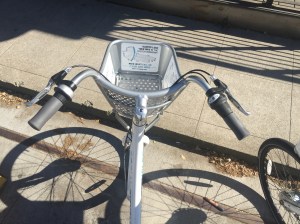
One of the things I do not like about these bikes is the handlebar configuration. They are sort of like beach cruiser bikes, with the angle along the side rather than the traditional handlebar angle. I hate this hand position. After 10 minutes of riding, my forearms were sore. I can put them in a more comfortable position, but only by taking my hands off the brakes. I see other bikes with this handlebar configuration, so I’m sure some people will love these. Not me!
The seat height is adjustable over a wide range, and the seat post has numbered marks so that once you find your comfortable seat height, you can immediately adjust each bike to your height.
The bikes have eight gears, in an internal hub. This is more than flat Sacramento needs, but nice to have. I find myself riding mostly in 6th, going down to 5th at intersections. 1st is very, very low. The bikes are heavy, so the low end gears will help less strong people get moving. Once the bikes are moving, the move along pretty well. They have rod drives rather than chains.
When picking up a bike on 18th Street last night, Steve Hansen was there doing an interview about the bike share system with a TV station. Maybe you saw it on the late news (I don’t have a TV). I talked a bit to Steve, but we both had other places to go. He is obviously pleased to have the new bike share in his council district. This hub was quite busy, and went from five bikes to zero bikes in a flash. I’ve been sort of watching the bike counts throughout the day. Some hubs seem to have a lot of turnover, going up and down frequently, while others don’t change much. This is just my observation, don’t know if the data backs that up.
As I mentioned, I returned three out-of-hub bikes to hubs, and got a credit of $1.50 for each. I have mixed feelings about this. I can imagine myself leaving a bike to go into inside, not sure how long it was going to take and therefore not wanting to put the bike on “hold” but still hoping it is there when I come out. On the other hand, these out-of-hub bikes might sit there for quite some time without being part of the circulation, which hurts availability. It had occurred to me, and Steve also mentioned it, “making a living” bringing these bikes back to hubs, and maybe accomplishing some rebalancing in the process. Of course it is just bike share credit, not real money, but my account balance it larger now than when I started.
The bike hub marker placed in the east end of Capitol Park, with a geofence covering the four square block area, is now gone. This may have been a programming error, or an experiment. After looking, I did not find any racks in the part of the park. However, I thought I saw a positive number in that hub mark during the day. Maybe my imagination.
The SoBi (Social Bicycles) bike share system in Sacramento is about to launch. The bike racks have shown up on the ground, and just yesterday, on the map.
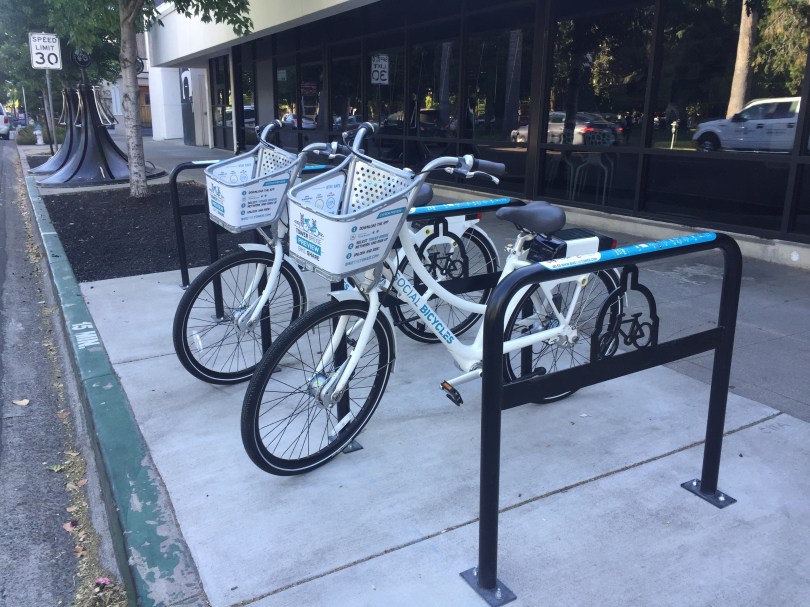
SoBi is a kiosk-less system, unlike, for example, Bay Area Bike Share in which bikes can only be checked out from and returned to kiosks with racks that the bike are designed to lock to. SoBi will lock to any rack, anywhere, as it has an integrated U-lock. As the system opens in Preview mode, perhaps tomorrow there are 14 rack locations or hubs that will have a total of 50 bikes. The map shows the locations, and by the zero in every pin marker, you can tell there are no bikes there yet. This screen shot is from the browser app, but the mobile app is similar.
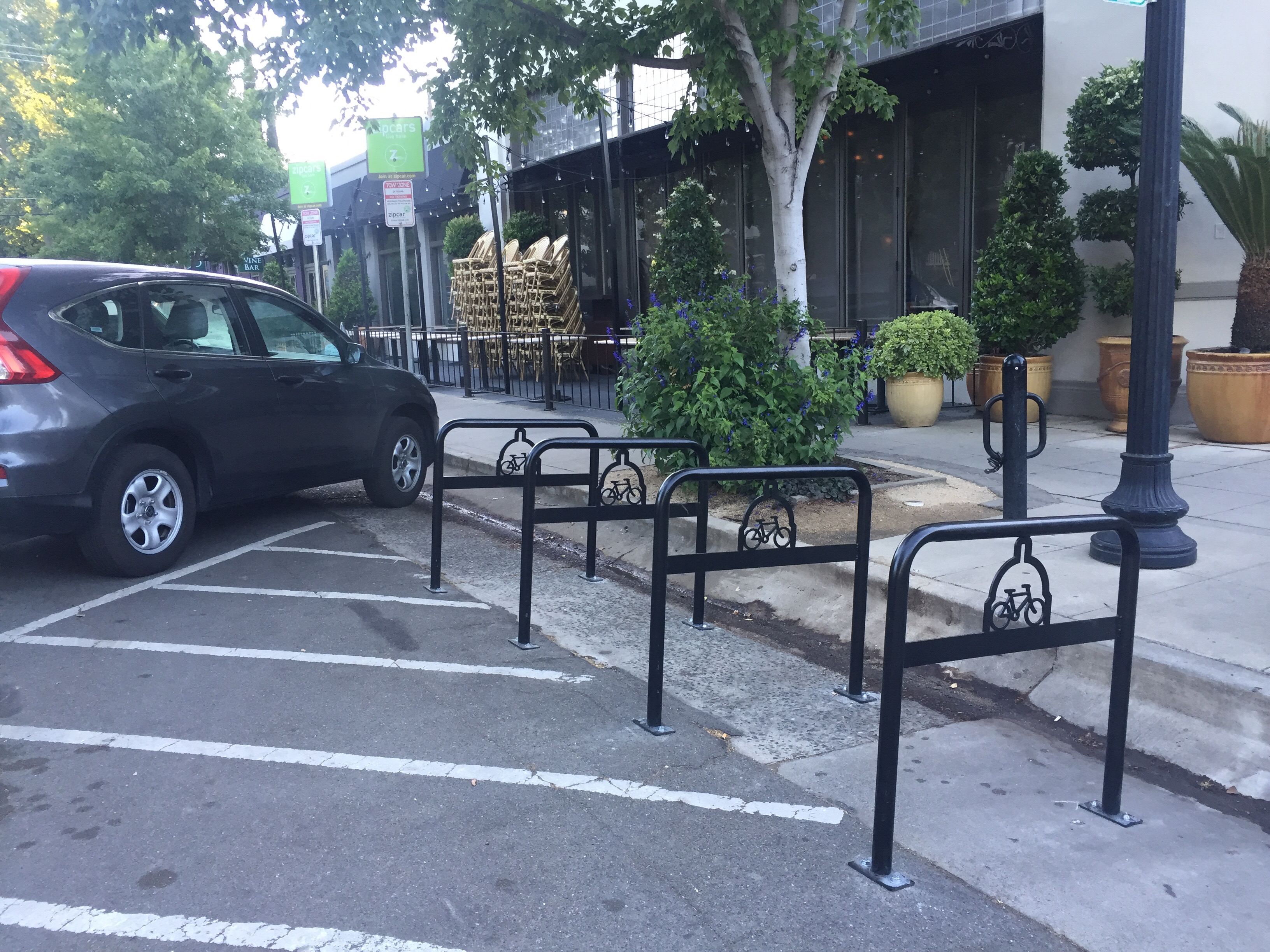
The system is called Tower Bridge, which makes sense, because the preview is in West Sacramento and downtown/midtown Sacramento, linked by the Tower Bridge. In perhaps November the system will be expanded to go as far west as Davis and as far east as Sac State. There will also be some rack locations that look more like traditional kiosks, with information signs. For now, the racks are just traditional bike racks, shown below. This location is on 18th St at Capitol Ave, next to Zocalo and the ZipCar parking spots. The other one in my neighborhood is across the street from the Fremont Park ZipCars, next to Hot Italian. These locations make sense to me, for multi-modal trips, part bicycling and part driving.
I’ve already signed up and banked some money in my account. To be honest, I’m not the target audience for this bike share since I live in midtown and having a folding bike that I can take anywhere, rarely needing to park it outside. But I will try it out as soon as bikes show up, and will probably use it on occasion. At the moment, the only membership type is a timed charge, $4/hour, prorated, with no membership fee. The first 30 minutes free that some other systems use is not offered in this one. There will be other kinds of membership eventually.
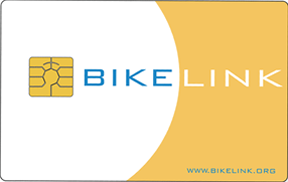
Forty on-demand bike lockers have been installed at Sacramento Valley Station by Capitol Corridor. They are located between the station exit to the platforms and the thruway bus area. These lockers use the BikeLink chip-card system, which I wrote about in 2013 (BikeLink). These join long-term lockers and the Pedal Stop bike station, and new lockers at the Amtrak/Capitol Corridor station in Davis.
Unfortunately, you can’t purchase a BikeLink card in the station, at least not yet. You can purchase them in the Cafe Car onboard all Capitol Corridor trains, but of course if you arrive at the lockers without a card, that doesn’t help you for this trip. You can also order cards via BikeLink. I am not sure how long it takes to get cards through the mail, but I think I remember about a week. The BikeLink map shows three vendor locations in Roseville, since Roseville now has BikeLink locker locations, though I have not used these. The cards cost $20, and that full value is available for locker rentals, though if you use a bike station location with multiple bike racks, such as the Folsom station and several in the bay area, you do have to pay a one-time $5 fee.
The lockers cost 5 cents per hour. That’s a pretty incredible deal given how much car parking costs, and the peace of mind knowing your bike is very unlikely to be stolen or vandalized. Even your seat will be dry!
Hopefully this will be the beginning of more installations showing up around Sacramento and the region, as business and agencies realize what a convenience and encouragement for bicycling the lockers are.
 This weekend in South Lake Tahoe I used the LimeBike bike share for the first time. This system is truly rootless, unlike the SoBi system that allows parking outside hubs but is hub focused. As a result, bikes are everywhere, including out of town. I saw a few parking way out the bike trail northeast of town, on Emerald Bay Rd. I’m not sure if there is some sort of outside geofencing beyond which one can’t ride or leave a bike, but the current use is quite expansive. I don’t know anything about what sort of rebalancing occurs.


 One of the things I do not like about these bikes is the handlebar configuration. They are sort of like beach cruiser bikes, with the angle along the side rather than the traditional handlebar angle. I hate this hand position. After 10 minutes of riding, my forearms were sore. I can put them in a more comfortable position, but only by taking my hands off the brakes. I see other bikes with this handlebar configuration, so I’m sure some people will love these. Not me!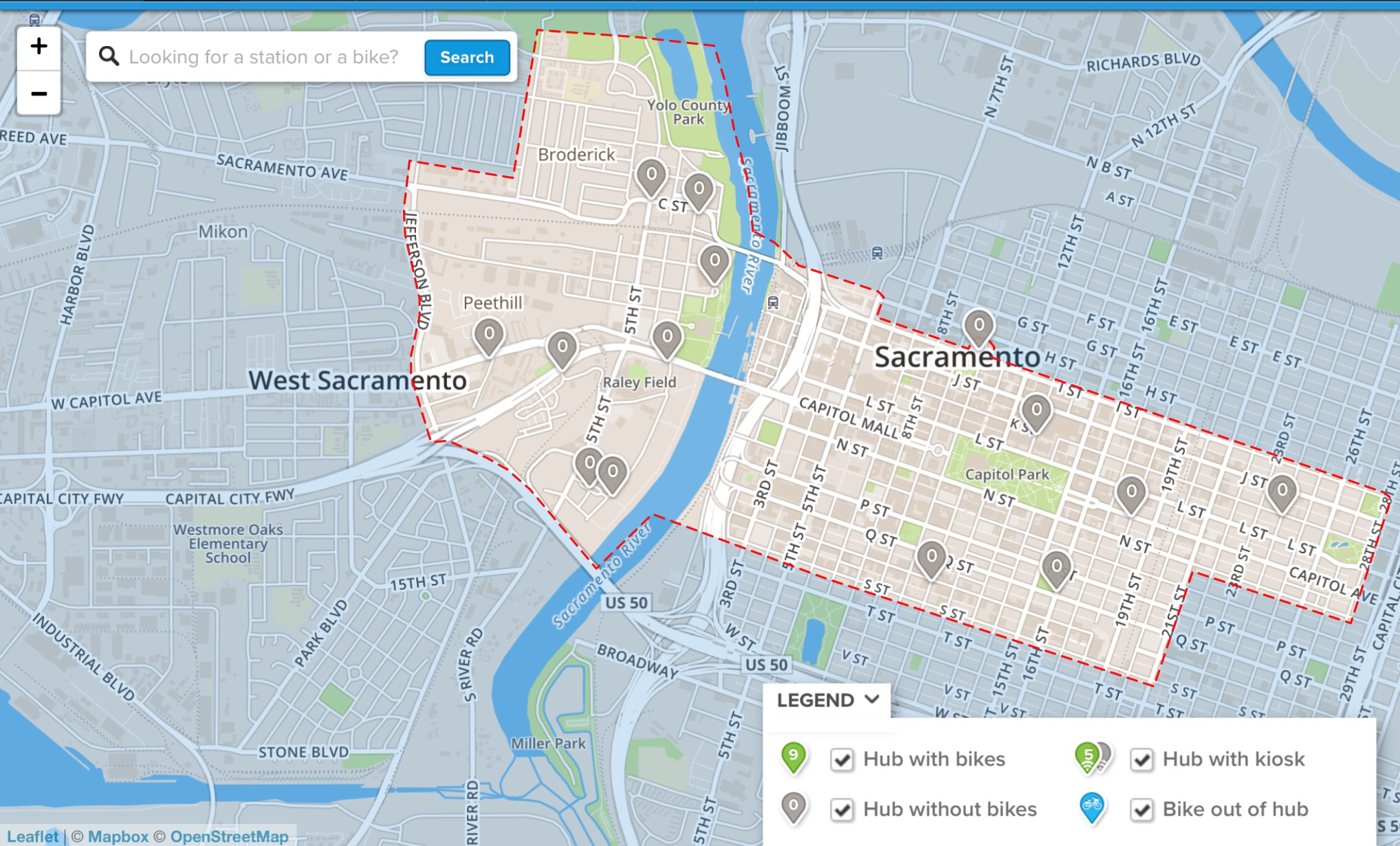

 Getting Around Sacramento