Additional posts on Broadway Complete Streets are available at category ‘Broadway Complete Streets‘.
On Broadway eastbound at Land Park Drive, there is a bicycle signal face, shown below. The signal is permanently red, it never changes to green. The presence or absence of bicyclists makes no difference; it does not change from red. This is confusing both motor vehicle drivers and bicyclists. Bicyclists wait for it to change, and it never does. Drivers wonder why bicyclists are proceeded along Broadway with the green ‘car’ light when the signal clearly says that they should not be proceeding. I have seen drivers yelling at bicyclists for going when it is not their turn, and this has been reported to me by a number of people.
This issue has been reported to the city, twice by myself, and multiple times by other people. It has been this way for at least two weeks, perhaps longer. The city has decided to ignore these reports and to not fix the issue. The city is endangering bicyclists, and is in fact legally liable for knowing that a safety hazard exists and doing nothing to respond. This is criminal behavior on the part of the city. Sorry to be so blunt, but when city employees, or contractors acting on behalf of the city, ignore a known and easily solvable safety problem, that is criminal behavior. Period.
This would be so easy for the city to temporarily solve, by covering the bicycle signal face so that it is not visible. The pedestrian crossing sign over Broadway at the east side of the intersection is covered, due to the construction on the corner closing the crosswalk. Beyond a temporary fix, the city needs to determine why the bicycle signal face is not working, and make it work.
Note: I’ve added text and a photo of the approach from the north.
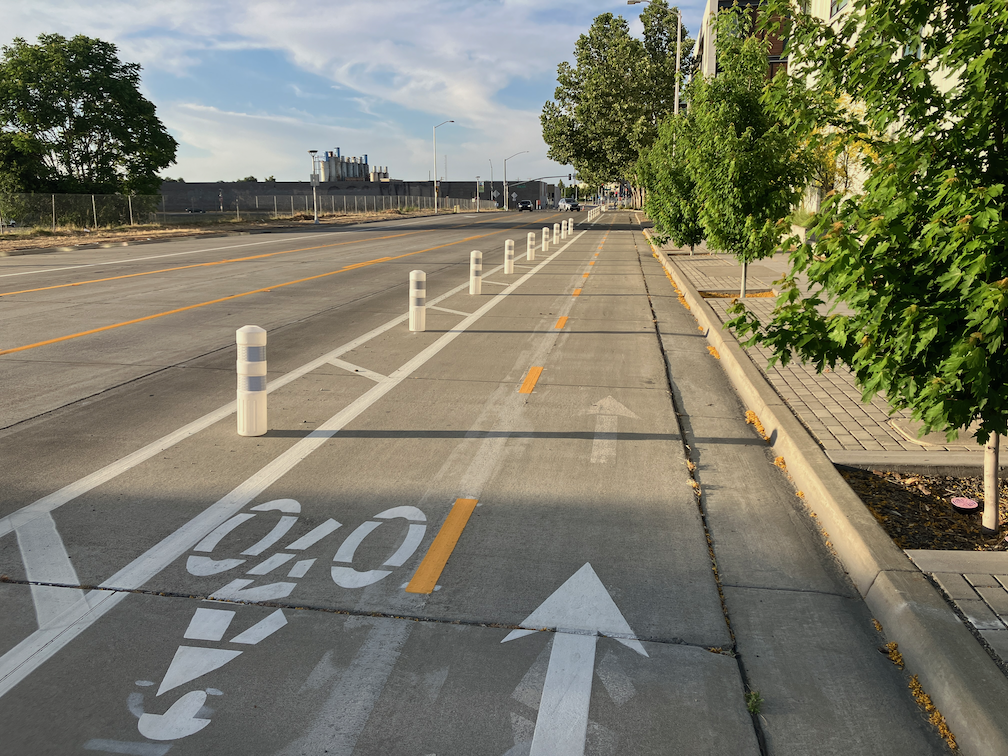
The City of West Sacramento has installed a section of cycletrack (a two-way Class 4 separated bikeway) on South River Road and 5th Street in the Bridge District. Apparently completed late 2023 (shows how long since I’ve ridden that way), it is part of the Riverfront Street Extension and 5th Street Widening Project.
From 15th Street (the connection to Jefferson Blvd) north to almost Mill Street, the bikeway is separated from motor vehicles by a hard curb divider. The on-street bike lane southbound still exists, but this bikeway provides a much safer alternative. The onramp to Hwy 50 east (or Business 80 as it is designated), was an extreme hazard for bicyclists due to drivers turning at high speeds. See two photos below.
South River Rd cycletrack / separated bikeway at 15th StSouth River Rd cycletrack / separated bikeway
From Mill Street north to Bridge Street, the cycletrack is separated by a buffer and vertical delineators (K-71). At Bridge Street and north, the roadways returns to traditional Class 2 unprotected bike lanes. Though it would have been great to extend the curb-protected cycletrack all the way north to West Capitol Avenue, at least the truly dangerous section at the freeway onramp was fixed.
To the south of 15th Street, South River Road has more traditional bike lanes, with buffers in a few locations, as it crosses the ship channel and goes through two roundabouts.
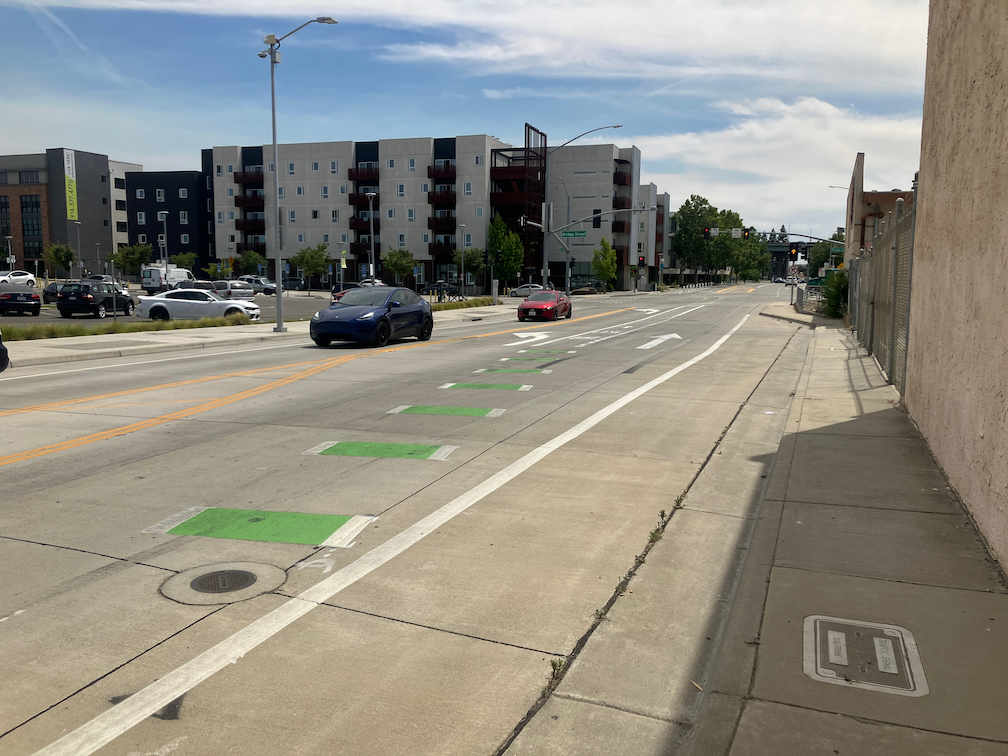
The transitions to and from the bikeway seem a little awkward as they swoop through the intersection, but are probably not unsafe. I observed several bicyclists heading westbound to 15th Street who were not following the skip green bicycle markings, but the maneuver was not unsafe. I did not observe any bicyclists at the Bridge Street intersection.
Approaching the cycletrack from the north, the southbound traditional bike lane on the west side of 5th Street transitions to the cycletrack on the east side of 5th Street at Bridge St. Though the transition does not feel safe, I think it actually is, with signals preventing inappropriate motor vehicle movements.
5th St bike lane transitioning to cycletrack approaching Bridge St signs and signals for bicyclist on 5th St at Bridge St
The city has proposed a Folsom Blvd Safety Project. See previous post on that project. I would like to present an alternative to the bicycle facilities aspect of this project, improvement of the M Street corridor. M Street, and related streets including Elvas Ave, provide an alternative route. This route is already used by hundreds of bicyclists per day, students at Sacramento State, other commuters, and recreational bicyclists accessing the American River Parkway. Folsom, on the other hand, sees very little bicycle use. This is because it feels dangerous for most bicyclists, and because it is not the most direct route for many destinations.
The lack of bicyclists does not indicate that the street does not deserve bicycle facilities. Folsom has no bicycle facilities in the section to be revised, does not feel safe for bicyclists, and is not safe for bicyclists. The classic saying is that you can’t judge the need for a bridge by the number of people swimming the river. Bicyclists deserve safety on every street.
However, since bicycle facilities are a primary feature of the project, so it is worth asking: ‘Is this the best investment of limited funds?’ I’d suggest that upgrades to the M Street corridor might be a better investment.
Neither route actually offers safe access to and through Sacramento State. M Street is a low volume, mostly low speed street, from Alhambra Blvd to Elvas Blvd, However, the section along Elvas to the Hornet Tunnel that goes under the railroad tracks, is hazardous and intimidating for bicyclists. Folsom Blvd, with this project, would provide basic bicyclist facilities from Alhambra to 65th Street. However, access to and through Sacramento State beyond 65th Street is poor. The ‘safer’ crossing of Folsom at 69th Street and Elvas Avenue is awkward, was designed for walkers and not bicyclists, and not really safe. I have observed a number of drivers blowing the red light at this crossing. After crossing Folsom, a bicyclist can jog west to Elvas Avenue, and ride that to Hornet Tunnel, though the street is very deteriorated, of widely variable width, and the entrance to the tunnel is awkward.
The map below shows both routes, M Street from Alhambra Blvd to Elvas Avenue, in orange, and Folsom Blvd from Alhambra Blvd to 65th Street. Both are of equal length. Folsom Blvd has bike lanes from Alhambra to 47th Street, and discontinuously from 49th Street to 57th Street, with nothing to the east. M Street does not have bike lanes, but is is a low volume, low speed roadway along which most bicyclists feel comfortable riding. It is a ‘low stress bikeway’. Some of the route is marked with bike sharrows. Though improvements could certainly be made to M Street, it is functional as is, as a bicycle route.
Folsom Blvd has a posted speed limit of 35 mph, and much higher speeds are routinely observed. The fatal crash was in fact due in part to egregious speed violation by a driver. The proposed project would reduce speeds somewhat due to prudent drivers, but will probably encourage passing in the center turn lane. The project would leave the posted speed limit unchanged. M Street has a posted speed limit of 25 mph throughout, and speeds above 30 mph are rare. Would bicyclists rather ride on a non-bicyclist facilities roadway with 30 mph traffic, or on a buffered and un-buffered bike lane with 50 mph traffic?
Both of these routes are unacceptable because they don’t create a safe corridor all the way to Sacramento State. However, I feel that an investment in improving the M Street corridor section along Elvas would be a better investment than bicycle facilities along Folsom Blvd which end at 65th Street.
I wrote about improving the section of the M Street corridor between 62nd Street and Hornet Tunnel earlier this year: Elvas Ave and Hornet Tunnel. I don’t have a cost estimate for this project.
I am not saying the the Folsom Blvd Safety Project is a bad idea, just raising the question of where funds can be best invested to improve safety and comfort for bicyclists.
The section of Elvas Avenue between 62nd Street and Hornet Tunnel which leads to Sac State is very dangerous for bicyclists. Bicyclists have to transition across four lanes of traffic (three travel lanes and a center turn lane), without any protection whatsoever. The pavement quality is low, particularly on the east side where the ‘bike lane’ (not a real bike lane) is. Despite this, it is a high-use bicycle route from Sacramento to Sac State and the American River Parkway trail. M Street, this section of Elvas, and the Hornet Tunnel serve as a bicycle boulevard (though not designated) between the central city, Sac State, and beyond.
Since the day I arrived in Sacramento and rode my bike to work in the eastern suburbs, I have known that this section needs to be fixed. It took me 12 years to get around to writing about it. I hope that it will take the city less to fix it. The solution presented here is not the only solution, so I encourage others to comment, point out flaws, and suggest optimal solutions.
Elvas Avenue is a high-speed, moderately high-volume roadway that acts in many ways as an expressway due primarily to the turns from Elvas Avenue to 65th Street, and from 65th Street to Elvas that encourage high speeds. The roadway is dangerous for motor vehicle drivers and passengers as well as bicyclists. North of 62nd Street, St. Francis High School (about 1100 students) suffers from traffic risk created by Elvas Avenue, so traffic calming to the south will benefit the high school as well as bicyclists. It might be appropriate to extend the separated bikeway north to the signalized crosswalk over Elvas to the school.
The ‘share the road’ sign, which has been very popular with traffic engineers, is NOT in the 2023 MUTCD. So this sign is dead, and a well deserved death. The ‘share the road’ sign was often interpreted by drivers to mean, bicyclists must share the road with motor vehicles, or in less polite terms, “get out of my way, the sign says so”. The share the road diamond shaped sign was never a legal MUTCD sign, though they were and are quite common.
W16-1P sign, which used to say ‘share the road’ now says ‘in road’, as in, bicycles in roadway. The left sign is common, the middle sign can be used, and the right sign is for temporary traffic control (TTC). Since this new sign content replaces the old with the same sign designation, I take it to mean that the old sign may no longer be used at all, and must be replaced by the new sign.
W16-1PW16-1aPW16-1P for TTC
The plaque is not used by itself, but with the W11-1 bicycle sign, below. Though the yellow version of the W11-1/W16-1P assembly is permitted, this sign would more likely be used at TTC in a construction zone.
MUTCD W11-1/W16-1P assembly sign ‘bicycles in road’
Outside of construction zones, the preferable sign would be MUTCD R9-20 ‘bikes allowed use of full lane’, below, and this sign can also be used in construction zones. This sign is similar to the old MUTCD R4-11 sign, which is no longer in the MUTCD.
MUTCD R9-20 ‘bicycles allowed use of full lane’
Only in a few cases does the MUTCD require replacement of existing signs, but does require that the current sign be used in any new installation.
The new MUTCD recognizes the green painted bicycle lanes and green dotted bicycle lanes (often called skip marking) through conflict areas such as merges and intersections. Unfortunately, it did not drop recognition of the ‘sharrow’ shared lane marking. Though the sharrow can be legitimately used to show a bicyclist path in confusing locations, it has generally been used to bias roadways against bicyclists and to encourage motorists to fail to yield to bicyclists in the roadway. Maybe next time!
The MUTCD now has an entire chapter devoted to bicycles, Part 9: Traffic Control for Bicycle Facilities. This is progress, even if less than desired.
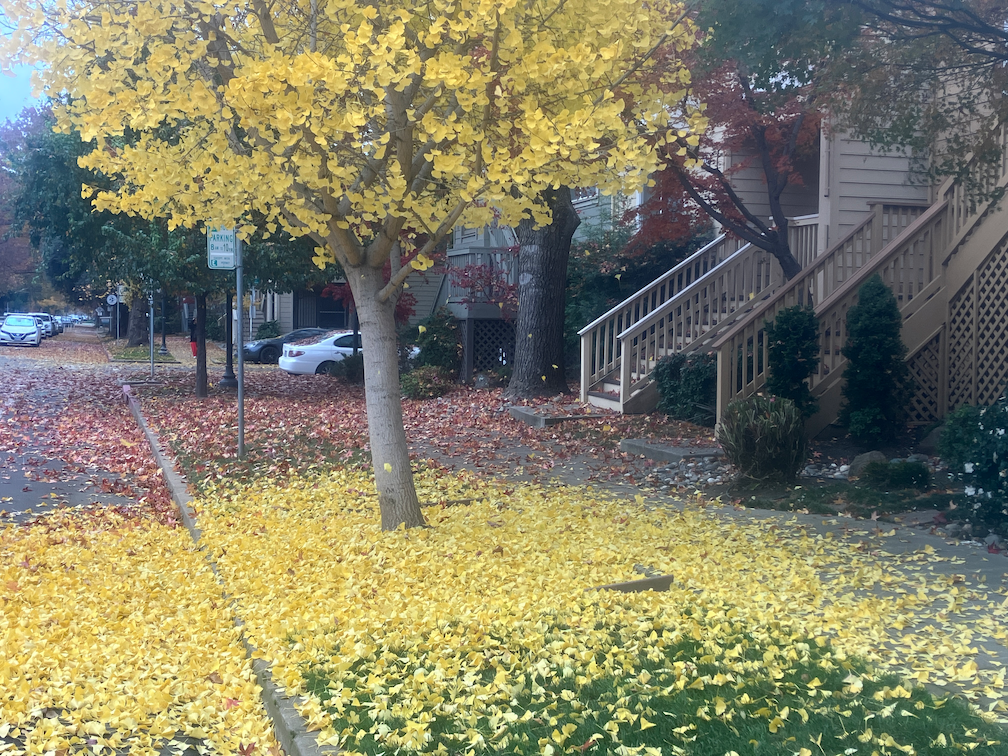
It is fall in Sacramento, trees are turning, leaves are falling. It is my favorite time of year, in part due to the knowledge that it will be over soon, only memories and photos. While out walking the last two days, I have been watching little breezes create leaf-fall, more fascinating to watch than snowfall. The four ginkgo trees back of my apartment are at their peak of brilliant yellow color, and the ground is carpeted in yellow. Blocks with a variety of trees are a kaleidoscope of colors.
This morning landscape workers were out blowing leaves into piles, but they were falling faster than they were moved. As I write, it is raining lightly, which will accelerate the leaf fall.
ginkgo tree and leaves next to bikeway on P St
What is not to like? Well, what happens over the next few days. The wet leaves will start to rot, which is a natural process. But any leaf area where cars are allowed to drive will grind the leaves into fine particles, and those particles with turn into what I call leaf slime. Leaf slime is incredibly slippery, and it is a clear and present danger to bicyclists (and walkers). The Class 4 separated bikeways probably won’t be too bad, since bicycles don’t grind up the leaves, and the city may even get around to sweeping the bikeways. But the regular Class 2 bike lanes will be horrible. Cars will drive over the leaves, and start the process. The city very rarely sweeps bike lanes. They may be partially cleared if residents have illegally piled leaves in the bike lane, and the claw picks up the leaf piles, but the very act of scraping up the piles leaves a thin leaf slime layer.
So, it is time of year to avoid bike lanes, until there is either maintenance or enough rain to wash away the leaf slime. Ride in the general purpose lane. Yes, you will get yelled at by asshole drivers whose car isolates them from the realities of roadways, but at least you won’t be slipping and falling on the leaf slime. Beware the leaves of December.
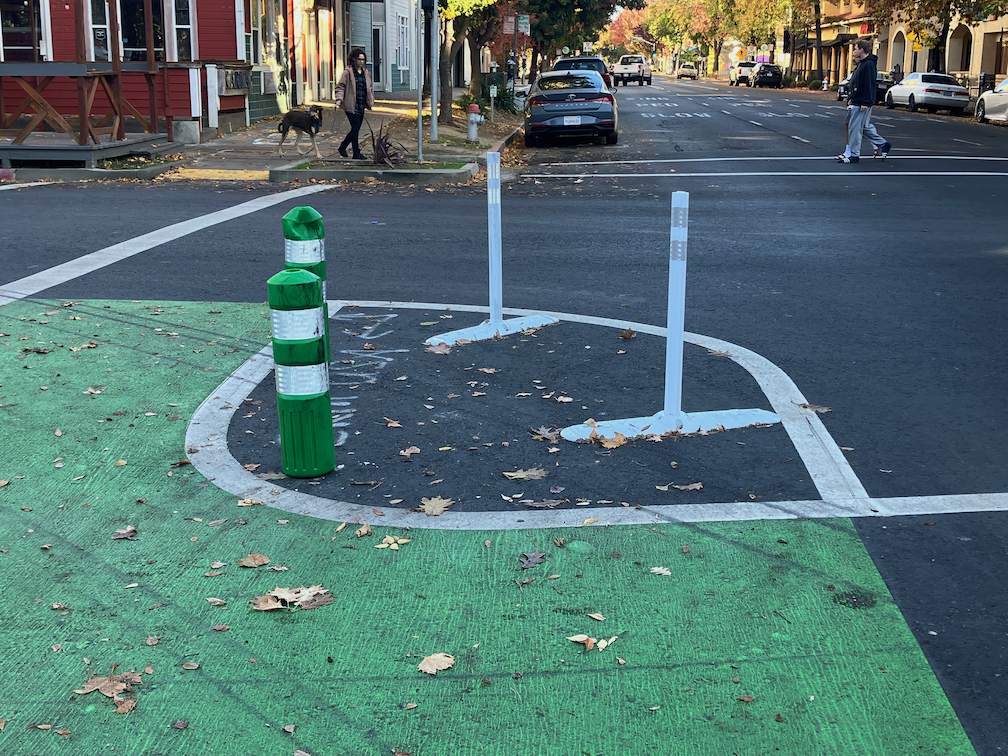
The rubber speed bumps have finally been installed on most of the non-concrete turn wedges. These are marked by vertical delineators, as shown below. it is odd that most of these installations have both green K-71 vertical delineators in addition. These K-71s might have been installed temporarily, while waiting for the rubber speed bumps, and be removed later, or may be permanent. In some of the locations, the white vertical delineators have already been hit and bent by errant drivers. I have not visited all of the locations where the rubber speed bumps have been installed (or not), so don’t have any more information. More info about the rubber speed bumps is available from the vendor TreeTop Products.
turn wedge at 16th St & P St, with green K-71 delineators and rubber speed bumpsRead More »
This is a guest post from reader Sonya Hendren. Sonya is a bike advocate and educator in the Sacramento region.
In looking back at this year’s May is Bike Month, two comments during meetings have left an impression, informing my current opinions on the efficacy of our bike advocacy.
During a neighborhood association meeting about walking/biking safety, a panelist emphasized that transportation projects are funded by competitive grants. It’s a fixed-sum game: if Sacramento gets a grant, all the losing cities’ projects are left unfunded. If another city’s project wins, Sacramento’s project doesn’t happen, at least not in this funding cycle, from this source. Of course our first instinct, mine included, is to cheer for Sacramento; we get funding, we do projects.
My revelation is that I don’t want Sacramento to win competitive grants. In the Freeport Blvd Transportation plan, the city never considered a road diet (reduction in lanes), despite it being a prominent request during the community input phase, because their goal is to maintain previous ADT (average daily traffic count.)1 The city works to maintain current levels of private-car use. The city’s Climate Action and Adaptation Plan, companion document to the General Plan, reduces the MCCC (Mayors’ Commission on Climate Change) goal of 30% Active Transportation, down to 6%. Under these practices and policies, Sacramento would use transportation funding to further cement car-dependency. Grant funding would be better spent in another city that is actually trying to shift transportation mode share away from private-cars, trying to reduce VMT (vehicle miles traveled). The project in another city would do more good to Sacramento by serving as a positive example, than spending the money in Sacramento under Sacramento’s current practices and policies.
Second, during a debrief-and-next-steps meeting on school “bike buses,” I learned that after Safe Routes to Schools programs end, feedback of continued walking/biking is the rare exception, not the norm. The norm is that Safe Routes to Schools programs are funded for one to three years, they get a group of kids walking or biking during those years, and when the funding ends, all the families go back to driving. Current infrastructure and incentives are such that without a paid person there helping, even students/families who have been taught how to walk/bike to school and practiced it for years, do not. That’s so discouraging: if “holding people’s hands,” not just teaching them the routes, but traveling those routes with them regularly, sometimes for years, doesn’t convert people to using the routes, how can any of our encouragement projects have any affect??
I worked for 10 years as the Safe Routes to School Coordinator for San Juan Unified School District. Three of those years were focused on Citrus Heights schools, and the rest on schools in unincorporated Sacramento County (Orangevale, Fair Oaks, Carmichael, Arden-Arcade, and Gold River). The interchanges with Interstate 80 presented barriers for students who lived on one side and went to school on the other. They could not walk or bike across the freeway, because the interchanges were designed to be safe only for motor vehicle drivers (and not really even those), not to be safe for walkers and bicyclists. Crosswalks over on-ramps and off-ramps were placed where drivers would cross them at freeway speeds, with poor visibility due to the curves. Bike lanes were usually non-existent, and when they were there, exposed bicyclists to high speed merges at on-ramps and off-ramps. If you have ever had the ‘pleasure’ of walking or riding across one of these interchanges, you will know how scary and unpleasant they are. Generally only ‘fearless’ bicyclists and people who have no other choices will walk or bicycle here.
Since these horrible interchanges were designed and constructed by Caltrans, you might think that they are responsible for fixing them. They deny responsibility. They say to cities and counties, if you want a better interchange, you build it on your own money, or with grants. One of the interchanges in Citrus Heights, Antelope Road, was repaved by Caltrans, and they removed the bike lane from the westbound direction. Of course that bike lane was not safe to begin with, but removing it was criminal.
Same Caltrans denial of responsibility for ped/bike bridges over the freeway. There is one ped/bike bridge over I-80 in the entire stretch between Sunrise Blvd and Watt Ave, a distance of about eight miles. One. And it is no a pleasant crossing to use, often full of trash and graffiti. Again, to the cities and counties, Caltrans says, if you want it, you pay for it, don’t expect it to come out of our budget.
Given this, Caltrans will not even allow the application of complete streets designs to these interchanges. They want them to remain as they are, barriers to travel, and killers of the few walkers and bicyclists who use them.
All of this after spending four years developing a new complete streets policy, which could have been done in a year if Caltrans were not dragging its feet. Caltrans says that it has changed its ways, and is now concerned with people who walk and bicycle. Their actions say otherwise.
The number of $5 billion (or more) has been bandied about recently as the amount of money we need to fix all the poorly designed and dangerous roads in the City of Sacramento. The number seems reasonable, and I myself have estimated that sidewalk repair alone is $1.5 billion. This is just the city, let alone the county or region. The county and region are in most cases much worse off than the city. I support more funding for this work, some via sales taxes, but more via property taxes. After all, it is property that requires our transportation infrastructure and benefits from a good system.
But what if there is a better way? A less expensive way?
I encourage you to watch the latest (August 24) episode of Not Just Bikes (by Jason Slaughter), titled ‘Even Small Towns are Great Here (5 Years in the Netherlands)‘. He has collected video clips from visits to small towns across the Netherlands. He has two main points about small towns: almost all of them are served by good rail service, and many of the small towns and suburbs don’t need extensive bike structure because there are so few motor vehicles that it is safe and comfortable to ride on any street. My favorite quote from the video is:
“To make a place friendly for cycling, it was more important to restrict cars than it was to build a bunch of expensive bicycle infrastructure. After all, protected bike lanes are just an extension of car infrastructure, right. You don’t need bike paths if you don’t have a lot of cars.”
Not Just Bikes (Jason Slaughter)
A related quote, that I will have to paraphrase, since I can’t find the original source is: We have plenty of space for bikes on our streets, its just that it is currently occupied by cars.
The point, for me, is that we could make much more effective investments if we greatly reduced the number of cars on the road rather than trying to make all our roads safe for bicycling and walking. We need to make car drivers pay the true cost of their transportation choice: fossil fuel extraction, climate change, air pollution, expensive highways, foreign wars and fossil fuel subsidies, and a long list of others. Yes, and making it necessary to build protective infrastructure for walkers and bicyclist to protect them from those drivers. We need to make is more expensive and less convenient to drive, so that people will make other choices.
If we actively and directly reduce car dominance, we might only need $1 billion to fix everything. Still a lot of money, but not out of reach.
Jason moved to the Netherlands from Canada, but the car dominated ‘no places’ that he left are the same car dominated ‘no places’ of the United States, and of Sacramento. In fact, Canada tried to imitate the US, and left themselves impoverished, both economically and mobility wise.
Imagine for a moment, someone saying “Carmichel, where there are so few cars that it is safe to bicycle and walk on any street, and the are great transit connections to all the regional destinations.” They would be laughed out of the room. Yet Carmichael, and unincorporated town in Sacramento County, is about the same size as many of the small cities called out in the Not Just Bikes video. We have designed a horrible world in service of the idea that we can and should drive everywhere. We if we flip that and make it hard and expensive to drive everywhere, places will begin to heal. Even Carmichael.




 Getting Around Sacramento