- Sacramento RT offers help to homeless light rail passengers (SacBee 2016-08-26)
- Bill to install breathalyzers in DUI offenders’ cars goes to Jerry Brown (SacBee 2016-08-25)
- City Council approves downtown parking rate hike (Sacramento Business Journal 2016-08-24)
- Back-Seat Driver: Sacramento light rail agency wants to make station ‘naming rights’ deals (SacBee 2016-08-22)
Author: Dan Allison
Dan Allison is a transportation advocate in Sacramento, CA. Dan dances and backpacks, as much as possible.
Myth?: transit takes longer
“But, what is more important is that only a small portion of jobs, and other destinations can be accessed through transit in any reasonable time and the travel time for transit is far higher than for driving.”
Well, this one is much more true that the myths I addressed (Myth: housing more expensive in dense areas, Myth: driving is supported by user fees). But it is worthwhile analyzing why this is so.
There are four employment centers in our region: downtown Sacramento, Rancho Cordova, Folsom, and Roseville. However, downtown is by far the most important. Check yesterday’s post (SacRT and employment) to see what a remarkable concentration of jobs there is, and how much of the county is essentially empty of jobs. Downtown is easily accessible by transit, the other three have much more limited options. So, how about time? Yes, there is a big time difference.
Three examples of morning commutes:
- Greenback/Sunrise to downtown: 78 minutes by transit (bus route 21 and Gold Line) while Google reports driving is typically 35 minutes but can be 70 minutes. So on a bad traffic day, the two modes are comparable, but on a good traffic day driving is more than twice as fast.
- Zinfandel/Sunrise to downtown: 61 minutes by transit (Gold Line and some walking) while Google reports driving as typically 22 minutes but can be 45 minutes. Again, driving is more than twice as fast.
- Florin/Greenhaven to downtown: 30 minutes by transit (route 6), while Google reports driving as typically 10-16 minutes. Again, driving is more than twice as fast.
So, back to why. The nature of buses is that they have frequent stops, and spend a significant portion of their time in dwell, not moving. Light rail has fewer stops, so spends less time in dwell. There are express buses, of which SacRT has a few that run very limited schedules. It is also possible to create Bus Rapid Transit (BRT) routes with few stops, and travel times close to light rail. The commuter buses operated into downtown by Placer County, El Dorado County, Elk Grove, Roseville and others have only a few stops at each end, with long runs in between, and so have travel times as good as or better than light rail and BRT. However, these commuter buses serve a much smaller number of riders than any of the other options, and are also quite a bit more expensive than SacRT fares.
A second big difference it that you don’t have to wait for the next bus or light rail. You jump in your car and go. Of course there is time parking at the destination (an urban area typically sees about one-third of traffic is circling for parking, and my observation says Sacramento is similar. I live very near the CDPH buildings, and when I’m home during the day, I see a lot of employees walking to their cars to pay more or move them. More time time lost to the driving habit.
Perhaps the biggest difference is the amount of money we spend on driving, both individually and as a society. A transit pass costs $120 per month. Commuting can cost many times that much (before you say but… realize that almost all drivers underestimate what their vehicle really costs them). As a society, we spend incredible amounts of money on highways, far, far more than we spend on transit. One data point is the $133 million “80 Across the Top” project which is adding just a single travel lane in each direction for about 10 miles. $133 million for a lane. Wow! I have previously estimated the cost of the freeway system in Sacramento county as about $1 trillion. I don’t have a cost estimate for the light rail system, but it is a tiny fraction of this. What if we had spent the money on transit instead of privately owned vehicles? How would travel times compare then? We have created a transportation system whose primary purpose is to move a lot of cars at high speed. We have not created a transit system move a lot of people at a reasonable speed.

SacRT and employment
I earlier produced maps showing how SacRT routes related to population density and income (SacRT with income and population). I also wanted to present a map on employment or jobs – where people are going to on the transit system. It took much longer to track down that data, and I needed help from SACOG’s GIS staff. The employment data is from the Census Bureau’s Longitudinal Employment-Household Dynamics (LEHD). The data is normalized over area. The map is below, with the SacRT_employment pdf also available.
Myth: driving is supported by user fees
Another myth promulgated by people who support roads over transit is that transit has to be subsidized while motor vehicles pay their way. “Transit, particularly rail transit, is very expensive to build, operate, and maintain. While driving is pretty much self-supporting through user fees, transit must be heavily subsidized by taxpayers.”
Roads for motor vehicles are anything but self supporting. For the state and federal highway system (from the interstates all the way down to some arterial streets that many people don’t realize are designated highways), gas taxes pay for roughly half of constructing those roads. Where does the other half come from? Out of our pockets, from the general fund, through income taxes and other fees. You may have heard that the federal highway trust fund is out of money, but highways are still being built. How is that possible? Well, money keeps getting dumped into transportation to make up for the lack of gas tax income. Though it is now down to 50%, if the gas tax is not raised, it will be a continually declining percentage until nearly all of our transportation funds come out of the general fund.
So if the gas tax doesn’t pay for maintaining roads, what does? Nothing! Very little money is being spent on maintenance, and our roads have deteriorated in a way that is obvious to anyone who drives, or rides a bike, or even walks. Politicians give lip service to fixing roads, but when it comes to spending money, it is all about big new roads and ribbon-cutting opportunities. Or even big new transit projects and ribbon-cutting opportunities.
For local roads, those paid for by counties and cities, very little comes from the gas tax. Counties and cities in California do not have gas taxes nor income taxes (though they do in some other states). So where does the money come from? Sales tax, and out of the general fund, which is mostly property tax. Self supporting? Hardly. Counties and cities do get some state and federal funds, some of which comes from gas taxes, but it usually is only for new construction (not that it has to be, but that is what is asked for and given), and it is a small part of what it takes to build and maintain local roads.
And then there are the externalties of a car-centric transportation system. Climate change, air pollution, sprawl, unemployment or underemployment for people who can’t afford to get to jobs, death and severe injury on our roads ($80 billion per year, for just injuries, not including fatalities), high portions of both family income and family wealth devoted to just one purpose, the car, deteriorating infrastructure, foreign wars for oil (if you think the war in Iraq was about freedom rather than oil and profit for Halliburton and Dick Cheney, you haven’t been paying attention).
All forms of transportation get some subsidy. Motor vehicles, bicycles, buses, trains, airplanes (the subsidy here is probably the highest percentage of any), all get subsidized. Though rail freight is subsidized far less than other modes, which is why it seems to not be competetive with road and air, when it would be if the playing field were level. The real question is whether the subsidies result in a transportation system that serves all citizens, and not just those who choose to drive or are forced to drive by a lack of choice. My opinion is that we have our priorities all wrong.
So why do we still keep spending money we don’t have on highways and roads, rather than a rational transportation system? The “asphalt lobby” as it is called. This is a network of engineers, construction companies, government workers, and politicians who profit incredibly from continuing to spend our money on their pet projects. AASHTO (American Association of State Highway and Transportation Officials) and ASCE (American Society of Civil Engineers) are probaby the most prominent proponents, but there are organizations and lobbyists too numerous to list. OK, I can’t resist: the Asphalt Paving Alliance, the Asphalt Institute, the National Asphalt Paving Association. Not to mention: the American Concrete Pavement Association, the American Concrete Institute.
Time to stop!
News summary 2016-08-21
- Getting to new downtown arena must be simple (SacBee 2016-08-20)
- Streets in Sacramento’s downtown railyard open to drivers for the first time (SacBee 2016=08-19)
- Kings offer prime parking to season ticket holders (SacBee 2016-08-19)
- Editorial: Streetcar plan could put West Sac on the map (SacBee 2016-08-18)
- Kings roll out app for reserved parking near Golden 1 Center (Sacramento Business Journal 2016-08-18)
- Has Sacramento Regional Transit upped its game enough for arena opening night? (SacBee 2016-08-18)
- Park(ing) Day will transform a downtown street into interactive parklets (sactown magazine 2016-08-17)
- Regional Transit wraps old trains (SacBee 2016-08-17 video)
- State awards almost $9 million to Capitol Corridor for new Roseville service (Sacramento Business Jounal 2016-08-17)
- Book bikes expand library resources to Yolo County readers (SacBee 2016-08-17)
- State puts Sacramento’s streetcar dreams back on track with $30 million grant (SacBee 2016-08-17); Streetcar gets $30 million in cap-and-trade funding (Sacramento Business Journal 2016-08-16)
- City Council moves on marijuana, bikes and legal fees (SacBee 2016-08-17)
- Editorial: Let’s get the training wheels off Sacramento’s bike plan, finally (SacBee 20916-08-16)
transit and rail grants to Sacramento region
California State Transportation Agency (CalSTA) announced the recipients of its Transit and Intercity Capital Program (TIRCP) grants. Sacramento benefits from two projects:
- $9M to Capitol Corridor Joint Powers Authority for expanded service to Roseville and related rail improvements
- $30M to Sacramento Regional Transit District for a new streetcar
These grants of course are only a fraction of the cost of the projects, but every bit helps, and it is likely that these projects will now move forward though both were formerly stalled or moving very slowly.
From Streetsblog California, some more detail:
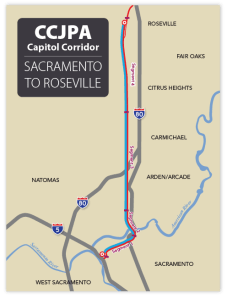
2. Increased Rail Service to Roseville and Rail Improvements
$8,999,000 to Capitol Corridor Joint Powers Authority
The project includes:
- Extending rail service to Roseville, building eight miles of a third track, a new bridge, station improvements, and more.
- Creating a service optimization plan to connect with Altamont Corridor Express and Amtrak San Joaquin passenger rail services.
- Adding standby electric train power to enable more trains to utilize grid electricity at the Oakland Maintenance Facility.
Capitol Corridor’s website News & Alerts page has more detail.

10. Sacramento Streetcar
$30,000,000 to Sacramento Regional Transit District
Funds go to the planned Downtown/Riverfront Sacramento-West Sacramento Streetcar (pending the project’s federal full-funding grant agreement expected by early 2017) including nineteen stations and six streetcars.
city failure on Capitol Mall bike lane
Sacramento has nearly completed a reconstructed bridge over I-5 between 3rd Street and Tower Bridge. This is part of a project to provide access from and to Old Sacramento, but that part is not complete yet. The pavement is fresh, with bright white lines and green carpet bike lanes. But, the bike lane design is a failure. The eastbound bike lane is OK. A little strange because it varies in width, but acceptable. The westbound bike lane, though, is a hazard to bicyclists.
Below is a photo of the first problem, a bike lane to the right of a place where a right turn is permitted. This is at the entrance to the Old Sacramento access.The straight-and-right arrow indicates that the city expects heavy right turning traffic at this location.
While this design is in compliance with the law, using a dashed line to indicate that traffic from the general purpose lane and the bike lane should safely merge, the use of green paint here is the wrong message. Though green paint has no legal meaning, the general meaning taken is that this is the place for bicycles. So an average bicyclist will stay in the bike lane, not realizing that the safe manesuver is to merge into the general purpose lane. The result is a right hook danger that has been created by the design.

There are a lot of ways to solve this issue, but this is the worst possible solution. Creating a separate signal phase for bicyclists and right turning traffic is one solution. Dropping the bike lane in favor of green-back sharrows in the general purpose lane is another.
However, this problem spot is minor in comparison to what happens just on the other side of the intersection. Here, the bike lane suddenly ends and becomes a right turn only lane. There is no signing for bicyclists or motor vehicle drivers, no pavement markings, no indication of what biyclists should do. I’m a vehicular bicyclist and would not be in this bike lane fragment to begin with, but for the average bicyclist, this green paint is a clear message, “this is where you belong.” Whoops. Sorry. Turns out we needed the road for a right turn lane, and just got rid of the bike lane. Hope you are still alive, but if not, well it wasn’t our fault. But the thing is, it is the city’s fault. This is a mis-design, and the city should be sued the first time someone is injured at this location. It is not as though this was an existing location where the city did the best if could to squeeze in bike facilities. This is a new construction where things should have been done right. They were not.

There are several good solutions for this location, and the NACTO Guide to Urban Bicycling has several, but even the standard MUTCD design is better than this. Though you can’t see the turn lane due to the parked FedEx van (it was there for more than 10 minutes, double-parked, and I couldn’t wait any longer for the photo), there are no bike markings in the right turn lane at all. There is no “bicyclists may use full lane” sign. Maybe bicyclists are meant to fly over this right turn lane and return to earth at the bridge. Or maybe they are meant to die.
As I always warn people in bicyclist education classes, don’t get sucked in by paint. Paint doesn’t keep you safe. And in this particular case, paint creates a danger for you that would not exist if not for the paint. Negligent design, for sure.
Myth: housing more expensive in dense areas
Todd Litman recently gave a talk at Transit 101 presentation hosted by 350Sacramento and others. There were some comments afterwards questioning some of what he had to say and his premises.
One of these was “He also ignores that the type of concentration he is advocating significantly increases the cost of housing.” Litman did present densification as one of the solutions to transit systems that are too spread out to function effectively, which is certainly one of the issues for SacRT.
If one looks only at the price of housing, the cost does usually increase as one moves from the suburbs towards the urban core. Though the pattern is actually much more complicated than that, with some inner-ring suburbs doing quite well while others are in steep decline. But the price of housing is only one aspect of living costs. The big, and often forgotten or dismissed, cost is transportation.
The key resource for exploring the tranportation aspects of housing affordability is the H+T Index (housing plus transportation) of the Center for Neighborhood Technology. To quote:
“By taking into account the cost of housing as well as the cost of transportation, H+T provides a more comprehensive understanding of the affordability of place. Dividing these costs by the representative income illustrates the cost burden of housing and transportation expenses placed on a typical household. While housing alone is traditionally deemed affordable when consuming no more than 30% of income, the H+T Index incorporates transportation costs—usually a household’s second-largest expense—to show that location-efficient places can be more livable and affordable.”
The map below shows the H+T index for a part of the Sacramento area. Light colors are affordable, dark colors are not. The general pattern is that housing becomes less affordable the further one goes from the urban core, though the pattern is of course complex. Part of Arden-Arcade is unaffordable both because housing is very expensive and it is a transit desert, while other parts are more affordable because housing is less expensive and it is not quite as much of a transit desert.

The devil is in the details, so I’d encourage you to explore the maps at CNT in more detail to see how this calulation works for specific areas, and how the H only (housing only) map compares to the H+T (housing plus transportation) map. I’ve written a bit about H+T before (Abogo), but it is always worth coming back to these very important concepts.
A lot of what people think about when they think about high costs in dense places are the really dense places, New York, Paris, San Francisco. However, the high costs of those places has as much to do with demand as with density. These places are expensive because so many people want to live there, and with limited housing options, competition drives prices up. In fact, the lower costs of suburban housing can be explained in large part by the far lower demand for such places. Not many people want the suburbs, so there is little competition for housing there, and prices stay lower. This is an oversimplification, but nevertheless true, and one of the perspectives that needs to be considered when looking at housing prices.
Another aspect of this misunderstanding is that many people envision densification as leading inevitably to very dense urban areas, which they associate with poor livability (though others seek out these dense areas), what are sometimes called inner cities, skyscrapers and tenements. Densification can mean intermediate densities, such as houses on smaller lots, multi-family housing, and buildings of moderate height up to five stories. Of course some people don’t like that either, but this is the minimum necessary for a functional transit system. The “new-traditional” format of houses on large suburban lots, or even worse, very large houses on very large exurban lots, cannot support a transit system. In the Sacramento area, midtown is an example of a moderate density place. It has single family homes, but also multi-family houses, apartment complexes, low-rise residential buildings, a good mix of housing types. And it is hardly dense at all, at least in my view.
Beyond the direct costs to the invidual homeowner/renter, however, are the costs we pay in sales tax and property tax, as well as fees, to build and maintain infrastructure. Infrastructure in less dense areas costs much more per household, or per square foot of floor space. Everything is longer in the suburbs: power lines, water lines, sewer lines, telephone/cable TV lines, roads, freeways, and most specifically distance to amenities. Everything. So far we have hidden that cost by having everyone pay equally for infrastructure, but if people were charged both for initial construction and maintenance by the amount of infrastructure per household or square foot, people who live in the suburbs would be paying much more for their services. As it should be. In fact, most of the suburbs are financially unsustainable since they can never generate enough sales tax, property tax, or fees to pay for what it really costs. That is in part why the suburbs are falling apart – there simply isn’t enough money to keep them going.
The cost of living in denser areas is less, the cost of living in less dense areas is more.
News summary 2016-08-14
- Late-night trains to serve downtown Sacramento arena (SacBee 2016-08-10)
-
Highway to Hell? (Sacramento Magazine 2016-08-10)
- Sacramento to ring downtown arena with higher-priced parking zones (SacBee 2016-08-09)
- RT’s Henry Li sees Golden opportunity for a turnaround (Sacramento Business Journal 2016-08-05; subscriber content)
 Getting Around Sacramento