Leaf season

In my neighborhood, about half the trees have lost all their leaves for the year, and the other half are still hanging on. If I listen closely, I can hear the tick of leaves hitting the ground.

So, how have the bike lanes been doing during leaf season? At least for the parts of the central city and east Sacramento that I ride in, acceptably OK. People are putting their leaf piles in the bike lanes much less often than in previous years. I’m not sure why. I haven’t noticed any city effort to educate about this, other than a vague “When possible, avoid placing piles in bike lanes.” on their Leaf Season page. But I really do believe there are less piles in the bike lanes. Maybe people are beginning to clue in. If only there were a similar improvement in trash cans in bike lanes.

A big concern was how the new separated bikeways (‘protected bike lanes’, ‘cycletracks’) on P and Q and 10th (and now 9th) would do. The city has not yet purchased a device for sweeping these bike facilities. Apparently the ‘the claw’, the loader that collects the leaf piles and moves them into dump trucks, can negotiate the bikeways, and this is how they have been kept clear. This is working pretty well, all except for one block, pictured below. This section of P Street between 15th and 14th has a large accumulation of leaves, and the leaves have developed into leaf slime, with is an incredibly slippery mush of decayed leaves. I am not sure what is different about this block, but it certainly is different. It needs to be cleaned now, and cleaned more frequently.

P Street separated bikeway leaf slime

Sacramento among 10 best new bikeways

People for Bikes just published “America’s 10 Best New Bikeways of 2018” and Sacramento is one of them. Congratulations!

4. Sacramento, California
The J Street Safety Project was designed to calm traffic, improve pedestrian crossings, provide parking-protected bikeways, and make the street more inviting for travel. They chose to add a parking-protected lane to allow people of all ages and levels to bike the grid, separated from moving traffic. Travel lanes were reduced from 3 to 2, encouraging slower vehicle speeds, decreasing pedestrian crossing lengths, and improving corridor safety.
The project came out of the Central City Transportation Plan (Grid 3.0) in 2016, and is a marriage of street maintenance funding and transportation planning. They found that there was a need to calm traffic and improve pedestrian crossings, which was identified by the local businesses and residential community. The project improves pedestrian visibility by moving parking back from the intersection. It also benefits local businesses along the corridor by slowing traffic and increasing ease of crossing the corridor.
So far they’ve built over 25 blocks of parking-protected bikeways this year, and have funding for another 22 blocks.

People for Bikes

21950 and Vision Zero

California Vehicle Code 21950, failure to yield to pedestrians, is in my opinion the most important violation as it applies to implementing Vision Zero in Sacramento. The Vision Zero Sacramento Action Plan (draft) says “Launch high-visibility enforcement campaigns against speeding, failure to yield to pedestrians, distracted driving, and impaired driving. Campaigns will focus on HIN corridors.” The state code says:

21950.
  (a) The driver of a vehicle shall yield the right-of-way to a pedestrian crossing the roadway within any marked crosswalk or within any unmarked crosswalk at an intersection, except as otherwise provided in this chapter.
(b) This section does not relieve a pedestrian from the duty of using due care for his or her safety. No pedestrian may suddenly leave a curb or other place of safety and walk or run into the path of a vehicle that is so close as to constitute an immediate hazard. No pedestrian may unnecessarily stop or delay traffic while in a marked or unmarked crosswalk.
(c) The driver of a vehicle approaching a pedestrian within any marked or unmarked crosswalk shall exercise all due care and shall reduce the speed of the vehicle or take any other action relating to the operation of the vehicle as necessary to safeguard the safety of the pedestrian.
(d) Subdivision (b) does not relieve a driver of a vehicle from the duty of exercising due care for the safety of any pedestrian within any marked crosswalk or within any unmarked crosswalk at an intersection.

VEHICLE CODE – VEH, DIVISION 11. RULES OF THE ROAD,CHAPTER 5. Pedestrians’ Rights and Duties; http://leginfo.legislature.ca.gov/faces/codes_displaySection.xhtml?lawCode=VEH&sectionNum=21950; retrieved 2018-12-15

So, how is the Sacramento Police Department doing on enforcing this code against drivers who fail to yield to pedestrians in the crosswalk? Well, from the ‘Sacramento Police Vehicle Stop Data’ (http://data.cityofsacramento.org/datasets/sacramento-police-vehicle-stop-data) of the last two years, there were 101 violations of 21950 recorded, out of 61,151 violations. This is 0.17 percent, or, other violations were 582 times more common.

Anyone spending more than 10 minutes standing on the corner of any busy pedestrian intersection could count a hundred violations of this law. I know this because I do it. It is part of my job and it is also part of my advocacy. In two years the police only wrote 105 citations? I will also add that I have seen Sacramento Police Department officers in motor vehicles violating this very code hundreds of times, on myself and on others. Even the bicycle mounted officers are frequent violators. I will say that officers have yielded to me in the crosswalk, but it is much more common that they don’t. I’m not saying that they are trying to run me down, rather than they don’t wish to be slowed or inconvenienced, and so will cross through the crosswalk when I’m in it. They are, in this sense, just like other drivers.

So what is this disconnect between what is important and what officers do? I’m going to be blunt here. The police not partners in achieving Vision Zero, in fact they are the main impediment to Vision Zero. If they persist in their windshield perspective that pedestrians are the problems and drivers don’t mean to cause harm, pedestrians will continue to die, and drivers will continue to not face consequences for their violations, for their assaults, for their murders.

If you wish to reply that we all need to work together, and consider perspectives, well, please present evidence that this has worked in the part, or some construct that says it will work in the future. I’m not seeing it. In case you think I am picking on Sac PD, things are actually worse in other jurisdictions, but since this is where I live and observe the issue every day, it is the place I focus on.

By the way, thank you Don Kostelec @KostelecPlan for getting me fired up about all the ways in which our entire system is biased against pedestrians, and that those people whose job it is to consider and act on safety are mostly only concerned about drivers and traffic flow. I encourage you to follow his ‘The Twelve Days of Safety Myths‘ series.

Sac Opportunity Zones

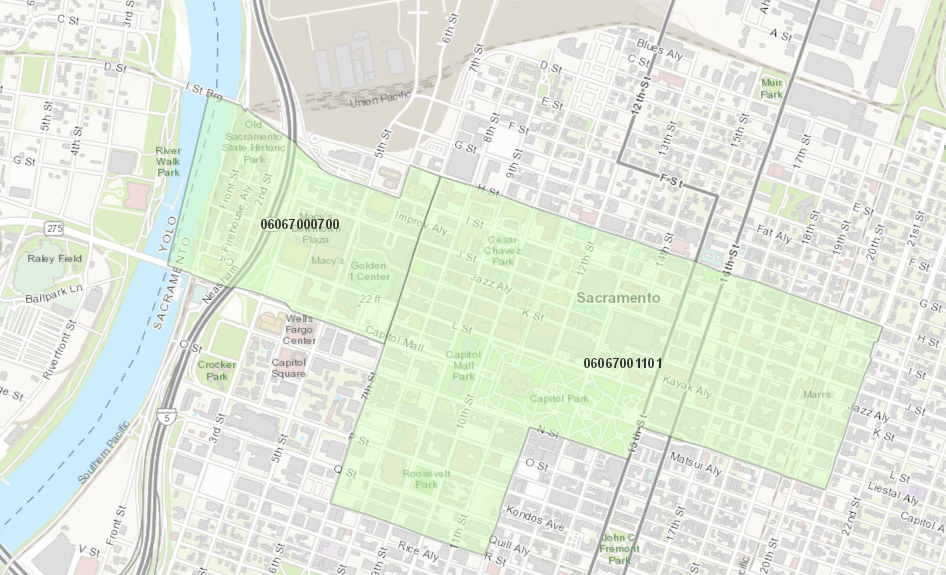
Opportunity Zones are something I’ve never paid much attention to, and don’t understand very well, so what follows is just information from a new report, National Opportunity Zones Ranking Report, by LOCUS and Smart Growth America. The report selects two of the 46 designated opportunity zones/census tracts in the county for ranking, 06067000700, western downtown, and 06067001101, eastern downtown and midtown, as shown on the map.

On the  ‘Top Opportunity Zones for Smart Growth Potential’ list, 0700 is in the ranking 3 band (of 6), and 0101 is in the ranking 4 band. On the ‘Top Social Equity and Vulnerable Places with High Smart Growth Potential’ list, 0700 is ranked 6 of 50, but 0101 is not on the list. On the ‘Top Opportunity Zones Markets for Office Asking Rents’ list, Sacramento is ranked 8 of 10, but it isn’t clear whether this is one or both census tracts. On the ‘Top Opportunity Zones for Office Asking Rents’ list, the two Sacramento tracts are ranked 47 and 47, with asking rents of $31.14 per square foot. On the ‘State (Top 10) Opportunity Zone Snapshots’ list for California, Sacramento 0700 is ranked 3 in the whole state.

What does this all mean? Well, I’m not sure. I hope that other people will chime in. I do note the following things:

  • The emphasis for Sacramento is on office space. I don’t think that is a good measure of a livable city, particularly one whose downtown is already overwhelmed by state offices. What downtown needs is people, not offices. But if the investment opportunity is in offices, that is what we will get.
  • The population of western downtown, 06067000700, is small, 2798 in 2012, and for 06067001101, 2082, though because it is much smaller 0700 has a population density of 13,990/sqmi while 1101 is only 3,413/sqmi.
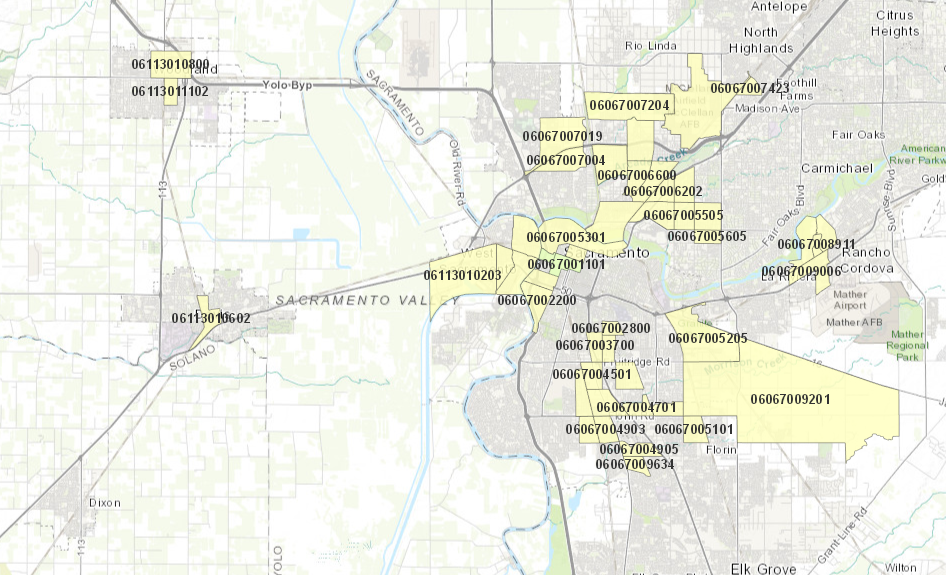
  • Why do the other 44 opportunity zones in Sacramento county not show up? It could be because the have less opportunity for smart growth investment, or it could be because they have significant challenges on the SEVI (Social Equity + Social Vulnerability) scale. I’m not sure. See all the Sacramento region Opportunity Zones on the map below.

There is an interesting opinion article in the SacBee California Forum from May: Sacramento has its best shot in years at outside investment. Seize the opportunity. California has an interesting website at https://opzones.ca.gov/, but it doesn’t really answer my questions either.

Smart Cycling and LCI Seminar now open!

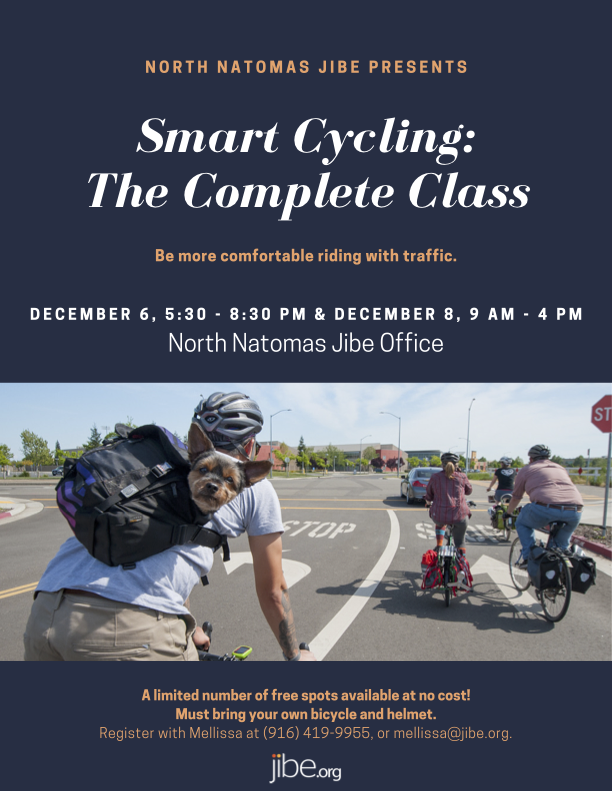
Jibe (formerly North Natomas TMA) is hosting two Smart Cycling (Traffic Skills 101) courses, in December and January, and a League Cycling Instructor (LCI) Seminar in February. If you are interested in working with youth for Jibe and other regional programs, or being a bicycling instructor, check the flier and position announcement, and sign up now! Yours truly is a LCI who leads the bicyclist education program in San Juan Unified School District, and cannot speak more highly of this opportunity. Go for it!

Smart Cycling class December

Jibe Bicycle Instructor Position


Sacramento Vision Zero Top 5 outreach

This information from the City of Sacramento via email.

Vision Zero Top 5 Corridors Banner

We have added and updated upcoming outreach events for the Vision Zero Top 5 Corridors.

Join us to learn more about the Vision Zero Top 5 Corridors Study and share your experience biking, walking and driving along these streets at one of the following events:


Date and Time Event Location Corridor of Interest
Monday, November 5th

5:00-7:00 p.m.

Community Workshop Peter Burnett Elementary School

6032 36th Ave.

South Stockton Blvd.
Wednesday, November 7th

Noon-2:00 p.m.

Pop-up Event Transit stop at Broadway and Stockton near Food Source (4401 Broadway) Broadway/Stockton Blvd.
Saturday, November 10th

9:30-10:15 a.m.

Old North Sacramento/Dixieanne Community Association GraceCity

701 Dixieanne Ave.

El Camino Ave.
Thursday, November 15th

5:00-7:00 p.m.

Community Workshop Luther Burbank High School

3500 Florin Rd.

Florin Rd.
Thursday, November 15th

6:30-8:00 p.m.

Gardenland/Northgate Neighborhood Association Stanford Settlement Conference Room

450 W. El Camino Ave.

El Camino Ave.
Friday, November 16th

4:00pm-6:00 p.m.

Pop-up Event Grocery Outlet

2308 Del Paso Blvd.

El Camino Ave.
Wednesday, December 5th

6:00-8:00 p.m.

Hagginwood Community Association William J. Kinney Police Facility

3550 Marysville Blvd.

Marysville Blvd.


About the Study


In 2017, the City of Sacramento identified the five corridors in Sacramento with the highest numbers of fatal and serious crashes involving pedestrians, bicyclists, and motorists.

The Vision Zero Top Five Corridor Study will analyze the factors that contribute to these corridors’ high crash rates.  Based on technical analysis, community input, and best practices in roadway safety and design, the study will identify improvements for each of these corridors that can be implemented in the near-term.

More information about the project is available at http://visionzerosac.org

Traffic Skills and Project Ride Smart

Jibe (formerly North Natomas TMA) and partners are offering two Traffic Skills 101 workshops, in December and January. Though the workshops are schedule to train new instructors for the Jibe Project Ride Smart program that teaches bicycling skills and safety in schools, they are open to others. Traffic Skills is a League of American Bicyclists course that qualifies people to go on to take the League Cycling Instructor Seminar.

The first workshop is Thursday, December 6, evening, and Saturday, December 8, daytime.

Please check the flier for more information.

Parking thoughts

Applicable to the City of Sacramento, but also to any urbanized area:

  • Any block on which parking capacity regularly fills on any day of the week and any time of day should charge parking fees.
  • The price of parking should be managed so as to always have at least one free space per block (the Shoup criteria)
  • Any block with mixed use should have one spot per block for bike racks and scooter parking, and one spot for ride-hailing and delivery use. These spots could be in the space daylighted by red curbs for crosswalk visibility.
  • The fees paid for by residents for parking permits should be sharply increased so that they more closely reflect the cost to the city of providing car storage space for car-owning residents.
  • The income from all new parking fee areas should go into a fund to be spent on the neighborhood that generated it, to enhance livability. It should not go into the general fund, and not be used to bond against. (again, the Shoup criteria)

Free and underpriced parking is one of the largest subsidies the city provides to car owners, but everyone who doesn’t own a car or has on-property parking pays for the subsidy. Which is not fair, and which encourages car ownership and car use.

I’m not suggested we get rid of on-street parking, it is a good use for some of the space we’ve set aside for it, but we do need to manage it more intentionally for the benefit of everyone and all modes of transportation, and charge for what it really costs.

Much more could be said, but that is enough for today.

JUMP news

I learned from a JUMP field staff how to deal with U-bars that won’t insert. Just move the rear wheel a bit, and it will go in. The U-bar is hitting the spokes, so rotating the rear wheel removes the block. This happens particularly with the charging rack, since with the front wheel locked into the rack, the rear wheel doesn’t move as much.

JUMP just changed their return to hub policy. Users will get a 25 cent credit for returning a bike to any hub, on that trip, and a dollar credit for returning to any charging hub. The email (graphics below) doesn’t make it clear if this applies to any drop zone hub, or only the charging hubs, but my experience yesterday and today is that it is for any drop zone hub (the green icon with lightning bolt). The credit I got for drop zone hubs was $1.25, both credits together. This could change. It could also vary depending on your membership type. I hope that this will encourage people to return bikes to hubs at the end of their trip. I often see bikes parked less than a half block from hub. Will 25 cents make a difference? Probably not, but it is a start. How about 50 cents, JUMP? In some other cities, there is a charge of $2 for leaving a bike outside a hub, in addition to the trip charge. I hope that we don’t need to go there in Sacramento.

I now have a student membership in JUMP Sac since I’m a student at American River College. At $30 a year, it is a great deal for anyone who uses JUMP regularly. You get 60 free minutes a day. Almost makes it worth being a student! An oddity is that taking a bike to a drop zone hub for credit counts against my daily minutes, until the daily minutes are used up, then the ride time is no longer charged. So it seems I get partial credit while I still have minutes, and full credit after I don’t have minutes remaining. I’m not sure I understand this structure, and I’m not sure it is consistent.

I, and everyone else, had hoped that bike parking would improve over time as people got used to the system, but parking seems to be getting worse rather than better. I’m not talking about parking in the buffer zone or to the side on wide sidewalks, which while technically illegal is practical where there are no bike racks, but parking in the sidewalk. This morning there were six bikes parked on and blocking the sidewalk on S Street. I don’t know why users would do this, as there was a sidewalk buffer immediately adjacent with plenty of space for bike parking (though nothing to lock to). Get it together people! There is no excuse for this kind of parking. It is both rude and hazardous for people walking, particularly if they have mobility issues and can’t go around. I moved the bikes. Yes, they are heavy.

I have been finding a lot of dead GPS bikes, with no display and no lights on the GPS unit. I’m not sure if this is common, or I’m just adept at finding them. If you find a bike like this, that does not wake up when buttons are pressed, please report it to support@jumpbikes.com. Sometimes they have lost track of these bikes, and sometimes they know the last location before the unit went dead, but it doesn’t hurt to report it.

change the signal at J St and 13th St

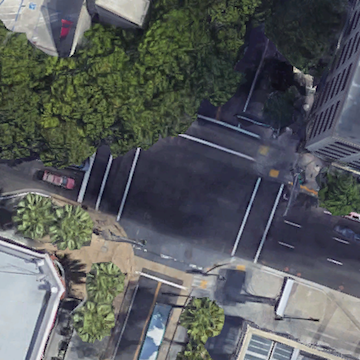
The signal at J Street and 13th Street in downtown Sacramento (shown at right) does not work well for pedestrians. The signal cycle is long, even compared to other signals on J Street, so the wait for pedestrians is quite long. I have seen the signal cycle skip both pedestrian crossings and vehicle crossings a number of times, which means that the wait is doubly long. Most walkers respond to this long wait by simply crossing the street against the pedestrian signal, and I don’t blame them at all.

A second issue is that the signal is set so that the east crosswalk walk mode occurs at the same time as the left turn from 13th Street southbound to J Street eastbound, meaning there is always a conflict between pedestrians and drivers at this point, and this conflict has been created by the signal setup. Many drivers cut directly behind or in front of people walking, as they know if they wait until the crosswalk is clear, as the law requires, they won’t make the signal.

This signal should be reconfigured so that it gives priority to pedestrians, without making them wait an unreasonable period of time, and does not create unnecessary conflict between turning drivers and people walking. The east crosswalk at a minimum needs a longer leading pedestrian interval (LPI).

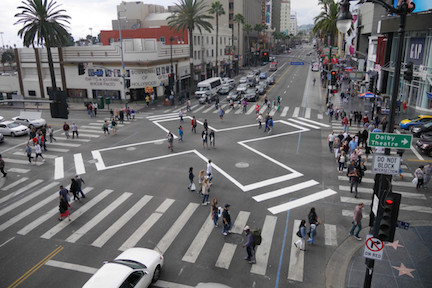
Even better would be to make this a pedestrian scramble intersection, with an all-direction crossing phase during which all vehicle turning movement are prohibited. The intersection can be marked with diagonal crosswalks, and additional diagonal pedestrian signal head added, however, simply changing the signal timing is sufficient as an initial step. This is a busy crosswalk intersection, with the convention center on one corner, the Sheraton Grand on another, and the parking garage for the Sheraton and others on the third corner. It is alway busy, and the people crossing here are commonly tourists, who are likely used to more advanced ‘world class’ cities where pedestrians are not second class citizens after car drivers.

Note: There are a number of busy pedestrian crossing intersection in the Sacramento central city that deserve an upgrade, but this is the one that most irritates me, whether walking or bicycling.