real turn wedges

This is Central City Mobility Project update #16.

A post today on Streetsblog LA (Santa Monica’s New 17th Street Curb-Protected Bike Lanes are Amazing) is about new bicycle facilities on 17th Street in Santa Monica. I think you will find some of the photos interesting. At first glance, it looks like some of the ones being installed as part of the Central City Mobility Project, but looking more closely, two differences really stand out. Most of the separated bikeways in Santa Monica are curb-protected. Bikeways that are solely parking protected only are protected when cars are parked. Otherwise, they are really just buffered bike lanes. And the turn wedges are hard curbs with additional markers, not paint-only, and definitely superior to the Sacramento’s suggested turn wedges which might have vertical delineators or other markers, but won’t have curbs.

curb turn wedges in Santa Monica (from Streetsblog LA)

To illustrate the problem these curb turn wedges solve, see the photo below of a motor vehicle making a high speed dangerous turn over a painted parking wedge at P Street and 15th Street.
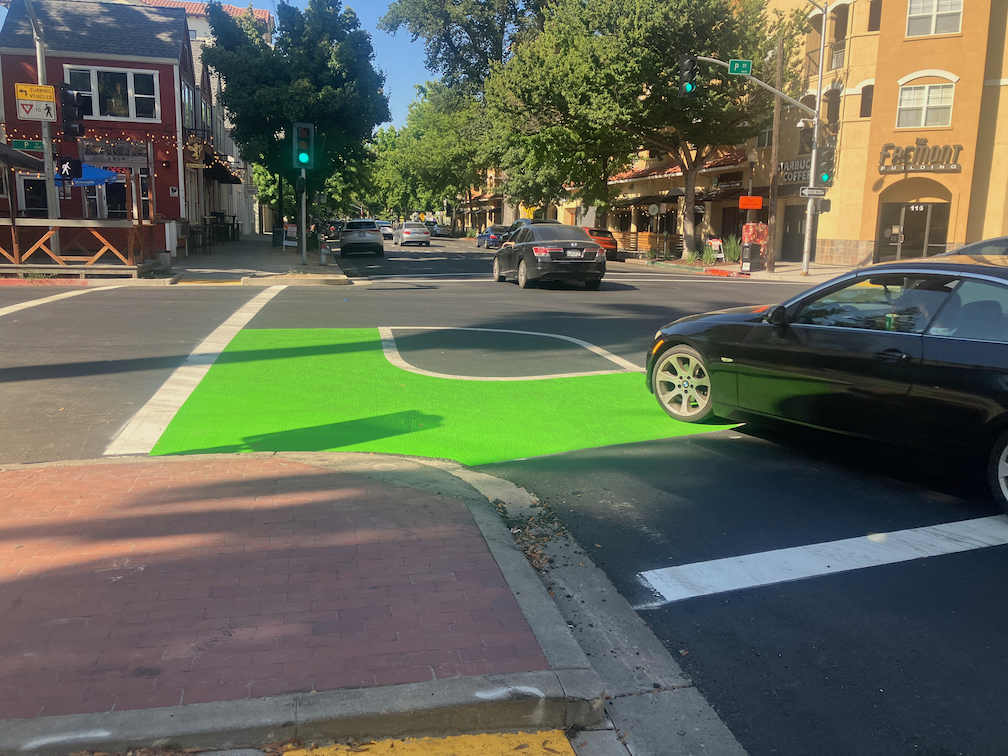
16th St & P St, Sacramento, high speed turn across painted turn wedge

Other

  • P Street markings including green paint are nearly complete. In two blocks, the green paint is nearly the entire block, for unknown reasons. There is nothing unique about these blocks. While green paint is useful to mark conflict areas, excessive use will just lead to maintenance expense over time.
  • Q Street has preliminary markings, but the temporary lane tabs still indicate overly wide and dangerous general purpose lanes.
  • 19th Street is nearly complete from H Street to Q Street, but there is no marking south of Q Street. South of Q Street, the old bike lanes show in some places, but otherwise have been erased in favor of overly wide and dangerous general purpose lanes. Several blocks of the new bikeway are in the gutter pan, making an unacceptable rough and dangerous surface.
  • 21st Street is complete except for a few spots that were missed and have not been picked up. The confusing arrow at 21st Street and W Street has been corrected. There is still accommodation or signal for bicyclists at 21st Street and I Street.
  • I Street work has begun, with the last few ADA ramps complete and some repaving.
  • 10th Street has the last few ADA ramps complete.
  • 9th Street doesn’t have any work in evidence.
  • 5th Street has not progresses past installation of signal bases.
  • Overall, no vertical delineators have been installed at any locations.
  • Delivery vehicles are parking in and blocking the separated bikeway on P Street approaching 16th Street. The city did not mark any of the parking spaces for delivery use. Cones and barricades have been placed in the buffer to reduce this hazardous driver behavior, and have been removed by someone, and replaced by citizens, and removed by someone, and …

Sac City is transportation bankrupt

There is an insightful admission hiding in the City of Sacramento General Plan 2040 update. In the Mobility Element, A Multimodal System section, Maintenance and Funding subsection (page 8-8), “A key challenge for Sacramento is that existing revenue streams do not fully cover operations and maintenance costs, and this same funding is also used to support implementation of improvements for safety and mobility throughout the city.”

Revenue does not cover expenses. Liabilities exceed assets. The city is bankrupt, just as you would be in this situation. Some asset of yours, like your house if you own one, or your business if you own one, is deteriorating, and you do not have the income to fix it. In the case of the city, it has incurred debt in order to build a transportation network that it cannot possibly maintain under the current taxation regime. And it never will. Never. If the city raised taxes, of whatever type, to the point they would pay for debt service and maintenance of the existing system, people would revolt. And that does not even include the new transportation infrastructure that some people would want. The city’s transportation system is bankrupt. It always will be. The core of the reason is that the city asked developers to pay for transportation infrastructure within a development, but then the city takes on liability for maintenance of that infrastructure. It all looks good for about 30 years, until things start to fall apart. The streets need repaving. The sidewalks are cracked. Painted lines and crosswalks have long since faded to invisibility. Not to mention what lies beneath (water and sewer), which is even more expensive to fix. For an in-depth explanation of how cities and counties and states got into this situation, I can recommend Confessions of a Recovering Traffic Engineer: Transportation for a Strong Town, and Strong Towns: A Bottom-up Revolution to Rebuild American Prosperity, both by Charles Marohn of Strong Towns. In fact, just in time for my post, an article today on Strong Towns: Why Cities are Flying Blind When It Comes to Their Own Debt.

So, what to do?

  1. Don’t bond anything again. We don’t need more roadways, or wider roadways, or interchanges. We don’t need big projects. Pay for maintenance of what we have, out of current income. This also means that we would never again bond against future income for current funding, as the city has done with parking revenue.
  2. Figure out what we can’t afford to maintain, and have that discussion with the public. I’d suggest that we can’t afford to maintain parking areas, whether on street, surface lots, or structured parking. Parking has never paid for itself and never will, and if we have to triage our transportation spending, it should be the first to go. Next would be cut-de-sacs and intentionally dead-end streets.
  3. Change accounting and budgeting so that transportation infrastructure shows up as a liability in accounting and budget, because it must be maintained forever, rather than as an asset.
  4. Cease accepting responsibility for new roadways built by developers. If a developer wants infrastructure, they can pay for it, and maintain it, forever, by setting aside reserves to cover the necessary maintenance. This would result in gated communities, which I definitely do not like, but a gated community is better than fiscal bankruptcy. It would also result in far, far fewer greenfield developments, since the financial model for these is that society will take on maintenance responsibility, and will build the surrounding infrastructure of arterial roads and highways that the development must have to pencil out. That is all to the good.
  5. Wean the city off of federal, state, and regional grants. Not all at once, but decrease the percentage of transportation projects that depend on outside money. This would mean even less money for transportation in the city, but it would force the city and citizens to look at what is really important, to individuals and society, and spend on the things that are really important. I hope that safety comes out at the top, and that we spend on transforming out transportation system from the current one that kills and maims people to one that protects vulnerable users first and foremost.

Note that the city is bankrupt in many ways, not just transportation. But transportation is my thing, so that is what I focus on.

Capital Southeast Connector sneaks another one in

Please see the Streetsblog California post today on transportation projects which increase VMT (vehicle miles traveled): California Will Continue Funding Projects that Induce Driving, Despite State Policy. The post in particularly calls out the Capital Southeast Connector highway project in Sacramento County as inducing VMT (not to mention greenfield developing), in direct violation of the principles of California’s Climate Action Plan for Transportation Investments (CAPTI).

When CTC (California Tranportation Commission) member Darnell Grisby raised questions about the project, the project representative tried to gaslight Grisby and the commission by saying the JPA did not have land use authority and the development to be induced is not their problem. But the JPA does, indirectly, because highway projects promote sprawl and directly reduce the effectiveness of walking, bicycling, and transit projects.

Having been shot down in the recent Measure A sales tax, which failed in large part because it included controversial Capital Southeast Connector projects, the JPA (joint powers authority) is trying other back-door methods. The ultimate outcome desired by the JPA is a full freeway from El Dorado Hills and Highway 50 to Elk Grove and Interstate 5. The public has rejected this idea, so the JPA is working to sneak the project through in segments, by nickel and dime-ing the taxpayers until it is ultimately finished. In case you aren’t aware of the Capital Southeast Connector, I have written about it many times: Measure 2022: Southeast Connector exceptionalism, No to the southeast connector, Measure 2022: greenfield developer sponsors, and many others on the failed Measure A 2022.

SACOG has repeatedly refused to put the project as a whole into the regional MTP/SCS (metropolitan transportation plan / sustainable communities strategy) updates and specifically said it will not be in the upcoming Blueprint.

The Capital Southeast Connector JPA is a rogue agency. It serves the needs of greenfield developers and politicians who see the future as even more motor vehicle dominated than the present. The JPA should be disbanded. This probably wouldn’t completely kill off the project, since the county and cities might continue to waste taxpayer dollars on inducing sprawl and travel, in order to gain campaign contributions, but it would certainly help.

No Capital Southeast Connector highway, now or ever, in pieces or as a whole!

SACOG ATP awards

Ten projects were awarded ATP (Active Transportation Program) funding in the SACOG region for 2023-2027. Brief descriptions follow. All are full funding of the grant request, unless otherwise noted.

  • Citrus Heights – Arcade Cripple Creek Extension. Construct a 0.5 mile Class I multi-use trail following the Arcade Creek alignment between Sayonara Drive and Mariposa Avenue. $7,155,000
  • El Dorado County – El Dorado Trail / Missouri Flat Road Bicycle/Pedestrian Overcrossing. Construct a Class I multi-use grade-separated crossing over Missouri Flat Rd, closing a gap in the El Dorado Trail. $3,271,000
  • Elk Grove – Laguna Creek Inter-Regional Trail Crossing at State Route 99. Construct Class I Bikeway across State Route 99 and adjacent class I trail gap closure. $6,874,000
  • Folsom – Folsom-Placerville Rail Trail Gap Closure Project. Install curb ramps, sidewalk connections, curb extensions, pedestrian refuge islands, curb & gutter, raised medians, pavement markings, signage, striping, and asphalt overlay. $1,700,000
  • Roseville – Dry Creek Greenway East Trail, Phase 2. Construct a Class I multi-use trail and Class II buffered bike lanes. $6,063,000
  • Sacramento County DOT – Bell Street Safe Routes to School. Construct new sidewalks and curb ramps. Relocate signal poles and straighten sidewalks. Install pedestrian signal, RRFB, new signs, bike lanes and bike detectors. $8,808,000
  • Sacramento County Regional Parks – Dry Creek Parkway Trail. Construct a paved Class1 multi-use trail, including dg shoulder, plus two bridges and roadway crossing evaluation. $7,704,000
  • Sacramento – 9th Street Separated Bikeway Project. Construct a Class IV bikeway and a Class II bikeway. [This would extend the Central City Mobility Project from Q St to Broadway, which is not part of the current project.] $2,564,000
  • West Sacramento – North 5th Street Complete Streets & Connectivity Project. Project will install bike lanes, intersection enhancements, and new sidewalks, and an ADA ramp connection from 5th Street/A Street to Riverwalk Trail. $3,131,000 (partial funding)
  • West Sacramento – West Capitol Avenue Regional Connection Bicyclist and Pedestrian Safety Improvements. Construct vertical delineators to create separated bike lanes, Class II bike lanes , intersections improvements, and improve Westacre Rd underpass. $735,000

I am particularly pleased about Bell Street Safe Routes to School and Arcade Cripple Creek Extension, as these were projects that I promoted when I was Safe Routes to School Coordinator for San Juan Unified School District. Bell Street is used by many students attending Howe Avenue Elementary, Encina Preparatory High, and Greer Elementary, as well as several private schools in the area. The Arcade-Cripple Creek trail project serves both students at a number of schools and promotes active transportation for the entire community.

too wide, too fast

This phrase summarizes the street network we have in the City of Sacramento. With a very, very few exceptions, every single street is too wide and too fast, across the entire range from residential streets to traffic sewer arterials. These streets kill and injure incredible numbers of people every year. Walkers, bicyclists, drivers, passengers, no one is immune to the danger that these poorly designed streets present. Though rankings change year to year, and depend on details, Sacramento is at or near the top of crash rates for the state. We probably don’t have worse drivers than other cities, we have worse streets.

The city has promised that it will update the Street Design Standards that have created this hazard. Maybe soon, maybe not for years. In fact, the existing standards don’t even have all that much detail, so a lot of the streets were apparently designed on the whim of traffic engineers, not even on standards. MUTCD (Manual for Uniform Traffic Control Devices) and CA-MUTCD will not be considered acceptable roadway designs since they emphasize motor vehicles over all other roadway users. NACTO (National Association of City Transportation Officials) or European standards such as the Netherlands CROW will be referred to as needed.

The new standards must ensure that we never build an unsafe roadway again. The goal must be no fatalities or severe injuries, no matter how drivers behave. Sacramento must be a true Vision Zero, safe systems city, not the lip service, we will fix things someday, when we have the money, that it is now.

What should the new standards be like?

  1. There should be separate documents, or at least clearly separate sections, for new construction and for healing existing designs.
  2. The state and federal roadway functional classification system (FCS) should not be used. Instead, a system that addresses the intended purpose of streets including ALL users should be used. The FCS is in large part responsible for the mess we have now. It represents that traditional traffic engineer focus on maximizing motor vehicle volume and speed. See SacCity street classification for more information.
  3. New construction standards:
    • will emphasize limited roadways, one lane in each direction, and would include designs for two lanes in each direction in exceptional circumstances
    • design speeds and posted speed limits must match
    • base design speed is 20 mph
    • roadways over 20 mph must have bike lanes; over 30 mph must have separated bikeways
    • no roadway will have a design speed over 40 mph. Anywhere. Ever.
    • intersections will be designed so that it is clear that crosswalks, at sidewalk level, continue through the intersection, and motor vehicles are the guests
    • all new developments will be designed with a street grid of 1/4 mile
    • rolled curbs will not meet standards, however, streets without curbs may be used if the design speed is 10 mph
  4. Healing existing roadways:
    • no street will be repaved without consideration being given to reallocating right-of-way width to walking, bicycling, transit, and sidewalks buffers for trees
    • the intent of reallocation will be to achieve the same design as new construction
    • on-street parking will be retained for its traffic calming effect, however, removal of parking will never prevent reallocation to higher uses
    • for overly wide streets, parallel parking will be converted to back-in diagonal parking in order to narrow roadways for safety
    • streets without a tree canopy will have trees added, in parking lanes if no other space is available
    • the city will adopt responsibility for maintenance of sidewalks, in the same way that they are responsible for pavement
    • designs will be available for closing sections of street temporarily or permanently for dining or community events
    • designs for diagonal ADA ramps will not be part of the updated standards; only perpendicular ramps will meet standards

My intent here is to provide something simple, summarizing beyond the details of previous posts on Street Design Standards.

What would you add?

bikeways in Seattle

I was in Seattle in May, for Northwest Folklife, and am back again at the moment, reminded that I had not posted about transformations happening in Seattle. Seattle is, on the whole, a very traffic-y city with sparse bike facilities, but what is interesting is what they are doing with re-allocating roadway space to better use than motor vehicles. Bus lanes, wider sidewalks, protected bikeways, removal of parking. It is inspirational.

I have not been able to pin down whether it is official policy, but I can say for certain that the city is no longer installing paint-only door-zone bike lanes. Anywhere. All of the bike facilities are separated, some by car parking, some with planters, some with substantial vertical delineators. Almost all the new ones are either at roadway level and protected by hard curbs, or raised to sidewalk level and therefore separated from the roadway by curb and buffer strip.

Read More »

Sac General Plan & street design update

City of Sacramento Public Works staff has told the Active Transportation Commission that an update to the Street Design Standards will start soon. But the General Plan says otherwise. From the plan, Implementation Actions, pages 8-28 to 8-29:

M-A.10: Street Design Standards Update. The City shall review and update City Street Design Standards as needed to ensure they adequately support objectives for prioritizing people throughput, safety, and efficient transportation management.
Responsible Entity: Department of Public Works
Timeframe: Mid-term (2030-2035)

This timeframe indicates that the update will not even start until 2030, six years after the adoption of the plan in 2024. Six years of Public Works enforcing outmoded and dangerous street designs on the public and on developers. Hopefully the plan is out of date, and staff is correct that it will start soon.

Yes, I had promised quite some while ago a summary of my many blog posts on the Street Design Standards update. Coming soon to a blog near you.

turn wedges of death

This is Central City Mobility Project update #15.

I have been following the progress of the Central City Mobility Project which has now mostly completed separated bikeways on 21st Street, half of 19th Street (H to Q), most of P Street, and now going to Q Street. One of the features of the design is ‘turn wedges’ which I have written about before: where the bike lane ends – update, where the bike lane ends, Central City Mobility update. I have spent a lot of time observing driver and bicyclist behavior at the intersections which have these turn wedges installed. The wedges are marked only by white paint, though city diagrams show them having some sort of physical barrier installed in them.

Drivers are using the turn wedges, and the buffer areas of the separated bikeway, to make very high speed, very wide turns at these corners, cutting the corner where a bicyclist might be riding. The prior configuration of a regular intersection did not allow such wide and high speed turns. I have seen a number of close calls between motor vehicles and bicyclists, and walkers, for that matter, since these high speed turns cross the crosswalk as well as the bikeway. These turn wedge corners are also encouraging drivers to run red lights, even more so than the usual red light running. I saw three drivers run the red on a single signal cycle, and a driver on the cross street had to slam on their brakes to avoid a collision. I’ve seen a large number of near-misses for motor vehicles.

It is not clear whether these turn wedges are complete or not. Will the city actually install something here that prevents or at least discourages these high speed dangerous turns? I don’t know. What I do know is that in the meanwhile, these turn wedges are a clear and present danger to bicyclists.

I spent time this afternoon watching left turns from P Street westbound to 15th Street southbound. Drivers were using the buffer area and the bikeway to form two lines of left turning traffic, where there should be only one. The block of P Street was completely devoid of parked cars, so drivers were queuing into two lines way back near 16th Street. Since the intersection is in no way marked for a double left turn lane, there were motor vehicle conflicts on every signal cycle.

Sorry to be the doom-sayer, but I have to recommend that bicyclists simply not ride on these streets until the projects are truly complete, with as full a protection for bicyclist as can be achieved with these less than international best practice designs.

The city’s attitude seems to be that since the bikeways will eventually be safer, we just have to put up with the unsafe situation in the meanwhile. I completely disagree. This may be criminal behavior on the part of the city, to remove moderately safe bike lanes and replace them with unsafe bikeways. If bicyclists (or walkers or drivers) die before the project is complete, is this just a ‘whoopsie’? Professional engineers designed this project, signed off on this project, and should be inspecting the project as it goes along. Why do we then have these unsafe situations? Is is intentional? Is it indifference to bicyclists and walkers? Is it professional incompetence?

It is imperative that all construction projects accommodate walkers and bicyclists, who are even more vulnerable at these projects than normally. The attitude of ‘it will be safer later’ is completely unacceptable.

The construction company for this project is McGuire and Hester. Though many people might blame these problems on the construction company, I don’t. It is the city’s responsibility to design safe projects, during and after construction, and it is the city’s responsibility to inspect projects to see if they are complying with the design, and to fix things if not. But I strongly suspect that the construction company is doing exactly what the city told it to do.

21st St and T St turn wedge

Sac General Plan at ECOS 2023-06-27

At the meeting of the ECOS Climate Committee on Tuesday, June 27, there was a presentation on the City of Sacramento General Plan 2040 Update by city staff Remi Mendoza. The presentation gave an overview of the plan, which is pretty much available on the city website, but the questions and comments were interesting.

Heather Fargo raised issue of language to address disability transportation concerns; does plan address sidewalk maintenance? Staff did not really answer about disabled mobility, rather, the answer was about walking and bicycling for other people. Heather said she is dissatisfied with bicyclist improvements which make things harder for disability. I will ask Heather for clarification on her concerns. Heather also expressed a number of concerns about the lack of a commitment to protecting agricultural and wildlife lands in the Natomas Basin and Natomas area, both in the main general plan and in the specific North Natomas Community Plan.

I asked two questions:

  • Why is the council commitment to removing parking mandates now a weak ‘could include’? Staff answered that a consultant is working on this, and if council wants stronger language, it can reinstitute it. This is a very dissatisfying answer. If the council wanted weaker language, they could asked for it, but they have not. I suspect that some politically powerful people (more powerful than you or I) asked for the language to be weakened, and staff complied. Was this City Manager Howard Chan, or was it one of the powerful who is not on the council?
  • Map M-3 emphasizes light rail and arterials for transit oriented development. These are both NOT the best locations due to surrounding land use (often industrial and toxic), poor accessibility to transit (long distances to safe crosswalks over high speed, high volume, very wide arterials), lack of existing neighborhoods to build on in several cases, and the pollution created along these freight routes and motor vehicle traffic sewers. This question was brushed off.

A number of others asked questions about the plan, which were only partially answered. It appears that the transportation and climate community are very concerned about the general plan. And they should be.

The members of city Community Development Department, which initially seemed to be on board with very innovative and future-looking goals and policies, seems to have backed way off, and are now proposing something not remarkable different from the current 2035 plan, which was outdated before it was even adopted.

I appreciate ECOS (Environmental Council of Sacramento) for their willingness to stand up to the powers that be. I’m a member of a number of other groups that are not willing to stand up. The city and the county, and the other cities in the county, get away with the status quo and gaslighting because no one is calling them out on their poor decisions and lack of attention to the needs of the people who live here.

bicycling at 21st St & I St

This is Central City Mobility Project update #14.

When bicyclists using the separated bikeway on 21st Street come to I Street, they are left without any bicyclist facilities at all, in a hazardous situation. The city intends to install a bikes-only signal here to allow bicyclists to proceed when motor vehicle traffic is not moving, but until at least late July, bicyclists are on their own. See the previous posts where the bike lane ends – update and where the bike lane ends for background.

The city has recommended, in the information sign on 21st St approaching I St, that bicyclists cross I Street using the pedestrian signal. I recommend otherwise. The double left turn general purpose (motor vehicle) lanes from 21st Street northbound to I Street westbound encourage drivers to make high speed turns, with no attention to other roadway users, while the pedestrian signal shows the white walker. This was a serious problem before the reconfiguration of 21st Street, but now is worse because not only are walkers are endangered, but now bicyclists as well.

I recommend looking for gaps in traffic from 21st Street southbound (21st is two-way north of I Street with much less traffic and much lower speeds) and I Street westbound (I Street to the east is a two-way street with much less traffic and much lower speeds), and cross against the red light. Illegal, yes. But safer to be making an illegal move than competing with drivers turning left on the green light.

This intersection could be made safer in the meanwhile by two city actions: 1) Create a separate phase for walkers crossing I Street on the west leg, where the signal remains red; and 2) Prohibit left turns on red at the signal. Since this is a one-way street to one-way street turn, it is legal to turn on red, unless posted otherwise. The advantage to prohibiting left turn on red is that it will allow bicyclists to only pay attention to two opposing traffic movements rather than three. It will be necessary to prohibit left turns on red when the bike signals are installed, so why not do that now? There is a ‘left turn yield to pedestrians’ sign here, but it is small and mounted high up, so unlikely seen by drivers. Drivers may reasonably expect walkers crossing at slow speed, but are not expecting bicyclists crossing at much higher speed. It’s why bicyclists are discouraged from riding crosswalks, and why the city is wrong to be encouraging such behavior here.

21st St & I St bicyclist crossing sign