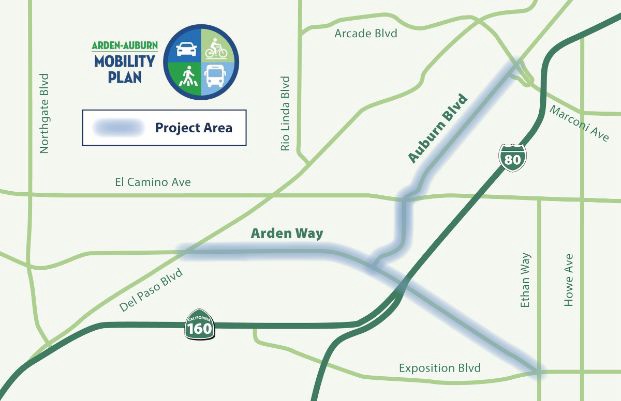
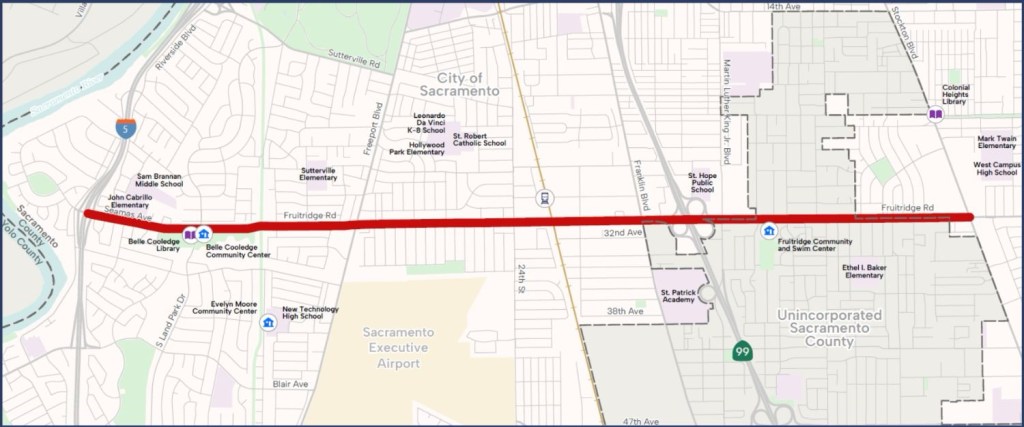
And there are several more in the planning or development stages. The city has a list at Transportation Planning: Current Efforts, There is also a map, Public Works Transportation Projects that shows the number of projects and status. Selecting for ‘planning’ shows Fruitridge Road Safety and Mobility Plan, Truxel Road Bridge Over American River, Norwood Ave Complete Streets Plan, Arden Way and Auburn Boulevard Vision Zero and Mobility Plan, Reconnecting Old North Sacramento, and Howe Ave Transportation Vision Zero Plan, which is mostly planned and about to go to council. You can also select for preliminary engineering, final design, in construction, and construction complete.
This is just within the City of Sacramento. Widening out, there are projects in each of the cities within the county, and Sacramento County itself. Widening our even further, there are projects and transportation policy development in the region, and for the region, under SACOG, and the other five counties within SACOG.
There are more projects and policies than any one person, or even an advocacy organization, can keep up with. Many of these projects depend on funding from the regional, state, or federal government to be implemented, and so many will sit on the shelf. Many of the policies will remain theoretical because there is not the political will to overcome the inertia of government and dedication of staff to doing things the way they have always been done. But sometimes writing about a project or policy does lead to positive change.
For me, I will focus on only a few of these, and quite possibly never write again on most of them. My current focus is Vision Zero Action Plan Update, H Street Bikeway, and Stockton Boulevard Safety and Transit Enhancement Project (STEP).
So why do I bring this up? I’d like to plant the seed of interest. If one of these projects, or one of the many others, piques your interest because it is in your neighborhood, or along your route of travel, or aligns with something you are passionate about, I’m inviting you to research and write about it, here. Getting Around Sacramento is the only regular local source of information about what is going on with transportation. I don’t wish to claim to much, but it is essentially Streetsblog Sacramento. If writing for this blog appeals to you, please get in touch – allisondan52@icloud.com. We can of course talk directly, but you will need to ask for my phone number, or arrange coffee/tea. What one project appeals to you? What, in general, do you want to say about it? You need not be familiar with WordPress, which is the host for this blog, as you could write directly or I can post your writing.
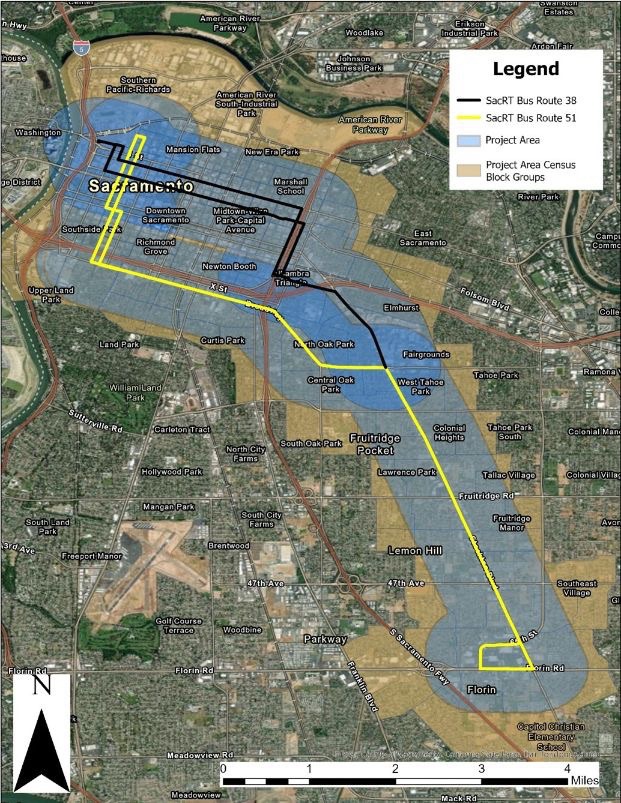
And yet another City of Sacramento planning effort, the Stockton Boulevard Safety and Transit Enhancement Project. This is a Vision Zero project. Two segments are on the Vision Zero High Injury Network Top 5, Broadway and Stockton (Broadway between Martin Luther King Blvd and Stockton Blvd, and Stockton Blvd between Broadway and 13th Street), and Stockton Blvd South (Stockton between 65th Street and 37th Avenue). However, the project includes the entire route of SacRT 51, from downtown, along 8th and 9th Streets, Broadway, and Stockton as far as Florin Road. It is also a transit project, to enhance bus service along the Stockton part of Route 51, in particular.
Stockton has long been a focus for the city, and county, with many plans developed but none implemented. The current effort is a revision of those efforts to emphasize a potential Bus Rapid Transit (BRT) service along Stockton Blvd, and perhaps some enhancements to the other sections.
A community workshop was held this week at the Southgate Library, with city staff, consultants, and county staff present. Some issues that came up during the workshop include:
ridership on bus 51 drops off sharply south of Fruitridge Road, so investment should be focused on the section of Stockton between Broadway and Fruitridge; the nature of the neighborhoods north and south of Fruitridge are quite different, with south being significantly more car-dominated, and so less likely to generate ridership
sloped driveway ramps, common along Stockton, must be repaired so that they are compliant with PROWAG; provision of sidewalk buffers which contain the sloped driveways are the optimal solution
earlier outreach for Stockton, and every project the city has planned, surfaced a strong community desire for more street trees; healthy street trees need wide sidewalk buffers (the city calls them planting strips) of 8 feet; tiny sidewalk buffers lead to unhealthy trees and root heaves of the sidewalks
additional housing going in right now on Stockton, particularly around 8th to 10th Avenues, will generate a lot of walking, and the sidewalks there need to be improved and widened, not in the future, but now
several of the design concepts show a center turn lane throughout the project; in most sections, these are a waste of valuable roadway right-of-way; instead, left turn pockets should be provided where clearly needed
businesses have concerns about unhoused people using bus shelters and shelter, and crossing Stockton at random places
though rail is not being proposed for Stockton, the BRT design should not preclude rail being added at a later time as adjacent density and high ridership develop to justify an investment in rail
The project is also considering changing SacRT Route 51 so that it runs on Stockton from Broadway to Alhambra, and thence on surface streets to downtown. This section of Stockton has a narrower right-of-way, but it also hosts UC Davis Medical Center which could be a major generator of ridership for the bus. The existing Broadway Complete Streets project, and the additional segments from 24th Street to Stockton, have designs with a single general purpose lane in each direction and a center turn lane, which is not a good setting for BRT. The map below shows this option. If SacRT Route 51 was re-routed, there would need to be additional bus service along Broadway, since it is a high transit use corridor.
City and county staff, and consultants, seem to be supportive of a transformed Stockton Blvd, which will effectively serve transit riders, bicyclists, and walkers (and rollers). But there is likely to be pushback from the car-centric people who drive through on their way somewhere else, and who feel that time saving is more important than safety. It will take concerted effort to ensure a strong project.
Yet another City of Sacramento planning project, Reconnecting Old North Sacramento. This one is in early stages, no outreach or survey yet, but there is an email signup.
This is not a Vision Zero project, rather a project to addressed past neglect of this community.
A community workshop will be held March 11, details on the webpage, including an optional Eventbrite registration. There will also be a survey and pop-up workshops. You can also sign up for email updates.
These two roadway segments are on the city’s Vision Zero High Injury Network, so attention is appropriate.
A community workshop will be held March 4. See the webpage for details. There is an Eventbrite registration link, though you do not need to register to attend.
You can also sign up for email updates.
Fruitridge is on the city’s Vision Zero High Injury Network, so attention is appropriate.
The City of Sacramento’s Vision Zero Action Plan Update process has produced a Draft Actions chart. Item 9 in the high priority list is:
“Update City Traffic Signal Operations Manual (TSOM) to reflect complete streets and designs reflective of reducing exposure, likelihood, and severity. Include application of Leading Pedestrian Intervals, No Right Turn on Red, Protected Left-Turn Phasing, Rest on Red, and other similar strategies.”
Sounds great. The problem is, the TSOM apparently does not exist. I did a PRA (Public Records Act) request with the city for the existing document. The city first referred me to the Traffic Signal Operations and Standards webpage. That page contains links to short documents that might or might not be part of the manual, but the manual does not exist on that page.
So I submitted another PRA, stating that the document I wanted is not on that page, and again requested it. The city’s response was that the document does not exist.
I suspect the document does exist, but the city is unwilling to admit it. But it is also possible that the city has been managing signals based on whim, not on documented policy and guidelines. A lot of the signal work the city does, including new signals, tends to support the second explanation.
It might be challenging to update something that doesn’t exist (snark).
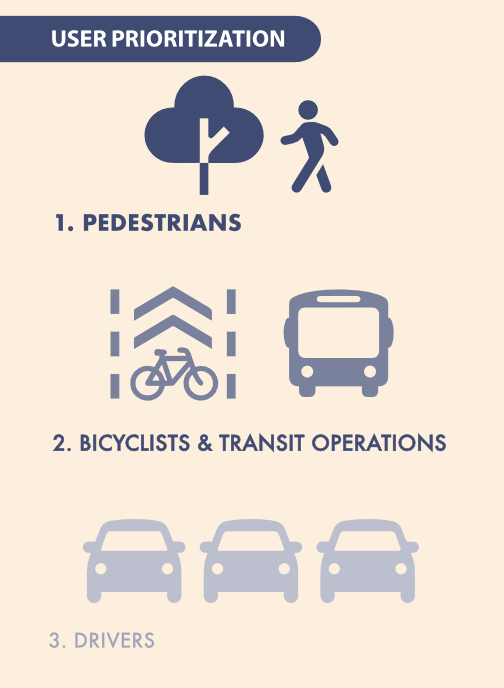
Below is a graphic from the City of Sacramento 2040 General Plan (Chapter 8 Mobility Element, page 8-9). As a transportation advocate, I obviously have a bias, but I think this is the most important graphic, and the most important message in the entire general plan.
User Prioritization from City of Sacramento 2040 General Plan
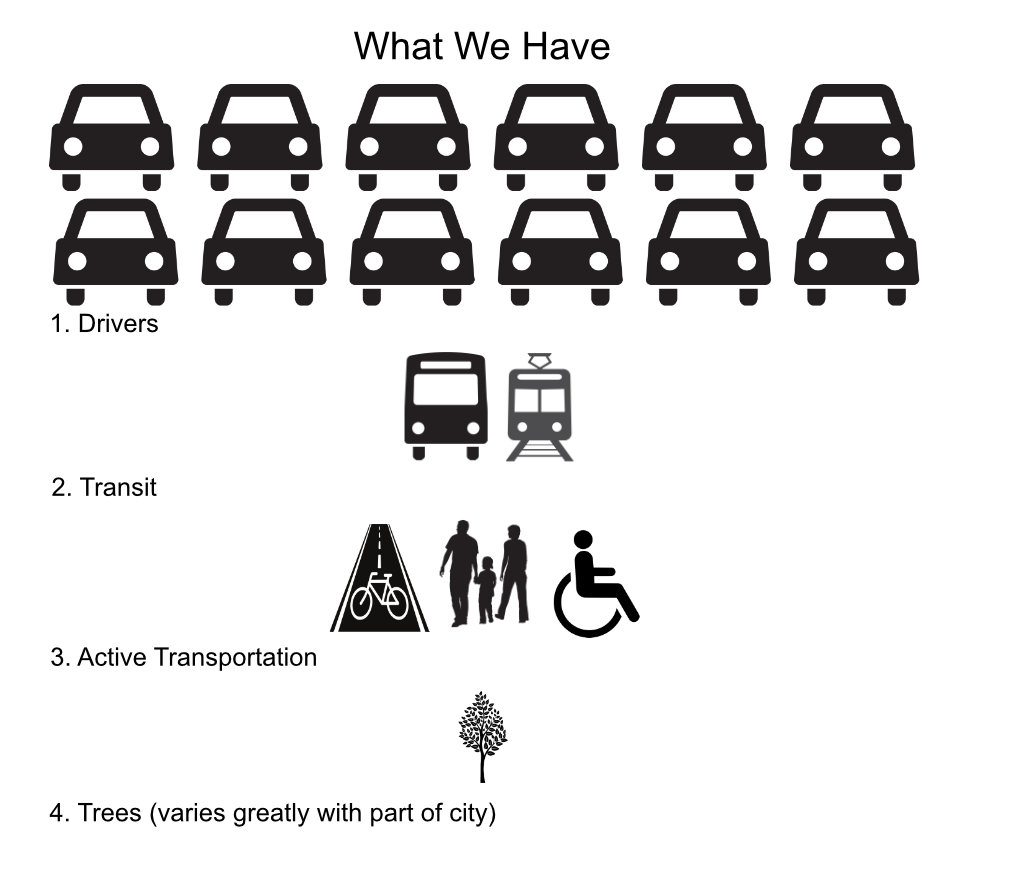
This is in complete contrast to the transportation system we have built. Below is the transportation system we have. One could argue endlessly about how this varies with parts of the city, and whether active transportation should be lumped together, but the graphic communicates the problem.
I follow the city’s transportation projects, some in great detail, others only superficially. There are far too many for one person to cover, or even a group of people.
What I see in these projects is a very gradual shift from what we have to what we want. We might reduce general purpose (car) lanes, in number or width, but not always. We might add bicycle facilities. We might, occasionally, improve sidewalks for people walking and rolling (but not if we can get away with making property owners do it). We might make it easier for transit. Though the central city, and some neighborhoods outside the central city, have a reasonable tree canopy, north and south Sacramento are largely lacking a tree canopy, and every transportation project neglects solving this issue. We don’t plan in trees from the beginning, saying we’ll get to them later in the process, but at the end, they are usually missing.
We have invested hundreds of millions of dollars in making things better for drivers and motor vehicles, and very, very little on anything else. It is time to almost completely reverse that, so spend nothing on drivers and motor vehicles, and almost everything on transit, active transportation, and trees.
Cross-sections
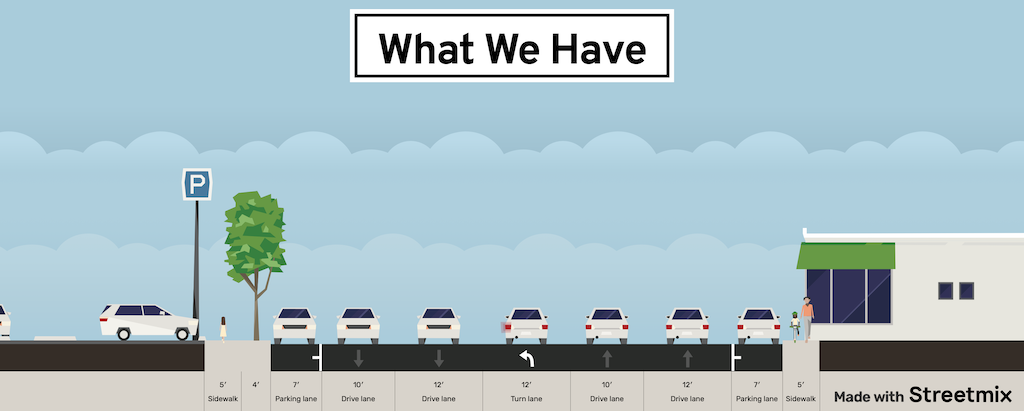
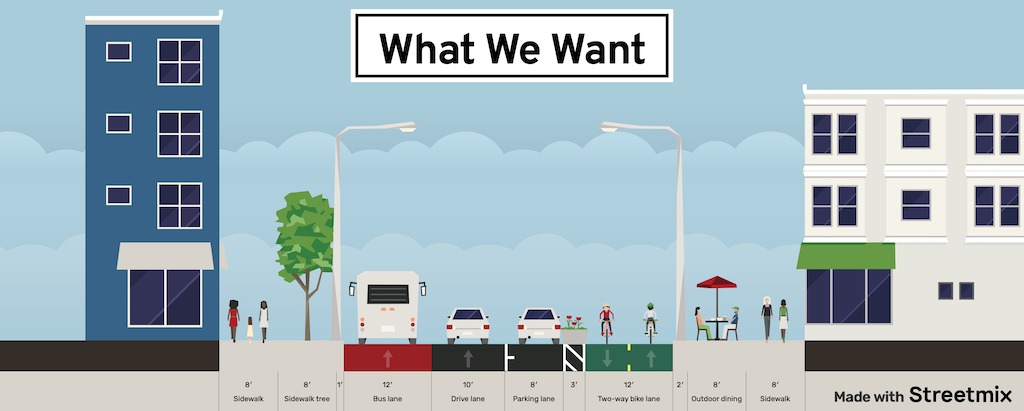
Another way of exhibiting this is street cross-sections. These are from StreetMix (https://streetmix.net/), for an 80 foot right-of-way. Neither is meant to represent an actual street, but rather illustrative of the way in which we can allocate street space to different uses.
In the ‘what we have’ cross-section, motor vehicles are dominant. Sidewalks are narrow, trees are present but in few numbers, and probably not healthy because they have been squeezed into small spaces, bicycle facilities are not present or are of low quality, ample space is allocated to cars in general purpose lanes, and left turn lanes and right turn lanes. Ample parking is provided, whether needed or not. I have intentionally picked low density and low productivity uses to line this roadway, parking lots and single story buildings, though most often there is a parking lot before you even get to the building. StreetMix only offers a few options for each element, and what is shown is what is available.
In the ‘what we want’ cross-section, private motor vehicles are strictly limited. There is parking, but not ample parking. Transit, where is makes sense to have it, operates in its own right of way. Since the general purpose lane is one-way, a two-way bikeway (cycle track) is provided so that bicyclists have more freedom of movement than drivers. Sidewalks are ample, 8 foot on average. Sidewalk buffers are ample, 8 feet on average, so that trees have space to grow and thrive. The buffers are not just for trees, though, they can host dining and bike racks and street furniture. Reflecting the people-centered nature of this street, there are higher density uses of housing and business, and the buildings come to the sidewalk rather than being set back. The city is not proposing ‘what we want’ anywhere.
This street is far, far safer than multi-lane streets. By reducing the amount of space devoted to motor vehicle through traffic, space is freed up for people, people walking, people bicycling, people eating and socializing, and people just hanging out. It is quiet. It is friendly. It not only feels safe, but feels welcoming. This reflects my axiom that we should design streets from the outside in, not from the inside out (street design from the outside in). Outside in preferences walkers and trees, inside out preferences drivers and motor vehicles.
Update: Edited to add more accurate segments and cross-sections, make additional comments on design, make clear that the 6th-7th cross-section should be similar to the 5th-6th cross-section, with light rail tracks in their own right-of-way rather than the southern one (Line 1) being in a shared or mixed use lane with private motor vehicles.
Note: I realized last night in thinking about H Street that I had accepted too much of the city’s compromise to prioritize motor vehicle traffic and preserve parking. This section of H Street could be a model for how to do streets right, but the 30% design presented is not that. I’ve changed some recommendations and reorganized the post content.
Key points:
Mixed use transit lanes prioritize motor vehicle traffic over transit safety and efficiency. The mixed use lane between 6th Street and 7th Street must be changed to a dedicated transit lane.
The two-way bikeway must be a minimum of 10 feet in width (5 feet each direction) in order to provide safety, usability, and maintainability. This will require changing parking and/or general purpose lanes widths.
Two-way bikeways must have bicycle signals at every intersection. This design does not.
Where there are two general purpose travel lanes in same direction, as between 9th Street and 10th Street, only one lane needs to be 11 feet, while the other must not be more than 10 feet. This is generous, as most modern recommendations are between 9 and 10 feet. The safety advantages of narrower lanes are well documented.
Maintenance of on-street parking is clearly a priority in this design. While on-street parking can slow traffic, and is appropriate in retail and residential areas, here it is for the convenience of workers who could park in the ample parking garages and lots along and near H Street. Where roadway width is needed for safe and high quality bikeways, on-street parking can and should be removed.
The H Street Bikeway to Sacramento Valley Station project is presenting at the SacATC meeting this week, Thursday, February 19, starting at 5:30 PM. A community workshop will be held Thursday, February 26, starting at 5:30 PM at city hall, room 1119. This project is part of a large grant-funded project (TIRCP – Transit and Intercity Rail Capital Program) to improve Sacramento Valley Station. H Street is the main access route from the station for bicyclists. There are no safe routes to the station, at this time.
The project will create a two-way separated bikeway (also called a cycle-track) on H Street between 5th Street (the station) and 10th Street and 9th Street with existing bicycle facilities.
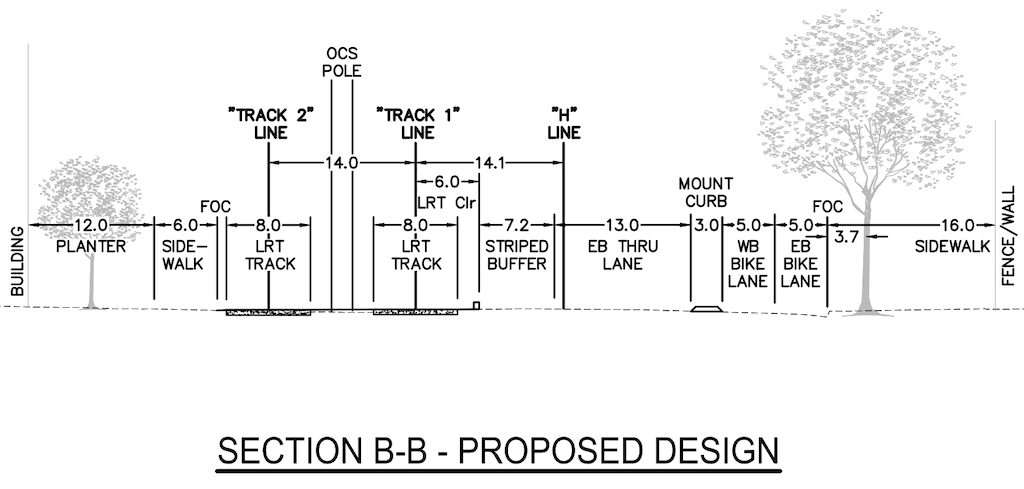
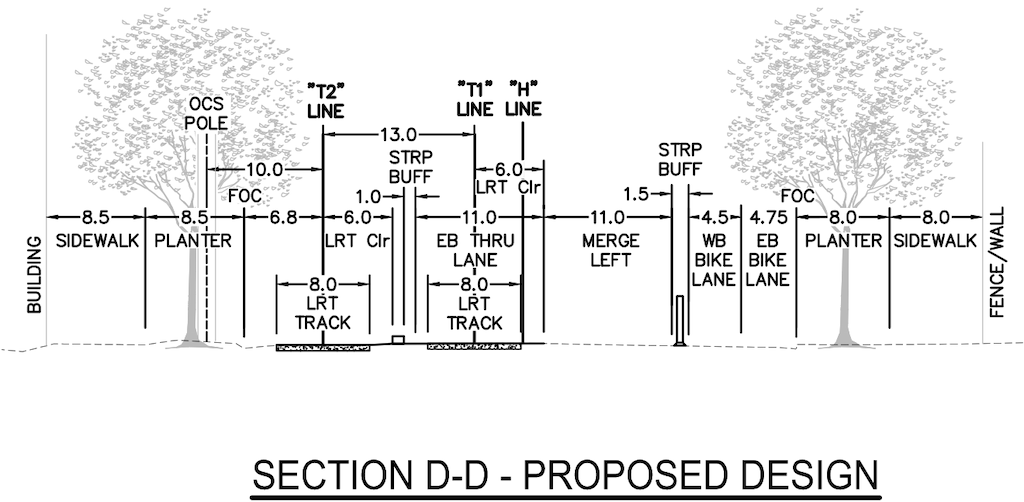
For the segment images, I have used the SacATC presentation. For the segment cross-sections, I have used the diagrams from the SacATC staff report, as they include measurements, which are critical for determining the safety and usability of the bikeway. StreetMix diagrams usually include measurements, but the ones in the presentation do not.
Transit priority
The TIRCP grant of which this project is a small part, is intended to support transit use to and from Sacramento Valley Station, to ensure that the station is the effective transit and rail hub that the city, region, and state want.
I support the double-tracking of light rail in the segment between 5th Street and 7th Street. Single-track light rail segments create pinch points where one train may need to wait for another, slowing the entire light rail system. The diagrams also seem to indicate a crossover between 5th Street and 6th Street, which is valuable for routing trains when there are blockages.
Segments
Bicycle facilities within Sacramento Valley Station, west of 5th Street, are not part of this project. I have not seen any recent information on how bicyclist circulation will be handled within the station area.
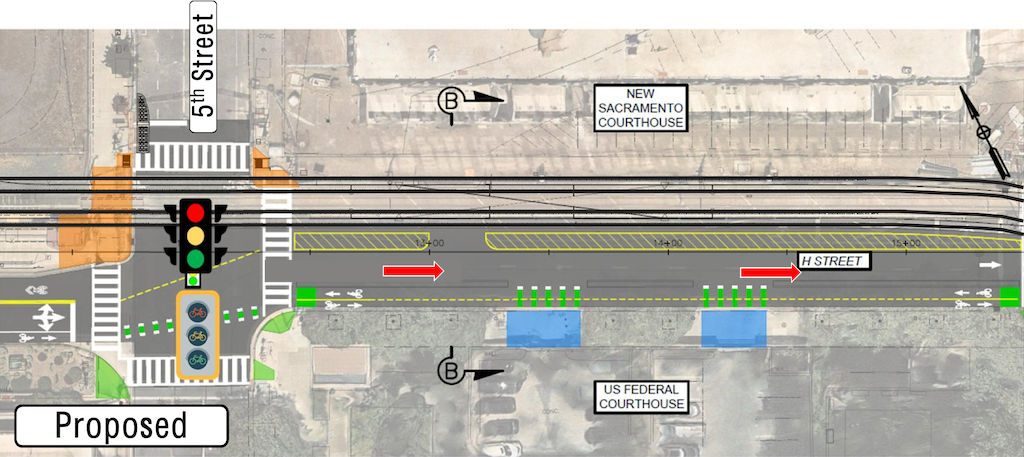
5th Street to 6th Street
This segment is reasonably well designed but could be improved. Double-tracking of light rail removes a bottleneck for the Gold Line/Green Line.
H St Bikeway between 5th St and 6th St, proposed (from SacATC presentation)
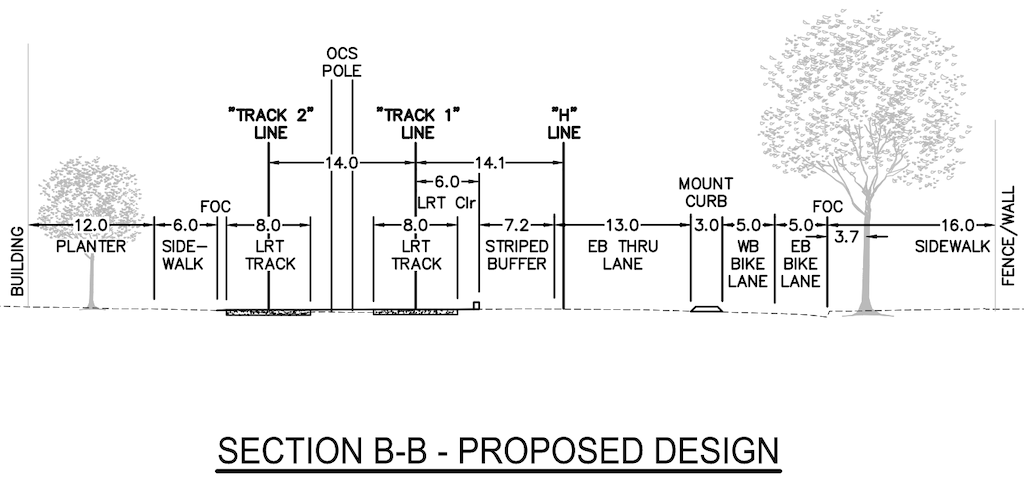
The buffer between light rail and general purpose lane (7.2 feet), and the overly wide general purpose lane (13 feet), totaling 20.2 feet, waste roadway width that could be devoted to the two-way bikeway. A better allocation would be, from right to left, 12 foot bikeway, 3 foot mountable curb, 3 foot buffer, 11.2 feet general purpose lane, and 4 foot buffer.
H St Bikeway from 5th St to 6th St, proposed cross-section, 92.5 feet ROW?, 52.5 feet FOC (from SacATC staff report)
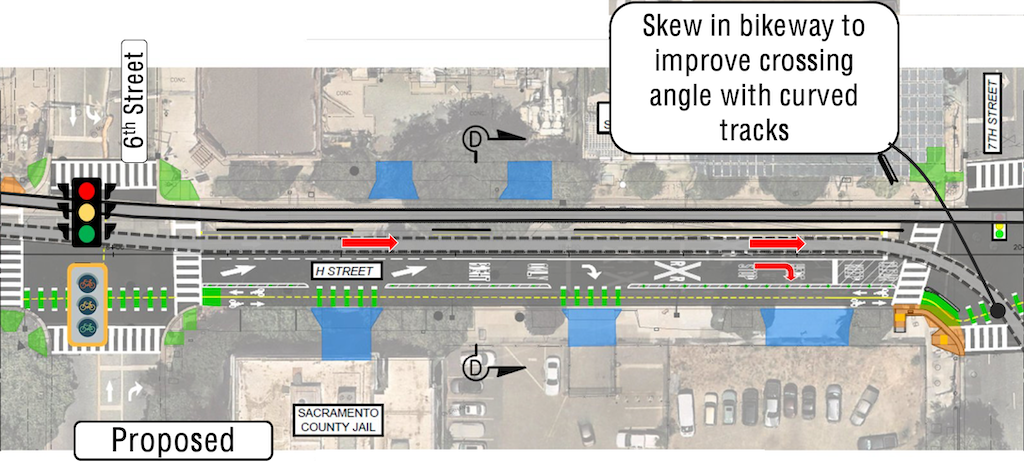
6th Street to 7th Street
The segment shows a light rail track sharing with motor vehicle traffic. This is inappropriate, and removes the advantage of double-tracking, since trains can be stuck in congested motor vehicle traffic. The southern or right hand lane should be a combined through and right turn lane, and the northern or left hand lane should be eliminated. The design constrains the bikeway to 4.5/4.75 feet, rather than the minimum of 10 feet. Diagrams below.
H St Bikeway from 6th St to 7th St, proposed (from SacATC presentation)H St Bikeway between 6th St and 7th St, proposed cross-section, 80.5 feet ROW?, 47.5 feet FOC (from SacATC staff report)
The 6th Street to 7th Street cross-section should be designed similarly to the 5th Street to 6th Street cross-section, shown below, with the suggested modifications to roadway allocation, as above in 5th Street to 6th Street segment.
H St Bikeway between 5th St and 6th St, proposed cross-section(from SacATC staff report)
7th Street to 8th Street
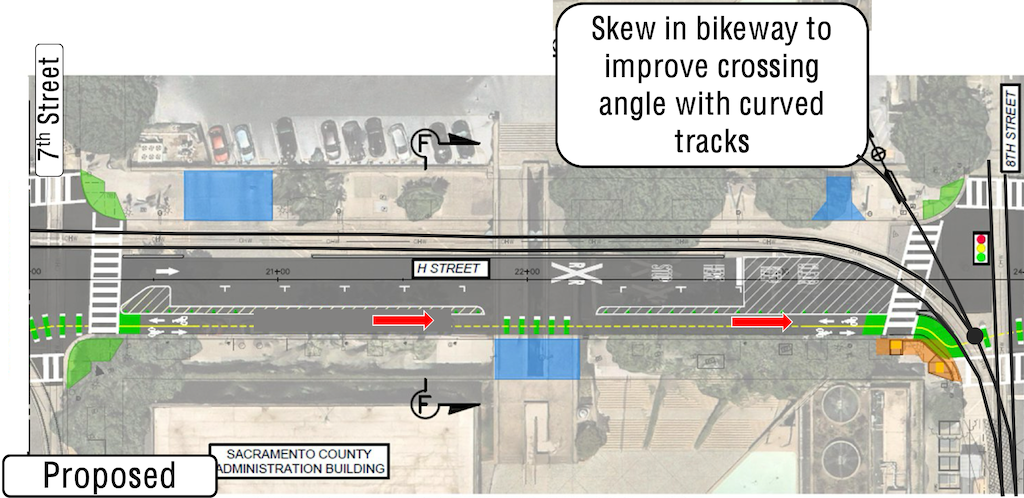
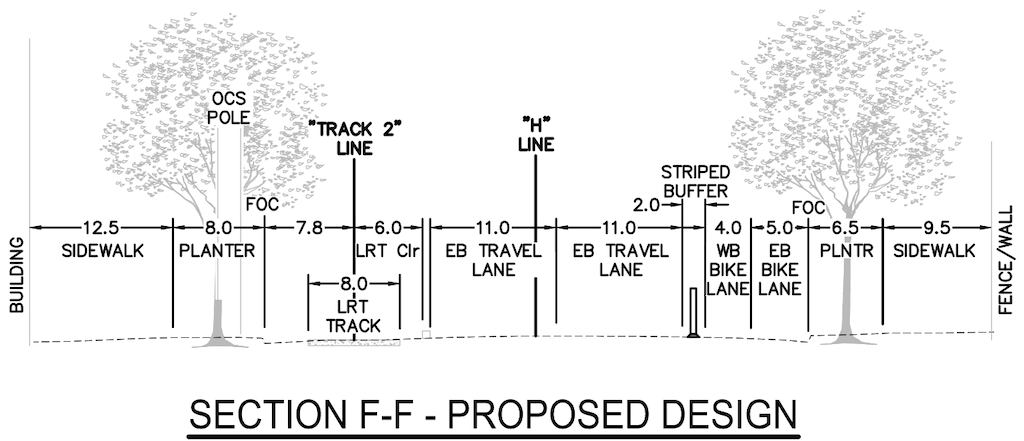
The preservation of parking in this segment is ridiculous. There is a parking garage of large capacity directly north across the street, so there is no reason for on-street parking here. The city’s desire to maintain parking in this section is in fact the reason why the existing Class III (sharrows only) bike facilitiy on H Street is dangerous and unpleasant. Again, retention of parking constrains the bikeway to 4.0/5.0 feet rather than the minimum 10 feet. Diagrams below.
H St Bikeway from 7th to 8th, proposed (from SacATC presentation)H St Bikeway from 7th St to 8th St, proposed cross-section, 83.3 feet ROW?, 48.6 feet FOC (from SacATC staff report)
8th Street to 9th Street
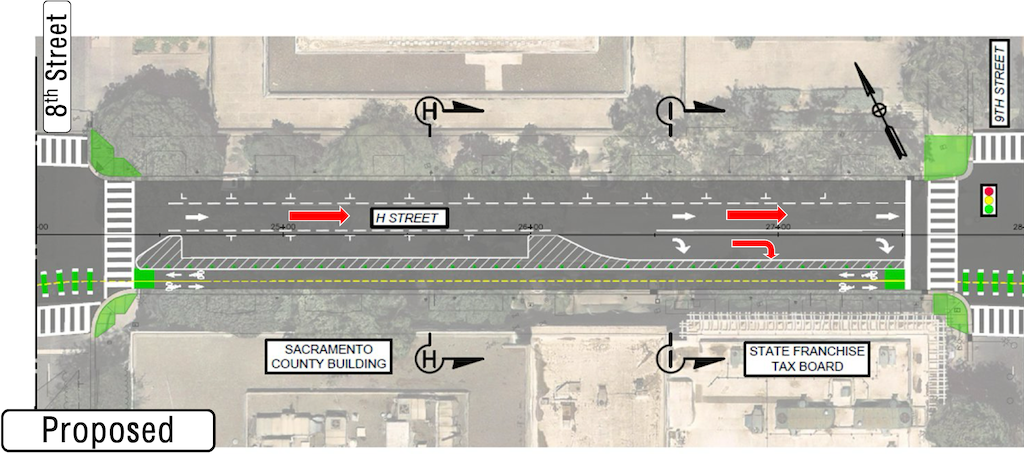
The segment design is reasonable.
H St Bikeway, 8th St to 9th St, proposed (from SacATC presentation)
However, since there are no driveways in this block, the separation between motor vehicles and bikeway should be a hard concrete curb, not a stripped buffer. The 10 foot bikeway is the minimum width, however, narrowing the parking lanes to 8 feet would provide space for a desired 12 foot bikeway.
H St Bikeway from 8th St to 9th St, proposed cross-section, 79.6 feet ROW?, 47.6 feet FOC (from SacATC staff report)
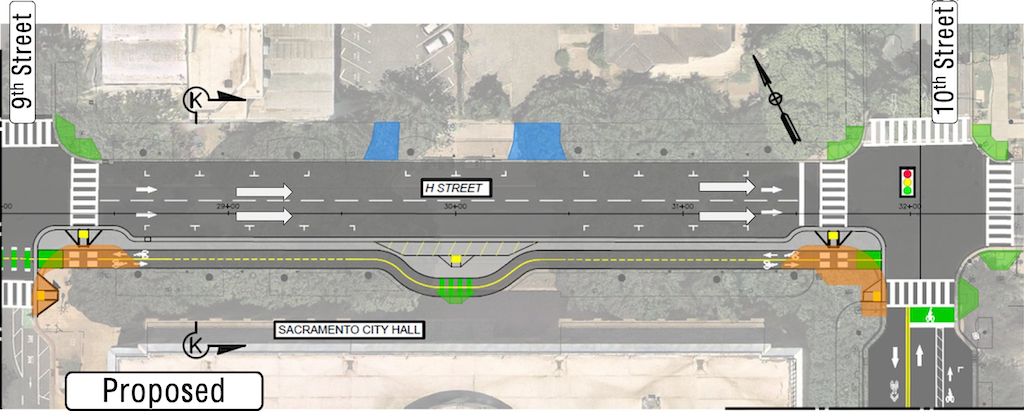
9th Street to 10th Street
I like the design of the segment, a sidewalk level completely separated bikeway.
H St Bikeway from 9th St to 10th St, proposed (from SacATC presentation)
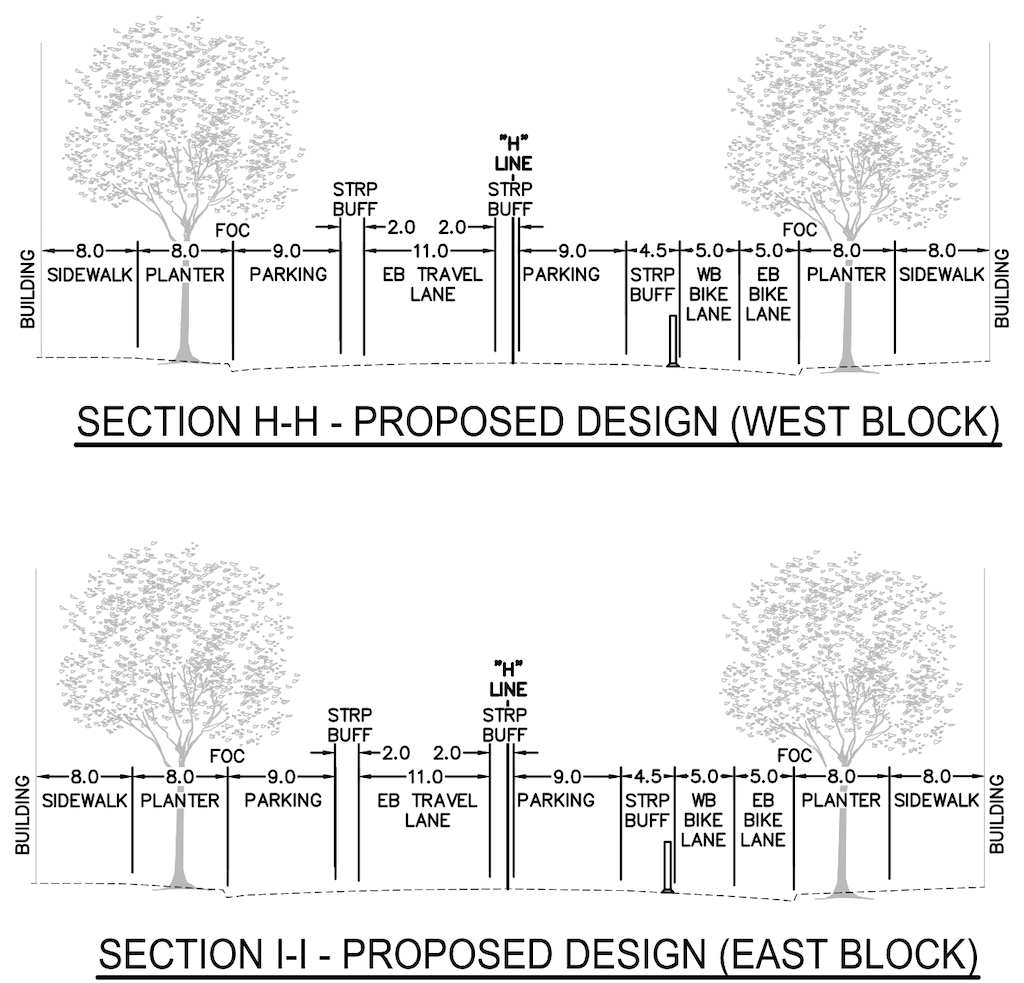
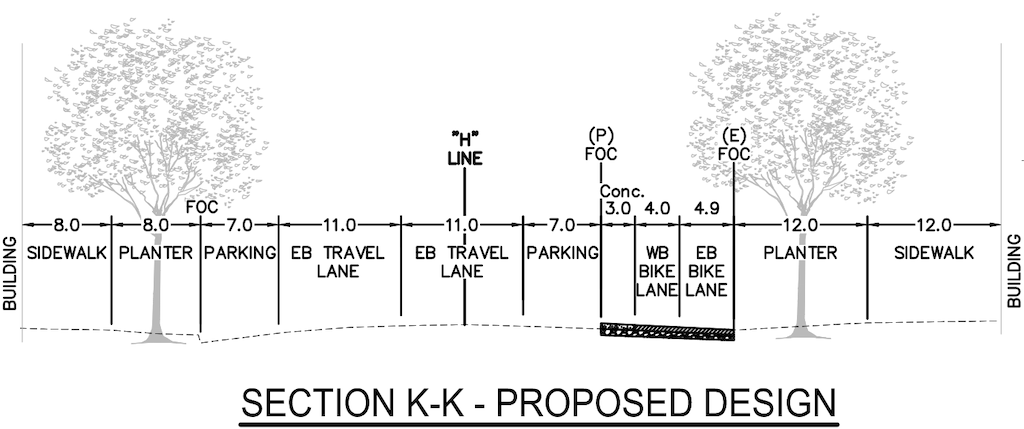
The width of the bikeway is 4.0/4.9 feet (8.9 feet) rather than the minimum of 10 feet. It is not clear how to reallocate roadway width to accomplish this, but it must be done.
H St Bikeway from 9th St to 10th St, proposed cross-section, 87.7 feet ROW?, 47.7 feet FOC (from SacATC staff report)
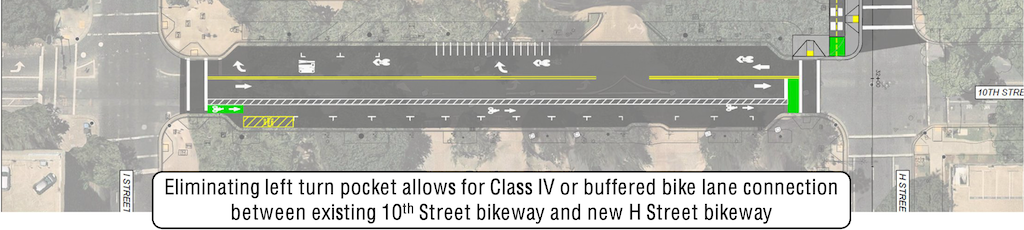
10th Street from I Street to H Street
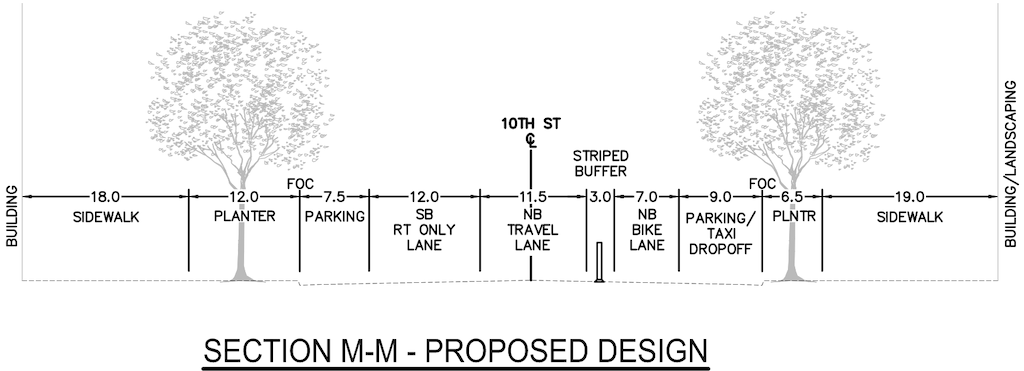
This segment design is reasonable, given the curb extensions (bulb-outs) present at the bounding intersections. This project probably does not have the funding to reconstruct the street to create a separated bikeway, though this should be done in the long term. A separated bikeway would complete a buffered or separated bikeway on 10th Street all the way from Broadway to H Street. Despite the call-out on the image below, this is just a buffered bike lane, not a Class IV (separated) bikeway. Parking is not needed on both sides, as ample parking is available on nearby streets and in the city parking garage on the southeast corner of I Street and 10th Street.
H St Bikeway, 10th St from I St to H St, proposed (from SacATC presentation)H St Bikeway, 10th St from I St to H St, proposed cross-section, 105.5 foot ROW?, 50 foot FOC (from SacATC staff report)
Signals
The staff report diagrams use the phrase ‘Traffic Signal (Eastbound/Westbound) to be Modified or Replaced’. I am very concerned with ‘replaced’. The city has a penchant for replacing signals, and controller boxes, that do not need to be replaced, raising the cost of projects or wasting money that could be better spent on other parts of the project.
The presentation diagrams show bicycle signal faces at 5th Street and 6th Street, but not 7th Street, 8th Street or 9th Street. Bicycle signals are necessary at every intersection for the safe operation of two-way separated bikeways. It is possible they were neglected on the diagrams, but they cannot be neglected in the project.
Signal timing should be set to a ‘green wave’ of about 13 mph, to allow bicyclists continuous movement through the five blocks. If signal timing remains the same, bicyclists will encounter red light at every intersection, making the bikeway much less useful.
Every pedestrian signal in this section should include a leading pedestrian interval (LPI). Though valuable to enhance transit and bicycling, the design must not disadvantage people walking along or across the corridor.
Speed
The posted speed limit in this section is 25 mph, but observed speeds are higher. This section seems to serve, since the conversion of 5th Street to two-way traffic, as a cut-through from 5th Street to 16th Street, and the design of the intersection of H Street at 16th Street, three dedicated left turn lanes, supports this use. The speed should be reduced to 20 mph, in part to reduce the differential between motor vehicles and bicyclists. Though the bikeway separates these two uses, bicyclists will need to use the general purpose lanes at some points to enter and exit the bikeway, reaching other destinations in addition to the end points. If the posted speed remains 25 mph, and the actual speeds higher, drivers will be encouraged to speed in order to hit green lights. In the central city, many signals are set to 28 mph, encouraging drivers to speed.
Bikeway design
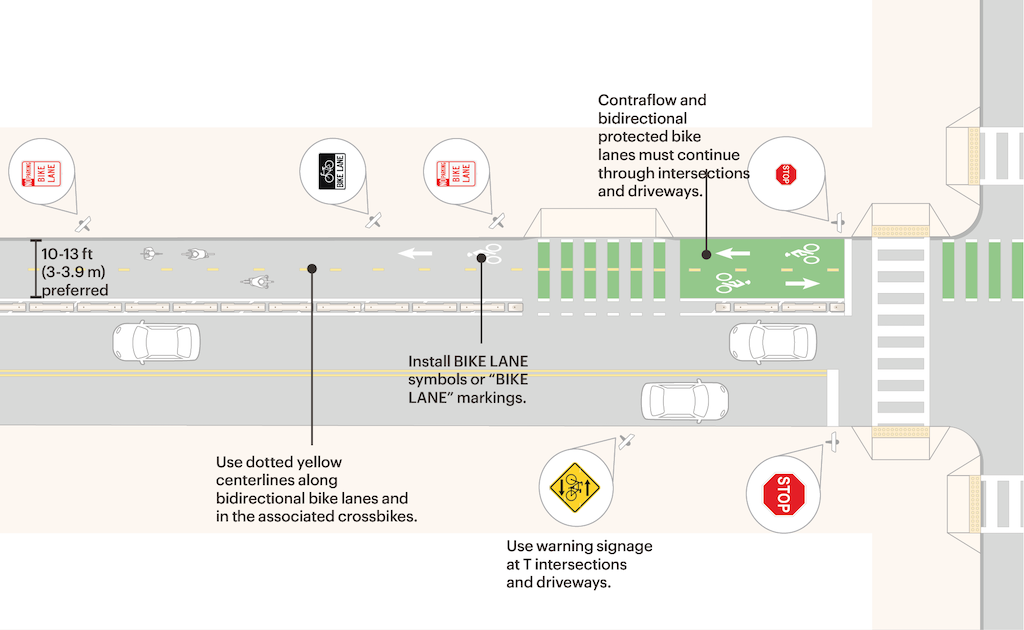
The width of the two-way bikeway in this five block section varies from 8.9 feet (4.0 + 4.9) to 10 feet (5 + 5). The smaller width is not enough to provide safe passage for two larger bikes, such as three-wheel bikes, cargo bikes, and bikes with trailers going in opposite or the same direction. The minimum width throughout must be 10 feet. NACTO’s Urban Bikeway Design Guide says: Two-way bike lanes should be at least 13 ft (3.9m) wide to accommodate all types of bicycles, side-by-side riding, platooning, and passing. A consistent width also allows for bikeway sweeping by devices which cover the full width of the bikeway. The City of Sacramento is deficient is maintaining its existing separated bikeways free of leaves and trash, so future bikeways must be designed for ease of maintenance.
Bikeways should be designed for maximum protection against errant motor vehicles. In blocks without driveways, a concrete curb should be installed, with small gaps for bicyclists to enter and exit. The segment between 8th Street and 9th Street is one such segment. The design with a buffer from parked cars is only effective when parked cars are present. A dedicated motor vehicle right turn lane is adjacent to the bikeway with only a very narrow buffer. The segment from 9th Street to 10th Street seems to have this protection by design. Mountable curbs, as shown for 5th Street to 6th Street may also be appropriate for parts of the 6th Street to 7th Street and 7th Street to 8th Street segments.
NACTO Urban Bikeway Design Guide
The page on ‘Designing Protected Bike Lanes‘ provide guidance on three situations, including two-way (bi-directional) bikeways. The diagram below is from that page. The page includes guidance on dimensions, marking, signs, and intersections.
Other posts on the City of Sacramento Vision Zero Action Plan update are available at category: Vision Zero.
The 2018 Vision Zero Action Plan focused entirely on corridors. It did not identify high injury intersections, nor suggest actions at those intersections, unless they were also part of a high injury corridor.
The update does recognize that intersections should be addressed, but at least so far doesn’t focus on them. It should. Element 6 says “Continue developing designs and securing grant funding for the Top 10 priority corridors identified in the 2018 Action Plan, with a focus on roadway designs for reduced speeds and in Areas of Persistent Poverty” which is fairly specific. Element 7 says “Complete 10 projects that separate severe vehicle-vehicle conflicts as well as vehicle-people or vehicle-bike conflicts at intersections” which is rather vague.
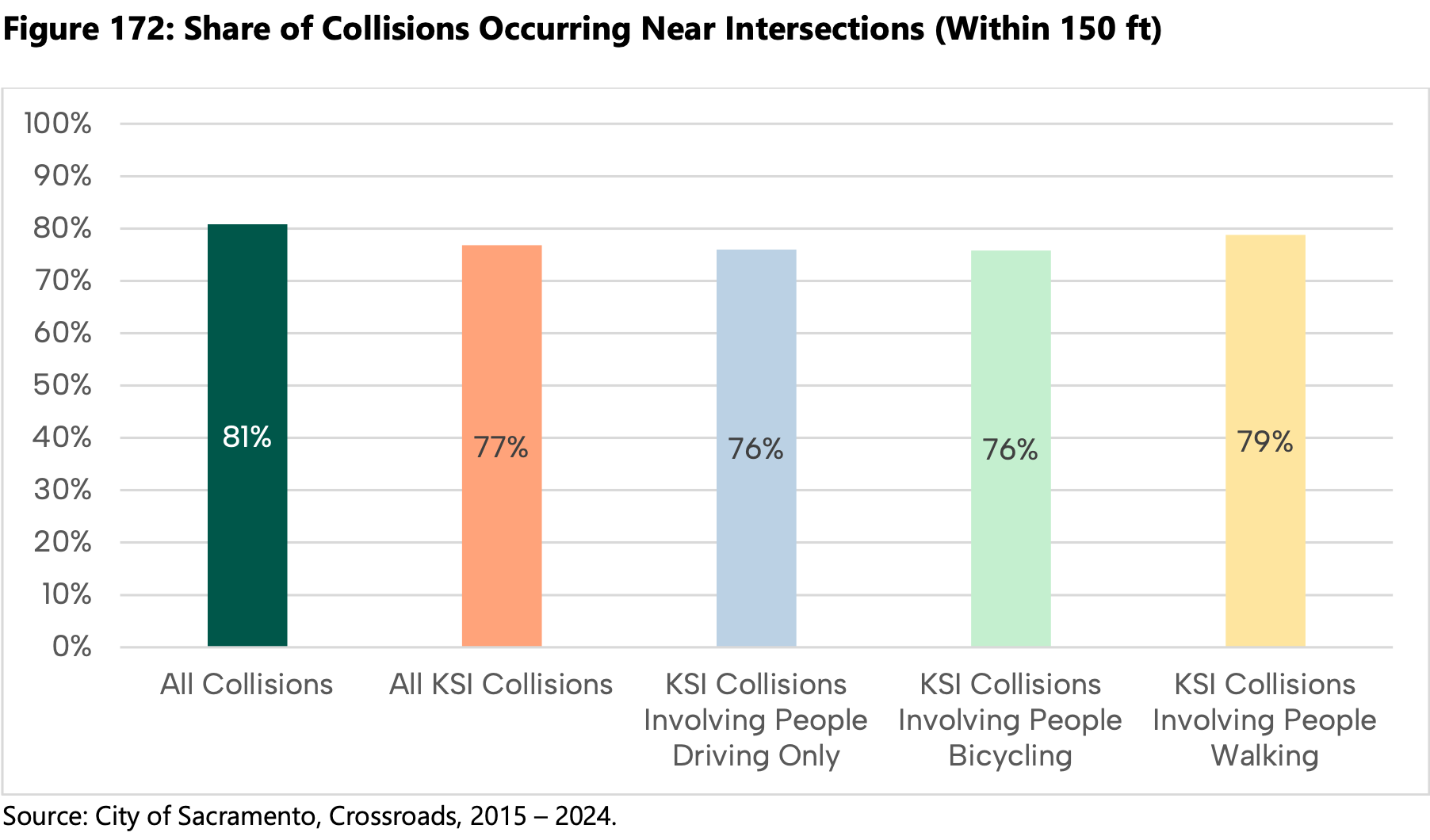
Why are intersections important? Because that is where most of the fatalities occur. Fatality locations are not, and should not, be the only criteria for focus. Serious injuries are also important, and the pattern of these is both more dense and different from fatalities. Actions that prevent fatalities or serious injuries are important.
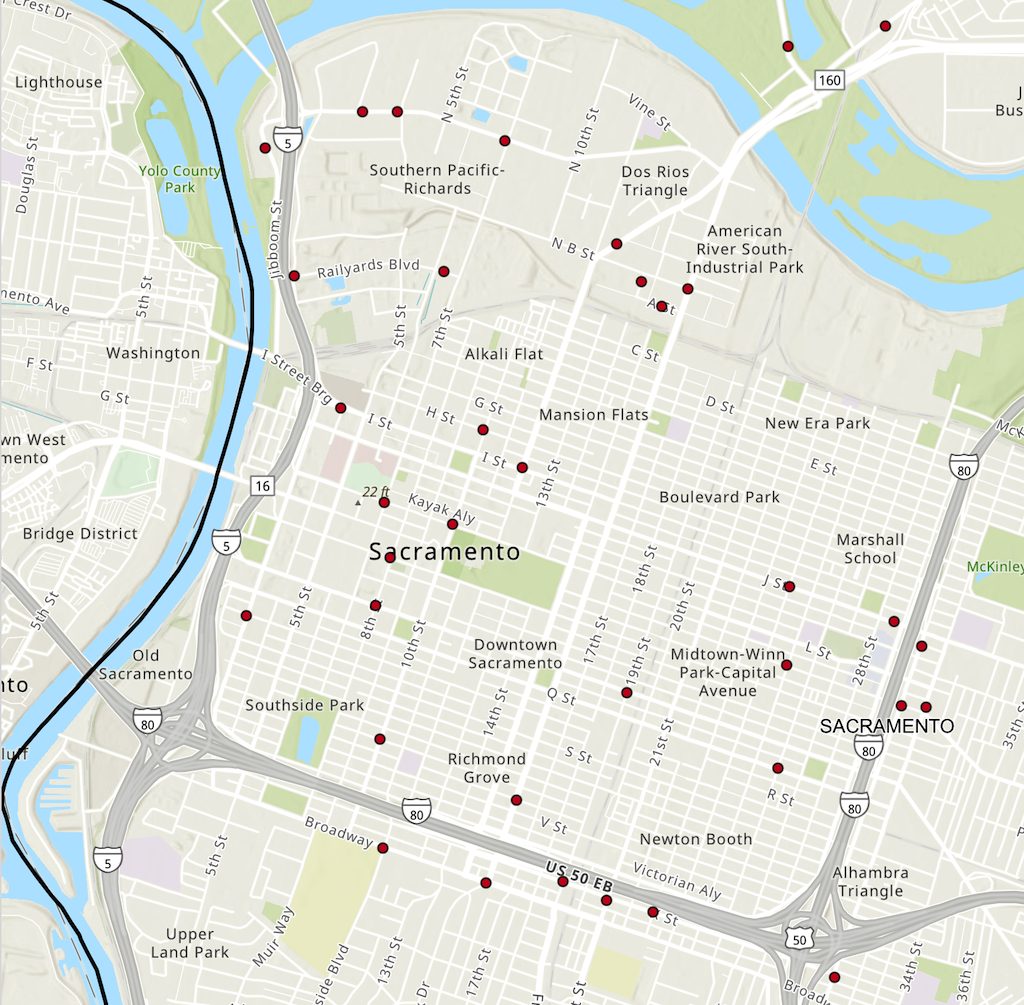
The map below, an except from the Vision Zero Crash Dashboard Interactive Map, shows only fatalities in the central city (American River to Broadway, Sacramento River to Alhambra). Of the 34 fatal crash locations shown, it appears that five are not at intersections, therefore 29 are at intersections.
This is a visual screen based on the map location of the crashes. The map shows primary road and secondary road for every crash, but does not show distance from the intersection. It would take an analysis of ever crash location to determine for certain whether it is at, near, or away from an intersection.
The only pattern that might be considered a corridor is X Street, the roadway just south of Hwy 50, known to be a high-speed traffic sewer.
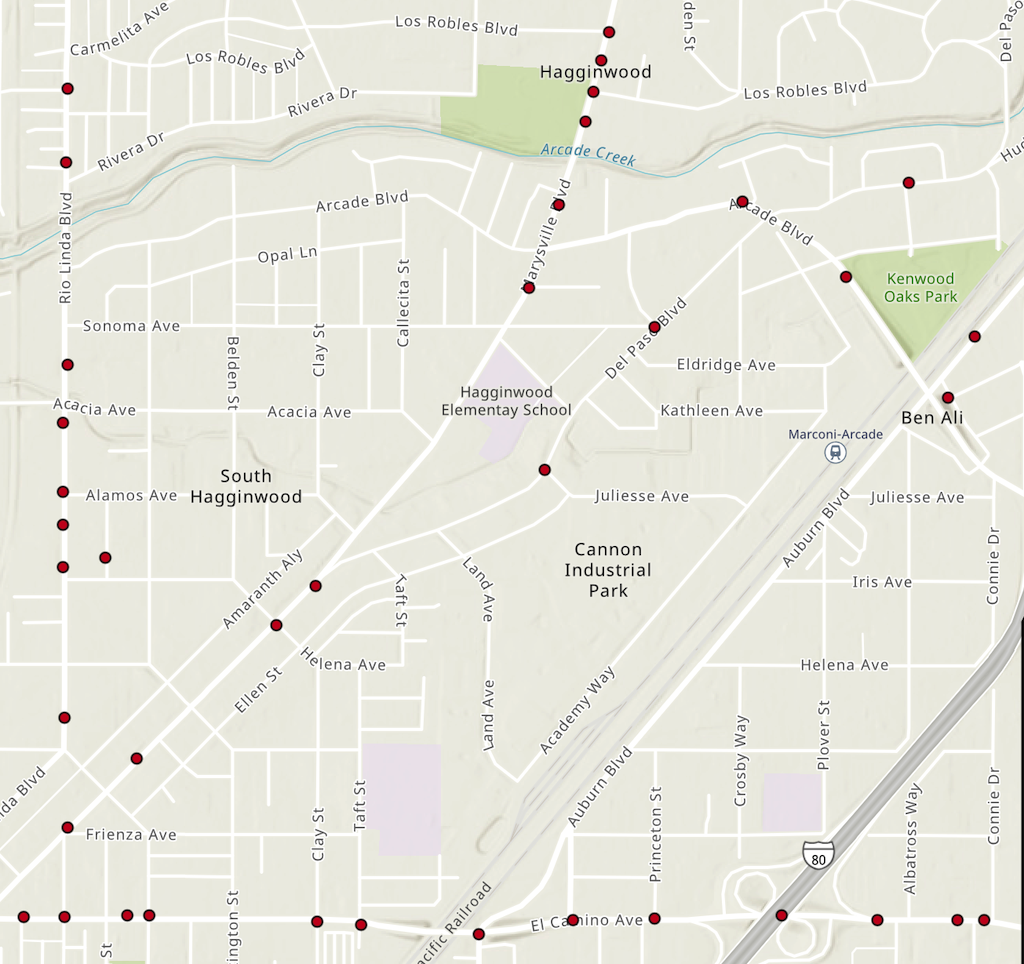
The next maps shows 39 crashes in an area of northeast Sacramento. Of the 39, it appears that 15 are not at intersections, therefore 24 are at or very near intersections.
This is a visual screen based on the map location of the crashes. The map shows primary road and secondary road for every crash, but does not show distance from the intersection. It would take an analysis of ever crash location to determine for certain whether it is at, near, or away from an intersection.
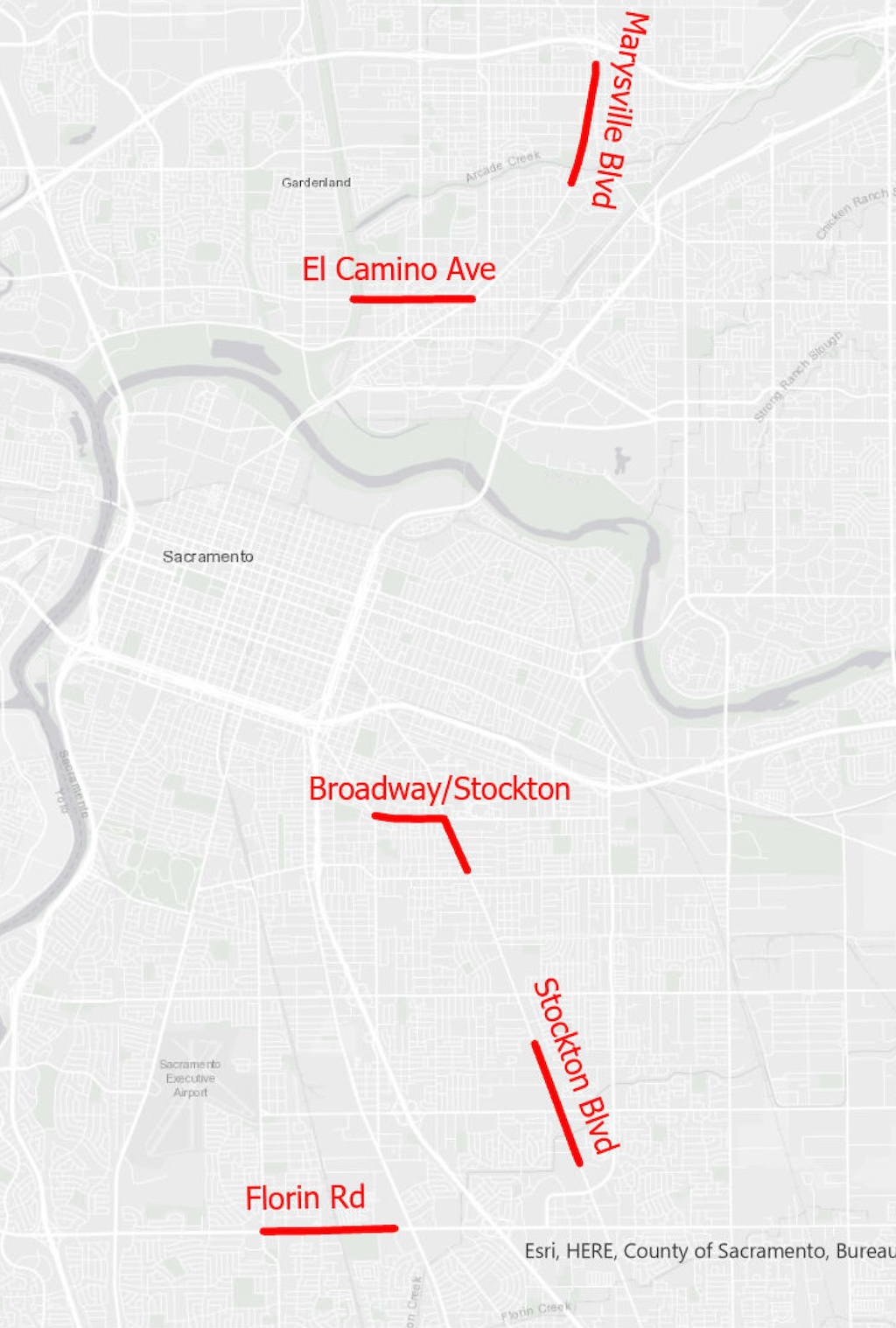
A corridor pattern is more evident on this map. Both El Camino Ave (at the bottom) and Marysville Blvd (middle north) have been identified as high injury corridors.
Other posts on the City of Sacramento Vision Zero Action Plan update are available at category: Vision Zero.
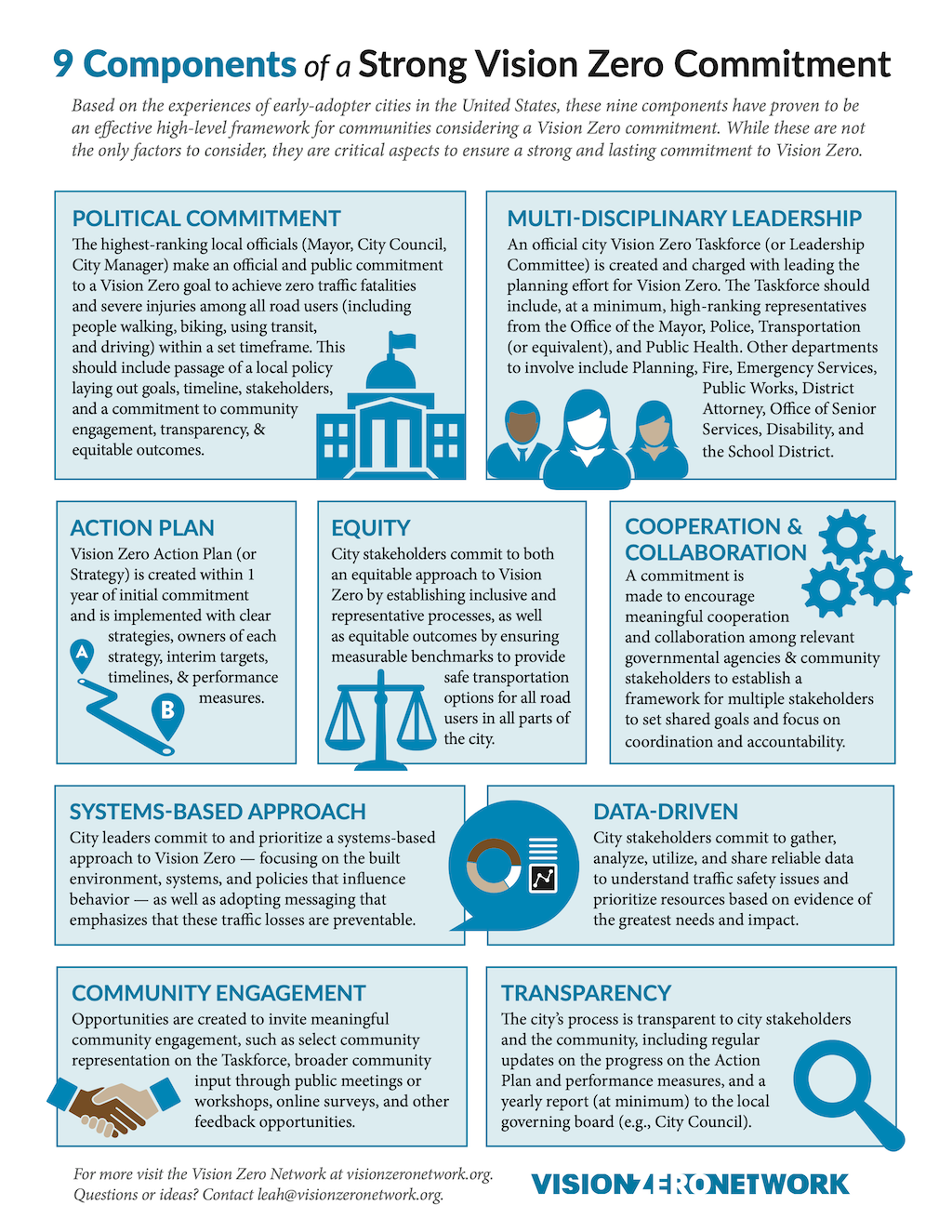
The Vision Zero Network is a national organization which provide leadership and resources for local vision zero efforts.
The organization offers a Resource Library, which has a wealth of documents and references on vision zero. The city’s action plan documents seem to rely on some of these resources, which is a good thing.
One of particular interest to me is a one page chart titled 9 Components of a Strong Vision Zero Commitment, below and pdf. It isn’t just about the action plan, but a strong overall approach.
 Getting Around Sacramento