make streets rough again!

This is a follow-on to my 2016 post back to the old ways? Since that time I have watched several streets in downtown being torn up for utilities. Under the asphalt pavement on several of them are cobblestone and brick streets, covered over by asphalt to provide a smooth and fast ride for car drivers, and a less safe street for everyone. There are also a number of streetcar tracks that have similarly been buried beneath asphalt. Car drivers have won the battle for our streets, so far, but the trend is starting to reverse, even in Sacramento. The City of Sacramento, in its new general plan, has decided that walkers are more important than drivers!

The Strong SacTown street design standards team has identified four roadway typologies, Local Streets, Active Streets, Transit Streets, and Roads. Every redesign of Local Streets should consider installing rougher pavement to slow motor vehicles. Of course if a street is used by bicyclists, the pavement can be only moderately rough, not like the cobblestone pavement on Front Street in Old Sacramento Waterfront. Sidewalk level bike lanes, separated from the roadway and smooth, solve this for some kinds of streets, but local streets usually will not have bicycle facilities because they are low speed and low volume safer streets.

Rough pavement slows drivers, not just where there are traffic calming features such as curb extensions and chicanes, but for the entire block. Rough cobblestones like Front Street limit motor vehicle speeds to 10-15 mph, but a moderately rough street can enforce 20 mph or less, which is the goal for all local streets.

Brick streets do cost more to install than asphalt (the cheapest, in both senses of the word) and concrete streets. But they last much longer, according to The Planning Lady: It Pays to Save Your Brick Streets. “A concrete street will be replaced 3 times and asphalt 6 times over that time period.” Brick laying machines, originally invented in the Netherlands (of course), but now available from many companies, reduce the cost of creating brick streets considerably. I don’t know the range of brick roughness that can be laid by machine, but it should be sufficient for moderately rough streets. The roughness of historical cobblestone like Front Street might not be affordable today, with the material harder to source and labor more expensive, but many cities are using cobblestone for slow streets and gateway treatments.

Photos below of Clay Street in San Francisco cobblestone, Front Street in Sacramento cobblestone, and Liestal Alley in Sacramento brick.

San Francisco, Clay St, cobblestone pavement
Sacramento, Front St, cobblestone pavement
Sacramento, Liestal Alley, brick pavement

Strong SacTown Street Design: Street Typologies Overview

The fourth post by Strong SacTown to improve and promote the City of Sacramento update to its Street Design Standards. Other posts at tag: street design standards.

To help support the design or redesign of stroads into either streets or roads, and to enhance the comfort and safety for all road users, we recommend a new, simplified street typology:

In lieu of Sacramento’s current seven typologies, ours comprises only fourLocal StreetActive StreetTransit Street, and Road.

  1. Local streets are the core of our street network, serving a built environment with multiple uses where most of the home, work, commercial and social needs of people are within walking or short bicycling distance. Motor vehicles are guests, safety is primary, and economic and social vibrancy are promoted. Some local streets may have no private motor vehicles traffic at all, or such use be limited to certain times of day. A majority of roadways in the city should be local streets. Local streets will have a maximum design speed of 20 mph.
  2. Active streets have features that allow bicyclists and mobility device users to travel at somewhat higher speeds over somewhat longer distances. However, the local street function is not compromised. Active streets will have a maximum design speed of 20 mph.
  3. Transit Streets have features that allow effective transit use including higher frequency buses, streetcars and possibly light rail. However, the local street function is not compromised. Transit streets will have a maximum design speed of 20mph for streets with transit priority and 30 mph for exclusively transit.
  4. Roads are designed to allow longer distance travel at somewhat higher speeds, by transit and private motor vehicles. The safety of all users is still paramount. Roads should be a minor component of the transportation network, occurring at intervals of one to two miles. Roads will have a maximum design speed of 30 mph.

Streets for People Interactive Map visual gallery – pedestrian

Streets for People Active Transportation Plan has posted an interactive map on which people may make comments on proposed projects, or add their own points or lines. There are visual galleries for pedestrian infrastructure and bicycle classes, but they overlay the map so can’t be viewed while viewing the map. The visual galleries have been captured and made available here. This post is the pedestrian infrastructure gallery, next will be the bicycle classes gallery.

These elements are not exhaustive. There are several elements in the Streets for People Neighborhood Connections storymap traffic calming tab which can be used on the interactive map as well. And you may add your own.

Note: Photos are not from Sacramento. These galleries and the elements they contain are re-used from projects in other cities.

Visual Glossary of Pedestrian Infrastructure

Note: Also available as a pdf.

Sidewalks

Provide an area for people walking to travel separated from vehicle traffic. Typically constructed out of concrete and separated from the roadway by a curb or gutter and sometimes a landscaped buffer. 

Read More »

Streets for People Interactive Map visual gallery – bikeway classes

Streets for People Active Transportation Plan has posted an interactive map on which people may make comments on proposed projects, or add their own points or lines. There are visual galleries for pedestrian infrastructure and bicycle classes, but they overlay the map so can’t be viewed while viewing the map. The visual galleries have been captured and made available here. This post is the classes of bikeways gallery.

These elements are not exhaustive. There are several elements in the Streets for People Neighborhood Connections storymap traffic calming tab which can be used on the interactive map as well. And you may add your own.

Note: Photos are not from Sacramento. These galleries and the elements they contain are re-used from projects in other cities.

Visual Glossary of Classes of Bikeways

Also available as a pdf.

Shared-Use Paths 

Paths shared by people walking and biking completely separated from motor vehicle traffic. These facilities tend to be comfortable for people of all ages and abilities. 

Read More »

People for Bike City Ratings for Sacramento

You won’t be surprised, but City of Sacramento achieved a score of 34 out of 100 on the People for Bikes annual City Ratings. The scores are simplistic, using road width and bike lane mileage, but are still indicative of the relative ranking of cities and of the progress being made. Progress in the case of Sacramento is very slow.

I believe Sacramento’s poor ranking is due largely to the city’s policy of building bicycling infrastructure almost entirely with grant funding, and not with city budget. When you are competing nationally, statewide, or regionally for grants, funds will be limited and progress very slow. The city must spend more of its general fund on shifting our transportation system away from unsafe car dominated streets to streets that work for all users.

Streetsblog: Has Your City Passed the ‘Bikeability Tipping Point’? (2024-06-25)

Broadway Complete Streets update

This is the eighth post (I think) on the Broadway Complete Streets project. Additional posts on Broadway Complete Streets are available at category ‘Broadway Complete Streets‘.

The long-line striping on Broadway is essentially complete, with the addition of yellow lines for center dividers and the center turn lane. There is still no green paint for bicycle facilities, and the shared transit/bike areas. None of the crosswalks have been installed. This lack of attention to crosswalks is typical of the entire project, motor vehicles first, sidewalks last and walkers crossing last.

Broadway at 3rd St striping

The short curb-separated bikeway eastbound between 15th Street and 16th Street was closed yesterday, though I had used it a few days earlier. I noticed a bicycle signal on Broadway at 16th Street / Land Park Drive, which may have not been there before or may not have been activated and so I didn’t notice it. In a short while of observing, it did not change to green, so perhaps it is awaiting completion of the curb-separated bikeway.

Broadway at 16th St / Land Park Dr, eastbound, bicycle signal

I continue to have concerns about the RRFBs (rectangular rapid flashing beacon) used for several crosswalks along Broadway. The one in the photo below seemed to be stuck on, for unknown reasons. The rate of driver yielding to people crossing is very low. An observer pointed out that because RRFBs are not common in Sacramento, drivers may not know how to deal with them, and that this would be a perfect time for a city educational effort to bring drivers up to speed (so to speak). The particular location shown below, Broadway at 22nd, has a median island in the center, preventing drivers from passing stopped motor vehicles by using the center turn lane. Other locations do not have this protection, and I observed at least one instance of a driver passing a stopped vehicle by using the center turn lane at Broadway and 18th Street. Reduced general purpose lanes, from two per direction to one per direction, do significantly reduce the multi-lane threat, where one vehicle stops and others do not, but the center turn lane allows drivers to continue to threaten walkers, and to violate the law.

Broadway at 22nd Str, RRFB and walker

As recently as the Broadway Fact Sheet in 2019, conversion of 16th Street between Broadway and X Street from one-way to two-way was part of the project. I’ve seen no evidence of work on that part, so it may have been delayed or may have been dropped. Also, work on Broadway between 19th Street and 21st Street has been delayed to another phase due to prolonged negotiation with Union Pacific over whether there will be one or two traffic lanes per direction approaching the railroad tracks between 19th Street and 20th Street.

I’ll post again when green paint has been installed, and the crosswalks completed.

Streets for People traffic calming

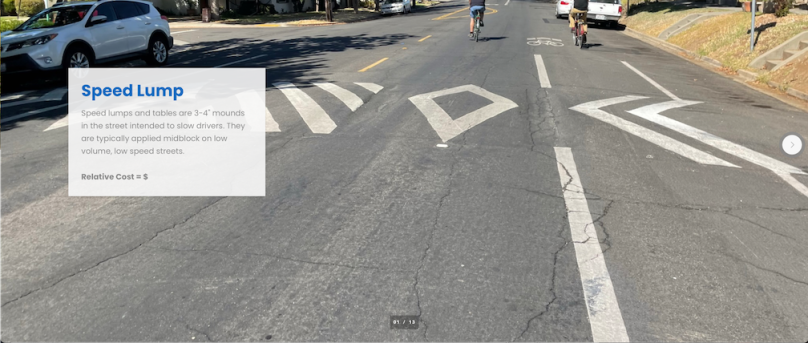
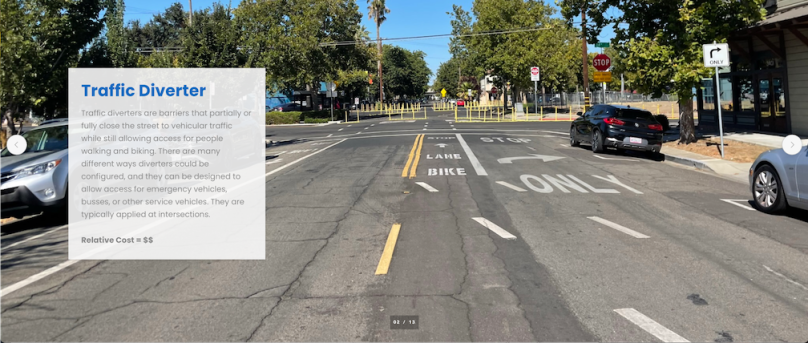
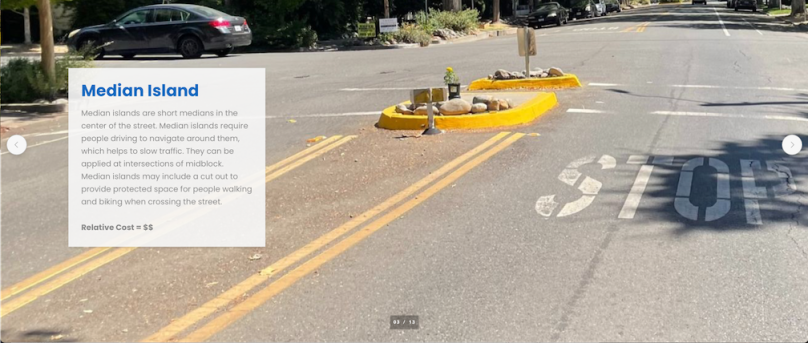
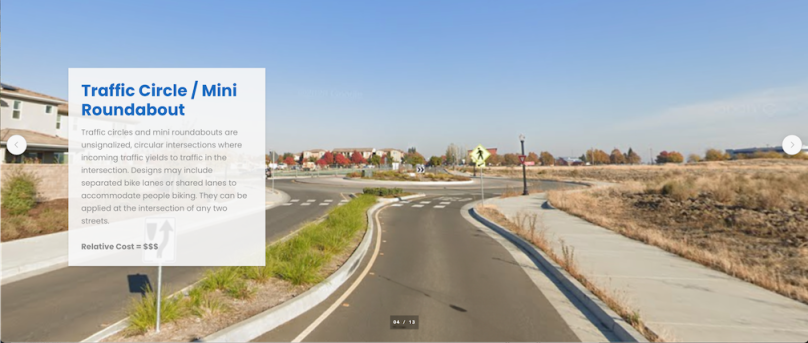
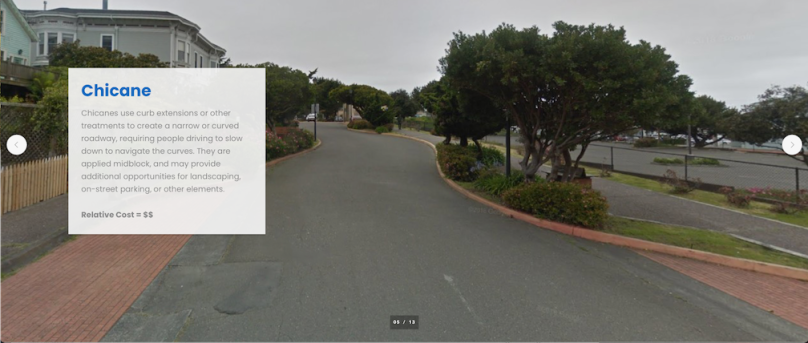
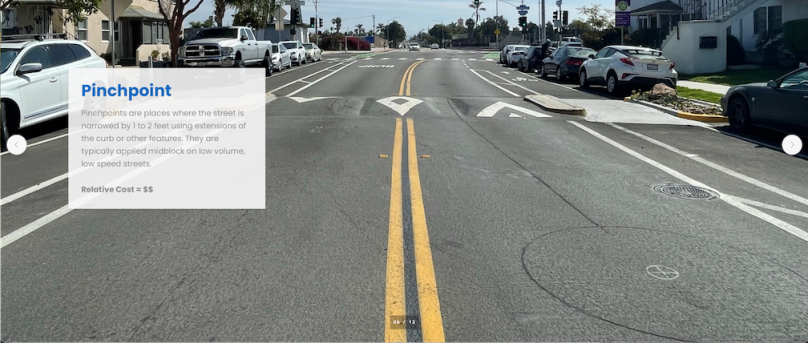
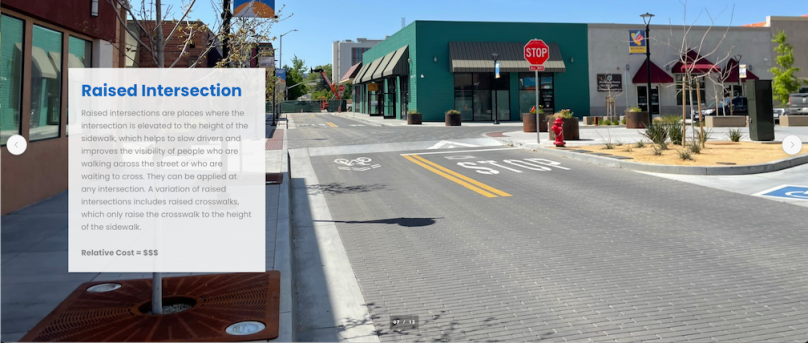
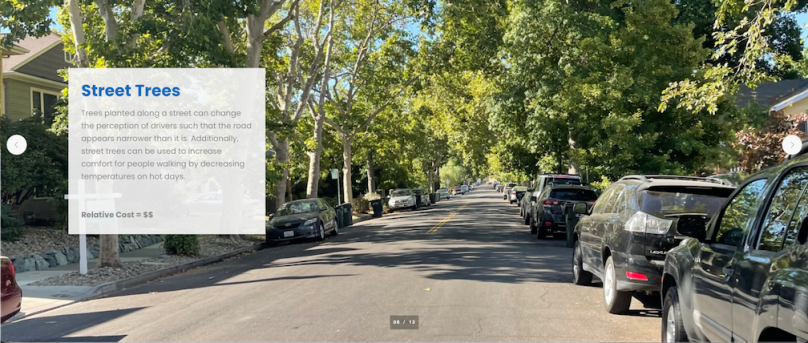
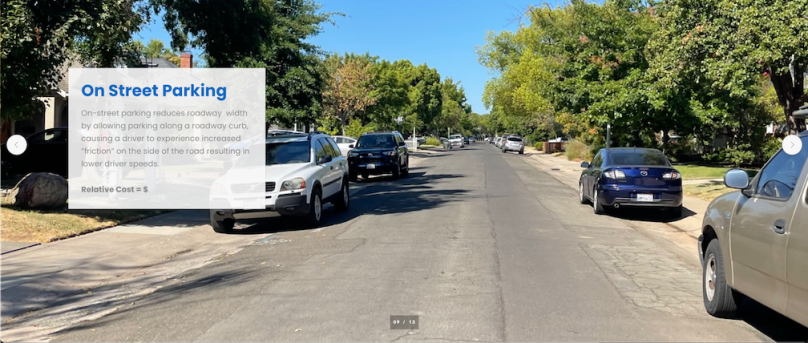
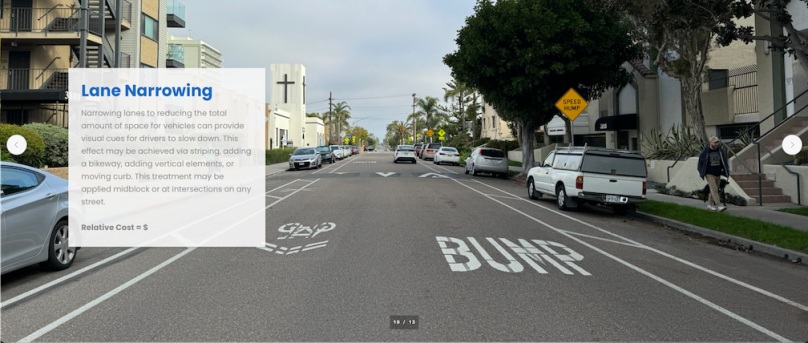
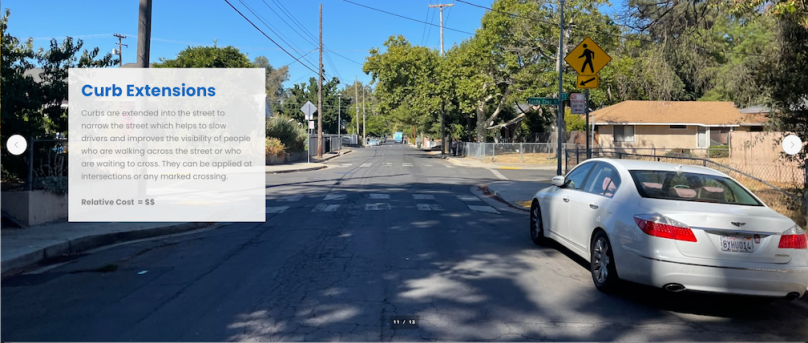
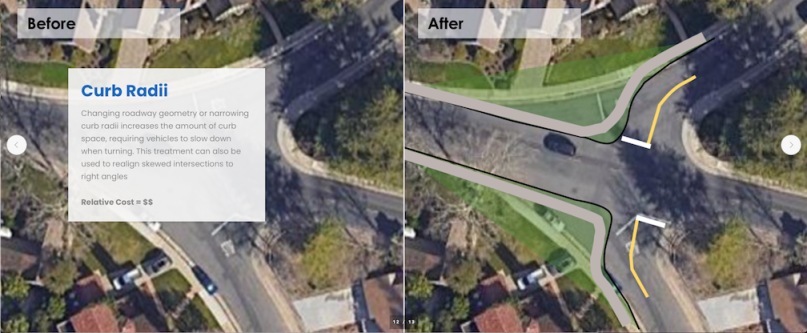
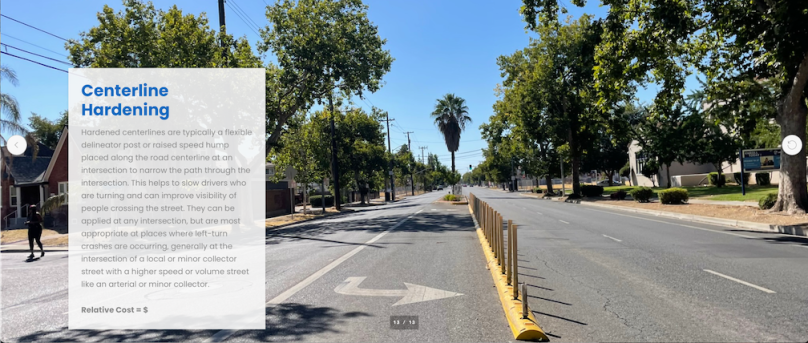
The city yesterday added the Neighborhood Connections Story Board to the Streets for People Active Transportation Plan webpage. I encourage you to look at the entire storymap, but the traffic calming slides are worth sharing independently. The slideshow below has the 13 traffic calming features, with photos, brief descriptions, and relative costs. These traffic calming features are meant for local and minor collector streets, not for major collector and arterials streets. Note that the city is still using the outmoded classification system (local, collector, arterial) that focuses on motor vehicle throughput. This typology approach must change.

Broadway Complete Streets update

Additional posts on Broadway Complete Streets are available at category ‘Broadway Complete Streets‘.

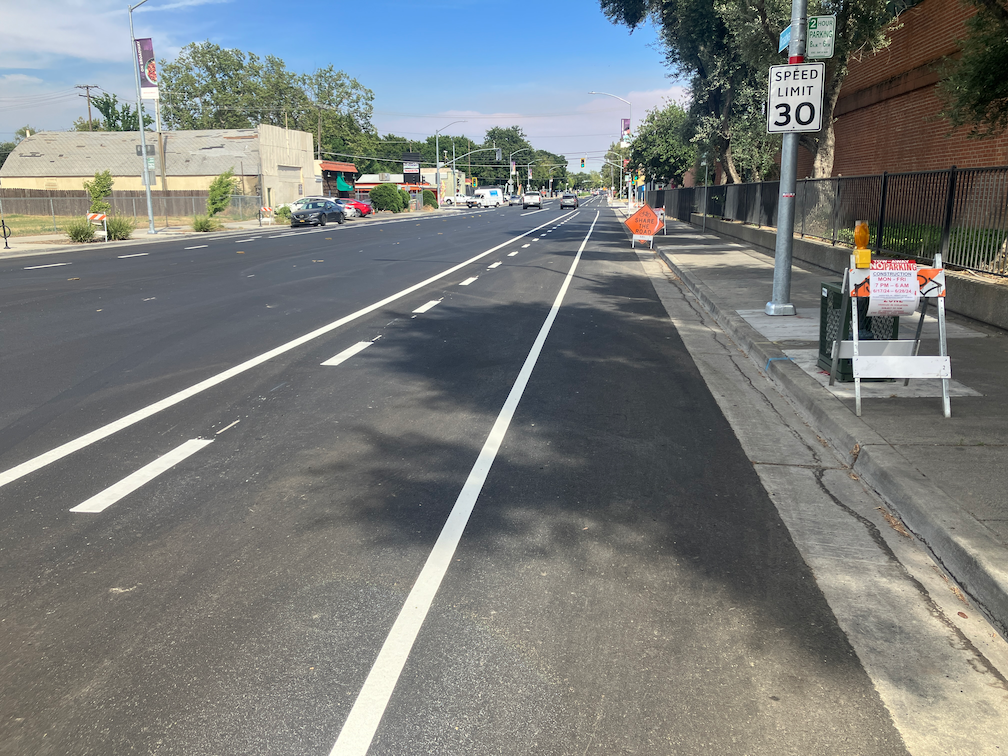
Striping is finally occurring on Broadway, more than two weeks after marking for the striping was completed. Crosswalks have not been striped, though if I were in charge, they would be the first thing striped. Striping is incomplete from 3rd Street to 11th Street, and there is minor striping east of there. There is no green paint yet.

photo of partial striping on Broadway at 3rd St
partial striping on Broadway at 3rd St

RRFBs (rectangular rapid flashing beacon) signals have been installed at three locations. These are mounted on poles and mast arms. Some observation has indicated they are being widely ignored by drivers. A person who has watched the RRFB at 18th Street says that only about 5% of the drivers were yielding to walkers who had triggered the lights. I will do more observation and talk to more people about their observations, but so far, the concerns I expressed in RRFBs are being ignored are true on Broadway.

SacATC 2024-06-20 on Streets for People

The City of Sacramento Active Transportation Commission (SacATC) will meet today, June 20, 2024, 5:30PM in city council chambers, 915 I Street. 

The main agenda item is: 

  1. Streets for People Active Transportation Plan

This is a discussion and feedback item, not for decision.

The attachments to the staff report are available separately on the Streets for People webpage. Hopefully this will solve issues with the very large and likely corrupted combined document.

You can comment via eComment at the city’s meeting page, http://sacramento.granicus.com/ViewPublisher.php?view_id=21, before the meeting starts, or in person. Of course in-person is more powerful, but eComments are valuable and the only method many people can use. eComments submitted well ahead of time can be viewed by commissioners, while last-minute ones will go into the record but not be viewed before the meeting.

If you are frustrated by my posting the meeting on the day of the meeting, please view or subscribe to the calendar hosted by STAR, at https://star-transit.org/events/, which has this event and many others of interest to transportation advocates.

what is public safety?

This post is a response to the Sacramento City Council meeting last Tuesday on the FY 2024-2025 budget adoption.

A number of people spoke on the budget, the majority of them downtown power brokers who were adamant that the police department budget not be reduced. They painted a picture of lawlessness in the central city that could only be reversed by not only not reducing, but increasing the police budget. Most of the problem was blamed on unhoused people, who were presented as violent drug addicts and criminals (never mind the white collar crime going on inside the buildings). Mayor Steinberg right off the bat said that the police budget was being increased, not reduced, but that did not prevent the speakers from claiming that it was being reduced. Several speakers used the term ‘defund the police’, which was originally an effort to reduce police budgets to force the police to be more accountable to the people, but has now been weaponized by pro-police people to suggest that every effort to hold police accountable is an effort to defund the police. One speaker attacked Councilmember Valenzuela, suggesting that she was personally responsible for all the problems in the central city.

To say the least, I was very disturbed by these messages. These are people of great privilege, asking that the city elevate their privilege over other citizens.

Not one of these central city people spoke about the epidemic of traffic violence that is harming people more than traditional crime. Several city council members did speak about this, but none of the downtown power brokers.

None of the power brokers even mentioned other parts of the city. Were they concerned about crime elsewhere? Apparently not.

Only one of the people who spoke in favor of the police budget appeared to be a person of color. He was not from the central city, and expressed ambivalence about police, acknowledging that he was concerned about crime related to his business, but also that many people were uncomfortable about the police.

Not one person from the low-income parts of the city spoke in favor of the police, or the police budget. There is a deep, and well deserved, distrust of the police in large parts of the city. Police have served as oppressors and killers in many, many incidents. Take a moment to think about all the incidents where the police escalated the situation, and then started shooting. Think about the incidents where they showed up and started shooting before they even knew what was going on, and killed innocent people. Think about the incidents where an unarmed person was running away ‘resisting arrest’ and the police shot them in the back. This is a reality that low-income people of color live with and are traumatized by.

In my view, police do not keep us safe. They respond to incidents involving bullets and knives. They often don’t respond to other incidents, or respond very slowly. And it is always response, never prevention.

What does this have to do with traffic violence and safe streets?

The police budget takes a large and growing part of the city budget. These are dollars that could be spent on solving problems, making the city a safer place, but instead they go to the police, who have only one solution, themselves. Councilmember Valenzuela made an effort to keep personal in internal affairs, the police who investigate police malfeasance and crime, but was rebuffed by Police Chief Kathy Lester who doesn’t believe internal affairs is important. Several times the issue came up, as it has many times before, about transferring a small part of the police budget to efforts that actually make a difference, such as Department of Community Response, but no action was taken.

The number of deaths in the city from traffic violence is larger than the number from homicide. Yet the city has only eight traffic enforcement officers. Eight, out of nearly 700 sworn officers (there are others who work for the department but are not officers). This understaffing is a choice that the police department makes, it was not forced on them by anyone else. It reflects their attitude that people who die by guns and knives are worth notice, but people who die by traffic violence are not. It also reflects their attitude that it is better to respond to violence than prevent violence.

I am not in favor of direct traffic enforcement by police. Of the few stops that occur, they are almost all pretextual, meaning that the police officer has stopped the person for a traffic violation, but really is seeking other violations. Most stops are of people of color, as documented by the police’s own data. These stops not infrequently escalate, escalation as often on the part of the officer as the person stopped. Some of these stops result in death.

Automated enforcement is the answer to most traffic enforcement. The city had a red light camera program, but when the county dropped it, so did the city. The police made no request to continue to program. Though the city has encouraged the legislature to pass and the governor to sign automated speed enforcement, the police have been silent. Again, an attitude that only an officer can enforce the law, technology cannot.

I have watched police officers routinely ignore traffic violations, just sitting around waiting for something ‘important’ to happen.

So what is public safety? Public safety is when:

  • resources are spent equally on protecting all citizens, not just the privileged
  • police and the city as a whole focuses on reparation, reinvestment, and dialog to heal the trauma created by police oppression
  • police allocate their officers and other resources based on actual threats to the public safety, not on outmoded perceptions
  • the city reallocates budget to those programs that are making a positive difference in people’s lives, not just increasing the budget of the loudest voices

I know I’ll lose some readers with this post. I know that some people concerned about traffic violence and safe streets are also supporters of the police and of direct traffic enforcement. Sorry to see you go. But I can no longer be silent when I see police and pro-police people claiming the right to use the term ‘public safety’ for their own benefit, to the detriment of others.