Is sales tax for transportation the wrong approach?

There are three ideas for transportation funding floating around, for the 2026 ballot, though none have been formalized. All rely on sales tax.

  • Sacramento Transportation Authority (SacTA) may create a ballot measure to fund transportation. It would be in addition to the existing Measure A, and might fund transportation infrastructure for infill housing, which has not been done before. As an agency-sponsored measure, it would require 2/3 vote to pass.
  • Sacramento Metro Rail and Transit Advocates (SMART) and Mayor Darrell Steinberg have drafted measure that would fund active transportation, transit, and housing. It would probably be for the county, but could be just for the City of Sacramento. As a citizen initiative, it would require only 50% + 1 to pass, a much more achievable vote.
  • SacRT it considering a measure for transit and related active transportation that might cover only a part of Sacramento County, the more transit-supportive part, probably the cities of Sacramento and Elk Grove. As an agency-sponsored measure, it would require 2/3 vote to pass.

Sales taxes are regressive, meaning that low-income people pay a much larger percentage of their income to sales tax versus high-income people. Most organizations which lead with equity are opposed to further sales tax increases, feeling that enough is enough.

In Sacramento County, with a strong anti-tax voice in the low density unincorporated county, it is difficult though not impossible to reach the 2/3 threshold. The 2016 transportation sales tax fell short of 2/3. Measures to fund schools districts are more likely to pass. A complicating issue is that Elk Grove recently passed a sales tax measure to fund many purposes, one of which is transportation. Folsom and Rancho Cordova have sales taxes for which it isn’t clear to me whether any goes to transportation.

General purpose sales tax measures, which may list uses but are not required to follow those lists, only require 50% + 1 to pass. That flexibility is both a feature and a danger, since a government may shift sales tax income from what they said it would be spent on to other purposes.

Though I have not heard parcel taxes being discussed, they are another source of funding, though they are also regressive because they are a flat rate per parcel, not based on the value of the parcel.

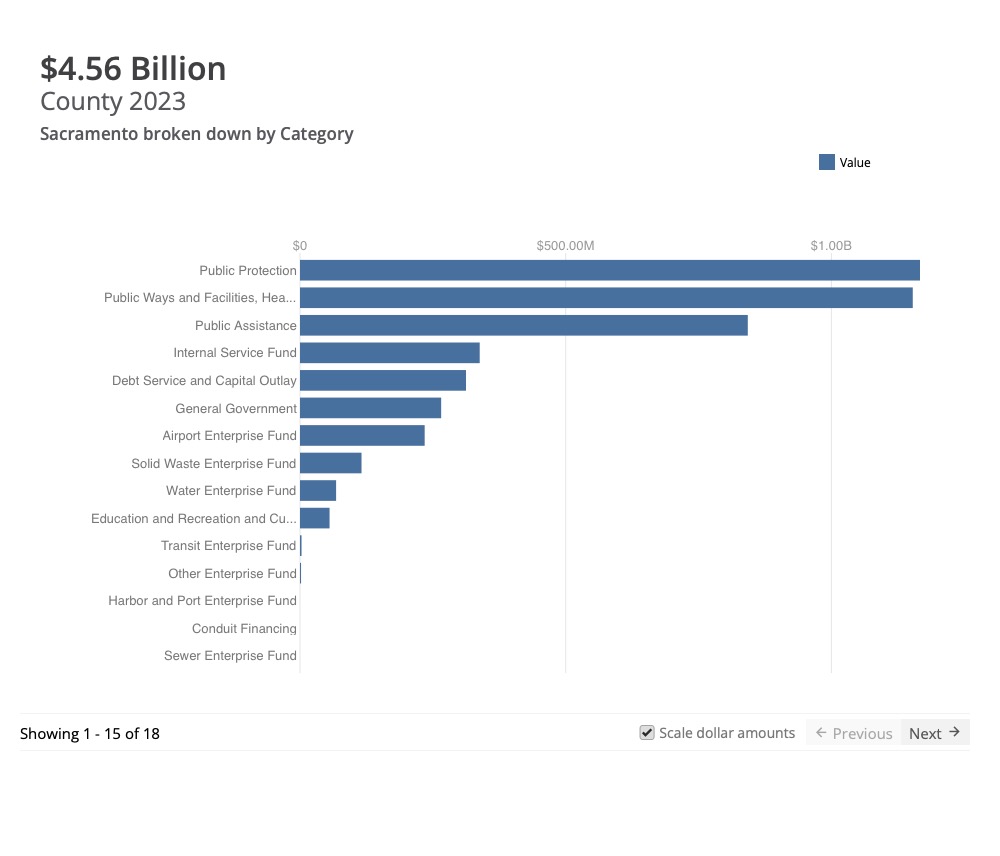
Two other types of tax which are progressive, meaning that high-income people pay a higher percentage of income than low-income people, are income tax and property tax. Income tax does fund transportation at the state level, but income taxes are not available to cities, counties, and special districts. Property tax can fund transportation, though due to Prop 13 which limits property tax, it mostly goes to schools and public safety. For Sacramento County in 2023, the chart below shows allocations. The ‘Public Ways and Facilities, Health, and Sanitation’ category goes mostly to Health, with Public Ways and Facilities being less than 20% of that category. This chart does not include school districts within the county, which also rely on property tax.
Transfer taxes, which are based on the value of a property when it is sold, are progressive. These have been discussed in a number of places in California, though not locally so far as I have heard. I am not aware of any existing transfer taxes that fund transportation, though they do fund a number of other government functions. The state levies a transfer tax throughout the state, and that income goes into the general fund.

Any county, city or special district can bond against property tax, meaning that they can expend money now and pay it back over time from future property tax income. Again, Prop 13 limits the usefulness of this by suppressing property tax income, but does not preclude it. If Prop 5 on the 2024 ballot passes, cities, counties, and special districts will be able pass bond measures with a 55% vote rather than 2/3 vote, though the proposition raises the bar on transparency and types of expenditures. Though Prop 5 is intended primarily to fund housing, it could fund transportation, and there is a logical nexus with transportation that supports housing.

For other posts on transportation funding, see category Transportation Funding.

this week 2024-11-04

SacMoves Coalition hosts an event calendar at https://sacmoves.org/events/, which is maintained by STAR (Sacramento Transit Advocates and Riders) and Getting Around Sacramento.

Monday 04

  • Sacramento Climate Coalition, 6:00 PM, To participate in this monthly meeting, please email info@sacclimate.org to be added to the list.

Tuesday 05

  • Election Day, as though you haven’t already voted

Wednesday 06

Thursday 07

Friday 18

Saturday 19

Sunday

SacCity mayoral candidates on transportation

I don’t know anyone who hasn’t already voted, but information about the City of Sacramento mayoral candidates, Flo Cofer and Kevin McCarty, will be valuable beyond the election. SABA (Sacramento Area Bicycle Advocates) sent in a Gear’d Up email a compilation of candidate positions and perspective on transportation, which I’ve copied below.

Sacramento Mayoral Candidates on Transportation and the Environment
SABA is taking a look at the stances of the two Sacramento mayoral candidates – Dr. Flojaune Cofer and Assemblyman Kevin McCarty – related to environmental issues. While we understand that there are many important issues facing Sacramento, especially with regard to the unhoused population, our focus here is on issues related to transportation and the climate crisis. 
The views presented here are taken from forums conducted by the League of Women Voters, the Sacramento Bee, and KCRA 3.
Flo Cofer - a Black woman wearing a purple jacket and yellow blouse.Dr. Flojuane Cofer is an epidemiologist, policy director, and advocate for change. She worked at the California Department of Public Health and then as a Senior Policy Director at Public Health Advocate. Cofer served on Sacramento’s Active Transportation Commission, Mayor’s Commission on Climate Change, Sacramento County Sheriff’s Outreach Community Advisory Board, and the Measure U Community Advisory Commission. 
Kevin McCarty - a man with light brown skin wears a gray jacket and blue shirt.Since 2014, Kevin McCarty has served as Sacramento’s Assembly member – representing the 6th Assembly District. McCarty serves as Chair of the Assembly Public Safety Committee. From 2014 to 2023, he served as the Chair of the Assembly Budget Subcommittee on Education Finance. A lifelong Sacramentan, McCarty began his career as a Housing and Redevelopment Commissioner, and then served on the Sacramento City Council for a decade.
SABA does not endorse either candidate. (Disclosure: Cofer is a member of SABA and McCarty has lent financial support to a project that will launch in 2025.)
Here’s where they stand on the issues:
Climate Action & Adaptation Plan, which includes a greenhouse gas reduction target for 2030 and a carbon neutrality goal for 2045.
Cofer: As a commissioner on the Mayor’s Climate Commission, Cofer helped develop Sacramento’s Climate Action Plan and would like to move the dates up to accomplish carbon neutrality sooner. As mayor she would commit to setting priorities for the city council and plan how the city can take on more to achieve climate goals sooner.
McCarty: He would like to achieve the goals that were set out in the plan and figure out how to pull down resources from the state and federal governments. When the city was in a budget crisis, he found resources to support city services like the firefighters and would do the same for the Climate Action Plan.

Funding for the Climate Action & Adaptation Plan Including Proposed 2026 Sales Tax (the Plan is budgeted at over $3 billion)
Cofer: She believes we need to look at the Plan and figure out how to implement it; set a goal and figure out where to start; and decide on the major investments we need to make now to save money down the line and yield us dividends. Cofer says we should look at matching funds from the state and federal government, as well as local partnerships. She believes neighborhood associations, unions, nonprofits and businesses will step up and that we should see them as partners rather than adversaries. The public was frustrated that the sales tax from 2019 was not spent on homelessness, affordable housing and the arts, and Cofer says we need to build trust with the voters by righting things before going and asking for more money; and we also shouldn’t impose a tax on people with lower incomes.
McCarty: He wants to look at opportunities to leverage funding for state efforts. McCarty says the State of California is our largest employer and landowner and we need them to step up to help us achieve our climate goals. Voters are very frustrated that things aren’t getting done and McCarty believes we have to restore confidence in city leadership to pass traditional revenue. He says the sales tax is regressive and that people of lower income are disproportionately impacted by climate and should not bear disproportionate burden.

Commitments to Climate Initiatives
Cofer: She believes we need new leadership. Cofer has built coalitions and served on five different boards, committees, and coalitions. In the first 100 days, she commits to 1) set priorities for the city of Sacramento that include our climate goals and take action every year. 2) Make sure we have a standing committee on climate where we have community members helping us to figure out new innovative solutions.
McCarty: His top two initiatives are to promote active transportation and build more infill housing.

Public Transit & Active Transportation
Cofer: She supported a resolution to expand transit and make it free for kids K-12. She believes the best way to expand transit is to provide it at low or no cost and wants to get young people to ride so they become lifelong transit riders. Cofer wants to expand free rides to college students and to make public transit accessible for disabled and older people. She would like to see it kept running for major events – make it convenient and useful for everyone, not just low-income people.Cofer served on the Active Transportation Commission because she is an avid bike rider and has been hit by a car. She wants to implement design features to make it safer for people to bike and walk. When there is new construction, Cofer wants to make bikes and pedestrians a priority to signal that safety is paramount.
McCarty: When he lived in Boston, McCarty took public transportation everywhere, but Sacramento’s transit system isn’t as comprehensive. McCarty believes we need more routes and frequency, and to look at land use so people can live closer to the things they need and won’t always need to drive. He believes our transportation infrastructure prioritizes cars. As a medical consultant for a school district, McCarty tried to get kids to walk more. He says there’s a need to make walking safer by not having people camping on sidewalks and by addressing other public safety issues.  

Cycling and Pedestrian Safety
Cofer: She acknowledges that traffic is the number one cause of fatalities and serious injuries. Cofer wants to invest money to draw matches at the state and federal level. She says traffic safety should be proactive.
McCarty: He believes that roads should be fixed to proactively eliminate deaths. He would like to improve bike and pedestrian infrastructure across Sacramento, not just midtown. McCarty acknowledges that there is an equity issue – some people ride by choice; some don’t have another option.

Sprawl and Urban Development & Downtown Revitalization
Cofer: One of the things in the CAAP is prioritizing infill development. Cofer wants to develop housing and build near existing infrastructure to not increase emissions. As someone who served on the Climate commission, she doesn’t want to start building in places where we already have trouble with transit. She believes we need to start building in places where we already have rail and bus lines and not create another car-centric community. Cofer doesn’t want to offer downtown properties to developers “for free.” She would like to use adaptive re-use for example, bringing Sacramento State downtown. Cofer says downtown needs to be an entertainment hub. She believes that bringing state workers back to the office is not the way – it goes against our climate goals.
McCarty: He says we have a housing shortage and we have people coming to Sacramento. McCarty believes we’re not going to end sprawl by simply limiting construction within the city; we can’t control what happens across another border. He says we need to facilitate infill development and that telework is here to stay. 45% of downtown property is state or federally owned and they pay zero property tax. McCarty would like to instead, put that property in private hands such as housing, entertainment, restaurants. He wants to work with Sacramento State to bring student housing downtown.

SacCity Neighborhood Connections workshops

The City of Sacramento is holding two online workshops on the Neighborhood Connections portion of the Streets For All Active Transportation Plan, on Wednesday, November 13 at 6:00 PM, and Wednesday, November 20 at 12:00 noon. Registration is available on the Streets for People webpage. The Neighborhood Connections Public Draft Plan will be available on November 4 on the Streets for People webpage.

The Neighborhood Connections Story Board is the most valuable document to come out of the project so far, well worth a look. I’ve written about traffic calming features in Neighborhood Connections before, as well as other topics in Streets for People and Street Design Standards. There is a great deal of overlap, and should be, between the Streets for People Active Transportation Plan and the Street Design Standards Amendment.

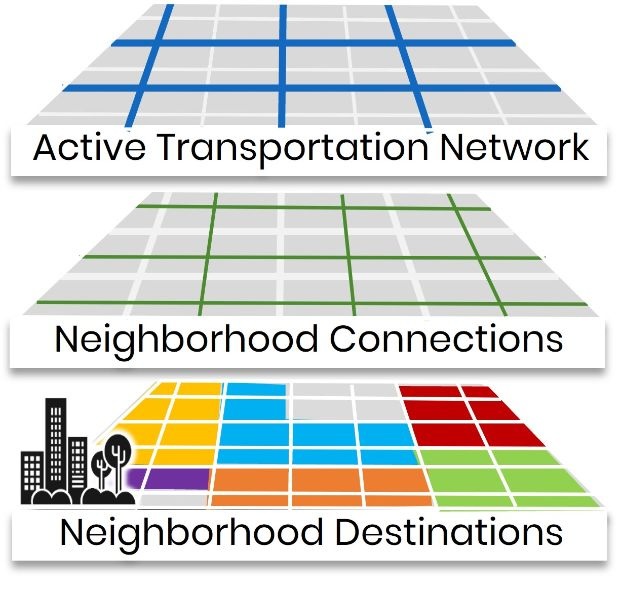
“The Neighborhood Connections Network is made up of residential streets and minor collectors that connect to neighborhood destinations, such as parks and retail. The network includes proposed traffic-calming treatments to reduce vehicle speeds and volumes to support people walking, biking, and rolling.”

diagram Streets for People Active Transportation Network, Neighborhood Connections, Neighborhood Destinations
graphic Neighborhood Connections workshops

SacCity parking revisions

The City of Sacramento is undertaking revisions to parking requirements for private motor vehicles and bicycles, as directed by council and the 2040 General Plan.

The draft parking strategy is available for review, as a document review webpage, and here as pdf.

Two online meetings are being held, Wednesday, November 13 at 10:00 AM, and Thursday, November 14 at 5:30 PM. Registration is required, and available on the city Parking Revisions webpage. You can also email the city, address on the webpage.

The city removed parking mandates in the central city in 2013, and within 1/4 mile of transit in 2019, and state law now prohibits mandates within 1/2 mile of ‘major transit stops’.

I have not had a chance to review, so don’t have any comments at this time.

SacCounty Climate Action Plan, November 6

Adoption of the Sacramento County Community Climate Action Plan is item 2 on the Sacramento County Board of Supervisors meeting on Wednesday, November 6, at 2:00 PM. I have not been following the Sacramento County CAP, as it is beyond my capacity, but several organizations have, and they are opposed to the plan under consideration. To summarize, the county has created a plan that won’t stand in the way of low density development at the edge of and beyond the county growth boundary. Translation: sprawl!

The best reference I’ve found is an email from 350Sacramento, so this is duplicated below.

“Tell supervisors: Don’t Approve

In 2011 Sac County promised to adopt a climate action plan (CAP), “within a year”. We’ve pushed them hard for five years to do that, and critiqued five technically and legally insufficient drafts. The problem is that the County is committed to approving several very large, high-GHG, sprawl developments outside the County’s growth boundary, and an effective CAP would get in the way.

This Wednesday the County will try to steam-roll us, adopting a final CAP with the same deficiencies as before, claiming the CAP isn’t subject to environmental requirements. We’re not buying it… Please click and send a pre-written email to County supervisors.

We’re making legal points, but feel free to substitute or add your own thoughts and feelings. Think of pointing out that elected officials are irresponsibly embracing land speculators and sprawl over protecting our environment.

All this proposed sprawl would do nothing to solve the housing crises: The County has already approved over a 100 years-worth of growth in infill and new projects. With the new sprawl they will have adopted almost 200-years of growth capacity. That won’t build-out in anyone’s lifetime; but it will start to build-out as small tracts scatter across the County – the worst possible land use for climate stabilization.

Make your voice heard and share this issue with others in your network!”

Truxel Bridge Community Open House, November 13

The City of Sacramento is holding a community open house on the Truxel Bridge project, on Wednesday, November 13, 5:30 – 7:00 PM. The event will be at SMUD Museum of Science and Curiosity (MOSAC), 400 Jibboom St, Sacramento, CA 95811. There is an Eventbrite registration, though registration is not required.

Truxel Bridge was originally proposed as a light rail and walking/bicycling bridge across the American River, part of the Green Line (light rail) to the Airport Project. Though it is unlikely light rail will ever go to the airport, it is possible that it will go to south and north Natomas, though the two council members from north and south Natomas don’t want to wait for light rail and would like to see bus rapid transit (BRT), sooner rather than later. The American River Parkway Plan, adopted by the county and the state, recognizes a transit bridge across the river though does not specify the location. The plan very specifically prohibits a private motor vehicle bridge.

The city, however, wants an all-modes bridge, including private motor vehicles. The addition of motor vehicles to the bridge would require a significantly wider bridge, and significantly more impact on the natural environment of the American River Parkway. The city is willing to pay for part of the bridge, but apparently expects SacRT to pay for much of it. The city is claiming the bridge will reduce VMT (vehicle miles traveled) and therefore GHG emissions, by shortening the drive from Natomas to downtown by a small distance, but has offered absolutely no proof for this claim. New motor vehicle capacity always induces more VMT. The city has also claimed that the selected crossing, from Sequoia Pacific Blvd to Truxel Road, is the best or only viable crossing, and has larded on all sorts of not-required improvements that would argue against using the existing river crossing at Highway 160. It is recognized that the Highway 160 bridges are substandard and will need to be replaced, but the city would rather fund a new bridge than fix the old. City staff has also claimed that since this project was approved by city council in 2014, only the exact alignment is under discussion. BS.

Sacramento Transit Advocates and Riders (STAR) has a number of posts on the Truxel Bridge project, category Truxel Bridge.

I hope that you will attend this meeting and speak up for the original concept, which is a transit/walking/bicycling bridge.

River District Open Streets October 19

This Saturday, October 19, 2024, the River District Open Streets Festival will occur 12:00 PM to 4:00 PM at Mirasol Village, 400 Pipestem St, in the River District. Civic Thread is the primary host, working with a number of other partners and supporters. Registration is not required to participate, but is available on Eventbrite.

From the festival info page:

“Get ready to experience the heartbeat of our community at the Open Streets Festival in the vibrant River District this fall!

Join us for a day filled with family fun, local flair, and exciting activities for all ages. Discover live music, delicious food from local vendors, arts and crafts. Participate in interactive games, enjoy street performances, and explore the many pop-up shops that line the streets. It’s a perfect opportunity to connect with neighbors, celebrate our diverse culture, and support local businesses. Don’t miss out on this unforgettable event that brings everyone together in the heart of our beloved community.

This event is intended to showcase the power of community connection, healthy and active lifestyles, and the multitude of what the River District has to offer whether it be arts, food, or fun. There will be tables from community organizations, food vendors, and performances, along with interactive community activities such as a bike rodeo.”

Rancho Cordova and SABA also hosted an open street event last Saturday, which I hope to post about soon. Several other open streets events have happened recently, and more are in the planning stages, which is good to see after the long pause since the Sunday Street on Broadway event in 2017.

what’s going on? (other)

There are so many actions and possibilities for improving the efficient, equity, and safety of our transportation system that I can’t keep up with it all, and even nonprofits that have staff are unable to keep up. So, what’s going on? The list below is not in any priority order, but may give you ideas about what you would like to get involved in. It takes a village!

Items specific to City of Sacramento were in a previous post, while these items are about other locations, and/or applicable to all the cities and counties in the region.

Transportation funding in Sacramento County: Transportation sales tax measures in 2016 and 2022 failed, and a 2020 measure was withdrawn. Each measure was weak on active transportation and transit (and the sprawl developer sponsored ‘citizens initiative’ in 2022 was horrible), and also suffered from anti-tax sentiment in the county. There are three efforts to place a funding measure on the 2026 ballot, Sacramento Transit Authority (SacTA) new Measure A, SMART/Steinberg citizen measure for housing, active transportation, and roadway maintenance, and SacRT transit measure for City of Sacramento and Elk Grove. All of these are in early stages, not yet formalized. Sales taxes are regressive, making low-income people pay a much higher percentage of their income on these taxes, so efforts to identify other mechanisms are critically important.

City of Rancho Cordova Active Transportation Plan: The city is starting the process of community engagement towards developing a plan for walking, rolling and bicycling.

Other active transportation plans: Sacramento County updated its plan in 2022. Folsom updated its plan in 2022. It isn’t clear what the status of Elk Grove’s Bicycle, Pedestrian, And Trails Master Plan is. West Sacramento’s Bicycle, Pedestrian, and Trails Master Plan, from 2018, received minor updates in 2024. Roseville is undertaking a Transportation 360 effort to include walking, bicycling and transit. Davis does not seem to have an active transportation plan.

Sacramento County Climate Action Plan: The county has delayed a climate action plan by years, going through a series of revisions that aren’t much better than the previous. Sacramento Climate Coalition and 350Sacramento have been the most active on this issue. It will take citizen pressure on staff and on the Board of Supervisors to ensure an effective plan.

Other climate action plans: Every city and county is required to come up with a climate action plan. I don’t know the status of plans other than City of Sacramento and Sacramento County.

SACOG 2025 Blueprint: SACOG is developing a new version of the MTP/SCS called Blueprint ‘Linking land use and transportation in the Sacramento region’. There is a constant tension between the desires of cities, in particular Sacramento, West Sacramento, and Davis, and the smaller cities and rural counties of the six county SACOG region, over what kinds of transportation investment to make. SACOG is required to come up with a plan that would reduce greenhouse gas emissions (GHG) by 19%, and the transportation policies and projects selected will make all the difference in whether the region has a chance for achieving that goal. Citizen pressure for infill and livable communities is required to counteract the small city and rural voices that just want money to continue doing what they’ve always done, which is encourage low density sprawl development with a motor-vehicle focused transportation network.

Caltrans District 3: While other entities are beginning to meet the public demand and legal requirements to reduce greenhouse gas emissions (GHG) by reducing vehicle miles traveled (VMT), and improve roadway safety, Caltrans District 3 is continuing to expand highway capacity, inducing travel demand and increasing GHG/VMT, and making it very hard for cities and counties to make their roadways that are state highways or that cross state highways (underpasses and overpasses) to improve safety. Caltrans headquarters has been unable to rein in District 3.

This list no doubt misses some important topics. Please suggest them in the comments.

Rancho Cordova Active Transportation Plan graphic