When a traffic crash results in a fatality, society mostly shrugs and moves on. Until Ariane Lange started writing in the SacBee about the victims of traffic, there wasn’t even a shrug. Sometimes all the evidence of someone dying is some small car parts pushed to the side, and maybe a small oil slick, easily ignored. There is nothing to say someone died here. The people who died might be drivers, passengers, walkers, bicyclists. Real people whose lives were cut short. It is likely for two reasons: roadway design that encourages speeding and reckless driver behavior, and human mistakes.
Rather than shrugging and moving on, we need to take notice. I think the best way is to close the intersection where the fatality occurred, and yes, it is quite often though not always, intersections. They are the locations with the most complex movement of motor vehicles, particularly turning movements, and walkers and bicyclists. The intersection should be closed until some action is taken to make the intersection safer.
Walkers: If the victim was a person walking, the easiest and quickest change is to implement a leading pedestrian interval (LPI) – see tag: LPI – or to lengthen the interval of the pedestrian crossing. This could be done tomorrow. A exclusive pedestrian phase can be implemented. Other changes take some time, but not a lot. Temporary curb extensions (paint and posts), temporary modal filters or traffic diverters (paint and posts), temporary traffic circles (paint and posts), closing slip lanes (paint and posts).
Bicyclists: The changes for bicyclist fatalities are more dependent on the context, but a quick fix would be to close slip lanes (paint and posts) and dedicated right hand turn lanes where they terminate bike lanes (paint and posts).
For crashes between two motor vehicles that kill drivers or passengers, it is again contextual, but common fixes would be to lengthen the clearance or ‘all-red’ interval. Egregious drivers will of course over time change their behavior to run red lights even later than they already do, but the timing change will make a difference until more significant changes can occur. Red light running is epidemic in the Sacramento region, and solutions will require a cultural change and rigorous automated enforcement.
How long should it be closed? Until something changes that makes the intersection safer. It need not be the fixes that will occur over time, but something must happen. That something could take as little as a few hours. The point is not to make a major delay in normal traffic flow, but to take notice, to witness the death and the unsafe nature of the roadways we have designed.
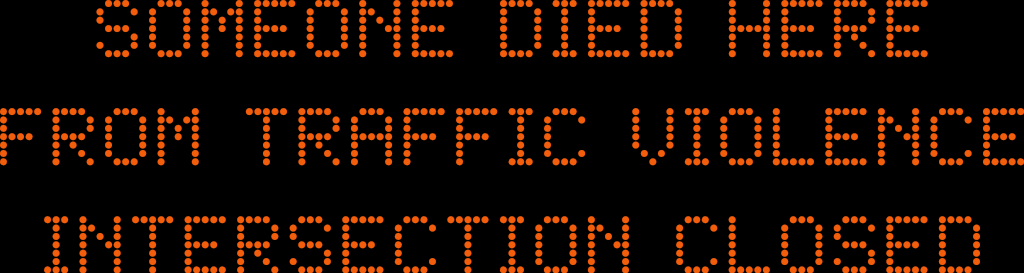
Changeable message signs should announce ‘someone died here from traffic violence’ to inform people about why the intersection is closed. The first sign below has the highest impact. The second sign is more politically palatable.

 Getting Around Sacramento