It is apparent that the City of Sacramento’s Vision Zero Action Plan has overall been a failure. Traffic fatalities in the city have increased, and Sacramento remains among the most unsafe cities in the state. I have written recently about the action plan update process (SacCity Vision Zero Update) and longer ago all the way back to the inception of the program (category: Vision Zero).
I believe that the failure is in large part due to the focus on improving corridors rather than specific points of concern which are mostly intersections, and a reliance on getting grants from federal, state or regional (SACOG) sources to accomplish these projects. The assumption was, and is for all transportation projects, that outside grants rather than the city’s general budget, will be the source for transportation infrastructure. The city spends very little of its own budget on transportation, beyond some basic maintenance and required grant matches. The recent quick-build program is the first time significant money has been dedicated to traffic calming and safety.
The city is offering a survey to gather community input on the action plan update, open through February 22. I just took the survey, and some screen captures are below, but I want to focus on the third page (the others are below). The top of this page offers a chance to rearrange actions in order of importance. Since these are screen captures, the six items in text are:
- Planning and constructing large street projects that make big changes to intersections and streets to greatly improve safety, but take longer to build
- Planning and constructing smaller projects that are quicker to build but may only modestly improve safety
- Implementing traffic signal changes that enhance safety for everyone
- Enforcement by police officers to address traffic violations most linked to serious or fatal crashes (for example, DUIs, red-light running, speeding)
- Automated enforcement to address traffic violations most linked with serious or fatal crashes (for example, DUIs, red-light running, speeding)
- Education campaigns reminding or teaching people proper rules of the road
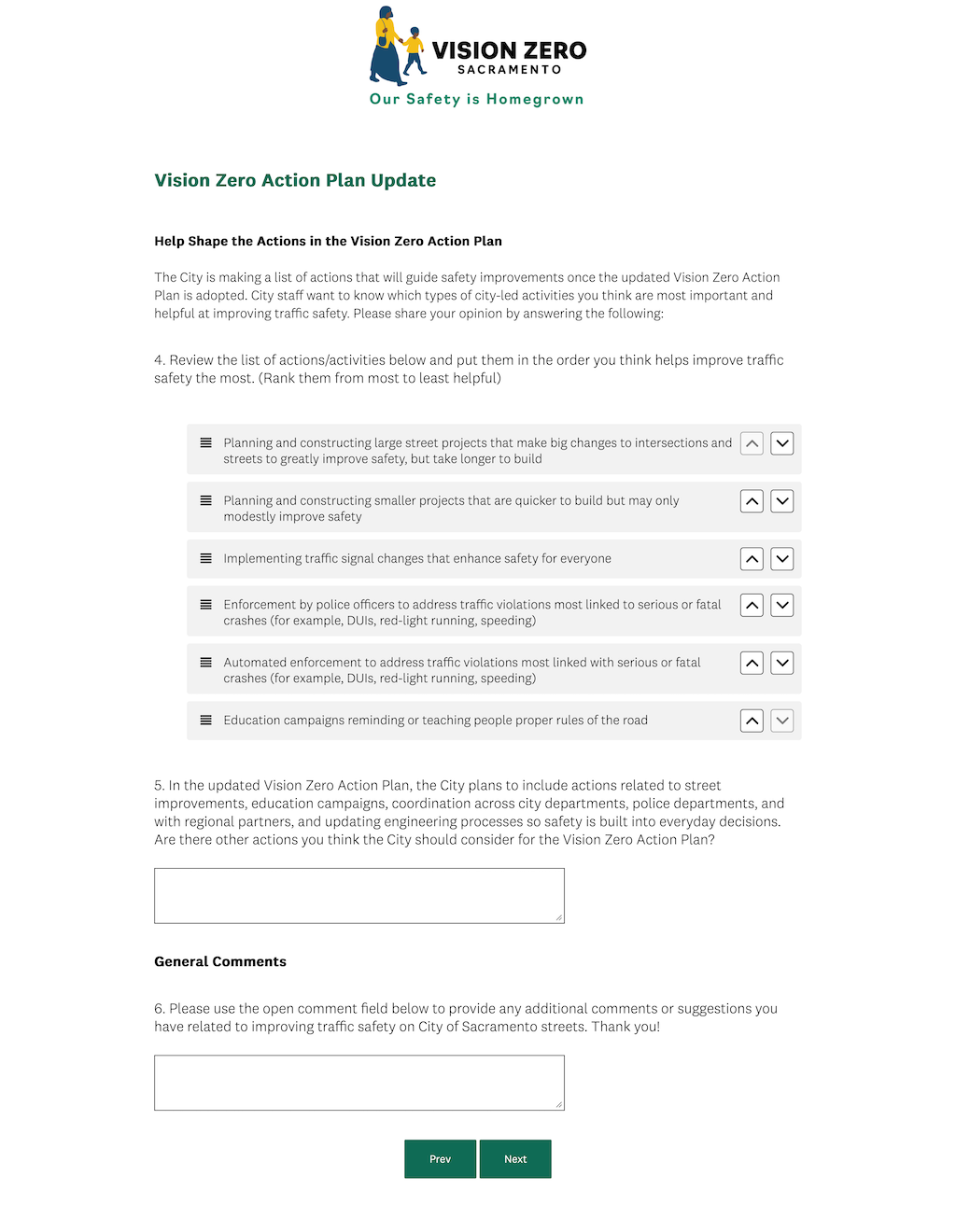
My ranking of these is:
- Planning and constructing smaller projects that are quicker to build but may only modestly improve safety
- Automated enforcement to address traffic violations most linked with serious or fatal crashes (for example, DUIs, red-light running, speeding)
- Implementing traffic signal changes that enhance safety for everyone
- Education campaigns reminding or teaching people proper rules of the road
- Enforcement by police officers to address traffic violations most linked to serious or fatal crashes (for example, DUIs, red-light running, speeding)
- Planning and constructing large street projects that make big changes to intersections and streets to greatly improve safety, but take longer to build
Why?
- These small projects are in line with the city’s new Traffic Safety Initiative (quick-build) program. Though there does not seem to be a webpage for this program yet, an article in City Express summarizes the program. It is still not fully staffed and fully active. This kind of program has proven to be effective in many cities, including ones that have achieved vision zero no fatalities or greatly reduced fatalities.
- Automated enforcement is the best solution for speeding and red light running. Red light running is particularly epidemic in Sacramento, though a problem everywhere. There are no widely available methods for automated enforcement of failure to yield to pedestrians (people walking in the crosswalk), but this is something that could be piloted and implemented.
- On roadways with frequent traffic signals, traffic can be significantly slowed by setting signal timing to award safe speeds and make unsafe speeds awkward. It can even be set to a ‘green wave’ where the signals are timed to the speed of bicyclists, about 12 mph. This would be higher on my list except that the city has, to this point, demonstrated that they use signal improvements not to improve safety for walkers, but to ease traffic flow. They are claim that the entire intersection must be upgraded, at a cost approaching $1 million per intersection. That is a complete waste of taxpayer dollars.
- Education does not work. Of the millions of dollars spent on ‘education’ programs, there are almost no studies indicating that these programs are effective. They are feel good, but worthless.
- Law enforcement bias, which in integral to officers and very very slow to change, makes this an unacceptable solution in nearly all cases. In-person enforcement is as likely to result in officer escalation and harm as to preventing unsafe driver behavior. Particularly in the past, but true today, many ‘safety’ enforcements have actually been stings targeting people walking and bicycling rather than driver behavior. There may be situations in which enforcement is the last but only solution, but it should definitely not be part of the program design.
- Large projects are what the city has been doing, and it hasn’t worked. The city has a backlog of poorly designed and unsafe arterial roadways that will take decades (or more) and hundreds of millions of dollars (or more) to fix. We can’t wait that long, or until we find the money, to save lives. That is why small projects are the answer. Of course the projects are nice when complete, and the city has done as well as most cities its size in getting grants for these big projects, but we need to save lives tomorrow, not ten years from now. Writing grants for large projects takes an inordinate amount of staff time.
The city seems to be OK with a focus on small short-term projects, and these have been promoted by the city’s consultant (Fehr & Peers). But the public will need to support this approach, particularly against pushback from the cars-first lobby and individuals.
If you have the time and inclination, reviewing the seven documents on the city’s Vision Zero Action Plan Update page will deepen your understanding of the issue and possible solutions. If you have time for only one, the Safety Strategies (2025.06.18) is probably the most valuable.
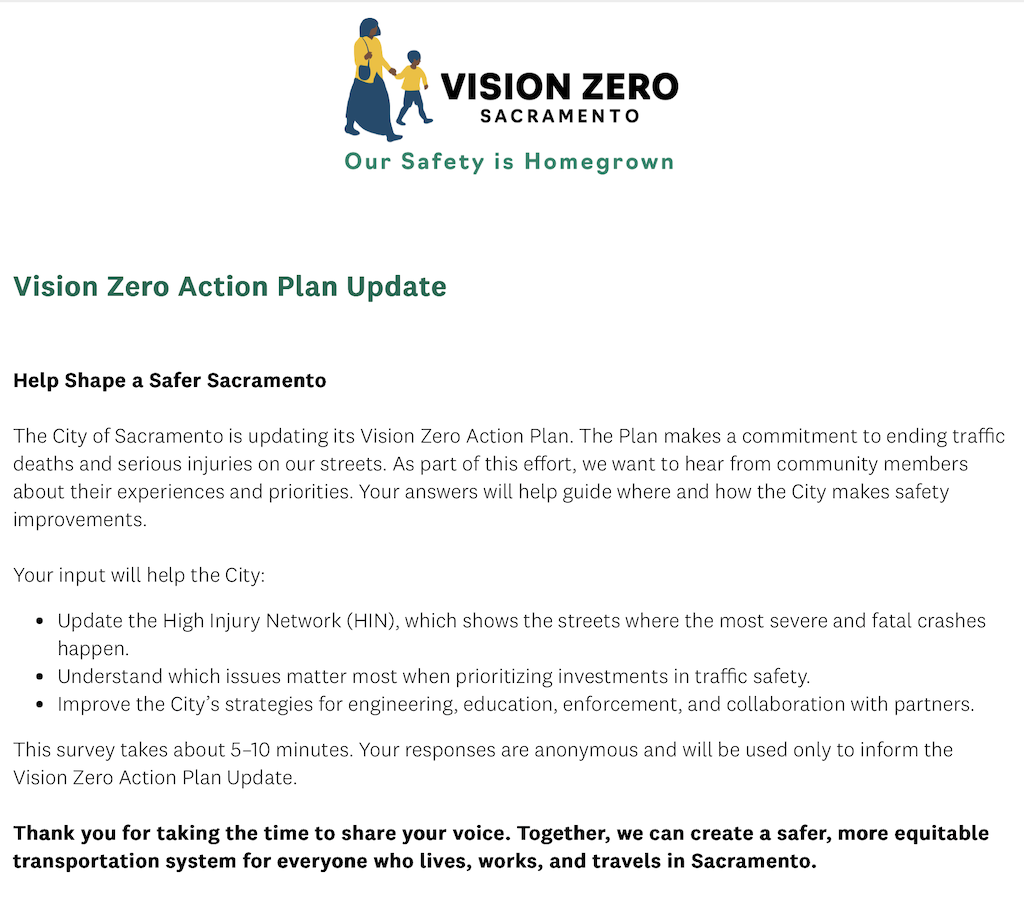
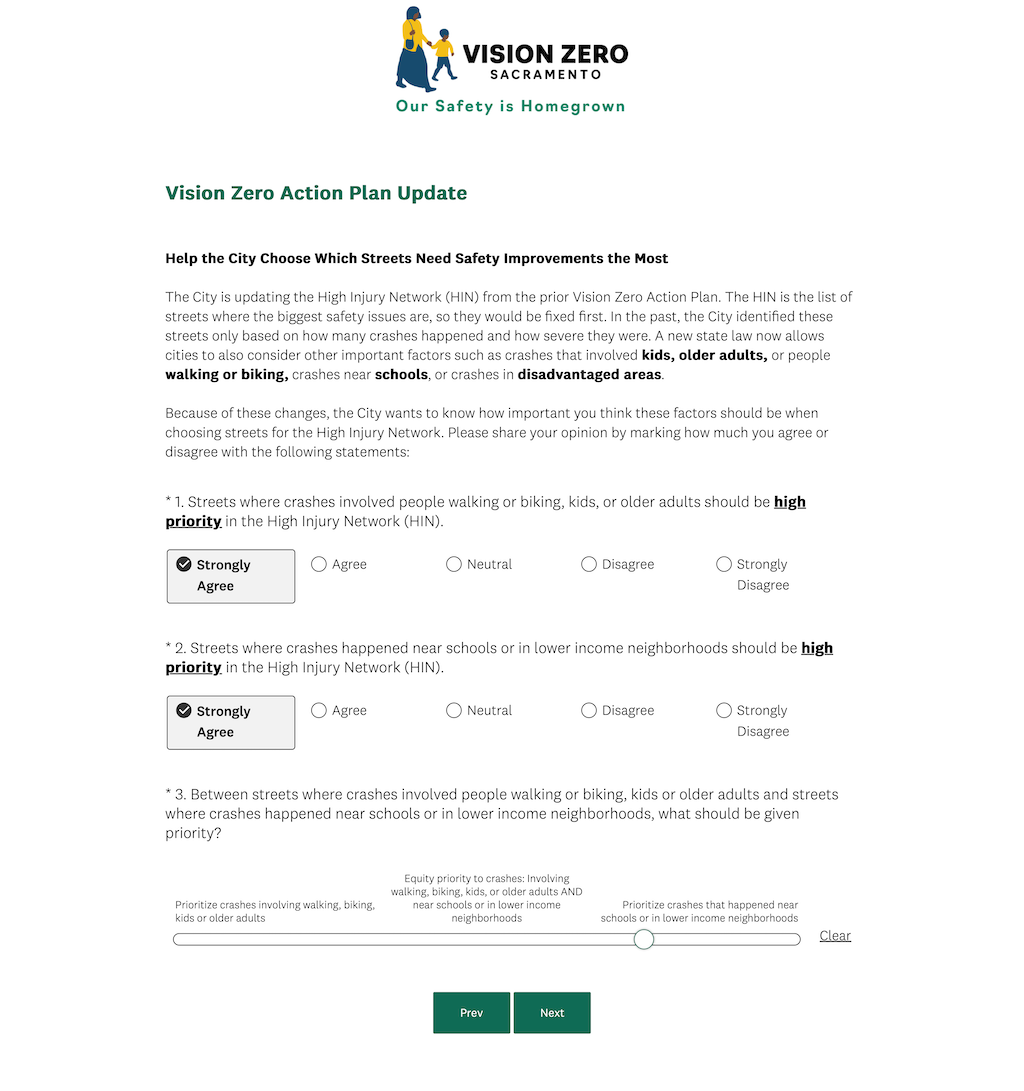
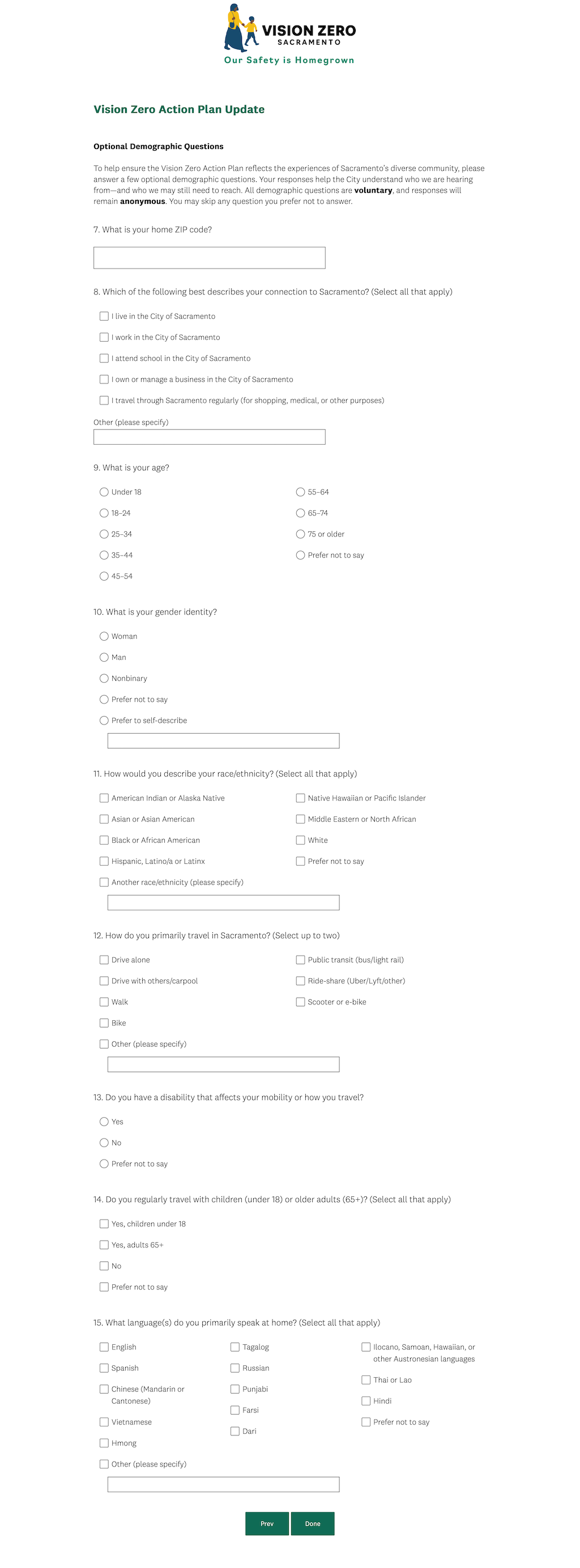
The other pages. Note that I sometimes had started to fill out a page before capturing it.
 Getting Around Sacramento
More information from Slow Down Sacramento / Isaac Gonzalez:
I recently read a story about Hoboken, New Jersey, a city that has gone nearly a decade without a single traffic fatality. Not zero crashes. Not zero injuries. Zero deaths. At a time when traffic violence is often framed as unavoidable, Hoboken shows that it is not.
What makes this powerful is how ordinary the approach was.
They slowed speeds to levels where people actually survive crashes.
They redesigned intersections to shorten crossings and improve visibility.
They enforced daylighting so people walking could be seen.
They used quick, low-cost tools like paint and flexible posts instead of waiting years for perfect projects.
They treated safety as a daily responsibility, not a slogan or a plan that sits on a shelf.
This did not happen overnight, and it did not happen by accident. It happened because the city refused to accept death as the cost of getting around.
I am sharing this not to suggest that Sacramento is there yet. We are not. And I am also not suggesting that our current Vision Zero work, as it exists today, is sufficient on its own. It is a framework, not a guarantee.
That is why participation matters.
Tomorrow, there is a virtual public Vision Zero meeting, and I want to encourage you to attend. Not because everything is perfect or because the answers are already written, but because progress only happens when people who care about safety show up, ask hard questions, and push the conversation forward.
Being in the room is part of how we get closer to what Hoboken has achieved. Not by rubber-stamping plans, but by insisting on urgency, accountability, and outcomes that actually save lives.
If you have ever felt that we can do better, this is one way to make that belief visible.
You can register for the meeting here:
https://us02web.zoom.us/meeting/register/eHufKSabQGCR_H190cnxAA#/registration
Thank you for continuing to care deeply about this work and for being willing to engage, even when the path forward is not simple.
Together, we keep pushing for streets that value human life first.
LikeLike
I would be more impressed if the city maintained the existing infrastructure. Have you ridden on the Sacramento Northern trail lately? It is in deplorable shape. There is a huge bump alongside the Blue Diamond factory that knocked the wind out of me recently and I almost crashed. You can’t see it unless you’re looking for it. The pavement on the American River bridge is crumbling away and it is so bumpy it might knock a filling loose. Sections through Del Paso have huge buckles and gaps and the section near Rio Linda Central park is washing away at the edges.
LikeLike