A recent article on CapRadio: Sacramento’s bike network received a failing grade. City officials disagree was also reference on Streetsblog California.
The People for Bikes analysis on Sacramento is at https://cityratings.peopleforbikes.org/cities/sacramento-ca. Note that only cities are rated, not counties, so there is no rating for unincorporated Sacramento County. Sacramento’s score was 36, Rancho Cordova’s 29, Folsom 37, Elk Grove 23, West Sacramento 25, and Citrus Heights not scored.
The lead photo on CapRadio is a concrete-separated bikeway on Broadway. But it is only one block long, and is the only one in the city.
A quote from Jennifer Donlon Wyant is revealing of exactly the problem with Sacramento bike facilities:
“M Street from Sac State to Midtown through East Sacramento is known to be an all-ages and abilities bikeway connecting schools and health care and retail, and that is shown as a high-stress facility,” she noted. “When known low-stress facilities like this are showing up as high stress, that concerns me.”
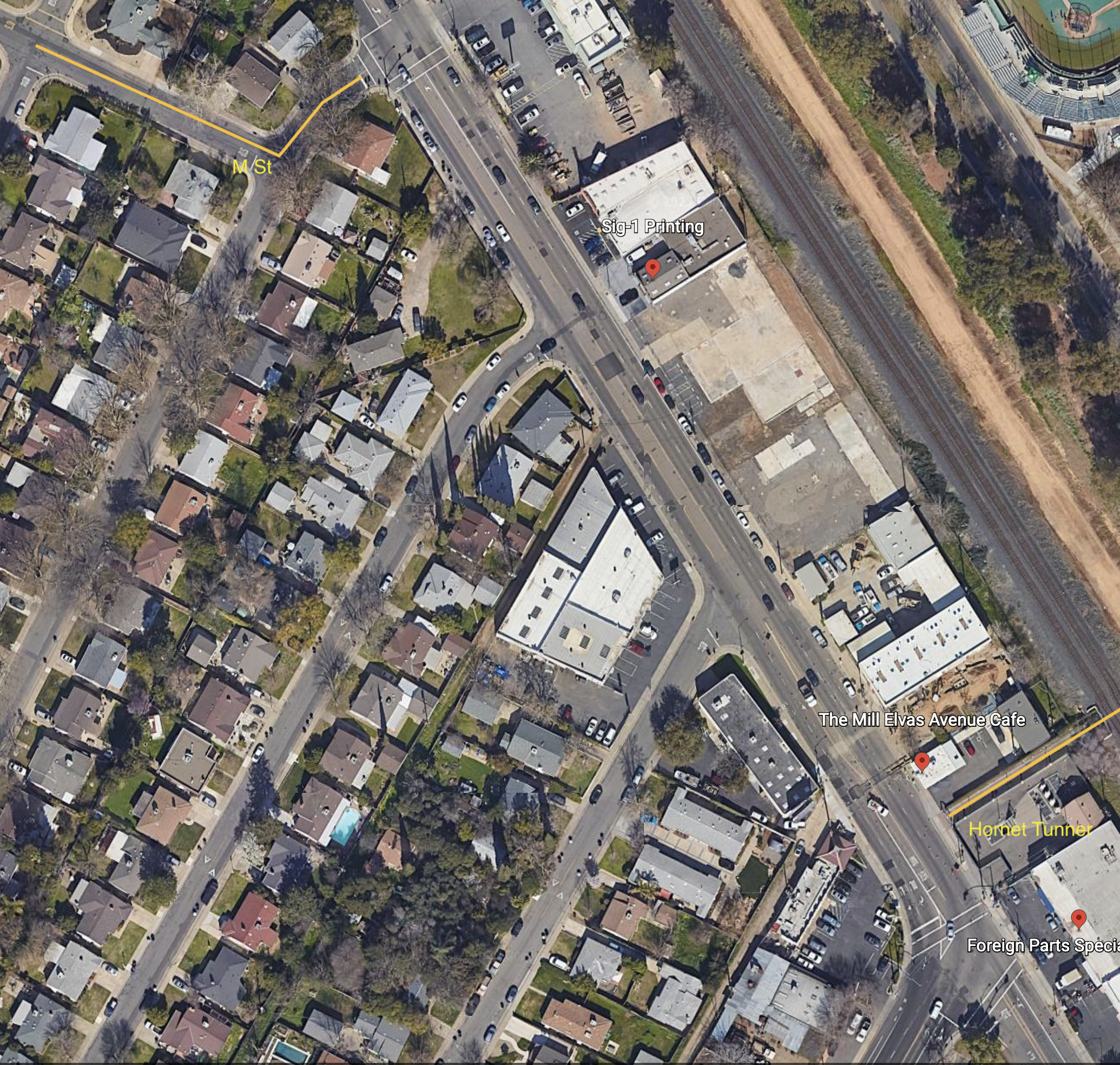
Yes, parts of M Street are great, and should be recognized with a neighborhood or greenway status. Though it is an overly wide street along much of its length, traffic is slow and light, and it meets the definition of a low-stress bikeway.
However, what happens at either end? Approaching Alhambra, M Street ends, with no bike lanes on Alhambra, and no wayfinding for how to shift to a low-stress route to continue westward. At the east end is Elvas Avenue, one of the most hazardous bike routes in the city. Bicyclists exiting onto Elvas Avenue from 62nd Street must cross four lanes of high-speed, high volume motor vehicle traffic to reach the safety of the Hornet Tunnel and SacState. Most bicyclists cross early and ride against traffic. It is slightly less hazardous to go westbound to M Street. There is no wayfinding for how to best deal with this situation.
The city has been aware of the Elvas problem for years. Nothing has been done. This blog has written about it many times: tag:Elvas-Ave.
All of the parking-protected, separated bikeways in the city are discontinuous:
- 10th Street northbound: starts at W Street with an awkward transition from east side to west side; ends at I Street
- 9th Street southbound: starts at I Street; ends at Q Street; design is very inconsistent with bike lane-only blocks
- P Street westbound: starts at 21st Street; ends of 9th Street
- Q Street eastbound: starts at 9th Street; ends at 21st Street
- J Street eastbound: starts at 19th Street; ends at 28th Street
- 19th Street southbound: starts at H Street; ends at W Street with an awkward transition from east side to west side; at Broadway the route transitions to Freeport Blvd with no bike facilities
- 21st Street northbound: starts at W Street with an awkward transition from east side bike lane to west side separated bikeway; ends at H Street with a semi-protected bike signal
For few of these routes do the separated bikeways take you to a final destination. There are transitions to regular bike lanes, or no bike lanes at all, at the ends of each segment. That is not a connected network. It is disconnected!
Almost every advocate in the city is supportive of Jennifer Donlon Wyant and all she has accomplished to make the city more bikeable, more walkable, more livable. However, the city policy, by staff at a higher level, and city council, to spend almost none of its general fund on transportation safety, and to rely only on state and federal grants. means that the city will continue to rank low on any assessment of bicycle friendly.
Sacramento needs a connected network, and we are far from that.
 Getting Around Sacramento