In compiling this list, I realized that it was becoming very long, so I’m splitting it into two lists, the second on non-City of Sacramento to be posted shortly.
There are so many actions and possibilities for improving the efficient, equity, and safety of our transportation system that I can’t keep up with it all, and even nonprofits that have staff are unable to keep up. So, what’s going on? The list below is not in any priority order, but may give you ideas about what you would like to get involved in. It takes a village!
City of Sacramento
- Street Design Standards Amendment: This is ongoing. The organization most involved is Strong SacTown, and of course, Getting Around Sacramento
- Streets for All Active Transportation Plan: This is ongoing. The neighborhood connections part of the plan, perhaps the most important element, will open a public input process in November, with two online workshops.
- Work Zone and Event Detour Policy: This is ongoing, however, opposition in Public Works has delayed this policy by many months, and it will take public pressure to free it up.
- Active Transportation Commission (SacATC): Though it has been pretty ineffective since founding in 2018, the addition of strong leaders to the commission and the notice of supportive city council members has opened the opportunity for real progress.
- Vision Zero: Though the city committed to Vision Zero in 2017, the rate of traffic fatalities and severe injuries has increased every year since, because of the city’s unwillingness to take dramatic action, and the very very slow process of depending on grant funding to improve streets. The focus on corridors and inattention to intersections is also a flaw. The Vision Zero plan is being updated, but so far there has been no public involvement.
- Speed limits: The city reduced speed limits in many school zones several years ago, on a few streets recently, and is working towards additional reductions under AB 43.
- Emergency Declaration on Roadway Safety: Vice Mayor Caity Maple, Mayor Darrell Steinberg, and council member Karina Talamantes are sponsoring an emergency declaration on roadway safety, to address the epidemic (pandemic?) of traffic violence in the city. The initial proposal focused on ineffective traditional responses, but they seem open to more innovative and effective approaches.
- Climate Action and Adaptation Plan: This plan, now part of the 2040 General Plan, set targets for walking, bicycling, and transit mode share, that were less ambitious than proposed in the Mayors Climate Action Plan, but nevertheless significant. Reaching these targets will require proactive changes to transportation funding allocation, street redesign, and implementation of quick-build projects.
- Transportation Priorities Plan (TPP): This plan was adopted in 2022, to guide city investment and grant seeking based on objective criteria, rather than the whims of traffic engineers. Though the priorities could have been better weighted towards equity, active transportation, and climate action, it is nevertheless an immense improvement. Citizens will have to monitor the city’s decisions to ensure that the plan is followed, and improved over time.
- Shared Mobility/Shared Rideables: The city has a shared rideables program which has resulted in a plethora of electric scooters in some parts of the city, and almost none in others, and almost no bike share at all, though we once had the second most successful bike share in the US. The city has chosen to let the market decide, the commercial companies, and has refused to consider city subsidy or a city program to ensure more widespread and equitable availability.
- Quick-build: The active transportation community has requested that the city implement a quick-build program, with funding, that can respond quickly to crashes and traffic safety issues. Leadership has primarily been by Slow Down Sacramento. Though the city has discussed a program, they have so far refused to implement or fund a program.
- Red light camera enforcement (no link because the city removed its page): The city participated in the county’s red light camera program, but when the county dropped the program, the city did as well, and so far as is known, has no plans to develop their own program. Red light running is epidemic (pandemic?) in Sacramento, and elsewhere, and there must be an automated enforcement program, with equity guardrails, to address this traffic violence issue.
- Daylighting: State law (AB 413) prohibits parking with 20 feet of intersections, in order to increase visibility between drivers and people walking. The city has not said whether it will enforce this law, nor whether it will add signing or red curbs to communicate it to drivers. So of the benefits of daylighting can also be achieved through temporary (quick-build) or permanent curb extensions.
- Speed camera enforcement: The city is not part of the speed camera enforcement pilot program (though to its credit, it asked to be). The city should continue to ask to be part of the pilot program, and to fully participate when the program becomes permanent.
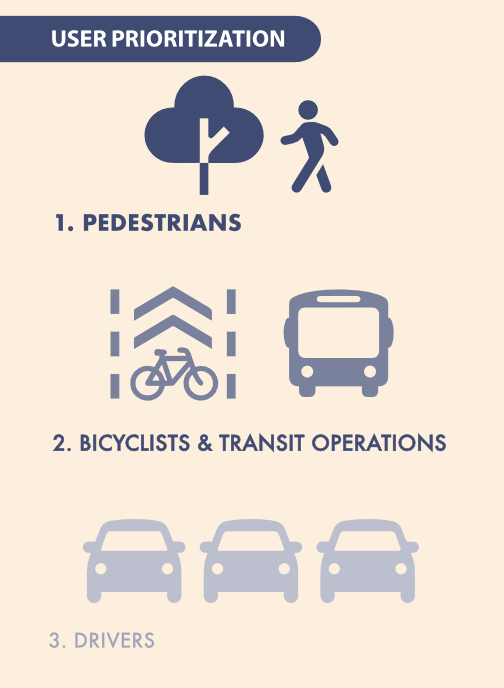
- The 2040 General Plan: The plan sets a new vision for mode priority in the city (graphic below). This is a seismic shift in priorities, and will be resisted by many city staff, so it will take citizen pressure to ensure that it is followed.
This list no doubt misses some important topics. Please suggest them in the comments. The next post will include some actions that are applicable to City of Sacramento, but also to other cities, the county, and the region.
 Getting Around Sacramento
[…] specific to City of Sacramento were in a previous post, while these items are about other locations, and/or applicable to all the […]
LikeLike