Strong SacTown has created a great visual introduction to quick-build fixes for street safety, posted to Instagram. I encourage you to take a look. The series includes curb extensions and modal filters (traffic diverters), both quick build with temporary materials, and permanent installations. Of course temporary materials should eventually be replaced with permanence, but it is better to get something on the ground now rather than waiting for the planning and money it takes for permanent installations. We are experiencing an epidemic of traffic violence, and even small actions can reduce fatalities and injuries. These installations are also called tactical urbanism, though the definition of quick-build and tactical urbanism is not identical.
Some additional ideas that are not always thought of as traffic calming.
Street Design
We can design better streets to begin with so that the need for traffic calming is reduced. Example one is the wide medians in Boulevard Park, which reduces turning movements to the intersections while providing a pleasant environment. Example two is wide sidewalk buffers in the Poverty Ridge area, where narrow streets reduce vehicle speeds, and the sidewalk buffers provide a pleasant environment. I have watched motor vehicle drivers passing each other on these narrow streets in the Poverty Ridge area. They are slowing to about 5 mph to pass. This is a traffic violence reduction design in action!


Diagonal Parking
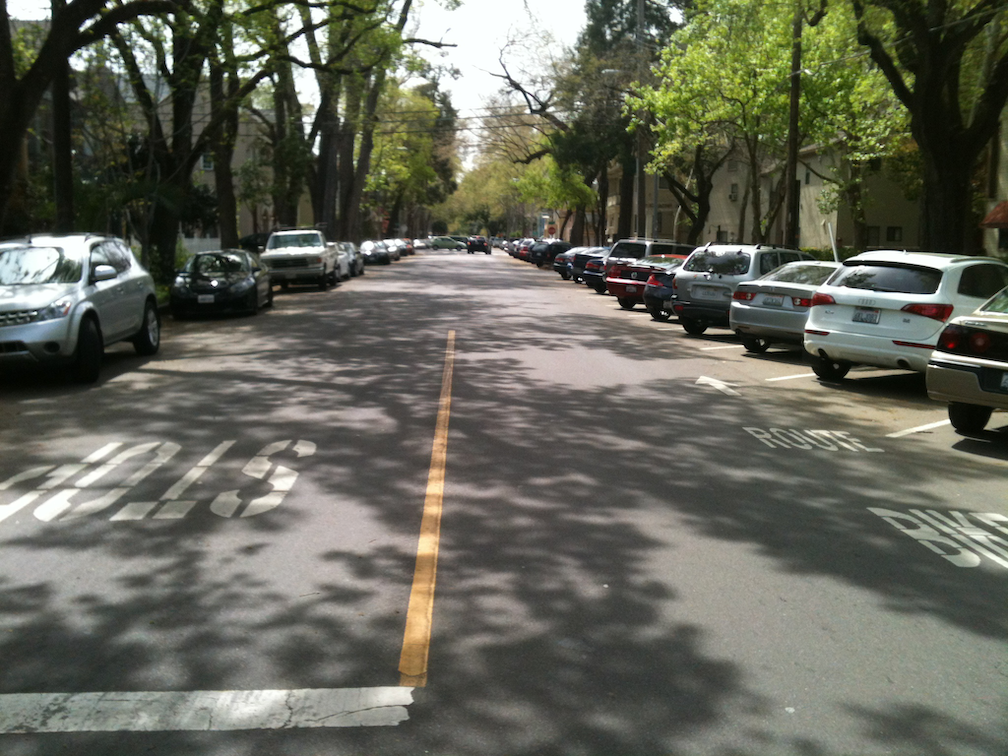
Nearly every street in the central city is overly wide. For many streets, three vehicles could easily fit across the width without even coming close to each other. Wide street encourage speeding. Adding diagonal parking to these overly wide streets can narrow the roadway significantly, resulting in lower speeds due to the greater sense of friction. Diagonal parking is sometimes criticized as making it more dangerous for bicyclists, but it doesn’t really. If the space is better used for bicycle lanes, great, put them in, but most streets need traffic calming to reduce speeds and make it safe for bicyclists to use the street. Reverse angle diagonal parking, which has been installing in a few places in the city, is safer than head-in diagonal parking, but both make for safer streets. Note in the photo below that even with diagonal parking on one side, the street is still too wide. The bike route stencil should be in the middle of the travel lane, not adjacent to the parked cars.

Slow Streets
The city has a slow streets program, which they called Slow Active Streets, during the pandemic. But they gave up on it for two reasons: some drivers didn’t like it, and the city was spending money on labor and materials fixing signs that were unintentionally hit, or intentionally hit, by drivers, and would not let neighbors take responsibility for the signing. There were also closed streets (R Street, Capitol Avenue, 20th Street) that were removed under the claim that business owners were opposed, though the city never provided any proof of that, nor did business owners contacted by advocates back up that claim.

No Turn on Red
Installation of no-turn-on-red signing holds motor vehicles at signals while walkers are crossing in the perpendicular crosswalk. Walkers are often hit by drivers who are looking only left for other cars, and not to the right for people walking. Of course some drivers violate no-turn-on-red, and once the signal is green, some drivers turning fail to yield to people walking in the parallel crosswalk. The city has installed no-turn-on-red in a few places, but it is uncommon. Note that in the case of one-way streets and intersections of one-way streets, the case may actually be no left turn. See the earlier Jackrabbit Trail crossing at Truxel Rd post for the three sign options.
Cities all over the United States are talking about or already have instituted on turn on red laws, sometimes citywide, sometimes in specific problem locations.

 Getting Around Sacramento
[…] and permanent in the long run. Temporary extensions are inexpensive and can be installed quickly (Strong SacTown quick-build street safety), while permanent extensions are more expensive and require planning. Sometimes curb extensions […]
LikeLike