This is a follow-up to my serious concerns about Broadway post. There will be additional posts about the Broadway Complete Streets project. The Broadway Complete Streets project is underway, with several locations of corners, midblock crossings, curbs, and sidewalks already reconstructed.
It is clear that throughout the planning and construction of this project, sidewalks were ignored or discounted. The project is all about the roadway, reducing motor vehicle lanes to 2 plus a turn lane (from 4), and adding buffered bikeways. It is common in project planning to assume that sidewalks will not be disturbed, and therefore do not need to be brought up to current ADA/PROWAG requirements. However, sidewalks are being replaced, newly constructed, in several locations along Broadway. That means they do have to meet current requirements, and that requirement is a clear width of 48 inches.
The Broadway Complete Streets Final Recommendations (2016) document identifies ‘Sidewalk obstructions or narrow sidewalks’ as a critical issue. It also says “The proposed road diet allows for a buffered bike lane through the entire corridor, and presents opportunities for pedestrian crossing improvements, new pedestrian crossings, and sidewalk enhancements.” However, other than curb extensions at intersections and mid-block crossings, nothing in the design actually enhances sidewalks. The ‘typical cross section proposed’ is below. Though the diagram shows 8 foot sidewalks, the actual sidewalk width varies greatly along the corridor.

The multimodal selection criteria section has this table, showing that sidewalks will be widened to some degree. When looking at the pedestrian space row, keep in mind this is an average width. Minimum width is not mentioned.

Pages 48-53 show sidewalk usage at various widths of 6 feet, 8-10 feet, and 15 feet plus. This looks good, but there is no mention of narrower sidewalks.
An additional document, Addendum to a Certified Environmental Impact Report (2019), provides some additional information about sidewalks. The original broad EIR is the Central City Specific Plan EIR (2018-02). The document provides diagrams for street design throughout the corridor. One example, relevant to this post, is below. Though it is hard to see, note that in the existing/proposed inset, street widths are clearly labeled, but the sidewalk width is not labeled.
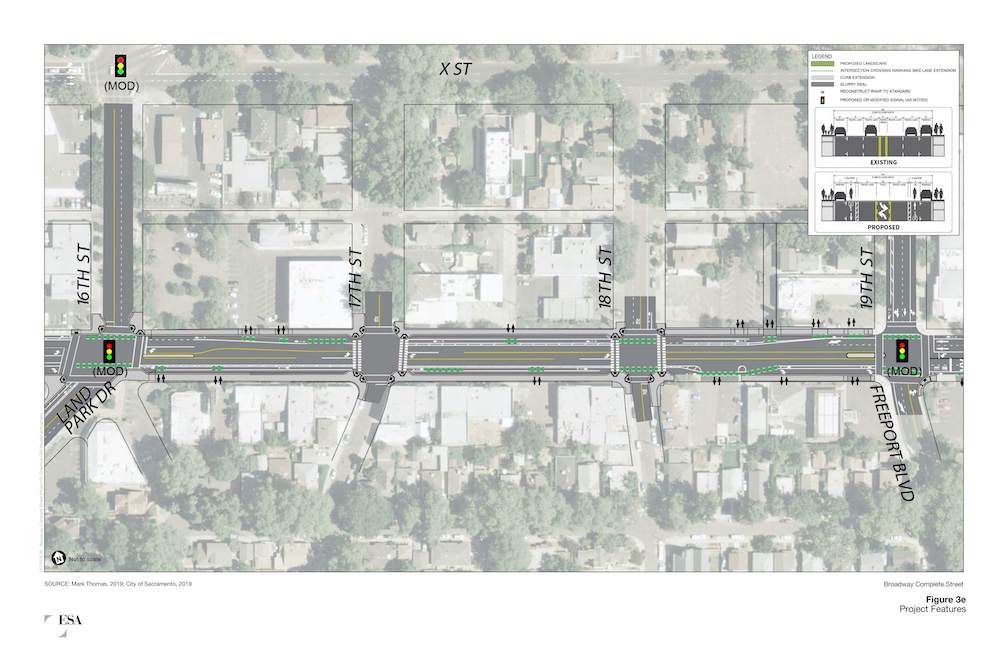
Two text selections from the document are below. Both state that sidewalks will not be narrowed, and that pedestrian facilities would be improved.
Sidewalks: The existing sidewalks would be maintained in most locations except for locations where bulb-outs would be constructed at pedestrian crossings. In select areas along Broadway, such as the Tower Theatre (2508 Land Park Drive), sidewalks would be widened to meet Americans with Disability Act (ADA) requirements and accommodate street trees and planters in front of the theatre. Where standard vertical curbs will be installed to replace rolled curbs, sidewalk reconstruction may be required to conform to the new curb elevation. Other sidewalks areas along Broadway may be widened or replaced based on assessment of existing sidewalk conditions to determine whether sidewalks comply with ADA standards and/or are in need of repairs. This determination would be made during the development of preliminary design plans.
The proposed improvements to pedestrian facilities along the Broadway Corridor are consistent with those described and analyzed in the CCSP EIR. Proposed improvements would include bulb outs and pedestrian-scale lighting. Other project roadway improvements would reduce potential for vehicle-pedestrian conflicts, maintaining pedestrian access to the corridor while improving travel conditions for pedestrians. Consistent with the findings of the CCSP EIR, the proposed project would result in a lessthan-significant impact to pedestrian facilities, as project improvements would improve pedestrian access.
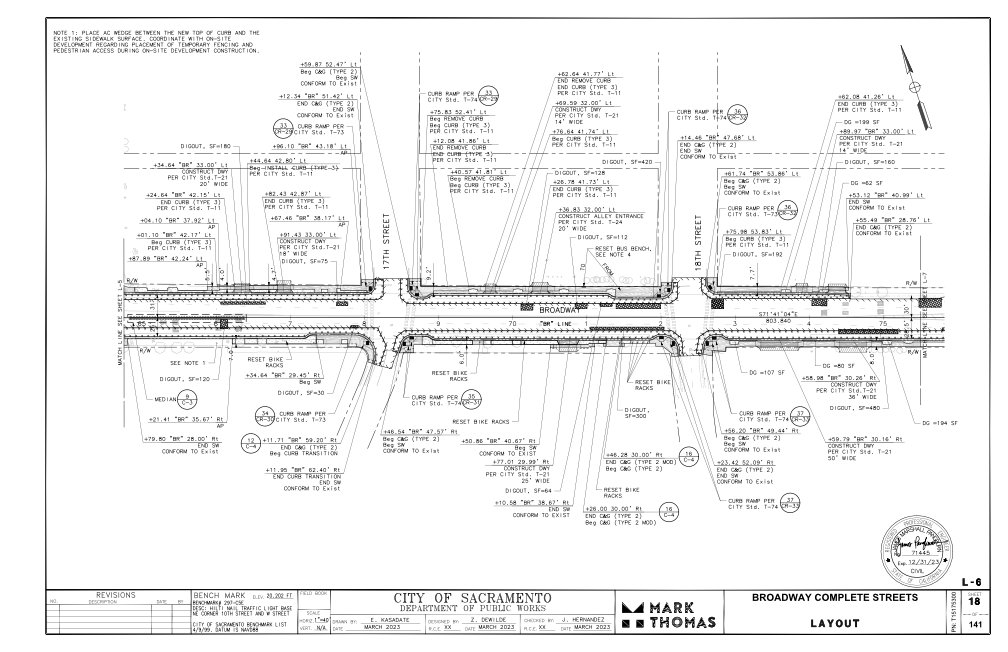
Now, on to the engineering design document, Broadway Complete Streets Plans – Combined (2023-03). Selecting one sheet for 17th Street to 18th Street, the diagram is below. It is not possible to read the callouts on this png version, but on the pdf version, they can be read. There are three sidewalk measurements indicated between 16th and 17th, 5 feet five inches, 4 feet, and 4 feet 7 inches. These would all meet the ADA/PROWAG requirement of a minimum of 48 inches of clearance. For the block between 17th and 18th, there are no sidewalk measurements, but one measurement of 9 feet 2 inches between the curb and the inner side of the sidewalk.
And now, on to the reality on the ground. The sidewalk between 16th Street and 17th Street is mostly complete. It was all replaced, meaning it is new construction, subject therefore to current PROWAG requirements. The sidewalk between 17th Street and 18th Street is largely complete, and was mostly but not entirely replaced.
Between 16th and 17th, I measured sidewalk widths of 43 inches, 44 inches, and several 47 inches, each at a tree well where the sidewalk was narrowed to accommodate an existing tree. These widths do not comply with ADA/PROWAG requirements. Though these sidewalk narrowing are common all over the central city, there are modifications of existing sidewalks to correct root heaves, not new construction. New construction must meet current requirements, not those when the replaced sidewalk was built. Between 17th and 18th, I measured sidewalk widths of 35 inches (x2), 36 inches, 37 inches. These widths do not comply with ADA/PROWAG requirements.

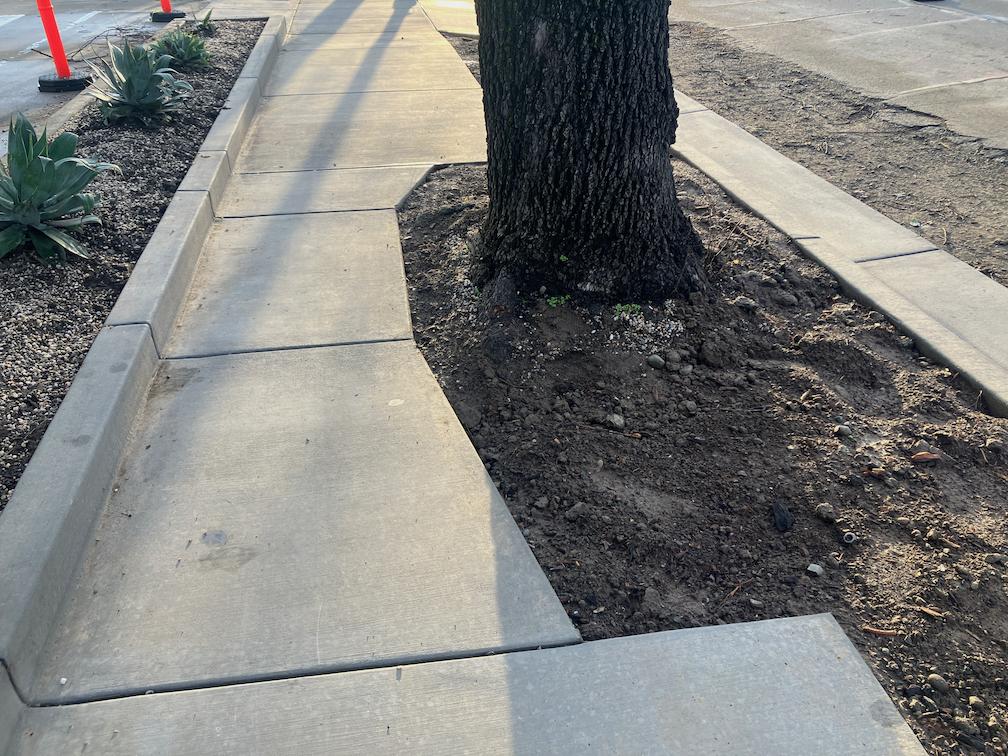
I don’t know how to best solve this issue, but then, it is the city’s responsibility to solve the issue, not mine. But the city must change the constructed sidewalks, in some way, to comply with ADA/PROWAG. Maybe parking will have to be removed in part of all of those two blocks, to create sidewalk space on the other side, the roadway side, of the trees. I certainly am not asking for the removal of the trees to solve the problem, and I’m sure the public would be irate if this were done.
 Getting Around Sacramento
The Central City Specific Plan EIR is available online. Search for EIR on the City’s web site, of Community Development Department, Environmental. Any questions or problems accessing the document, let me know. Tom Buford, tbuford@cityofsacramento.org.
LikeLike
Thank you. The post was updated with that link.
LikeLike
[…] city must correct its too-narrow sidewalks along Broadway. Where a parking lane is adjacent to these too narrow sections, the parking lane […]
LikeLike