I developed comments on the Draft Criteria and Guidance to Accommodate Active Transportation in Work Zones and at Events, and submitted them to the city, attached if you wish to take a look. There is a roundtable meeting for stakeholders on January 9, and a community meeting later in the month, possibly January 24.
PROWAG (Public Right of Way Accessibility Guidelines), released in August 2023, has the force of law, whereas MUTCD and CA-MUTCD are advisory, so relevant sections of PROWAG must be referenced in the work zone guidance.
Signing
PROWAG Chapter 3 says: [R303.2 Signs: Signs identifying alternate pedestrian access routes shall be provided in advance of decision points and shall comply with R410. Proximity actuated audible signs or other non-visual means within the public right-of-way of conveying the information that identifies the alternate pedestrian access route shall also be provided.]
The draft guideline says: ‘Proposed design and placement of the temporary traffic control signs, devices, and roadway markings must follow the most recent edition of the CA MUTCD.’
The draft guidelines must make clear that CA-MUTCD/MUTCD signs as shown on the diagrams must be used. This is a common failing of construction zone signing. Companies, and the city, use whatever similar signs happen to be on hand. They use roadway construction signs, and paper signs that melt in the rain and blow away in the wind. Note: I submitted a comment to FHWA for the MUTCD revision that these signs should be construction orange, as they are temporary construction closures, not permanent. They didn’t listen.

Barriers
MUTCD text and figures show barriers in crosshatched orange. Unfortunately, neither MUTCD nor PROWAG show details of what that barrier should look like. It is common in construction projects to use chain link fence or roadway construction barriers on sidewalks, but these do not meet the requirements for detectability by persons using canes. Though PROWAG does not specifically address barriers (unfortunately), it does have the text: R303.6.1 Top: The top of the top detectable edging shall be no lower than 32 inches (815 mm) above the walking surface and be free of sharp or abrasive surfaces, and R303.6.2 Bottom: The bottom of the bottom detectable edging shall be 2 inches (51 mm) maximum above the walking surface.
There are two diagrams that I’ve used before, left and center. Right is a commercial product (though note is is only compliant if the props are away from the walker, otherwise they are a trip hazard). This model has been used in several places in Sacramento, but they tend to fall down in wind, so may not be the best. The channelizer in center is often used as a barricade at crosswalks, and I believe this use is compliant, and they don’t fall down in wind. The draft guidelines must include some sort of diagram, otherwise, companies will use whatever is on hand, and whatever a sighted person thinks is sufficient.

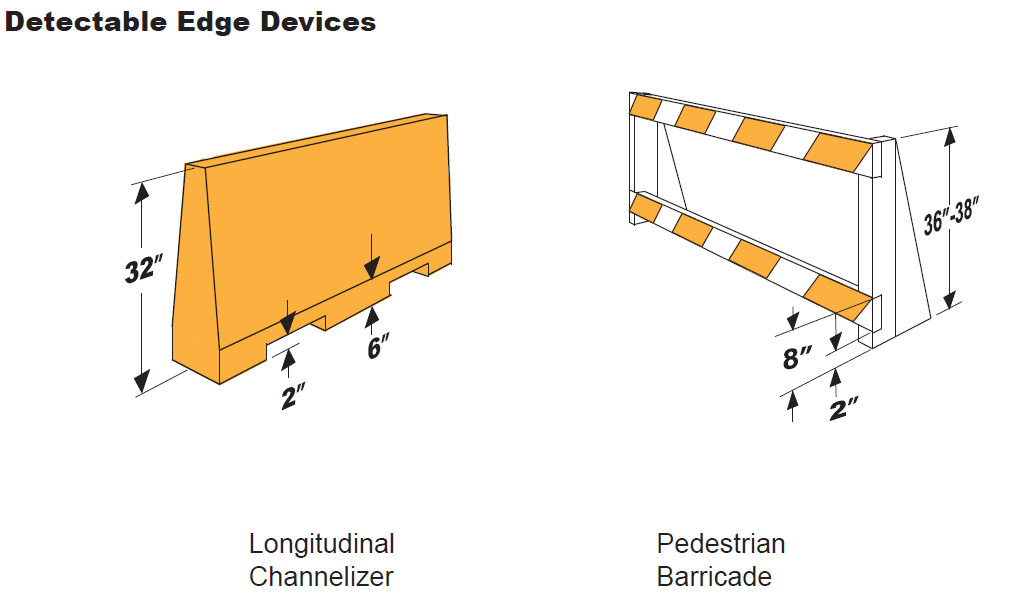

The left diagram is from Applying the Americans with Disabilities Act in Work Zones: A Practitioner’s Guide (https://workzonesafety.org/publication/applying-the-americans-with-disabilities-act-in-work-zones-a-practitioner-guide/), and the center diagram is from Work Zone Pedestrian and Bicycle Guidance (https://www.vdot.virginia.gov/media/vdotvirginiagov/doing-business/technical-guidance-and-support/technical-guidance-documents/traffic-engineering/WZ_Ped_Bike_Guide.pdf).
Diagrams
The sidewalk diagram in the new 2023 MUTCD Figure 6P-28 is better than the 2014 CA-MUTCD Figure 6P-28 because it makes clear that ramps from sidewalk level street level are necessary for a diversion. That diagram is below, and should replace the one in the draft guidelines. Figure 6P-29 is the same in both.

 Getting Around Sacramento
[…] across the width of the sidewalk. I think that the three examples I used in my previous post (SacCity work zone comments) would be compliant, though I am not […]
LikeLike