All-lanes tolling means that all lanes of a freeway or bridge are tolled, or priced. Freeways and bridges are incredibly expensive to build and maintain, even if they are not way over budget as most bridges and many freeways are. Gas tax or road charge (road charge) will never be enough to pay for these infrastructure projects and maintenance. Therefore, more than half of the cost is shifted onto taxpayers who use less of these facilities, or don’t use them at all. In the future, either more and more taxpayer funds will go to keeping these facilities in state of good repair, or they will deteriorate, which is already happening in many places. The solution is to have the users of such facilities pay the full price of such facilities.
Caltrans approach to transportation is to continually build more and to under-maintain what they already have. Anyone who says the era of big, expensive bridge and freeway projects is at an end doesn’t know Caltrans. Caltrans is like the heroin addict who needs ‘just one more hit, and then I’ll quit’. The only solution is to have Caltrans go ‘cold turkey’, ceasing all freeway expansions and focusing on maintenance. Of course most Caltrans engineers would be suddenly superfluous, and that it the real issue, that freeway and bridge building is just an employment program for engineers, having little to do with meeting the needs of the traveling public.
MTC (Metropolitan Transportation Commission) is the Municipal Planning Organization, MPO, for the nine county Bay Area, similar to SACOG in the Sacramento region. MTC is considering all-lane tolling in a study to determine how to fund maintenance of freeways. I encourage you to view the MTC presentation at the SPUR Digital Discourse in January 2023 (https://www.spur.org/sites/default/files/2023-01/NGFS_SPUR_Jan2023.pdf). The best summary page is below. Keep in mind that this is a long term study, and solutions might not be implemented before 2035. Nevertheless, the Sacramento region could learn a lot from the study, and even implement some ideas before 2035. Other MTC pages and documents of interest: Express Lanes START, Next Generation Bay Area Freeways Study, Bay Area Express Lanes, and Open Road Tolling. Yes, Sacramento is not the bay area, but anyone who claims we can’t learn from each other is stupid.
Most Bay Area bridges are already all-lane tolled, via the Bay Area Tolling Authority and the Golden Gate Bridge Highway and Transportation District. So the issue for the Bay Area is the freeways, some of which currently have HOV, HOT, or Express lane tolling on one lane, but many freeways do not have tolling at all.
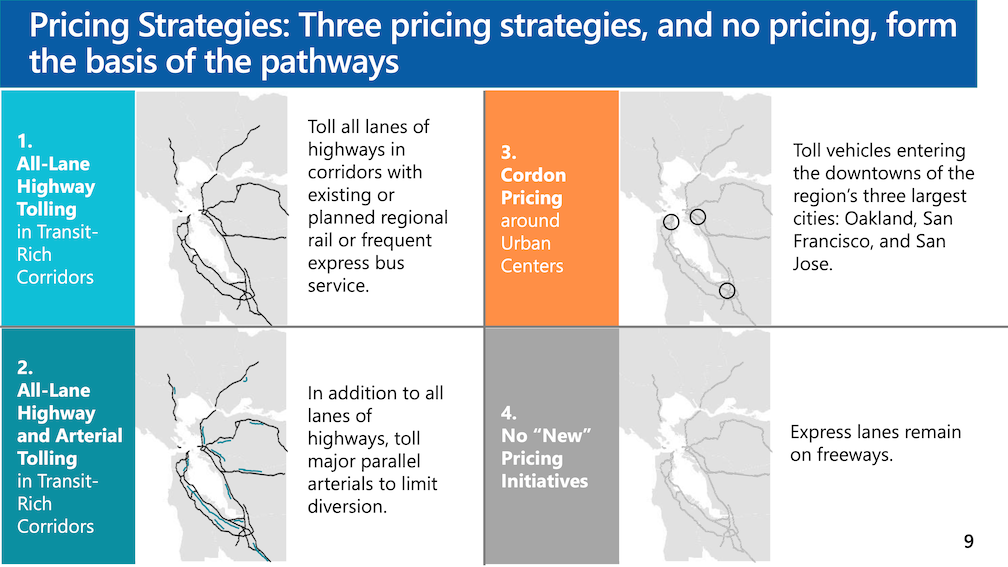
Note that it says ‘in Transit-Rich Corridors’ for two of the options. Sacramento currently has three corridors that might be considered transit-rich: Capitol Corridor between Sacramento and the Bay Area (if frequency were improved), light rail to Watt/I-80 for I-80 (if access and connections were improved), and light rail to Folsom for Hwy 50 (if access and connections were improved, and after 15-minute service to Folsom is implemented). I-5 does not have an alternate transit corridor. None of these are comparable to transit-rich corridors in the bay area provided by BART, Caltrain, Capitol Corridor, and several high frequency and BRT-ish bus services. To achieve this level of transit-rich in the Sacramento region will require funds beyond that which might be available from a new sales tax measure (which has been delayed until 2026, or beyond). I believe that tolling/pricing is the only practical source of funds that will allow our region to develop transit rich corridors parallel to our freeways, and beyond, as well as maintaining what we have. Note: I can’t find an official definition of high frequency rail, so I’m going to say 30 minutes during peak times and 60 minutes at all other times. Capitol Corridor and San Joaquins do not achieve this yet.
I believe that all-lane tolling is the best ultimate solution. Freeways should not be free. The illusion that they are free to use is the same that biases motor vehicle drivers over all other modes and users. The money is coming from somewhere, so the question is, is it coming from the users of the freeways, or from everyone? For individuals, paying for what they use would cause them to use less, and shift travel to other modes. Yes, people would still drive, but less than they do now. For freight, paying true costs would no doubt increase the price of goods transported by truck. Truck freight traffic is highly subsidized, most prominently by not making trucks pay their share of road damage. Rail freight is not directly subsidized, though in a sense accepting the diesel pollution, disruption of travel across rail corridors, and dominance over passenger rail are indirect subsidies.
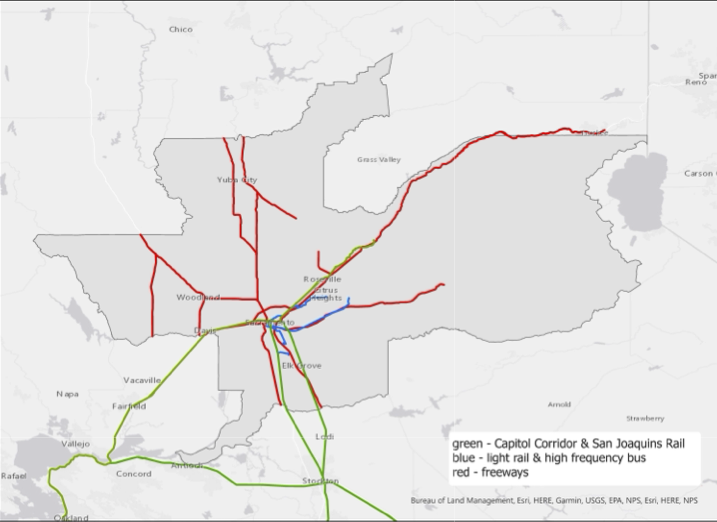
Below is a map of the SACOG region showing freeways, rail, and high frequency transit (light rail and bus). If you squint hard, you may be able to pick out the transit. So the following map shows the area focused on Davis to Folsom. These are sketch maps meant to give a general idea, so pdfs are not provided, and I intend to update and refine the maps.

 Getting Around Sacramento
[…] All-lanes tolling (freeways are not free) […]
LikeLike
[…] Story continues […]
LikeLike