This is Central City Mobility Project update #28.
Rubber Speed Bumps
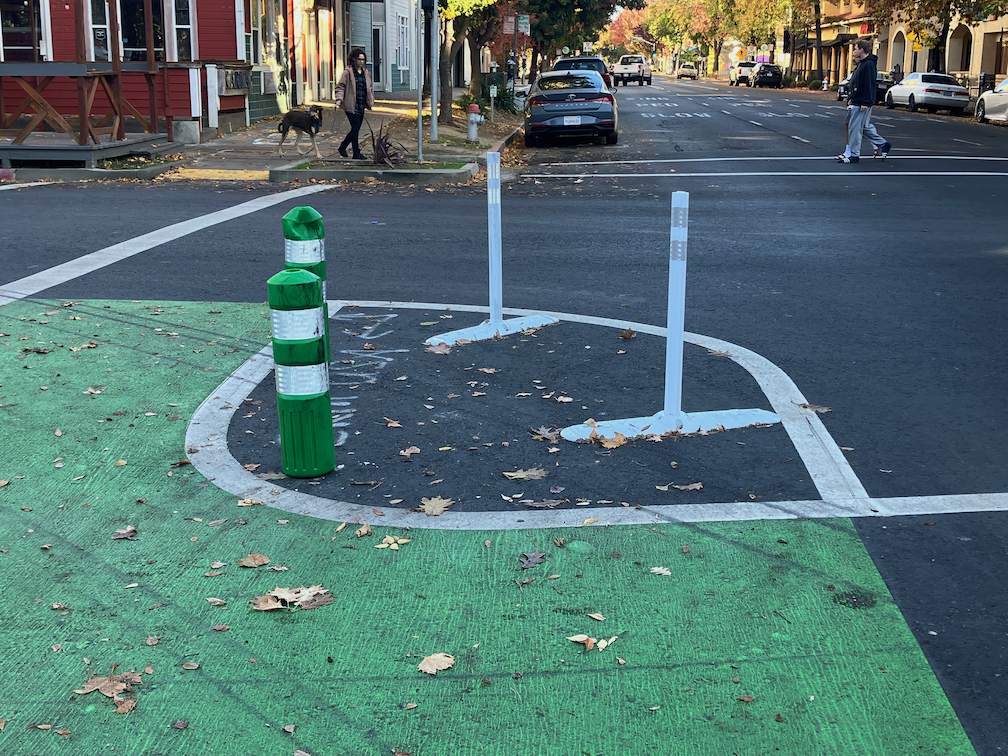
The rubber speed bumps have finally been installed on most of the non-concrete turn wedges. These are marked by vertical delineators, as shown below. it is odd that most of these installations have both green K-71 vertical delineators in addition. These K-71s might have been installed temporarily, while waiting for the rubber speed bumps, and be removed later, or may be permanent. In some of the locations, the white vertical delineators have already been hit and bent by errant drivers. I have not visited all of the locations where the rubber speed bumps have been installed (or not), so don’t have any more information. More info about the rubber speed bumps is available from the vendor TreeTop Products.
5th Street
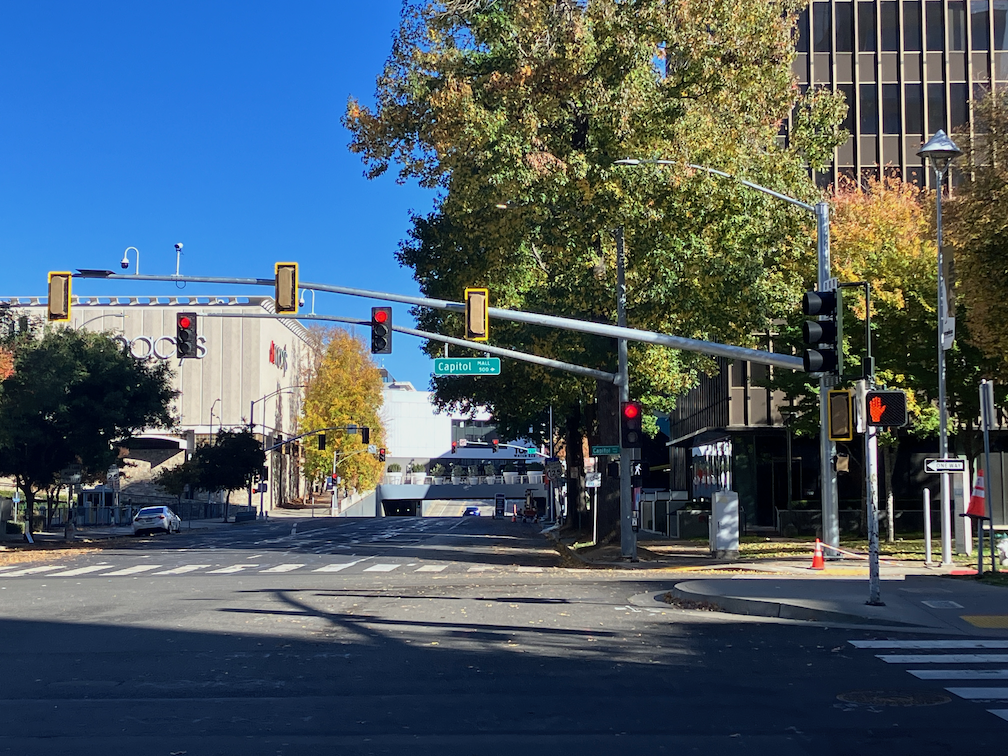
All of the new signals have been installed for 5th Street, but are covered until the street is restriped for two-way traffic. 5th Street is being converted from one-way to two-way. The photo below shows the new signal at 5th Street and S Street (more about this location in a separate post). The new signals have three signal heads, which is excessive for a street like this. None of the existing poles, mast arms, or signal faces are being reused. I presume they will end up discarded in a city boneyard. This is a waste of your taxpayer money, but then that is what the city likes to do, to waste your money. I suspect that for the entire Central City Mobility Project, the expense of the signals on 5th Street is a major part of the expense. Money saved on signals could have been spent on better bicycle facilities, but was not.

At 5th and P Street, 5th and Capitol Mall, and 5th and L Street, there are four signal heads, with the left-most one being for a dedicated turn lane. The signal head is placed far to the left, leaving space only for a minimal bike lane in the opposite direction. A closer look at the design diagrams seems to indicate that northbound bike facilities will be squeezed out approaching X Street. An unnecessary dedicated right turn lane is retained at Capitol Mall. The hazardous double left at I Street is being maintained. In many blocks, three or even four travel lanes are being squeezed in where only two exist now. In many locations, the bike lane is narrowed to five feet in order to retain eleven foot motor vehicle lanes and seven foot parking lanes. On some of the diagrams, bike lane width is unlabeled, so uncertain. Because of the design trying to squeeze in everything, the bike lane shifts back and forth, and changes widths, within and between blocks, making for any unpleasant bicycling experience.
The upshot is that the 5th Street portion of the Central City Mobility Project is a motor vehicle project. Capacity for motor vehicles is not only retained, it is expanded. This is not a bicycle facility project, and in fact, bicycling will be worse after the change than it is now. If this is the sort of project that the city is considering for future one-way to two-way conversions, I’d recommend against any further conversions.
Other
It appears that work on the other streets is essentially complete. There are missed green bicycle facility markings, missed parking guidance with curb colors and pavement signage, and scattered other issues. I don’t know whether these will eventually be picked up, or neglected. None of these are critical, in my opinion.
 Getting Around Sacramento
[…] to convert this from a one-way street to a two-way street, I was focused on the looking at the new signals and the mast arms. I failed to notice all the new beg buttons that have been installed. These are […]
LikeLike