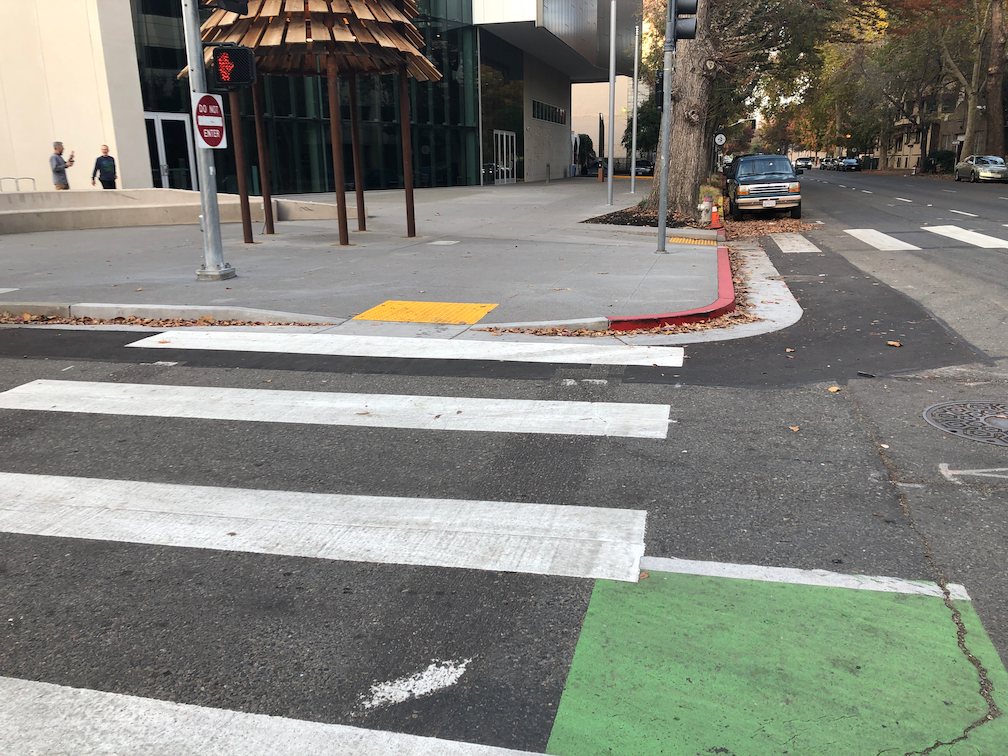
There has been a tremendous amount of infill building, much of it housing, in midtown Sacramento and even downtown. This is a wonderful thing. As part of the construction projects, sidewalks and curbs are often torn up and replaced. In some instances, the replacement is done the right way, with wider sidewalks, directional curb ramps (two to a corner, not diagonal), and curb extensions. But in at least half the replacements, but curb extensions are missing.
15th Street at K Street, missing curb extension, Sacramento
The photo above shows the new sidewalks and curb ramps at the southeast corner of the SAFE Convention Center, at 15th Street and K Street. That much is good, and a big improvement over what was there before.
However, the curb extension on 15th Street is missing. The purpose of curb extension is to slow traffic speeds, to shorten the crossing distance, and to increase visibility between drivers and walkers. But it is missing here. Once the convention center really opens, this will be a very busy crossing for pedestrians, and is already receiving increased use from the performing arts center.
What gives, Sacramento? Every reconstructed corner should have curb extensions. Yes, they must be designed appropriately so they only block the parking lane and not a bike lane, but in this case, there is no bike lane.
“In the year I’ve been in office, I’ve heard from thousands of people regarding their concerns and ideas about needed improvements in their neighborhoods. When I bring these community concerns to staff, I hear a lot of support and empathy for the issues raised, but it is often followed by a somber realization: there isn’t a sufficient budget to provide these services.
While I understand the limitations of the City budget, I also believe there are basic services any City should provide:
Streetlights, particularly in older neighborhoods that lack sufficient lighting to promote safety for all road users.
Sidewalk repair, the costs for which we put onto property owners during the 2008 recession. Sidewalks are a public good everyone uses and should be maintained by the City.
Public Restrooms to serve everyone in our city, particularly at parks. This should also include porta potties near large encampments.
Road and traffic safety improvements, particularly targeting streets and intersections where there are repeated collisions or injuries.
Public garbage cans and collection to help mitigate litter.
These needs aren’t unique to District 4, but are issues I’ve also observed citywide. As we approach the midyear and future budgets, I urge you to join me in asking that we consider the quality-of-life improvements the community is asking for and appropriate funds for these purposes.”
These five items are all transportation issues to some degree or another.
Streetlights: Many people will not walk at night when there is insufficient lighting. They feel unsafe. Many intersections are poorly lit for people walking, providing light for drivers but not for people in crosswalks.
Sidewalk repair: The lower the income level of a neighborhood, which is strongly but not complete correlated with people of color, the poorer the sidewalks. This is an ongoing problem in north Sacramento and south Sacramento, but exists other places. When the city claims it has not responsibility for maintaining sidewalks, but does maintain roadways, it is sending a clear message that drivers are more important than walkers. This must change. The first step is not to start fixing sidewalks, but to change city code so that the city is responsible for maintaining sidewalks, not adjacent property owners. There may be situations in which a tree on private property damages a public sidewalk, but most of the damage from trees occurs by city owned trees in the sidewalk buffer area. In fact, the worst sidewalks are often adjacent to city-owned property, where the ordinance requiring property owner repair apparently doesn’t apply. (In the interests of transparency, if one wishes to see truly horrible sidewalks, visit the City of Los Angeles. Makes Sacramento look like a walking paradise.)
broken sidewalk on V Street, Sacramento
Public restrooms: Any person who is walking is likely to be making a slower trip than a driver, and more likely to need to use a restroom during their trip. Walkers are also more likely to chain destinations, and therefore need a restroom during a longer trip, while drivers often make shorter individual trips to single destinations. The city has resisted making public restrooms available, partially in an effort to make unhoused people unwelcome. One new restroom was built in Cesar Chavez Plaza, and some parks have restrooms available for some hours, but many park restrooms remain locked. For example, the one in Fremont Park has been locked up for two years now.
Traffic safety improvements: This one is obvious. What is not obvious is that the city has an unwritten policy that it will only make major street changes with federal, state, and regional grants, not out of the general budget. A few things are done as part of routine maintenance, when a street is repaved and re-striped, but this is a tiny fraction of what is needed. Improvements to high-injury intersections and corridors should be a funded part of the city budget, not dependent upon grants from outside.
Public garbage cans: Again, people walking are likely to generate things that need to be trashed or recycled. For example, walk to your local coffee shop and then continue on your journey, you end up with an empty cup to dispose of. People driving simply throw it on the floor, or out the window in many cases. And if they throw it on the floor, it is likely to be thrown on the ground the next time the vehicle is parked. I know this because this is the pattern for people who commute in from the suburbs and park in the central city. I’ve observed it hundreds of times. It is true that in areas with active business improvement districts, there are more public garbage cans, but that leaves many areas of the city out, which are just as deserving of the service.
The city discriminates against people walking (and bicycling). These budget items would be a first step towards redressing that.
I will say that the greatest need for these improvements is not in District 4, which has often received more attention from the city than any district other than District 1. Sacramento has had and continues to have a serious equity failing, spending more money on repair and improvements in higher income areas.
This morning I was nearly hit and then assaulted by the driver of an SUV in Sacramento. I was crossing 14th St at the south side of P St at about 7:30AM. The driver had stopped before the crosswalk, so I proceeded across, but the driver lurched forward and nearly hit me. I had to jump back to avoid being hit, and slapped the side of his vehicle to get his attention. I proceeded across the crosswalk and onto the sidewalk. The driver leapt out of this vehicle and came after me, screaming that if I ever touched his car again, he would hurt me. I don’t remember the exact words, but they were violent words. He kept saying “I didn’t see you”, not in an apologetic manner, but in a way that implied it was my fault that he didn’t see me. After yelling a number of more threats, he shoved me. This is assault.
A bystander took photos of the driver and his vehicle, seen below. The bystander used the same term that I often used, ‘entitled drivers’. She was more than happy to provide the photos to me, and expressed hope that I would file charges. I have submitted an incident report to Sacramento PD.
the vehicle: GMC Yukon, grey, license M546BOthe driver, on left, white middle aged male
I notice when walkers and bicyclist post photo of vehicles driven by offending drivers, they often blank out the license number. I’m not sure why. Maybe it is fear of retaliation, worse violence from the driver. But here you go: the license plate was CA M546BO. It is a strange license number.
Back to the entitled. Many drivers feel that they own the road, and it is the responsibility of others to get out of their way. This applies particularly to walkers and bicyclists, but it even applies to other drivers. The excuse often offered is “I didn’t see them”. I think this is often fabricated after the fact to justify what would otherwise not be justifiable, which is an intention or willingness to harm others. But in some case it is true. They didn’t see because they didn’t look. Many drivers are looking at their phones or their large in-dash information displays. In this case, the driver was looking only to the right to see traffic on one-way P Street. He probably never looked left at all. But it is the legal responsibility of drivers to look and to see. If they are not willing to do that, as is true of this driver, they should not hold a license to drive. This driver, in part because he has a large, expensive vehicle, felt entitled to be driving on the street without paying attention, particularly at a crosswalk where walkers have the right of way.
This is the people we share the streets with. And the people about whom traffic ‘safety’ agencies such as National Highway Traffic Safety Administration (NHTSA) and California Office of Traffic Safety (OTS) continue to claim that road safety is a shared responsibility. Bullshit. Drivers kill people, walkers and bicyclists (with extremely rare exceptions) do not.
This is also a street design issue. One way streets are safer to cross for walkers because you only need to look in one direction, left or right. However, for people on cross streets, they are much more dangerous because many (most?) drivers never look the other direction for people in the crosswalk or bicycling.
The Sacramento Tweed group is hosting the annual Tweed Ride on Saturday, December 4, starting at 12:00 noon. The ride is “Winter Wonderland Ride and Picnic”. It meets at WAL Public Market at 1104 R St, at 11:30AM, and rolls about at noon. It is a ‘bring your own picnic’ event. The picnic occurs in a local park. There is sometimes an unofficial after-event visit to a drinking establishment.
There were a number of tweed riders on the SABA Mural ride on Sunday, distributing handbills and encouraging local bicyclists to join. Period clothing is appreciated and celebrated (roughly 1902-1920), but certainly not required. Period bicycles are also appreciated and celebrated, but certainly not required. Come as you are!
The City of Sacramento has 11 red light camera locations: Red Light Running Program. Of these, some are at high-injury intersections, but most are not. These locations are cross-referenced with high injury intersections shown in the post Sac Vision Zero new intersections map.
Location
Top all
Top ped
Top bike
Mack Rd & La Mancha Way/Valley Hi Dr
no
no
no
El Camino Ave & Evergreen St
no
no
no
Howe Ave & Fair Oaks Blvd
no
no
no
Mack Rd & Center Parkway
no
no
no
Exposition Blvd & Ethan Way
no
no
no
Broadway & 21st St
no
no
no
Folsom Blvd & Howe Ave/Power Inn Rd
no
no
no
Arden Way & Challenge Way
no
no
no
5th St & I St
no
no
no
16th St & W St
no
no
no
Alhambra Blvd & J St
no
no
no
My first thought is that the city was putting these cameras in the wrong location. But then I thought, what if the presence of red light cameras is making these locations safer and therefore dropping them out of the highest injury intersection list. I don’t have the information to answer that question, which would take analysis of crashes at the intersections, and before/after data.
What I do know is that many more red light cameras are needed to counteract the pandemic of red light running: pandemic of red light running. I spend time around the edges of Fremont Park, close to where I live, which includes the intersection of arterial streets P, Q, 15th, and 16th, and one of the things I do is watch traffic in the intersections. It has now become rare for a signal cycle for 16th St northbound at P St to not see an incidence of red light running. The other intersections are not quite as bad, but the pattern is there. And this is happening everywhere in Sacramento that I go; these are not likely to even be the worst intersections.
I believe that most of the red light running is by egregious violators, people who routinely and continuously violate traffic law for their own convenience or thrill seeking. This is true of most traffic violations, but red light running is the one most likely to result in fatality and serious injury, for people in all modes of travel. So having a more widespread set of red light cameras would serve to catch these red light violators. Of course the follow-up is necessary, to revoke the licenses and confiscate the vehicles of these repeat offenders. The longer the city looks the other way on this issue, the more people will come to see it as normal behavior, and the less safe our streets will be.
The standard response by cars-first entitled drivers is that tickets are just a money-making scheme by the government. The purpose of red light cameras is to make streets safer, and if that results in some income, so be it. I’m more than happy to have these sociopathic drivers hit in the pocketbook, and the money can be used to make our streets safer, such as by installing more red light cameras. Red light tickets, with photos, are part of the documentation needed to revoke licenses and confiscate vehicles.


 Getting Around Sacramento