the city could do this now

Some things the City of Sacramento could do today, and this week, to improve transportation and safety now and in the future:

  • Paint red curb offsets for all marked and unmarked crosswalks. These are upstream offsets, which have a strong safety value of increasing the visibility of drivers and walkers to each other. Downstream offsets, beyond the crosswalk, are much less important. Paint is cheap! Yes, maintenance of paint is more expensive, but this is important enough to make the investment.
  • Set all pedestrian signals to auto-recall, city-wide. Later we can have a discussion about whether to leave them this way, and how this interacts with the audible signals for limited vision people. I’m NOT saying disconnect the buttons, they would work if you pressed them, rather, that you no longer need to press them.
  • Convert the southbound light rail lane on 12th Street from a shared general purpose travel lane to a transit lane, from C Street to K Street. Having drivers interfere with light rail should never be OK. Consider doing the same for the portions of 7th Street and 8th Street where there is excess vehicle capacity.
  • Enforce, with a vengeance, speeding and failure to yield to pedestrian laws. Impound the cars and revoke the licenses of anyone who has more than one of these violations in a week. Our streets have been taken over by lawless joy-riders, and we need to take them back, for the safety of walkers, bicyclists, and other people in vehicles, and yes, people in adjacent buildings. Yes, these situations will end up in court, about whether the city has the power to do this, but in the meanwhile, we get these people off the street. This is an emergency, after all, and this seems a reasonable use of police emergency powers.
  • Close at least one street of at least a eighth mile length in every census tract. Since census tracts vary by population size, in a very rough way, this distributes the closed streets in the fairest manner. It provides people safe walking space in their neighborhoods, to ensure physical distancing.
  • Close the extra lanes on any street that has more than two lanes per direction, and re-allocate that space to either pedestrians or bicyclists, as demand seems to indicate.

There is construction going on right now on N Street adjacent to Capitol Park. The street has been narrowed from three lanes to one lane, and it is working just fine. The prudent driver, the one following speed limits, or at least in the range, now sets the speed of the roadway, and the egregious violators have to live with it. Which is, I think, why I’m not seeing problems on N Street right now, and am still seeing it on other wide roadways.

What else would you recommend, actions that could take place almost immediately and would not cost much?
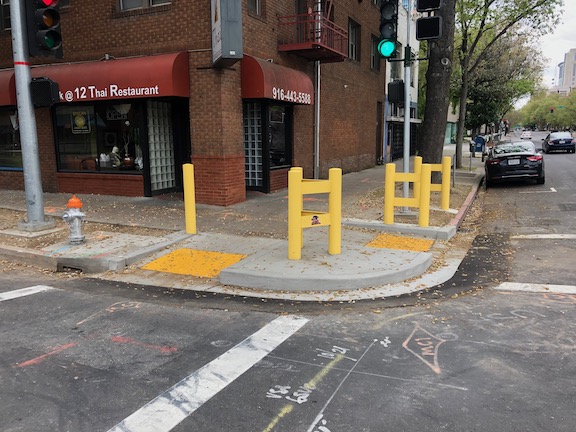
I & 12th crashes

The city has installed substantial bollards on the southwest corner of I Street and 12th Street in an effort to protect the Bangkok@12 Thai Restaurant there.

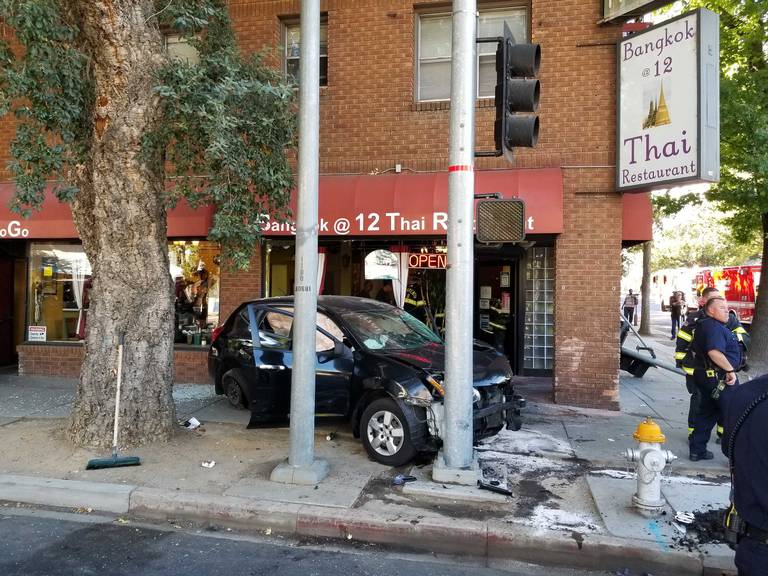
There were at least two major injury crashes into the restaurant in 2019, and the location has a history of crashes (see https://www.sacbee.com/article235349392.html for one example). There were 26 collisions at this intersection in the five year period 2015-2019. This is the most for any intersection in the central city, with the next closest being 19th Street and X Street, at 17.

2019-09-20 crash (photo from SacBee)

Why? Well, the primary reason is that this is the intersection of two 3-lane, one-way arterials, both of which are known to have a history of speeding. The city installed a speed display sign on 12th Street approaching I Street, but has not done so for I Street approaching 12th Street. I had not noticed this sign before yesterday, so I don’t know how long it has been there. Even a brief watch of it indicated that many drivers are exceeding the speed limit, some egregiously so, at more than 10 mph over the speed limit. And then, of course, there are the bollards pictured above. These are not solutions.

The city has identified the section of I Street east of 12th for a reduction in travel lanes from three to two, and that will help. But to the west, no reduction, so drivers will likely be speeding up through the intersection to spread out into the increased capacity. For 12th Street, a reduction from four (!) to three lanes will occur north of H Street, which may reduce speeds approaching here, but in the section between H Street and J Street, it will remain three lanes.

I strongly feel that all roadways of three or more lanes must be reduced to two lanes. Drivers simply cannot be trusted to behave properly on 3-lane roads. It doesn’t matter how much signing we add, or bollards we add, drivers will still speed and will endanger walkers, pedestrians, people in other vehicles, and people sitting down to eat a meal at restaurants.

Solution? The reduction in lanes on I Street must continue westward at least to 10th Street (I would continue it all the way to the freeway, but that is another issue). 12th Street must be reduced from three lanes to two lanes in the section between H Street and J Street (I would reduce it from C Street south). Most of the traffic on 12th Street turns left onto J Street, only a portion continuing south, so having one through lane and one left turn lane would not significantly reduce capacity, but would make things a great deal safer. A bonus would be that the left hand travel lane can be allocated to the exclusive use of the southbound light rail tracks. Currently, the southbound lane is shared between motor vehicles and light rail, and the light rail train is often delayed by congestion and by left turning vehicles. Two birds with one stone, as the saying goes.

The city’s Vision Zero effort focuses on corridors, stretches of street with a high crash rate, and this is not a bad focus, given that most of these corridors are in disadvantaged/disinvested communities. It does not focus on intersections, not even on very high crash rate intersections. San Francisco’s Vision Zero program, one of the leading in the country, identifies the top five corridors, AND the top five intersections. There has been significant though not necessarily complete infrastructure work on each of these. I would like to see the I Street and 12th Street intersection be prioritized for Sacramento.

Who is out there driving?

There has been a lot of discussion Twitter the last week about drivers speeding on roads, just because they can, with the streets mostly empty. Agreement has come in from a wide variety of places, but there are also doubters, who say this is not happening. So, I decided to pay more attention to what is going on. These observations are from Sacramento central city, east Sacramento, and south of Broadway to Fruitridge Road, but mostly central city.

On three lane one-way streets, egregiously poor driver behavior is rampant. It is less common on two lane one-way streets, but still noticeable. It is pretty much absent on two-way streets.

I took some time to observe drivers on two three lane one-way streets in the central city, J Street, and 12th Street, both of which I know to have speeding problems when they are not congested. Both locations had signals every block. I suspect driver behavior would be much worse on sections without signals every block, but have not done observations yet.

On J Street, 38% of the drivers were doing something significantly unsafe or obnoxious. On 12th Street, it was 45%. This was Sunday afternoon. What, specifically, was I seeing?

  • drivers going more than 10 mph over the speed limit (limit is 25 mph on these two streets), sometimes well over
  • muscle cars revving up to high speed between signals and then braking hard for the signal (usually, sometimes they just blew the red light); what I mean by muscle cars is vehicles with a horsepower rating far more that would ever be needed in a city
  • vehicles with exhaust systems modified to be very loud, and which were being driven in a way so as to generate that noise
  • drivers making right or left hand turns, against red signals, without really slowing down

I do not have a radar gun, though it would probably be a good investment. But I have spent many hours at speed display signs calibrating my perceptions of vehicle speed to the what the sign says. There is a speed display sign on 12th Street between H Street and I Street. Though most drivers (the ones not mentioned above) were going no more than 25 mph, some were going up to 35 mph, accelerating in just that one block, and several drivers pegged the display, which means it blanks out the speed and displays a message such as ‘too fast’, which on this sign I think means over 35 mph. How fast would they have been going if the signals were not here?

You might have some hope that the police would enforce against this. Sorry to dash your hopes, but every single Sacramento Police Department vehicle I saw today was going well over the speed limit. Not just a little, and not responding to calls (no siren, no lights), but well over.

Of course the long-term solution to this is not enforcement, but reconfiguring roadways to eliminate ALL three lane (or more roads), and to convert most one-way roads to two-way. The city is working on some of that, but at a snail’s pace, as streets are being resurfaced. We need to accelerate this change, to keep all of us safe, today, during the pandemic, and beyond. Yes, I am even including drivers and their passengers in the ‘us’, as they are as much in danger from this behavior as walkers and bicyclists.

I know that there are also people out there driving for valid reasons, going to essential jobs, to medical care, to buy groceries (though a lot of them could be bicycling). The best thing we can do for those people is to remove the others.

JUMP charging hubs

Someone asked me recently about the locations of JUMP bike charging hubs in Sacramento. There are 18 on the map below, and one new on on 19th Street just north of Q Street, at the Q19 Apartments development. I captured this map from the JUMP bikes website, which took a little doing.

JUMP bike charging hubs in Sacramento

I recently took photos of all the hubs I could find, and they are part of the Sac bike-share album at https://www.flickr.com/photos/allisondan/albums/72157713653167982. I was able to locate only one of the three hubs shown for Sacramento City College. It may be: 1) I just couldn’t find the other two (they are much harder to see at this time since they don’t have any bright red bikes in them), or 2) they are not charging hubs but regular bike racks, or 3) they are located where construction is going on and are inaccessible or removed. All the rest of them have at least one photo in the album.

So far as I know, there are no charging hubs in Davis, nor in West Sacramento (which shown on the map as part of Sacramento).

When you actually rent a bike, the app shows the location of these hubs, but with no bikes to rent (the system is currently shut down, in case you had not heard), I can’t see what the live map shows. But other than the one new one, I think this map is accurate. Let me know if you know otherwise.

16th & E construction problems

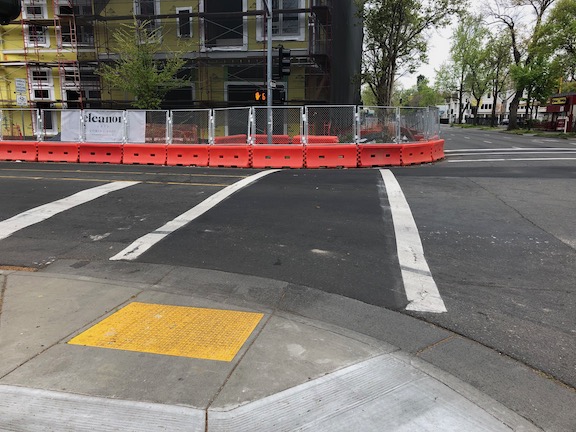
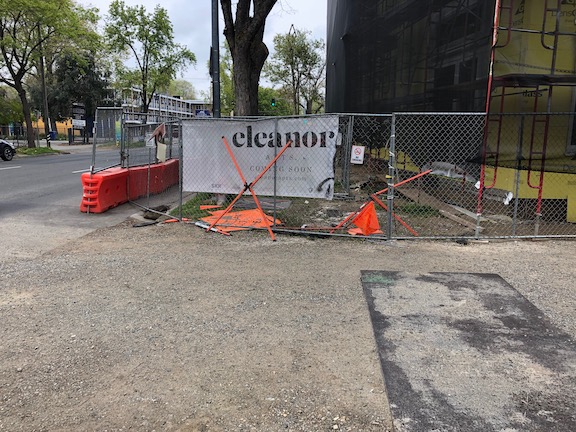
An new housing development at 16th Street and E Street (remember, I’m not against housing developments) has significant problems. At the southeast corner of 16th and E, the corner has been completely blocked by construction barriers and fencing, so there is no safe wait space for people using the crosswalk, and therefore both crosswalks should be closed. There should be a barrier and signing on the east side crosswalk over E Street, and there should be a barrier and signing for the south side crosswalk over 16th Street. Neither are there.

16th Street & E Street, no crosswalk barrier

The project also has problems on 16th Street approaching from the south, where the sidewalk end, but a small sidewalk closed sign is not visible because it is on a canted fence, and there is no advance warning at F Street.

16th Street northbound, no visible signing

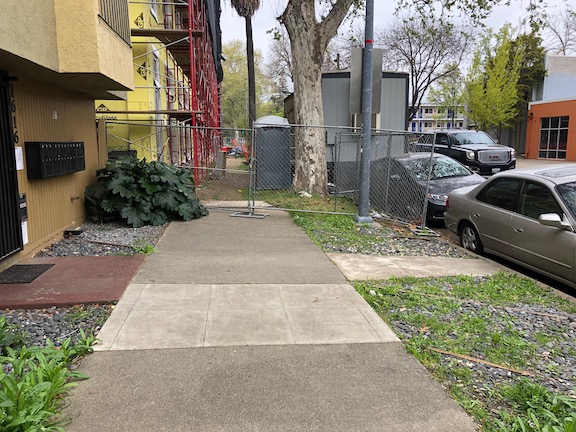
On E Street westbound, there is a construction fence with no sidewalk closed signing, nor is there any advanced signing at the last safe crossing at 17th Street.

E Street westbound, no signing

This property and development is apparently owned by SKK Development, Sotiris Kolokotronis, and is called Eleanor Apartments.

closed sidewalk & dead project at 700 16th

The apparently dead redevelopment project at 700 16th Street, the old Clarion Hotel, which occupies the block between 16th and 15th, and H Street and Government Alley, has closed sidewalks for a long period of time, even though nothing is happening there. The sidewalks closed are on H Street, the entire block, and 15th Street, the half block. As seen in the first photo below, there is enough pedestrian traffic on 15th Street to have worn a path in the sidewalk buffer. The solution here is to require the developer to remove this fence. If fencing is needed, which is doubtful on this side of the building, it should be on the property and not in the buffer. Re-opening this piece of sidewalk until such time as there is active development is the right thing to do.

15th Street use path, north of H Street, old Clarion Hotel

On the northwest corner of 15th Street and H Street, the corner could have been left open so that the two crosswalks could be safely used, but it was not. Instead, a sloppy fencing job leaves a sidewalk too narrow for ADA use.

15th Street & H Street, northeast corner, no ADA access for crosswalks

The sidewalk closure on H Street might need to remain because there is building access on this side, but it should be properly signed approaching from the east, which is is not.

H Street & 16th Street no signing

Lastly, on 15th Street southbound at Government Alley, there is a fence but no signing, and there is no advance warning at G Street that the sidewalk is closed ahead.

15th Street at Government Alley, no signing

This property is apparently owned by SKK Development, Sotiris Kolokotronis, and is called The Bernice. This failure to accommodate walkers is both the fault of the owner/developer, for the poor job of fencing and signing, and of the city for failing to monitor the situation (and perhaps for allowing it to exist in the first place). This also points out that there must be bonds for construction zone fencing and signing so that if a owner/developer fails to proceed with development, the city can go in and partially or fully restore access at the developer’s expense.

Sac permanently closes sidewalk

Note: updated 2020-03-28 to correct lane descriptions and add a photo of the lane shift.

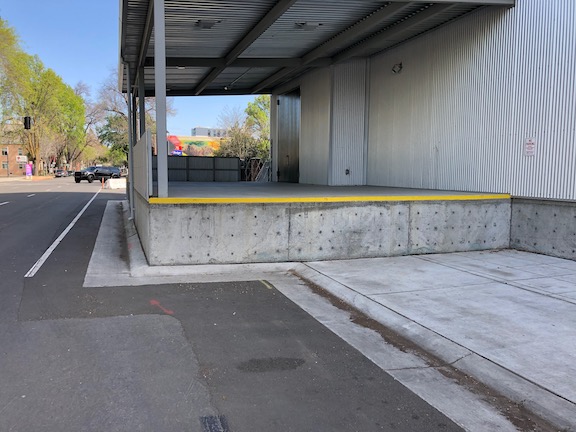
On the south side of I Street, between 15th Street and 16th Street, the city has permanently closed the sidewalk. This was to construct a loading dock for Memorial Auditorium. I had noticed the construction going on there, the first phase of the city’s project for the convention center and community center theater, and just assumed things would be returned to normal when construction was complete. How wrong I was. I was flabbergasted when I saw this. The loading dock sticks quite a ways into what used to be the public right of way, erasing the sidewalk and two parking lanes (the general purpose lanes were shifted to the right). The loading dock is concrete, intended to be there forever. See the photos below.

If the loading area was really than important, and could not be provided anywhere else, the city could have set things up for easy temporary closure of some of the street so as to allow loading when needed. They did not, they made it permanent.

I have walked by here, on the sidewalk, when events were going on at the Memorial Auditorium and there were a lot of walkers using this sidewalk. I imagine for a lot of other uses as well.

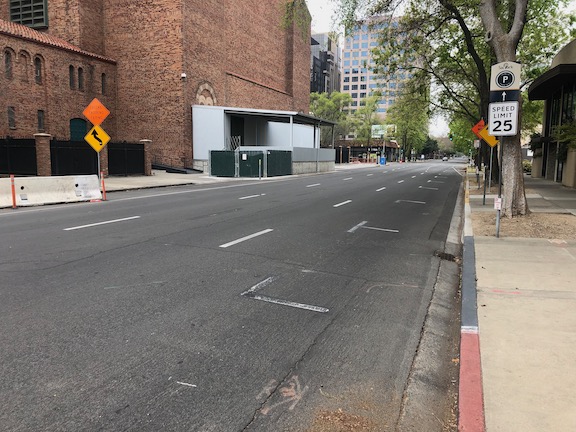
Also note that the ‘ bike lane’ stripe does not meet standards for a bike lane because it is immediately adjacent to a hard barrier and fence, so requires shy distance not provided. So that means when there are eventually bike lanes on I Street, this will be a gap, permanently.

What the fuck were you thinking, City of Sacramento?

photo: I Street, south side, east of 15th Street
I Street, south side, east of 15th Street
photo: I Street, south side, east of 15th Street
I Street, south side, east of 15th Street
photo: I Street, south side, west of 16th Street
I Street, south side, west of 16th Street
photo: I Street, south side, west of 16th Street
I Street, south side, west of 16th Street
I Street westbound, lanes shifted right

public or private bike share?

JUMP (Uber) pulled out of the Sacramento region (the cities of Sacramento, West Sacramento, and Davis) in order to meet their concerns about COVID-19. They announced this on March 18, though the bikes and scooters were mostly gone two days before that (except for a few dead ones they still haven’t picked up because without GPS they don’t know where the devices are).

Of course the bikes and scooters were getting used a great deal for recreation and socialization, but they were also being used by many people to get to and from work, and to go grocery shopping (small loads) and other errands. Some of these people do not have an alternative, they do not own a bike, or their bike is not functional. I don’t know what the level of participation was in the JUMP Boost program for low income individuals, but I suspect most of those people do not own cars, or cannot afford to keep them running, so JUMP bikes were a major transportation solution for these people. JUMP pulled the rug out from under these people. As a private company, they are entitled to do so. I will note that Spin scooters still seem to be available, and Spin has publicly made a commitment to continuing to offer scooters.

I am not one of the people depending on JUMP bikes. I have a bike, and using JUMP was just a matter of convenience for me, letting me make faster trips to the store and other errands, and during the warm/hot months, get there without a sweat. But there are others not so fortunate.

I consider bike share to be a part of the transit system for Sacramento. Both JUMP and SacRT also seem to see it this way – they cooperated to install JUMP charging hubs at a number of light rail stations in the city of Sacramento. But now we are without that first mile/last mile option (as it is called, though bike certainly allow more than a mile). Just as transit is funded by the public (as well as user fees), bike share, and probably scooter share, should be funded by the public (as well as user fees).

Going forward, the city needs to give serious thoughts to whether it is acceptable to have a private system as the only provider of mobility devices. Coronavirus is only one ‘natural’ disaster emergency. There will be others from other causes that demand we continue to have a functional transportation system. I am not suggesting that JUMP be eliminated in favor of a public system. JUMP (Uber) has had its issues, but when I think back to where we were before SoBi > JUMP, I can’t doubt it was a good thing. Certainly the fairly rapid expansion of the number of bikes and scooters, and the service area enlarged to much more (though not all) of the city of Sacramento, could not have happened without private investment.

Maybe the city can work out an agreement with JUMP that a certain number of bikes would remain available through any disaster. And through education, make it clear that this limited set of bikes if for Boost members and people in essential occupations.

I don’t know the best solution, and am happy to hear from others. What I do know is that if we come out the other side of the pandemic without having talked about this, we have failed to plan for the future and ensure an effective and equitable transportation system.

Dr. Destiny Thomas (@DrDesThePlanner) posted on Twitter today that if we are serious about bicycling as an alternative during these times, we need to address how to get bikes into the hands of those who don’t have them and can’t afford them. I agree!

10-minute walk to parks

There is a national movement, 10 Minute Walk, with a goal of every person in cities of all sizes is within a 10-minute walk to a park, by 2050.

In the Sacramento region, the City of Sacramento (Darrell Steinberg), the City of Elk Grove (Steve Ly), and the City of Citrus Heights (Jeannie Bruins) have signed on. None of the other cities have. Looking at the listing for the western United States, all are cities except for Los Angeles County. I am not sure if park districts can sign on, but that might make some sense for Sacramento County which has a large number of separate park districts as well at Sacramento Regional Parks.

Why is this important right now? Many neighborhoods do not have sidewalks, so people out for physical and mental health must walk in the street. Sometimes that is OK, on very low traffic and low speed streets, but as you may have noticed, some drivers are using the empty roads as an opportunity to speed and driver recklessly, unconstrained by congestion. Even on streets that have sidewalks, they are often much too narrow (4 feet, 5 feet, occasionally 6 feet, rarely more; I am talking about neighborhoods were most people live; central business districts often have wide sidewalks but few residents) to share with the 6-foot physical distancing requirement. Parks are a great alternative. I am not talking about gathering in parks, which has been prohibited or strongly discouraged in most places, but just a safe and pleasant place to walk. Though many of us will be working to prevent a return to previous traffic levels and speeds, the mostly empty streets we are seeing now have a limited shelf life, and the need for parks will be even greater.

Though I’ve been aware of this goal for a while, I have not looked into it or gotten involved yet. As I have the chance, I will post more, perhaps a map of the city or county showing ten minute walk buffers around parks, and information about whether this goal is in the existing and updated general plans for the counties and cities in the region.

In the meanwhile, you might want to look at the National Recreation and Parks Association (NRPA) web page on 10 Minute Walk for some background information.

Enjoy your walks!

10 Minute Walk logo

construction zone solutions

So, now that I’ve spent several posts complaining, on to solutions. The city is working an ordinance for construction zone handling, but I have not seen any draft documents. When something is available, I’ll add it.

The City of Oakland has what is generally considered to be the model guidance (http://www2.oaklandnet.com/oakca1/groups/pwa/documents/memorandum/oak062315.pdf), though Seattle also has something good that I’ve not tracked down yet. Sacramento could do well to simply adopt the Oakland guidance, but it is pretty radical for Sacramento, so I’m expecting something weaker to come out. Let me say what I think is most important.

Let me credit Robert Prinz of Bike East Bay for publicizing the guidance (he may have also had a part in developing it, not sure about that), and for monitoring compliance and publicizing failures. He is an inspiration for me.

  1. Management:
    • Responsibility for approving traffic control plans should be removed from Construction Services and placed in another division of Public Works that will actually ensure quality traffic control plans and enforcement as needed. Construction Services has demonstrated that they cannot be trusted with this responsibility. They continually bias for motor vehicle traffic and drivers, and against walkers and bicyclists.
    • Construction sites should be inspected on a regular basis by city personnel, to ensure that they have correctly installed the signing and barriers specified in their approved traffic plan, and that these are maintained until completion of the project.
    • Fines will be imposed on construction companies that do not correct problems within 12 hours of reporting to the city, by city staff or by citizens. If the construction company fails to correct the issue within 48 hours, the construction project should be shut down.
  2. Sidewalks and bike lanes:
    • For any roadway with more than one general purpose travel lane in the same direction, it shall be automatic that temporary sidewalks and bicycle lanes will be placed instead one lane.
    • For any roadway with parking lane on the same side as the construction zone, it shall be automatic that temporary sidewalks and bicycle lanes will be placed in the parking lane.
    • For any roadway where the bicyclist and/or pedestrian traffic is above a certain level (I’m not sure what the number should be), if no accommodation can be made by using a parking lane or general purpose travel lane, then the road will be closed to motor vehicle traffic in one or both directions for the duration of the project.
  3. Crosswalks:
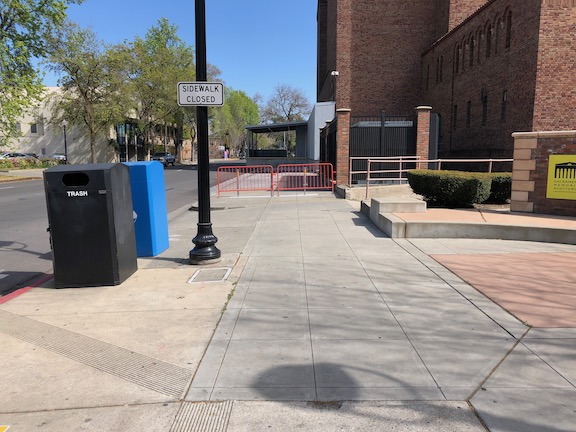
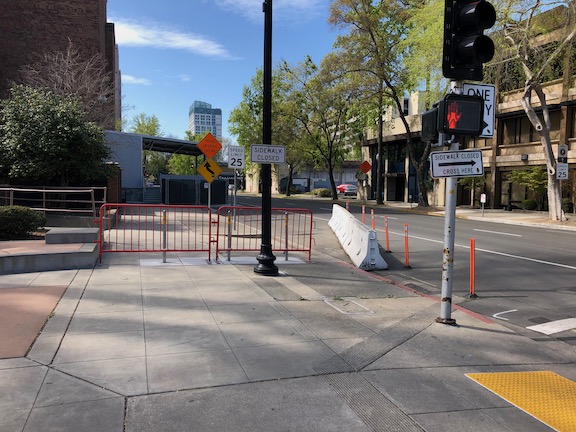
    • ADA compliant barriers and signing will be used at ALL construction projects which close a crosswalk, no matter what the duration of the project. For any closure of over a week, fixed metal barriers should be used (see photo below). Plastic barricade poles or construction tape will never be used by themselves to mark a closure.
    • Unless the closest safe crossing is clearly evident from the point of closure, wayfinding signs will be included specifying the shortest distance and safest crossing.
crosswalk closure barrier
ADA detectable crosswalk closure barrier

Signing off for now with the construction zone topic. I found several more problematic locations on my walk this morning, but I need to take mental break from this, and talk about other things.

As always, I invite your comments and additions. Stay safe walking and bicycling out there, but don’t stay home. Your sanity requires being outside, or at least that is my opinion.

This series of posts is available at https://gettingaroundsac.blog/tag/construction-zone/, and supporting photos at https://www.flickr.com/photos/allisondan/albums/72157713569318138.