This is Central City Mobility Project update #33. Note that 5th Street has not yet been converted from one-way to two-way.
When looking at 5th Street, part of the Central City Mobility Project to convert this from a one-way street to a two-way street, I was focused on the looking at the new signals and the mast arms. I failed to notice all the new beg buttons that have been installed. These are the ‘wave at’ variety. Installations are at Q Street, P Street, N Street and Capitol Mall. At Q, P, and N Streets, there are 8 new buttons per intersection. At Capitol Mall there are six, all on the east side of the intersection, because there is a pedestrian crossing prohibition on the west side. I don’t have documentation of what was here before these were installed, but I’m pretty sure that these intersections were on auto-recall, meaning that the button did not need to be pressed, or waved at. I have to admit I have been fooled again by City of Sacramento Public Works. I had been assuming that either things would remain the same, or things would get better. They have proved me wrong by making things worse.
5th St & Q St SE new wave beg button
There are beg button posts installed at R Street as well, but since this crossing of 5th St has not been activated, I don’t know how the beg buttons will be labeled.
The bike signals and related signaling is now installed at the intersection of 21st Street and I Street, where the northbound 21st Street separated bikeway ends, and the westbound I Street separated bikeway begins. East of this intersection, I Street is two-way. The I Street bikeway is on the north side, right side, so bicyclists must transition from the southwest corner to the northwest corner. Bicyclists continuing north on 21st Street must also transition from the left side bikeway to the right side general purpose lane.
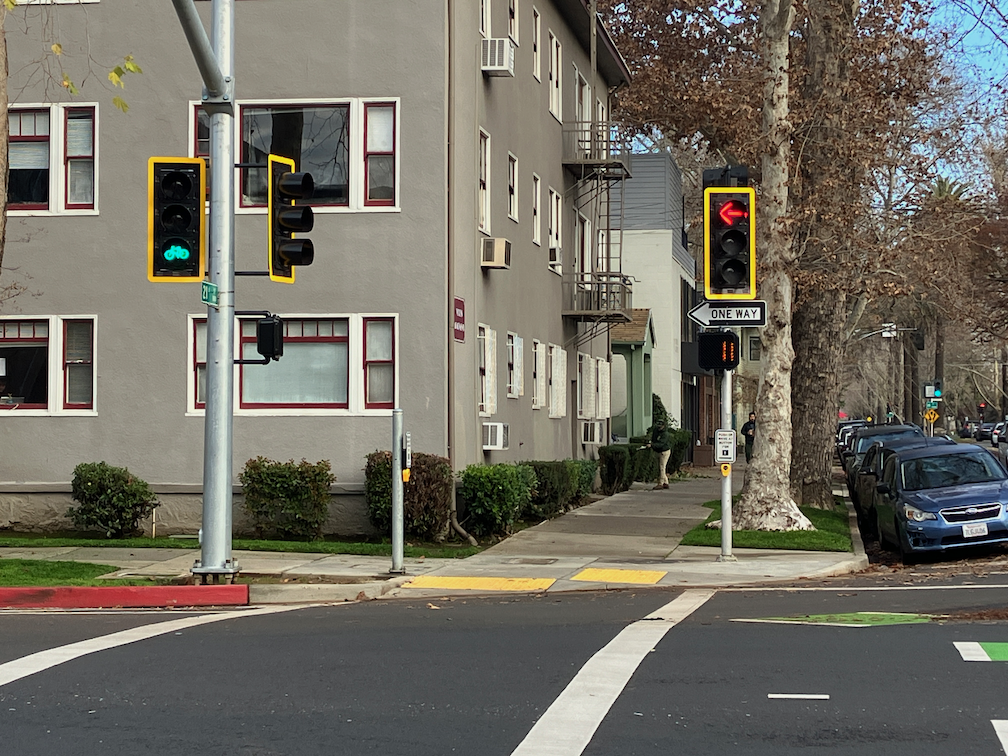
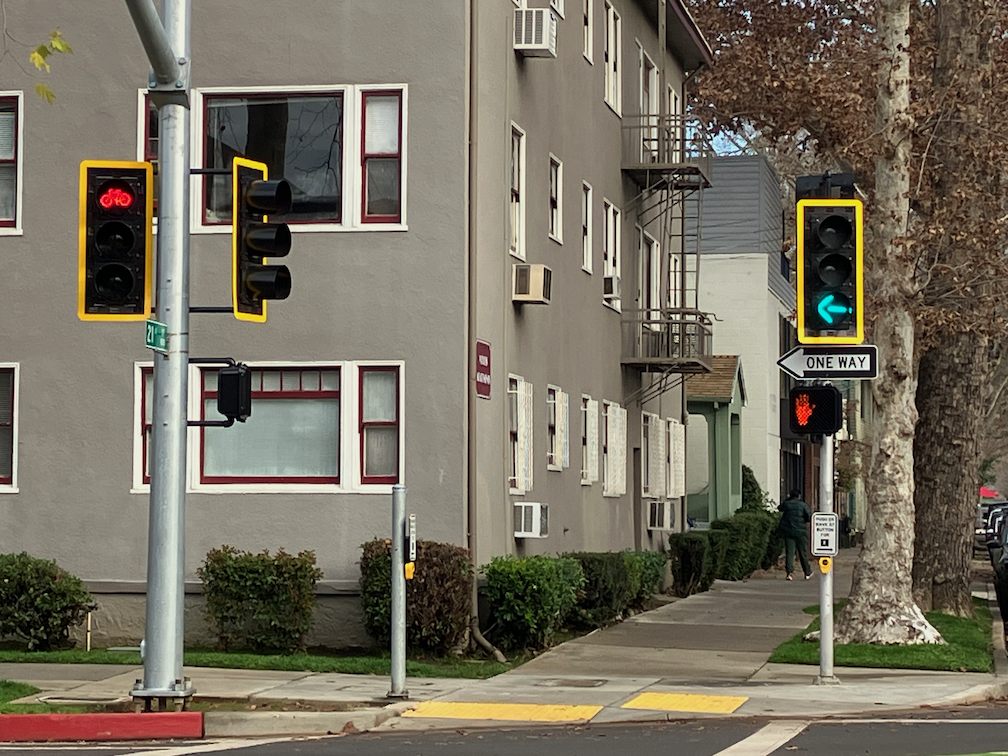
The city has attempted to solve this problem by installing bicycle signal faces on the northwest corner, for bicyclists turning left on I Street, and the northeast corner, for bicyclists going straight on 21st Street. The photos below show the northwest corner bicycle signal green and turn arrow red, bicycle signal red and turn arrow green, and the bike signal on the northeast corner.
21st & I St, bicycle signal green and turn arrow red21st St & I St, bicycle signal red and turn arrow green21st & I St, bike signal on the northeast corner
The signals are set up so that bicyclists, and walkers on the west leg of the intersection, have an exclusive phase, meaning that no cars are supposed to be moving when the pedestrian signal shows walk, or the bike signal is green. Actually, triggering the bike signal also triggers the pedestrian signal, and vice versa, they are ganged together.
The problem is that drivers are turning left from 21st Street to I Street against the red arrow, endangering bicyclists going west and north, and walkers in the crosswalk. In about 30 minutes of observation over the last few days, I saw drivers turning left against the red about half of all signal cycles. Once the front driver decides to turn, all other drivers follow. I did not see any drivers turning from the right hand left-turn-straight lane.
California Vehicle Code (CVC) 21453 says: (c) A driver facing a steady red arrow signal shall not enter the intersection to make the movement indicated by the arrow and, unless entering the intersection to make a movement permitted by another signal, shall stop at a clearly marked limit line, but if none, before entering the crosswalk on the near side of the intersection, or if none, then before entering the intersection, and shall remain stopped until an indication permitting movement is shown.
So, every single one of the drivers who turned left on the red arrow was breaking the law. Sadly, the city has designed an intersection that assumes drivers will not break the law, but as every bicyclist and walker knows, drivers do so pretty much continuously. I do not know what the solution is for this intersection. It is difficult to control driver behavior. In any other situation than roadways, the behavior of routinely breaking the law is called lawlessness.
Signal actuation (beg buttons)
In addition to the new signals, there are signal actuators, generally called beg buttons. Nothing here is on auto-recall, meaning there is not a bicyclist and pedestrian phase on every signal cycle, but only when requested.
The actuator for the pedestrian signal is shown below. This is first placement of this technology in the city, so far as I know. The sign is CA-MUTCD R10-3j (CA). The ‘wave at’ function is an infrared proximity detector, that works for up to about 15 inches, and also works for standing as well as waving. An example commercial product is WiAPPS Wave, though I don’t know what vendor the city used. It is not automated pedestrian detection, which would cover the full width of the sidewalk.
pedestrian actuator (beg button), 21st St & I St
Strangely, the bicyclist actuator (beg button) does not have this technology; the bicyclist must actually touch the button.




 Getting Around Sacramento