SacTA Board 2024-10-10

I realize that posting meetings so close to the meeting makes it impossible to schedule your possible attendance, and sometimes even to submit comments through email. But it is still useful, I think, to keep up on transportation issues and government agencies. Discussion and even decisions on the agenda are often not the final word.

The Sacramento Transportation Authority (SacTA – I label it SacTA rather than STA, to distinguish from the California State Transportation Agency which goes by STA or CalSTA) Board of Directors will meet today, Thursday, October 10, at 1:30 PM in the Sacramento County Board of Supervisors chambers, 700 H Street in downtown Sacramento. The agenda can be viewed on the SacTA Board Meetings page, or here. The entire meeting packet is available on SacTA, but it is quite a large document, and you may find looking at individual agenda items to be more efficient. I’ve commented on a linked to three items of greatest interest to me.

Agenda 08: SB 1 Cycle 4 Local Partnership Program (competitive) Project Prioritization

There are two projects to be prioritized for application to the state SB 1 Local Partnership Program, one related to the I Street Bridge Replacement project, and the other for a transit bus yard, hydrogen buses, and hydrogen refueling in north Sacramento, and other transit and transportation projects. Generally only one submitted project is funded, so the prioritization is important.

I don’t have any strong feelings about the two projects, though I will caution that the rush to hydrogen, which is fueled (pun intended) by strong federal, state and local subsidies, is risky. Though hydrogen fuel cells may turn out to be the best solution for some transit routes, the paucity of green hydrogen (that does not rely on fossil fuels or biomass conversion), and the lack of really addressing this issue, is concerning. Much of hydrogen boosterism comes from the fossil fuel industry, trying to maintain its grip on our energy system.

I think everyone would agree that the I Street Bridge replacement is critical, but the city has made sure that it is an expensive trophy bridge rather than a utilitarian bridge.

Agenda 11: Potential Legislative Changes (I’ll let you read the full agenda item title)

The charter for SacTA, established with the passage of the existing Measure A (not the failed Measure As) limits the agency to pass-through of transportation funds to local transportation agencies, with limited influence over the projects implemented. The ‘Measure C’ proposal by SMART (Sacramento Metro Advocates for Rail and Transit) and Mayor Steinberg, places an emphasis on transit, housing, and safe streets. And no roadway capacity expansion. The measure being considered by SacRT, for the City of Sacramento and Elk Grove portion of its service area, would provide some support for infill transit oriented development and first mile/last mile active transportation, but would be primarily for transit. SacTA does not have the authority to fund anything other than direct transportation projects. This agenda item would allow SacTA to consider legislation to broaden it mandate to include housing or housing-supportive infrastructure related to transportation.

It is not clear whether any measure proposed by SacTA would approach the model proposed by active transportation and transit advocates, but this idea is worth pursuing.

I support this agenda item.

Agenda 12: Consider the Creation of a Temporary New Transportation Funding Subcommittee

This agenda item would form a subcommittee to explore the possibility of, and chances for success, of a 2026 transportation sales tax measure sponsored by SacTA.

We know that a transportation measure heavily weighted towards roadway capacity expansion has failed and will fail, but with a possible shift in priorities to roadway maintenance (fix-it-first), transit and active transportation, there is some chance of success. If Proposition 5 passes this November, it is possible that a ballot measure in 2026 would require only a 55% yes vote, rather than a 67% yes vote, which is difficult to pass in Sacramento County with its strong suburban and semi-rural opposition to all taxes.

Several transportation advocacy organizations are opposed to any additional sales taxes since they are regressive, having a much greater impact on low-income people than other taxes. However, at this time, it does not looks as though any of the potential proposals uses alternative taxes.

I support this agenda item.

SacBee: city response to crashes

The SacBee published an article yesterday: After a deadly crash, Sacramento fixed a dangerous road. Why isn’t this the norm? Apologies for linking to a firewalled article; if you have a subscription or access to a printed newspaper, it is well worth reading.The article is quite in-depth, more like the investigative reporting that the SacBee used to do, but rarely does any more. The author is Ariane Lange.

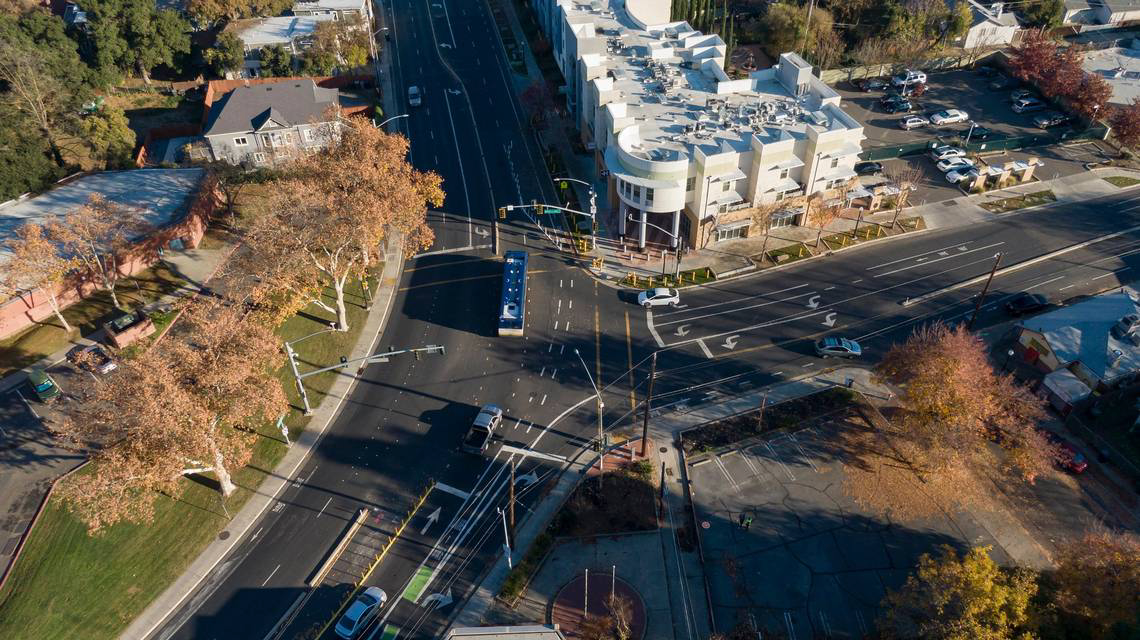
The article highlights changes made to the intersection of Broadway and Martin Luther King, Jr. Blvd (MLK) after a fatal crash single-vehicle crash in 2021. Though the article did not make clear, the driver was likely eastbound on Broadway and continued straight into the building. Google maps, below, does not show the changes, but a photo from the article does (second).

Broadway & MLK intersection, Google Maps (not up to date)
Broadway & MLK, SacBee photo (more recent)
Read More »

transportation and May is Bike Month thoughts (guest)

This is a guest post from reader Sonya Hendren. Sonya is a bike advocate and educator in the Sacramento region.

In looking back at this year’s May is Bike Month, two comments during meetings have left an impression, informing my current opinions on the efficacy of our bike advocacy.

During a neighborhood association meeting about walking/biking safety, a panelist emphasized that transportation projects are funded by competitive grants. It’s a fixed-sum game: if Sacramento gets a grant, all the losing cities’ projects are left unfunded. If another city’s project wins, Sacramento’s project doesn’t happen, at least not in this funding cycle, from this source. Of course our first instinct, mine included, is to cheer for Sacramento; we get funding, we do projects.

My revelation is that I don’t want Sacramento to win competitive grants. In the Freeport Blvd Transportation plan, the city never considered a road diet (reduction in lanes), despite it being a prominent request during the community input phase, because their goal is to maintain previous ADT (average daily traffic count.)The city works to maintain current levels of private-car use. The city’s Climate Action and Adaptation Plan, companion document to the General Plan, reduces the MCCC (Mayors’ Commission on Climate Change) goal of 30% Active Transportation, down to 6%. Under these practices and policies, Sacramento would use transportation funding to further cement car-dependency. Grant funding would be better spent in another city that is actually trying to shift transportation mode share away from private-cars, trying to reduce VMT (vehicle miles traveled). The project in another city would do more good to Sacramento by serving as a positive example, than spending the money in Sacramento under Sacramento’s current practices and policies.

Second, during a debrief-and-next-steps meeting on school “bike buses,” I learned that after Safe Routes to Schools programs end, feedback of continued walking/biking is the rare exception, not the norm. The norm is that Safe Routes to Schools programs are funded for one to three years, they get a group of kids walking or biking during those years, and when the funding ends, all the families go back to driving. Current infrastructure and incentives are such that without a paid person there helping, even students/families who have been taught how to walk/bike to school and practiced it for years, do not. That’s so discouraging: if “holding people’s hands,” not just teaching them the routes, but traveling those routes with them regularly, sometimes for years, doesn’t convert people to using the routes, how can any of our encouragement projects have any affect??

Read More »

California needs to drop Caltrans, and create a Department of Highway Maintenance

Caltrans has sliced and diced cities with highways, dancing to the tune of segregationists who wanted to isolate and destroy communities of color so that they could ignore the existence of ‘those people’. Caltrans is not likely to be building any completely new highways in the future, though many in Caltrans would still like to. What they will be doing is continuing to widen existing highways, increasing motor vehicle capacity and inducing more driving. It seems that nothing will cure them of this, except disbanding of the agency and firing most of the highway engineers. So that is what I am proposing. In it’s place, there would be a Department of Highway Maintenance. The purpose would be to maintain our existing infrastructure, and I mean actually maintain, not just use safety and maintenance as a cover for widening. If bridges were replaced, they would be required to have the same or less motor vehicle capacity as before.

The department could do projects which remove motor vehicle capacity. This might include removing freeways completely, but with guidelines that prevent the design of ‘boulevards’ that are just as much traffic sewers as the freeways. It might include converting existing general purpose highway lanes to managed lanes, but would never include constructing new managed lanes. It might include projects which reduce on-ramps and off-ramps from two or more lanes to one lane, shortening the crosswalk distance over on-ramps and off-ramps, and creating right-angle on-ramps and off-ramps which slow motor vehicle drivers by design, and it might include narrowing freeway lanes and posting lower speed limits.

All designated state highways which are actually surface streets would be transferred to local transportation agencies, so the state highway system would shrink to actual freeways.

So what would happen to the funds that currently go to widening highways? I propose that one-third be given to local transportation agencies, on a competitive basis, for active transportation projects. All of this funding would go through the California State Transportation Agency; Caltrans would have nothing to do with it.

The other two-thirds would go for rail and transit. A Department of Rail and Transit would be created out of the existing Division of Rail and Mass Transportation. The purpose of this new department would be to purchase rail right-of-way, by condemnation if necessary, from the freight railroads, so that passenger rail may run in California without interference from the freights. It would also fund infrastructure and operations for rail and transit throughout the state. With the movement of funds from highway widening to rail, it should be possible to complete High Speed Rail on schedule, and to greatly enhance the operating frequency of the three regional rail services (Capitol Corridor, San Joaquins/Altamont Commuter Express (ACE), and Pacific Surfliner). Once higher frequency service and modern ticketing are in place, the regional rails would separate from Amtrak and be operated completely by the state. The state already owns the equipment. Though the agency could fund other transit, the emphasis would be on rail.

What’s Next? – SacMoves Coalition

An earlier post covered the Mayor’s Environmental Advocates Roundtable.

SacMoves is a coalition of transportation advocacy organizations and environmental and climate advocacy organizations, primarily, though it does include some other interests such as housing. There are also a number of interested individuals who participate in the meetings. I am not speaking for the coalition. I represent one organizational member of the coalition, Sacramento Transit Advocates and Riders (STAR), and serve on the Process Committee of the coalition, but otherwise don’t have position or authorization to speak for the coalition. I am relaying information that I think will be of interest to others.

SacMoves decided not take a position on the Measure A transportation sales tax. Most organizational members were opposed to the measure, some very strongly, and there were a few members that did not want the coalition to take a position. As a result, several individuals and some organizations formed the MeasureANotOK group, assisted by Climate Plan, and were primarily responsible for defeat of the measure (though there is of course always an anti-tax contingent). And it was a resounding defeat!

SacMoves Coalition held a special meeting on March 9 to discuss What’s Next?, and more specifically whether SacMoves would take a key role in formulating future transportation funding, or would wait and respond to what others proposed. The group meeting that day confirmed that the coalition would take a key role, and the next regular meeting confirmed that. A one-page summary of the special meeting is here: https://gettingaroundsac.blog/wp-content/uploads/2023/03/sacmoves_2023-03-16_planning-summary.pdf.

The regular meeting on March 17 formed three working groups to start developing background information towards providing a model for transportation goals and funding, which are policy, funding, and communications. The coalition also decided to work more closely with housing and particularly affordable housing interests to see how each can contribute to the best solutions. Transportation and housing cannot stand in siloes, or they both fail.

The coalition does not see itself as the only group working on transportation funding. Organizational members and individuals are following and participating the other efforts, including the Mayor’s roundtable. Perhaps eventually the efforts will coalesce behind a single proposal which will move forward through the efforts of all the interested organizations and individuals.

Unfortunately, SacMoves does not have a website, so I can’t direct you there for more information or contacts, but if you contact me, I will pass you along to the right people.

What’s next? – Mayor’s Environmental Roundtable

After the failure of Measure A transportation sales tax measure, everyone who was for it, and everyone who was against it, asked ‘What’s next?’ It is clear there is a need to fund at least some types of transportation infrastructure, including transit, active transportation, and repairing the potholes. It is also clear to me, at least, there there is absolutely no need to fund roadway capacity expansion. We have all of the roadways we will ever need – we need less capacity, not more. But that is not clear to everyone. A lot of people initially were saying things like “we just need to improve the measure a bit, perhaps by removing the Capital Southeast Connector, and then it will pass in 2024. Fortunately, that view has faded. We need something much better than the failed Measure A, and it is not obvious that more transportation sales tax is the right solution. So, What’s next?

One of the groups working on that question is the Mayor’s Environmental Advocacy Roundtable (the mayor being Mayor Darrell Steinberg). A premise of the group is that there might be a role for the city in defining how to fund transportation, and perhaps creating a sales tax or other measure focused on the city. This group has met four times. I was able to attend the last meeting on March 22, and have a brief report. Please keep in mind that these are my notes about what I found interesting, not minutes of the meeting. First, two documents were available, shared here, the agenda, and the overview. Jennifer Donlon Wyant gave a presentation on the city’s transportation planning and funding, which I do not have available. The remainder of the meeting was discussion. So, my notes:

Read More »

SACOG Board on sales tax analysis

The SACOG Board met today, and agenda item 12 was on the SACOG Review & Analysis of Proposed Citizens’ Transportation Tax Initiative in Sacramento County. This was an information item, for discussion, not for action. This post is a brief summary of the discussion, to follow on to the earlier post on the analysis: SACOG analysis of Measure 2022. The analysis identifies 26 (or more) capacity expansion projects proposed in the measure’s Transportation Expenditure Plan, all of which would increase GHG/VMT, and most of which would also increase sprawl.

Nearly every representative of the cities and counties in Sacramento County rejected the analysis as being flawed, some even said it was unprofessional. They claimed that the analysis made so many assumptions that it could not be trusted, and that SACOG should not be in the business of producing documents like this. Despite that fact that planning for transportation and land use is specifically the purview of the MPOs, and that they instead support a measure that speculates about transportation needs for 40 years into the future. If you don’t like the message, blame the messenger.

I can’t resist pointing out that this has become a pattern for supporters of more of the same (more capacity expansion, more sprawl, more GHG/VMT):

Supporters of sprawl and the measure proponents: Show us the data!

SACOG: Here is the data.

Supporters of sprawl and the measure proponents: No, not that data. We don’t believe you.

On the other hand, every representative from the other five counties in the SACOG region expressed great concern that allowing the measure to go through would threaten their own transportation projects and funding due to the region not meeting GHG reduction goal of 19%. Don Saylor of Yolo County was the most succinct, saying that SACOG must consider the impact on the region as a whole, and that it is time to move past the limited vision of the past.

The out-of-left-field part of the discussion was that Darrell Steinberg talked about an ongoing negotiation with the measure proponents that would mitigate for the worst aspects of the measure. This apparently has been going on for six weeks, and is the reason the release of the analysis was delayed, even though it was completed a month ago.

Darrell talked about five elements of the negotiation (this is captured from his verbal report, and may not be accurate, no printed information was offered):

  • $300M in the measure for the connector would be contingent upon SACOG defining mitigation measures, and that the Capital Southeast Connector JPA accepted the mitigation.
  • SACOG would develop a scenario in the currently developing MTP/SCS that includes the connector.
  • SACOG would commit to putting the connector in the MTP if these other conditions where met.
  • An additional $300M would be provided for connector mitigation in the measure.
  • $100M will be added to the California Mobility Center, diverted from other projects.

It looks as though Steinberg is putting the onus on SACOG, not on the proponents. It is true that none of the government entities have any control over the measure, but if negotiations are going on, it should be from a position of strength, not weakness. If the City of Sacramento opposed the measure, it is very unlikely that it would pass.

The proponents intended to bully the agencies into supporting it, and to make sure that they got their message across, removed the climate protection language from the measure. They want the agencies to make their own decisions about whether and how to mitigate climate impacts, regardless of regional interests or the intent of the state legislature, or even the interests of the counties that would be impacted.

To my knowledge, no opponents of the measure, of which there are many, the majority of the transit, transportation, and environmental advocacy organizations, were asked to participate in the negotiations. Yet another example of excluding public engagement, just as the people who wrote the measure excluded public engagement.

SACOG said that the analysis would be presented to the various SACOG committees, and would come back to the board in June. It isn’t clear to me what, if anything will happen at that point. I assume the negotiations will have completed by then, successfully or unsuccessfully. It isn’t clear what kind of agreement could be reached that would actually be binding on Sacramento Transportation Authority and the other governments, since a measure, if passed and not found unconstitutional, has the force of law. Maybe there is a way.

For more on the measure, see Measure 2022 posts. The use of this category is not meant to confuse. A lot of people are referring to this as Measure A, but the measure letters are assigned by county elections after they have qualified, so this is in no sense Measure A at this time.

Measure 2022: transit congestion improvement???


A group calling themselves A Committee for a Better Sacramento is sponsoring a citizen-initiated ballot measure for the November election, titled “Sacramento County Transportation Maintenance, Safety, and Congestion Relief Act of 2022—Retail Transactions and Use Tax”. (Note: Some people are referring to this as Measure A, but measure letters are assigned by county elections, not by the sponsors. I’ll continue to refer to it as Measure 2022, for now.)

One of the categories in the Exhibit A: Transportation Expenditure Plan is Congestion Relief Improvements (page A-16), and the subcategory Transit and Rail Congestion Relief Improvement Projects, which is allocated 10.85% of the measure, or about $890M over the 40 years. Projects listed are (they are not numbered in the document, but are here for reference):

  1. LRT peak service trains
  2. LRT extensions, Green Line to the airport, Blue Line to Elk Grove and Citrus Heights, Gold Line to Folsom
  3. High capacity bus corridor network throughout Sacramento County, including but not limited to Stockton Blvd, Watt Ave, Sunrise Blvd, Florin Rd, and Arden Way
  4. BRT to Citrus Heights, Stockton Blvd, and Sunrise in Rancho Cordova
  5. In coordination with the Capital Southeast Connector Joint Powers Authority, design, plan and construct a transit component, such as a bus rapid transit service, along the Capital Southeast Connector corridor to mitigate greenhouse gas (GHG) emissions and meet air quality targets. SacRT will match $40 million in revenues generated by this Measure with $80 million in state and federal funds for a total of $120 million in resources toward this goal. The project would consist of providing signaling and a bypass at critical connector sections to improve service, lower travel time, and reduce GHG impacts

The document does say that funding is ‘intended to be flexible’, which is good since the types of projects that might be constructed over 40 years will likely have little to do with this list. None of this funding is available for operations, which is in a different category, Sacramento Regional Transit District (SacRT) Maintenance, Operations, and Transformative System Improvements. More about that soon.

Light rail extensions and improvements for more frequent peak service (not for operating more frequent peak service, just for the infrastructure) sound appealing (items 1 and 2). Currently SacRT has unofficially prioritized Green Line to the airport, even though that would do almost nothing to reduce congestion. Infrastructure for Gold Line to Folsom is already funded, so it is strange to see it here. On the other hand, Blue Line to Citrus Heights is here, even though SacRT has removed it from consideration for the foreseeable future.

The terms ‘high capacity bus corridor network’ and ‘BRT’ (items 3 and 4) are not defined in the document, so the public really has little idea what is intended. SacRT has not been very clear about this either. Projects in other places have revealed that the quality of the improvements to a corridor, and the restraints placed on private vehicle travel, make all the difference in whether bus corridor enhancements are valuable or pointless.

The $40M for the Capital Southeast Connector (item 5) is small in comparison to the size of the allocation, but it points out how poorly thought out the entire measure is. Who would even use transit on this corridor? The connector is designed to serve commercial traffic between Folsom (really El Dorado County) and Elk Grove, and to promote greenfield development along the connector. Greenfield developments are not designed to appeal low income workers, they are designed to appeal to high income white collar workers, who might be commuting to Folsom, Rancho Cordova, and Elk Grove. But those are not the sort of people who use transit unless it is clearly superior to drive-alone, and transit on this soon-to-be-congested corridor will not make the grade.

All of these projects are premised on the idea that the other projects in the measure will maintain or increase congestion, so it is necessary to improve transit to mitigate for that other congestion. Sadly, the SACOG MTP/SCS makes the same assumption, that transit projects will counteract the increased VMT and GHG emissions from other projects and poor land use.

Transit should not be a mitigation; it should have standing in its own right as a superior mode of travel. It should not be an attempt to make up for bad decisions made elsewhere. The question should be: what can we do to better serve existing riders, and what can we do to induce new riders?

This section of the Transportation Expenditure Plan is so-so. Not bad, not good, but mostly not well thought out and not clear what the benefits and trade-offs will be.

Search for category Measure 2022 to see posts as they are added.

Measure 2022: words have meaning


A group calling themselves A Committee for a Better Sacramento is sponsoring a citizen-initiated ballot measure for the November election, titled “Sacramento County Transportation Maintenance, Safety, and Congestion Relief Act of 2022—Retail Transactions and Use Tax”. (Note: Some people are referring to this as Measure A, but measure letters are assigned by county elections, not by the sponsors. I’ll continue to refer to it as Measure 2022, for now.)

As your parents no doubt told you, words have meaning. So what are the words used in the proposed measure?

  • congestion (in the context of congestion relief) = 24 occurrences
  • greenhouse gas = 6
  • climate = 3
  • low-income = 3
  • community engagement (only in Exhibit B ITOC) = 1
  • equity = 0

A major purpose of this measure is to fund capacity expansion, in an effort to provide congestion relief. But it is well documented and uncontroversial (except among greenfield developers and engineers whose jobs depend on expansion) that attempts to relieve congestion through expansion actually induce new traffic that fills every bit of added capacity. The sponsors of this measure do not believe that. They refuse to believe that. This is a 1970s version of transportation investment, that time when the only issue was building infrastructure that would allow cars to go further and faster. Walking, bicycling, and transit was either an afterthought, or actively discriminated against. We don’t live in those times any more, but the sponsors still do.

Search for category Measure 2022 to see posts as they are added.