Norwood Avenue

The city is asking for public input on a project to increase safety and mobility on Norwood Avenue in north Sacramento. I have not had a chance to look at the details, so for now I’ll just repost the article from the city’s Sacramento City Express. The project web page has more details, including street cross-sections for the three alternatives.


Community invited to weigh in on plan to address safety on Norwood Avenue

Residents in north Sacramento are invited to help shape the future of Norwood Avenue as the next phase of a transportation safety and mobility project gets underway.

The Norwood Mobility Project is focused on a two-mile stretch of Norwood Avenue between Main Avenue and Arcade Creek—an area identified as part of the city’s High Injury Network due to its history of serious traffic collisions.

After initial community engagement beginning last fall, City transportation staff are now presenting a set of proposed design alternatives and gathering public input to develop a final concept that improves safety and mobility for all users, including pedestrians, cyclists, transit riders and drivers.

“We’ve heard from residents about the challenges they face walking or biking along Norwood, especially near schools and bus stops,” said associate transportation planner Charisse Padilla. “This is the community’s opportunity to directly influence the changes we make to the corridor.”

Upcoming public engagement opportunities include an in-person open house on Saturday, June 7, from 10-11:30 a.m. at the Robertson Community Center, and a virtual workshop on Monday, June 9, from 6:30-7:30 p.m. Registration is required for the virtual meeting.

Residents can also share their feedback on the proposed alternatives through an online survey.

The Norwood Mobility Project is funded through a Caltrans Sustainable Transportation Planning Grant. A draft plan is expected this fall, with final recommendations anticipated in early 2026.

Having a Council-adopted plan ensures the City is eligible for competitive grant funding for any next phases such as Preliminary Engineering Design, Environmental Clearance, Final Design and Construction.

For more information or to provide input, visit the Norwood Mobility Project page at norwoodmobility.org.

West Sacramento Vision Zero Action Plan

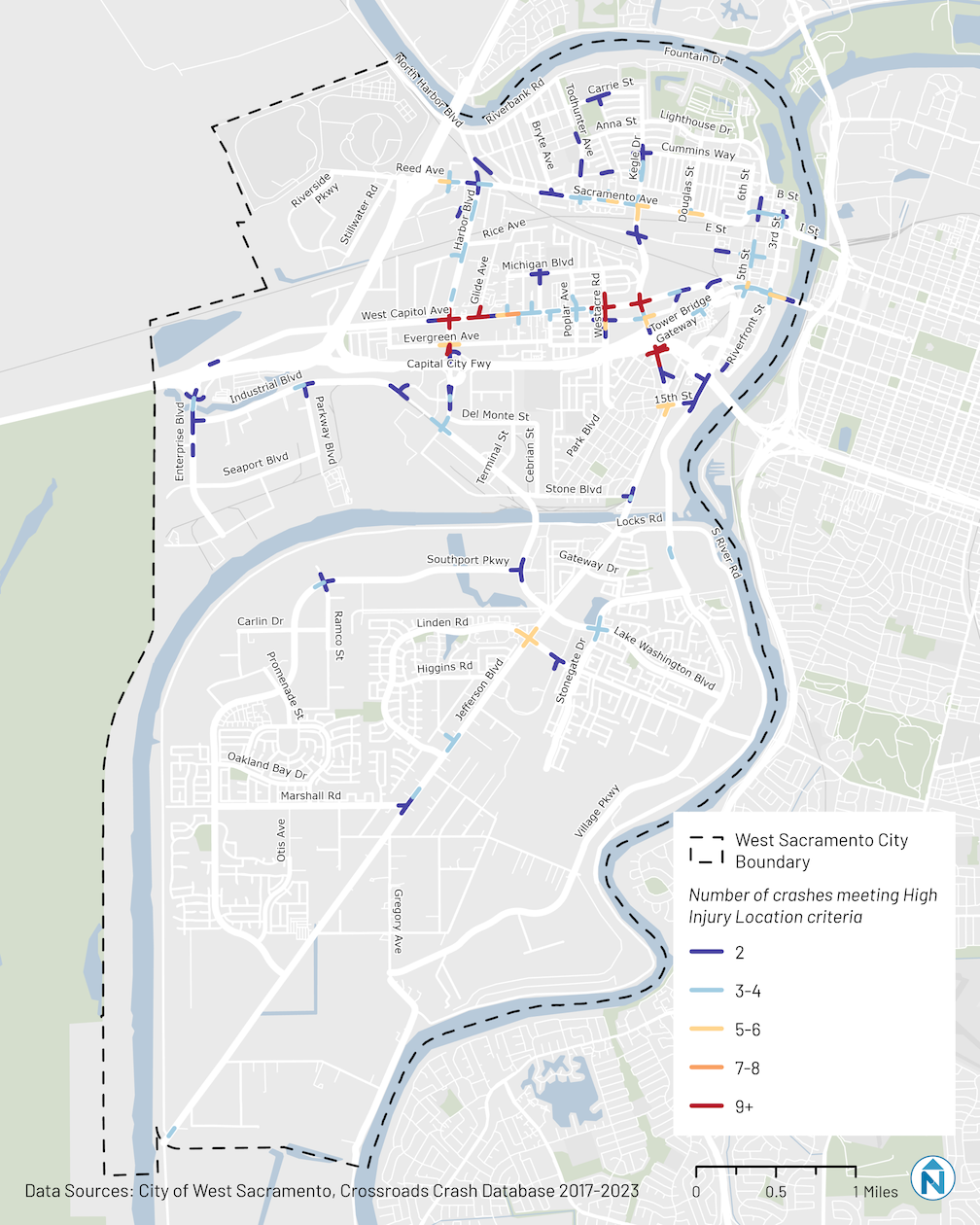
The City of West Sacramento is developing a Vision Zero Action Plan. If you live in, work in, or travel in West Sacramento, I encourage you to take a look at the VZ page. The map showing crash locations, nearly all at intersections, indicate that West Capitol Ave is the epicenter for traffic violence, with Sacramento Ave coming in second. That is my own experience in riding and walking on these arterial streets. West Capitol Ave is the route for Yolobus 42A/42B, and several other routes.

Vision Zero high-injury map for West Sacramento

SacBee: update on lack of city investment in street safety

An article today in the Sacramento Bee is about two traffic fatalities on Freeport Blvd, but also does an excellent job of summarizing the city’s lack of general fund investment and action street safety, and over-dependence on long-term grant funded projects. Yay, Ariane Lange for the excellent reporting on roadway safety and solutions, and the real people who are the victims of poorly designed roadways and traffic violence.

SacBee, Ariane Lange: Two grandmothers died blocks apart on a dangerous Sacramento road. Will the city fix it?
https://www.sacbee.com/news/local/article296838739.html

The city’s solution to fatalities and severe injuries on our our streets has been the Vision Zero effort and Vision Zero Action Plan (2018), and related documents. This resulting in a focus of grant applications on corridors with a high level of traffic violence, the high-injury corridors. For more posts on Vision Zero, see tag: Vision Zero. What has not occurred since 2018 is a significant increase of city general funds to address traffic safety. Since that time, Sacramento Police Department has largely ceased traffic enforcement, while their budget has continually increased, though there are strong safety benefits for people of color in that reduction of enforcement which tends to be pretextual and biased.

The city council has repeatedly suggested allocation of some general funds to traffic safety and fixing roadways, but City Manager Howard Chan, and perhaps Public Works, has resisted this. With the departure of Chan, this may change (more to come on that). The city has no program for quick-build projects, though a few have happened. The city’s transportation budget goes to pavement maintenance (which is a good thing, as your roadways are in poor condition for everyone), new capacity expansion, and grant matches. Almost none goes to quick-build solutions.

I am not suggested dropping the approach of grant applications for big projects, as those long-term projects are important. What I am suggesting, and the SacBee supports, is investment in fixing some of the worst roadway designs, now rather than someday.

SacCity fails to act on traffic violence

At the June 11 city council meeting at which the 2024-2025 budget was adopted, seven of the council members spoke strongly about the need to address safety on the city’s streets, acknowledging that the city leads California as the most deadly for roadway users. But no modification was made to the budget to reflect that priority, and the city manager refused to make any changes to the budget to fund street safety.

In the two months since that council meeting, nothing has shown up on the council agenda to move forward on street safety, nothing has shown up to allocate funds, except some minor grant applications.

The city has long had a policy that it does not fund street safety projects, except for the required grant matches. Other than grant matches, no city general funds are expended to make our streets safer. The city certainly has been successful in getting some grants, but also has not been competitive on many others.

The Sacramento Active Transportation Commission (SacATC) made a recommendation in their annual report to allocate $10M to safety projects. Council members spoke in support of the idea, but no action was taken to fund those ideas.

We have an epidemic of traffic violence in the city. Yet the city is doing almost nothing to address that. Walkers, bicyclists, drivers and passengers are all dying in horrible numbers. What is the city doing in response? Submitting grant applications and hoping for the best. This is unacceptable.

The council must take this public health crisis seriously, and allocate funds to start solving it. It must also stand up to the city manager, who does not believe in spending money on street safety. The city manager runs the city according to his own whims, and rarely follows the direction of council on anything. The council must either stand up to, or fire, the city manager. So long as he is in the position, the city will not move forward on saving the lives of vulnerable roadway users.

SacBee: city response to crashes

The SacBee published an article yesterday: After a deadly crash, Sacramento fixed a dangerous road. Why isn’t this the norm? Apologies for linking to a firewalled article; if you have a subscription or access to a printed newspaper, it is well worth reading.The article is quite in-depth, more like the investigative reporting that the SacBee used to do, but rarely does any more. The author is Ariane Lange.

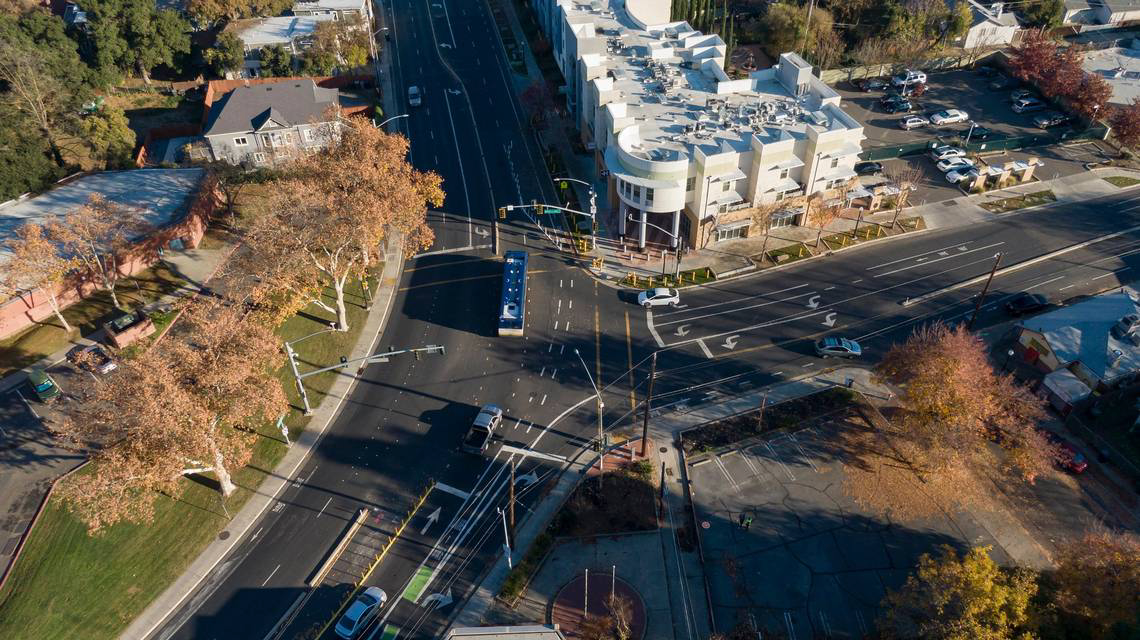
The article highlights changes made to the intersection of Broadway and Martin Luther King, Jr. Blvd (MLK) after a fatal crash single-vehicle crash in 2021. Though the article did not make clear, the driver was likely eastbound on Broadway and continued straight into the building. Google maps, below, does not show the changes, but a photo from the article does (second).

Broadway & MLK intersection, Google Maps (not up to date)
Broadway & MLK, SacBee photo (more recent)
Read More »

red light running consequences

I’ve written recently about red-light-running bullies. On Wednesday morning I got to observe the logical consequences of this behavior.

red light running crash at P St & 15th St

The driver of the SUV heading south on P Street intentionally ran the red light, colliding with the passenger car that was heading west through the intersection. The red light running was well after the light had turned red. Fortunately the red light running driver slammed on his brakes and the resulting collision was low speed, or the other driver might well be dead. I might well have been dead if the other car had not been in the way, since I was using the crosswalk over 15th St, west to east, and would quite possible have been run over by the SUV driver. The driver would have been much less likely to see me than to see the other car.

Really all the red light running driver had to say is that we was in a hurry.

Perhaps most interesting is that law enforcement refused to come to the crash. The passenger car driver had called 911 shortly after the crash, as did at least one bystander. I waited 45 minutes so that I could give a statement. The passenger car driver said that he had finally gotten a text message back that no one would respond. So the crash will not get recorded anywhere. The SUV driver will not get a ticket. Apparently the 911 operator had transferred the caller to CHP, and it is CHP that refused to respond. Perhaps they were busy attending a white supremacy meeting somewhere and couldn’t be bothered. No one died – what’s the big deal?

Just more traffic violence. Nothing to see here. Let’s move along.

what do drivers think?

As I was walking this afternoon, crossing 19th Street at S Street, with the light, a woman very nearly ran me over. She was looking only at opposing traffic, and decided she could make the left turn if she accelerated. She was not looking at the crosswalk or at me. In fact, I’m pretty sure she would not have seen me until I was on her hood. She only noticed me because I screamed at her as I jumped back to avoid being hit.

This is a story that anyone who walks could repeat, it is not in the least unique. I have probably 150 almost identical instances since moving to Sacramento 11 years ago. And it is not unique to Sacramento. Traffic violence is everywhere, almost all the time.

But as I continued my walk, I wondered what goes through the minds of drivers who almost kill people. In many cases, they blame it on the person walking, for having the effrontery of being on the street in front of their car. I know this because they often start the screaming, directing invective at me.

But what about the others? Do they drive more carefully, with more attention to surroundings? Do they refrain from accelerating into dangerous situations? Do they slow the fuck down? Probably, for a few days. I imagine some of these drivers are actually quite shaken by the realization that they almost killed someone.

I’m pretty sure that it doesn’t last, though. They must slide back into their old reckless ways. If this were not so, there would be much more careful drivers on the road, and much less traffic violence. But there isn’t.

I suspect almost every driver on the road has come close to killing someone before. Some drivers, many times. Some drivers have killed people walking. After all, killing someone with your vehicle is seen by law enforcement and courts as a whoopsie, unless you are very drunk.

Note that I define traffic violence as any driver behavior that intimidates people from walking or bicycling. The driver doesn’t have to actually kill or injure to have the (desired?) effect.

solving traffic violence with: yes, and

It is common among many transportation advocates to posit that we can only really solve the traffic violence problem by redesigning roadways to reduce the opportunity for drivers to speed, and many other driver behaviors which endanger walkers, bicyclists, and other drivers (not to mention sign posts, street furniture, and business fronts). It is true that we have designed our roadways to encourage fast driving, and to passing through rather than stopping, which is to say mobility instead of access. All of this is true. Everything from roadway design standards (federal, state and local), traffic law, signing, widening, and removal of street trees, makes roadways more dangerous and less usable by anyone not in a motor vehicle. So, yes, we need to redesign roads.

Yes, and. At the same time, we need to hold drivers accountable. The focus on fixing roads tends to ignore the contribution of reckless (sociopathic and psychopathic) driving to traffic violence. Every decision to go faster than is safe, to fail to yield to walkers, to pass a bicyclist too close, to use your motor vehicle to intimidate others, to disrupt people’s lives with intentionally loud exhaust and sound, to make unnecessary trips, is a decision. It could be decided otherwise.

I acknowledge that the trend towards blaming roadways, and the engineers who designed them, is a reaction to law enforcement using traffic law as an excuse for pretext stops, where the intent is not traffic safety but the identification and oppression of people of color and the poor. That is demonstrably true, for anyone who reads the research data on traffic stops, or for anyone out on the street paying attention, for that matter. So I am absolutely not advocating for traditional law enforcement, and in fact think that law enforcement has no place in Vision Zero efforts.

But there are other ways of holding drivers accountable. Automated traffic signal enforcement is already in place, though at far too few locations. Automated speed enforcement could be in place if CHP and other law enforcement agencies stopped killing it at every legislative session, with complicity of our windshield perspective governor. Automated enforcement of failure to yield to pedestrians is more complicated, but achievable. I continue to believe that it is a small though very significant portion of drivers who most egregiously violate the law, and kill the most people. If we can control those people, then we can eliminate much death and destruction. Not all, but most.

But how do we control those people? In my experience, most of those people are high income, entitled people, driving expensive cars and SUVs. They are often the people that others consider leaders in business and government. These are not people whose behavior will be controlled by a traffic ticket. We must up our game on them. First, base fines for violation of traffic law on the value of the vehicle being driven. That has the advantage of removing the valid concern about the effect of enforcement on lower income people. Second, impound the vehicle after a certain number of tickets. Third, confiscate the vehicle, sell it off, and use the proceeds to improve roadway safety.

So, after three rants about drivers (red-light-running bullies, Yield to walkers? Nah., and this one), I’ll go back to roadway design. Yes, that is where the ultimate solution lies.

speed limiting NOW!

If you read the news at all, you will already know why motor vehicles needs to be speed limited. The carnage grows every day, and egregious speeders and drunk/high drivers slaughter innocent people on the streets, on the sidewalks, and inside buildings.

So, I’m going to ask that Secretary of Transportation Pete Buttiegeg and National Highway Traffic Safety Administration (NHTSA) Administrator Steven Cliff immediately start the process of rulemaking to require always-on speed limiting devices on all new motor vehicles, and retroactive activation on all vehicles that were built with that capability, and implementation for all motor vehicles within 10 years. I hope that Congress passes legislation mandating this before NHTSA finishes its rulemaking process, because we can’t really wait for that process.

So, Pete and Steven. Will you do what is necessary, right NOW, or will you kowtow to the car-dominance industry and let things go on, let the slaughter continue apace? Now is the time for y0u to show leadership.

Slow Transportation (part 1)

Recently I was emailing a friend about a Slow Food gathering, and facetiously used the term “slow transportation” for getting there by train rather than flying. But the more I thought about it, the more the term resonated with what I believe in and what I work on. I have not heard, so far as I’m aware, the term used anywhere else, but I think readers of this blog will immediately resonate with it as well. What follows is a first attempt to pin down a working definition of Slow Transportation.

I am going to break this topic up into several posts, but at the end I’ll make it available as a single document in case that is of use to you.

1. What is wrong with our present transportation system?

I am going to keep the list short and succinct because I think most readers of this blog will either already be aware of the issues, and/or will agree that these are the problems. Entire books have been written about each of these issues!

Note: Don’t be depressed by the list of problems below. I promise I won’t leave you there for long.

  • transportation accounts for a significant part of greenhouse gas emissions (37% in california, 26% in the US, and 14% worldwide) as is therefore a major driver of climate change
  • we have emphasized mobility over access, the ability to get somewhere – anywhere, rather than the ability to get to places we want to go; there is an incredible amount of aimless driving, just for something to do, running a small errand to take up time and fill an empty life; only about 15% of car trips these day have anything to do with commuting to work
  • the convenience and low cost of driving has encouraged the separation of functions, where we live, work, recreate and socialize, diminishing the value of each place; though this has started to reverse, we are so far down this road (literally) that it will be hard to bring these back together
  • privately owned motor vehicles isolate people rather than bring them together
  • traffic violence is inherent in a system based on private motor vehicles; even when people are not killed and injured by the drivers of motor vehicles, they are still intimidated out of the public space, knowing they are at risk there and are being actively discriminated against
  • our cities, counties and states are either already insolvent or on their way to insolvency, in part due to the fact that we do not have and cannot ever have enough money to maintain the transportation infrastructure we have already built; though roadways are the worst of this, it is also true to some degree of transit systems, and most certainly our air transport system
  • our current wars are in significant part about oil, oil wars; if you don’t think this is so, ponder the fact that the former head of Halliburton, an oil exploration and facilities company, got us into the Iraq war and Halliburton was the prime contractor for that war; it is not just the US with guilt and blood, most of the wars today are at least in part about oil
  • we transport our food long distances, disconnecting us from the source, the soil, and the people who grow it; industrial agriculture is both dependent on and a driver (literally) of our unsustainable transportation system; again, this is starting to reverse, but we have lost much of the smaller farmer and small processor capacity of our country, and it will take time to rebuild
  • the housing affordability crisis is in part due to a focus on housing costs without considering the transportation costs; the Center for Neighborhood Technology’s H+T calculations indicates that much of the current housing stock is unaffordable because it is located so far from jobs and amenities; it is not really the urban areas (so much in the news) where housing is unaffordable, since transportation costs there are so much lower, but the suburbs and exurbs
  • our transportation system takes up too much of our wealth, particularly in the preference for mega-projects like new bridges and freeways, and inattention to small projects that would have greater benefits; there are plenty of things we could be spending transportation money on instead; I dont’ want to minimize the value of transportation investments, but to ask that they have the a similar social return to other things we could spend on
  • our transportation system takes up too much of our space, not just with roadways and interchanges, but with parking garages and parking lots and on-street parking; as a result of all this space devoted to one mode of travel, the private vehicle, everything must be further apart, thereby requiring even more driving, in an ever-downward spiral
  • our transportation system both encourages and depends upon greenfield development, which leads directly to loss of wildlife habitat and agricultural lands; we already have enough housing stock, but a preference for heavily subsidized greenfield development leads to abandonment and neglect of the sufficient housing stock we already have; greenfield development must stop, now and forever
  • there are so many externalities to private car use, costs that are borne by other individuals and society as a whole, that it really amazes me that we even allow private car use
  • we have reached peak car; peak does not necessarily mean the greatest number of cars or the greatest vehicle miles traveled, but it means the point of diminishing returns; the costs are now overwhelming the benefits and nothing we do can change that, except to walk away (literally) from dependence on motor vehicles

“The automobile has not merely taken over the street, it has dissolved the living tissue of the city. Its appetite for space is absolutely insatiable; moving and parked, it devours urban land, leaving the buildings as mere islands of habitable space in a sea of dangerous and ugly traffic.” —James Marston Fitch, New York Times, 1 May 1960