Strong Towns strength test for Sacramento grid

The latest Strong Towns blog post is on the Strong Towns Strength Test. Ten simple questions. A Strong Town should be able to answer “yes” to each of these questions.

Here are my answers for the grid portion of Sacramento, downtown and midtown.

  1. Take a photo of your main street at midday. Does the picture show more people than cars? I picked J Street at 16th; others might pick other streets. No, more cars than people. However, there are a few intersections in downtown and midtown that probably have more people than cars, due to state workers walking to lunch.
  2. If there were a revolution in your town, would people instinctively know where to gather to participate? Probably yes, at Cesar Chavez Plaza, where Occupy Sacramento started.
  3. Imagine your favorite street in town didn’t exist. Could it be built today if the construction had to follow your local rules? My favorite street is actually an alley, Liestal Row, with Edible Pedal bike shop and Old Soul coffee. It has a woonerf-like design more welcoming to pedestrians and bicyclists than cars. Unfortunately, only one block long, and there aren’t any other alleys or streets like it. Yes, I think it could be built today. In general, developers can build what they want, but if it is outside the norm, it takes a long time and a lot of money.
  4. Is an owner of a single family home able to get permission to add a small rental unit onto their property without any real hassle? Not easily, and often not at all.
  5. If your largest employer left town, are you confident the city would survive? In Sacramento County (much larger than midtown/downtown, but I could not find city data), the largest employer is the state (Sacramento is the state capital), followed by the county itself, then health care organizations in 3rd, 4th, 6th and 7th, followed by three school districts, and then the city itself. The largest private employer is Intel at 5th. Except for Intel, none of these are leaving town, though some or all could shrink. I don’t know what the statistics are for midtown/downtown, but since the state capitol and most government buildings are in downtown, the state would be even more prominent. One of the blog post commenters suggested that the measure should be largest industry rather than largest employer. I would answer yes, just because so many employers would not leave that a private employer would not make that much difference.
  6. Is it safe for children to walk or bike to school and many of their other activities without adult supervision? Moderately safe, so yes. Since Sacramento City School District eliminated most of the neighborhood schools, children are now largely bused or delivered to school in parent’s cars. So a question I’d add is, are there neighborhood schools?
  7. Are there neighborhoods where three generations of a family could reasonably find a place to live, all within walking distance of each other? Yes, in midtown, no in downtown, so somewhat.
  8. If you wanted to eat only locally-produced food for a month, could you? Yes, if you define local as including Capay Valley and the foothill farms and ranches.
  9. Before building or accepting new infrastructure, does the local government clearly identify how future generations will afford to maintain it? No. I’ve never heard the government even raise the issue.
  10. Does the city government spend no more than 10% of its locally-generated revenue on debt service? The city budget of $873 million indicates that 10.8% is for debt service. However, the city has $2.1 billion in unfunded long-term debt (before the arena and any of the proposed civic projects), so if the city were actually paying down debt rather than accumulating it, the percentage would be higher than this. So, no.

Score on these ten questions = four no, one somewhat, and five yes.

Read More »

Walk to the grocery store

Strong Towns issued a challenge to document your walk to the grocery store. Here is my contribution.

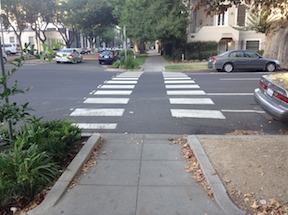
N Street, nice crosswalk, rude drivers

Grocery Outlet: One-and-a-half blocks. Out the apartment complex gate, through the alley, along and then across a quiet residential street (17th), across a two-lane one-way traffic sewer (N), and a block to the store. There are good sidewalks the entire way. Both crosswalks are clearly marked. The traffic on the larger street rarely yields to pedestrians, though that is the law in California, but most of the time it is not a long wait for a gap. I visit this store 2-3 times per week, almost always walking and carrying one large bag

Safeway: Nine blocks, 0.5 miles. Good sidewalks, nice streets, two semi-traffic sewer one-way streets (P, Q, same story, drivers seldom yield but gaps are available), one block without sidewalks but on a low traffic street (R). Sometimes I walk, sometimes I ride.

Sacramento Natural Foods Coop: 1.4 miles. Good sidewalks, mostly nice streets, several one-way traffic sewers (P,Q, 19th, 22nd, 29th, 30th). I occasionally walk this, but most often ride. I could take light rail, with a two block walk on both ends, but I seldom do. Depending on route, I can have quiet streets and/or bike lanes most of the way.

Trader Joes: 2.5 miles. Good sidewalks, mostly nice streets, two more traffic sewers than above. I have walked this, but rarely. I can take light rail, and sometimes do, two blocks walking on one end and three blocks on the other end. Mostly, I ride. Quiet streets part of the way (M Street, the closest we have to a bicycle boulevard), bike lanes available but on the less pleasant streets.

Farmers markets: Saturday farmers market seven blocks, 0.6 miles; Sunday (main) farmers market, 1.3 miles; other farmers markets at varying distances

You might think, well how lucky to live close to a store, but luck has nothing to do with it. I chose this place to live primarily for its proximity to grocery stores. Other considerations were tree lined streets, close-by coffee shops, restaurants, bars, bike shops, breweries, etc. Walk score is 86, and yes, I did look at it before I moved here.

I have a bag on my bike that is perfect for carrying groceries, and I can carry quite a bit of weight that way. I am also willing to carry quite a bit of groceries when walking. I prefer to go to the store more frequently so that I can have more fresh food. No family, I’m just shopping for myself.

More photos: Transportation (collection) > Sacramento sidewalks (album) > Walk to the Grocery Store (tag)

Not all economic development…

“Not all economic development is created equal. Not all local investments build wealth in our community. Not all open markets produce optimal outcomes for all places. If we want our places to prosper over time, we have to be prepared to ask a tougher set of questions at the local level.” Charles Marohn, in Dunkin Our Future, on Strong Towns blog

No net pavement: a modest proposal

I have long been thinking about a policy for construction of roads and highways, that would result in no more pavement. A post by Charles Marohn on Strong Towns blog titled “What is the federal role?” reminded me that I’d not posted on my idea. An excerpt from his post:

So if you forced me to have a federal transportation bill, then I would want it to do two things. First, I would want it to place a moratorium on the expansion, extension or construction of any new auto-oriented facilities. No new road miles anywhere. There is no need for this country to ever build another mile, another lane, another overpass or anything — we have far more than we can take care of now, most of it very unproductive. I would make this exception, however: any state that wants a new mile of highway has to remove two miles of existing. This would allow flexibility for states that wanted a strategic contraction, allowing them to allocate scarce resources to areas that would have the greatest benefit. In short, I would ensure the bill funded maintenance (which would make it politically irrelevant in the current context, but that is beside the point).”

I worked for several years in the Lake Tahoe basin, doing watershed education. The policy for hard coverage such as buildings and pavement, which produces runoff to the lake and a decline in water quality, is that there be no net increase in coverage over time. If a developer or homeowner wants to increase their coverage by expanding the areal extent of a building or parking lots, they must retire other buildings or pavement. The policy has been quite effective, and is primarily responsible the reversal in the steep decline of lake clarity. I realized that the policy would be a good one to apply everywhere. Pavement everywhere has the same effect, causing rain and snow to run off, carrying sediment and debris into waterways. Less pavement equals cleaner water. But there are so many more benefits of less pavement to the environment and to livability in towns and cities, that it makes no sense to continue paving, anywhere, anytime.Read More »