Strong Towns issued a challenge to document your walk to the grocery store. Here is my contribution.
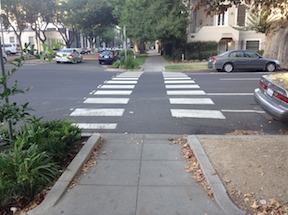
Grocery Outlet: One-and-a-half blocks. Out the apartment complex gate, through the alley, along and then across a quiet residential street (17th), across a two-lane one-way traffic sewer (N), and a block to the store. There are good sidewalks the entire way. Both crosswalks are clearly marked. The traffic on the larger street rarely yields to pedestrians, though that is the law in California, but most of the time it is not a long wait for a gap. I visit this store 2-3 times per week, almost always walking and carrying one large bag
Safeway: Nine blocks, 0.5 miles. Good sidewalks, nice streets, two semi-traffic sewer one-way streets (P, Q, same story, drivers seldom yield but gaps are available), one block without sidewalks but on a low traffic street (R). Sometimes I walk, sometimes I ride.
Sacramento Natural Foods Coop: 1.4 miles. Good sidewalks, mostly nice streets, several one-way traffic sewers (P,Q, 19th, 22nd, 29th, 30th). I occasionally walk this, but most often ride. I could take light rail, with a two block walk on both ends, but I seldom do. Depending on route, I can have quiet streets and/or bike lanes most of the way.
Trader Joes: 2.5 miles. Good sidewalks, mostly nice streets, two more traffic sewers than above. I have walked this, but rarely. I can take light rail, and sometimes do, two blocks walking on one end and three blocks on the other end. Mostly, I ride. Quiet streets part of the way (M Street, the closest we have to a bicycle boulevard), bike lanes available but on the less pleasant streets.
Farmers markets: Saturday farmers market seven blocks, 0.6 miles; Sunday (main) farmers market, 1.3 miles; other farmers markets at varying distances
You might think, well how lucky to live close to a store, but luck has nothing to do with it. I chose this place to live primarily for its proximity to grocery stores. Other considerations were tree lined streets, close-by coffee shops, restaurants, bars, bike shops, breweries, etc. Walk score is 86, and yes, I did look at it before I moved here.
I have a bag on my bike that is perfect for carrying groceries, and I can carry quite a bit of weight that way. I am also willing to carry quite a bit of groceries when walking. I prefer to go to the store more frequently so that I can have more fresh food. No family, I’m just shopping for myself.
More photos: Transportation (collection) > Sacramento sidewalks (album) > Walk to the Grocery Store (tag)
 Getting Around Sacramento