there are worse places!

Added note below on LA sidewalks.

I’m traveling, first in Las Vegas area, and now in Los Angeles area. Traveling to other places is a good reminder that Sacramento is not all that bad. There are worse places!

In Las Vegas, everyone drives everywhere. I observed a person jump in his Jeep, drive a half block to his mailbox, and drive back home. Walking to and from his front door, and to and from his mailbox (clustered mailbox), I saw no sign of disability. In fact, the prevalence of Jeeps is amazing. Every third suburban house has one. Cause you know, its wild out there. The number of them with dirt on the undercarriage, however, is infinitesimal. I see people leaving their house to drive and get coffee, and drive back home. Not as part of a chain of errands, but a drive just to get coffee, for no other purpose. Of course much of Las Vegas is so spread out, that it may to a long ways to a coffee shop (see coffee shops (tea) on the grid for a contrast). Every new development I saw is a gated community. I’m not aware of any being built or recently built that are anything but gated. Even the apartments are gated. People live in, and want to live in, a world where they don’t have to interact with other people, any more than absolutely necessary. They drive large vehicles with darkly tinted windows. They don’t know their neighbors, nor do they want to. The ‘living in a quiet neighborhood where you know your neighbors’ is a mythology perpetrated by people who want to defend their lifestyle, while preserving their isolation.

The worse thing about the neighborhood where my sister lives is the lack of any real shade. Though I celebrate the end of front yard lawns, trees seem to have been thrown out with the bathwater (‘throw the baby out with the bathwater’). Most front yards do not have trees at all, and the ones that do, they are mesquites and related trees, which are beautiful but provide almost no real shade. Except in the very oldest parts of the Las Vegas area, all sidewalks are attached, meaning no space for street trees. If they aren’t on private property, they pretty much don’t exist. Of course that doesn’t matter, because no one walks, so there is no need for shade. Not quite true. Everyone has a dog, or multiple dogs, and takes their dog for a 10-minute walk every day so they can leave their dog waste in someone else’s front yard. If you haven’t spent time in the Las Vegas area, it is always at least 5 degrees hotter than Sacramento, and up to 20 degrees hotter. It is a place that could really benefit from sidewalk shade, but doesn’t have it. Wait, I haven’t been fair. There are palm trees, everywhere. Shade? Nope. Wildlife value? Nope. Aesthetics? Nope.

There are a lot of bicycle riders in southern Nevada. They drive to the paved trails and to unpaved trails at the edge of the city. They don’t ride in the city.

Now I’m in Los Angeles. I have to say that people are much more friendly here. Complete strangers will start up conversations. And you do see a lot more people walking. There are sidewalks on every street. However, except along the main arterial roads, every block has a major issue the sidewalk, often root heaves that make the sidewalk impassible to people with mobility devices, and sometime even to abled walkers. If not root heaves, then there is just deterioration, big cracks and gaps. Bike lanes are scarce in the City of Los Angeles and unincorporated areas of the county. A few of the cities have really put in bike facilities, but in general, they just don’t exist. Because most of Los Angeles is on a grid, there are often lower speed, lower volume parallel streets to ride, but don’t bother with the major streets, or trying to get somewhere quickly.

I have been walking around Koreatown this afternoon, refreshing my memory and experience of the sidewalks. It is nearly impossible to walk a block, on any street except the arterial roadways, without running into a sidewalk issue that would make it difficult or impossible for someone in a wheelchair to navigate. The reason root heaves are so prevalent here is that the sidewalk buffers are only three feet, except in richer neighborhoods. Even Sacramento has six feet or more for sidewalk buffers (where they exist). So every tree that is older has root heaved the sidewalk (photo below). If it isn’t a root heave or deterioration, then a motor vehicle is parked across the sidewalk, blocking it. In several miles of walking, I have yet to see anyone using a mobility device, except in the grocery store. Are they staying home? Are they driving? Are they using transit? They aren’t rolling on the sidewalks!
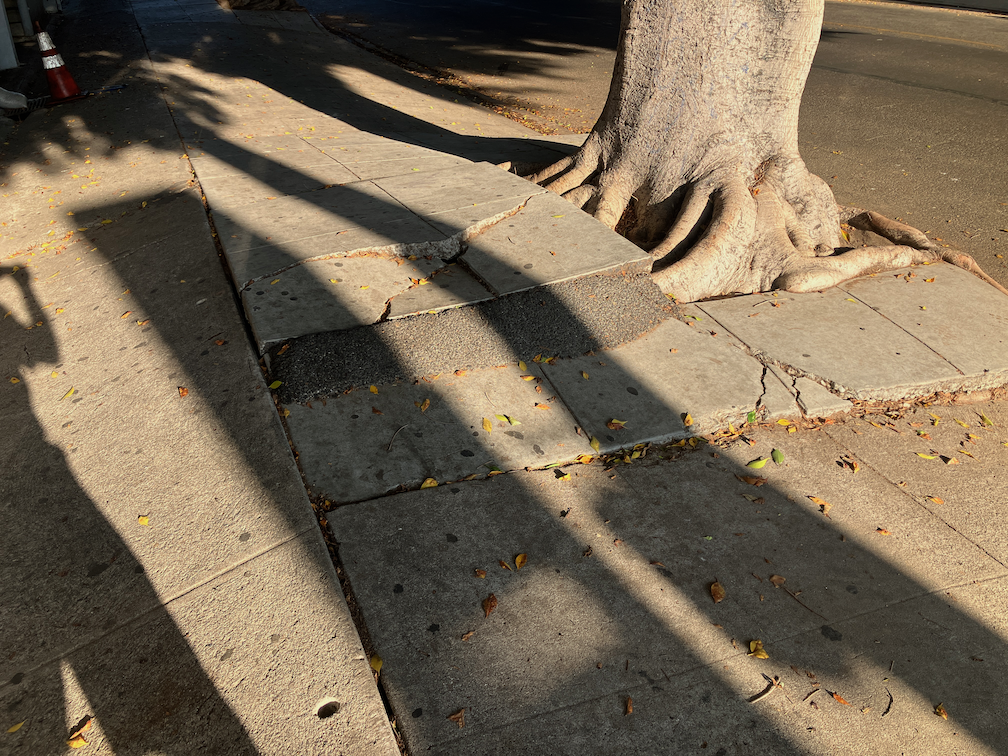
photo of impassible root heave, 9th St in Koreatown, Los Angeles
impassible root heave, 9th St in Koreatown, Los Angeles

I know I complain often about the built environment in Sacramento, and the very slow progress in correcting the mistakes and disinvestment of the past. All of that is true. But…

Sacramento has a great tree canopy in much of the city, and where it does not, everyone recognizes that there is a problem and I believe the city is making an honest effort to correct that (though handicapped by the same issue that lower income neighborhoods were built with attached sidewalks (no sidewalk buffer for trees). Though there are some areas of gated communities, they are mostly in the county, not the city. Other than our governor, most people don’t live behind gates. It seems to me that there is nowhere near as much dislike of other people as is present in southern Nevada.

The central city has good bike facilities, and relatively polite drivers, at least for bicyclists (not walkers), and is flat. Flat. And the central city is getting better, and work is or will be done on some of the arterial roads in the suburbs, though it is many years late and many dollars short. But it is happening.

I really like living in Sacramento. Of course I go to the bay area frequently, and it in most ways does not compare well with that. But it certainly compares well with Los Angeles, and Las Vegas area. Las Vegas is really just a suburb of LA anyway. 75% of the people came from LA, and the rest from Utah. But every place has its challenges, and I know my perception is just one of many.

How about you?

complete streets failure

Summary: Complete streets concept is a failure because it doesn’t address frequent safe crossings. It leaves streets dominated by motor vehicle traffic while not necessarily increasing safety or welcoming design for walkers and bicyclists.

A recent post on Strong Towns (Ager Road: Where Complete Streets Fell Short) shows a street that was converted to a ‘complete street’, and won awards, but is actually less safe and less pleasant than what was there before. A fatality occurred shortly after the conversion, perhaps as a result of the conversion increasing vehicle speeds, perhaps not, but the conversion did nothing to reduce the likelihood.

From the post: “This is a stroad in disguise,” remarked Strong Towns Director of Community Action Edward Erfurt when examining Ager Road in Hyattsville, Maryland. And a Twitter post below.

My response:

The complete streets concept is largely a failure, everywhere it is implemented. I’m sure the original intentions were good, but every complete street project I’ve seen affirms the primacy of motor vehicles over other modes. The greatest failure of all is not what happens along the street, but that the concept does not even address the need for frequent safe crossings of the roadway. No wonder traffic engineers have embraced the concept – it allows them to continue motor vehicle dominance and accept traffic violence.

Dan Allison

So you can see the present ‘complete street’ more clearly:

Google Street View of Agar Rd, referenced on Strong Towns

The complete Streets concept is all about travel ALONG streets. Though it recognizes that crossings of streets are important, and encourages designs that make crossing safer and more welcoming, it does NOT address the frequency of safe crossings. The Complete Streets Coalition, part of Smart Growth America, does not require that complete streets policies include anything about the frequency of safe crossings. And so nearly all polices do not address that. The Caltrans policy, which applies only to state highways but is often applied to other streets, does not mention the frequency of safe crossings.

Traffic planners and engineers have embraced the Complete Streets concept, and tout policies and implementation. But what do we really end up with in most cases? Just more motor vehicle dominated streets, which is what most traffic planners and engineers want anyway, and claiming a complete street isolates them from criticism of the roads being designed and built, while making it more likely that they will be a federal, state, or regional grant for their project. Very few projects are awarded grants these days unless they claim to be a complete streets project. That is good, but the bar is set so low for what can be called a complete street, that the result is just more car infrastructure.

The project shown in the Strong Towns post checks off the following elements:

  • sidewalk, check
  • bike lane, check
  • green paint, check
  • general purpose lane(s), check
  • fence to prevent walkers from crossing any place other than the signalized intersection, check (I put this here with tongue in cheek)

What it does not check:

  • narrow the travel lanes to calm traffic
  • reduce the speed limit or actual speed through design
  • remove slip lanes (ask any bicyclist how they feel about bike lanes that cross high speed slip lanes)
  • reduce the corner radius at driveways
  • install or maintain street trees to calm traffic and provide shade for walkers
  • widen sidewalk buffers to ensure healthy trees and vegetation
  • create a pleasant walking environment
  • provide wayfinding to the nearby Metro station

The next time you hear a planner or engineer mention ‘complete streets’, hold on to your wallet (because, after all, it is your tax dollars that fund ineffective projects), and look around you to identify the traffic violence that will remain or even be increased.

The first step in designing a safe and welcoming streets is top ensure that there are safe and welcoming sidewalks and crossings of the street. Everything else comes after that, if at all. Adding bicyclist facilities that are neither safe nor welcoming, and reducing the the environment for walkers in trade, is going the wrong direction, and will lead to less walking and more traffic violence.

street trees in the parking lane

Note: Added two photos to the bottom, or integrated parking and trees.

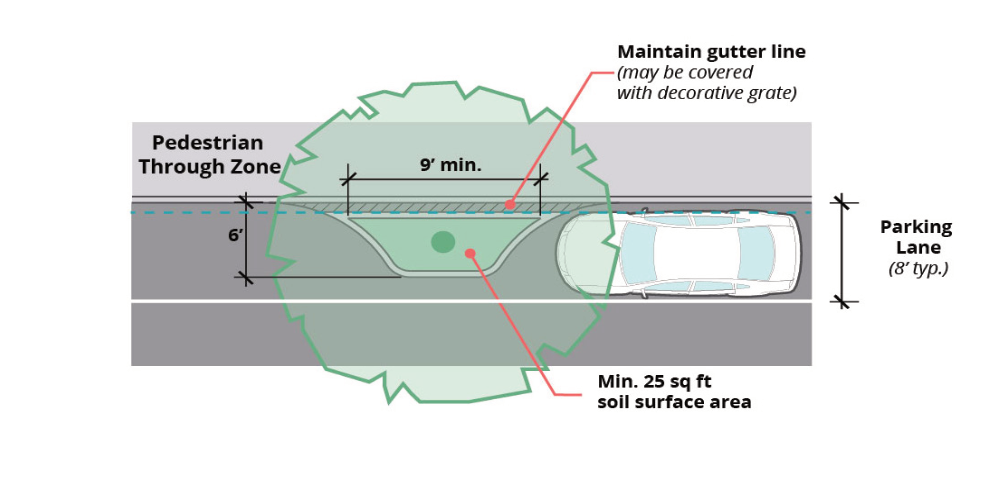
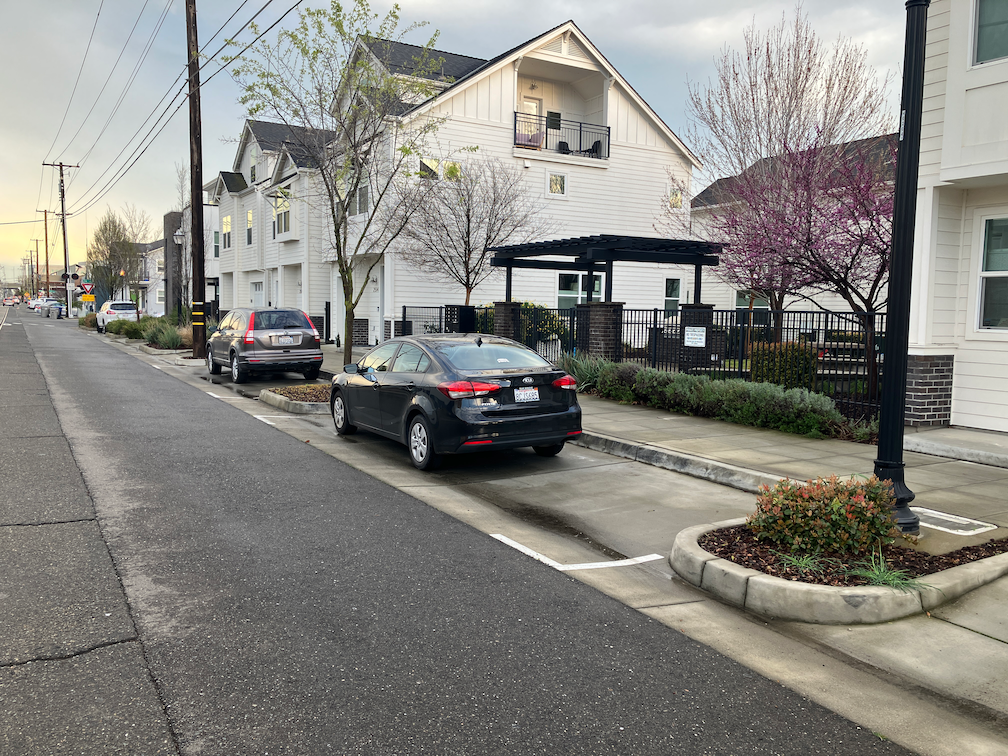
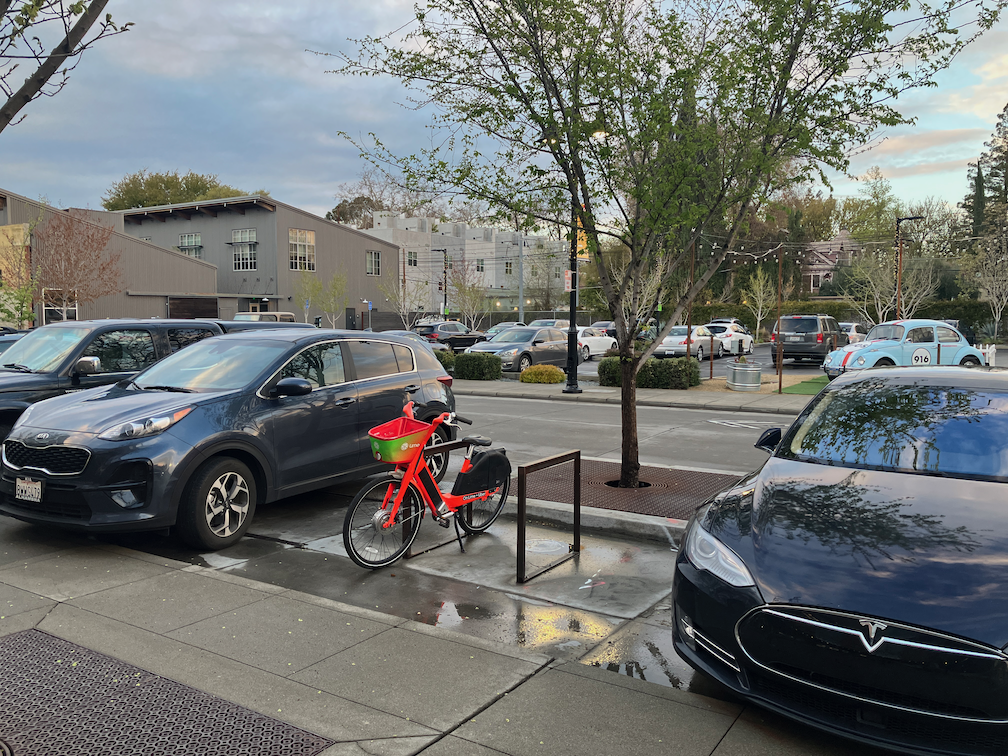
In situations where there isn’t any space for trees along the street, usually where a sidewalk buffer (planting strip) was never provided and where a reconstruction of the street to add sidewalk buffers is not in the budget or possible in the right-of-way, trees can be placed in the parking lane. I am not suggesting here that the entire parking area be replaced with trees, but there some trees and their associated shade for walkers and traffic calming effects could be provided on any street with existing parking.

Portland (PBOT) has a sheet about street tree enhancements, which includes Tree Planting in the Curb Zone:

Tree planting in the curb zone allows for encroaching into the on-street parking zone to increase planting widths. This offers an alternative method for increasing tree well size without negatively impacting people walking.

This new tool provides an opportunity to plant trees along curb tight sidewalks or where the furnishing zone is too narrow for large street trees, locations where tree planting would not be possible under current guidance.

PBOT Pedestrian Design Guide
PBOT Pedestrian Design Guide trees in the parking lane diagram
PBOT Pedestrian Design Guide trees in the parking lane

San Francisco has a Parking Lane Planter page:


Parking lane planters are landscaped sidewalk extensions placed between parking spaces at regular intervals or at specific locations. They provide space for street trees and landscaping on streets with narrow sidewalks, where tree planting is limited by conflicts with utilities or driveways, or where there is a desire to visually narrow the roadway.

SF Better Streets

It does not seem as though most cities have policies about placing trees in the street, and those that do, do not seem of long standing, but certainly the practice exists. Street trees in general, though, are of long standing, with every city having policy and design guidance. Sometimes urban forestry and transportation policies and transportation are well integrated, but as often, not.

The City of Sacramento does have an inventory of trees on city property, which includes planting strips (sidewalk buffers). I don’t know of any trees in the parking lane in Sacramento.


Two readers pointed out locations in Sacramento where parking and street trees are mixed in. Both of these were designed this way; the trees were not added later. Both are on R St, the first with a housing development, with parallel parking, the second with housing and commercial development, with perpendicular parking.

R St between 25th & 26th, south side, parallel parking and trees
R St between 16th & 18th, south side, perpendicular parking and trees