Slow Down Sacramento mid-year

Slow Down Sacramento recently sent a ‘Mid-Year Check-In: How Far We’ve Come (and Where We’re Going)’ email that very well summarizes ways in which the City of Sacramento has made progress, and has not, on the Slow Down priorities. As always, I encourage you to ‘join‘ so you don’t miss informative emails.

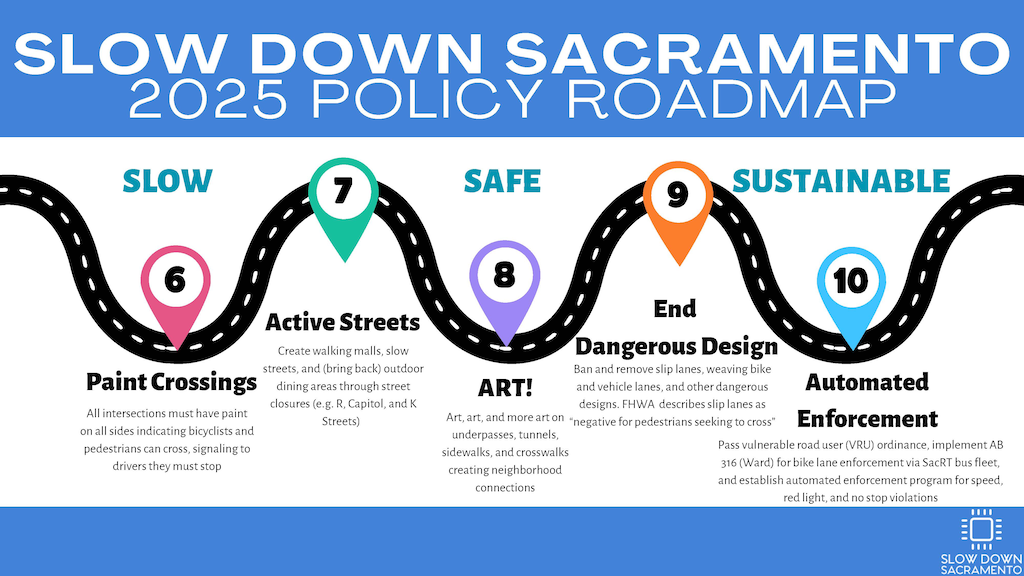
The email goes through each of the ten policies that Slow Down set at the beginning of the year, shown in the graphics below. Significant success has been made in:

Quick Build (1): The city has established a program, with budget and staffing. This was both a city initiative and strongly supported by the advocacy community including Slow Down.

There has been progress in Twenty is Plenty (2), Daylight Now (5), Art! (8) and Automated Enforcement (10). The others have been advocated for but no significant progress has been made. For End Dangerous Design (9), the city is undertaking an update of its Street Design Standards, which Slow Down, Strong SacTown, and other have been involved in, but the outcome has not been released. Of course the important thing is not just better designs to not repeat the same mis-design mistakes, but to correct the mistakes already made which make our streets less safe for everyone.

Thank you, Isaac Gonzalez and all the others on the Slow Down Sacramento team.

graphic of Slow Down Sacramento 2025 Policy Roadmap items 1-5
Slow Down Sacramento 2025 Policy Roadmap
graphic of Slow Down Sacramento 2025 Policy Roadmap items 6-10
Slow Down Sacramento 2025 Policy Roadmap

Strong SacTown: Things that work: traffic posts

Things That Work: Traffic Posts is the eighth post by Strong SacTown to improve and promote the City of Sacramento update to its Street Design Standards. Other posts at tag: street design standards.

You don’t often hear news about the crashes that didn’t happen. Today we’d like to highlight something already making real-world safety impacts in Sacramento: traffic posts (aka. delineators) on 15th & 16th Streets in Downtown. These traffic posts reduce the speed of cars (and severity of injuries) as well as channelize traffic – stopping cars from changing lanes at the crosswalk and potentially striking pedestrians who have started crossing.

Strong SacTown Street Design: Active Street Typology

Active Street Typology is the seventh post by Strong SacTown to improve and promote the City of Sacramento update to its Street Design Standards. Other posts at tag: street design standards.

“Active Streets are similar to Local Streets, but with additional features to encourage and prioritize active transportation including biking, rolling, and walking. Well-planned Active Streets form a cohesive network of safe, convenient, and direct connections to local destinations and between neighborhoods. Low vehicle volumes and speeds are an essential characteristic of Active Streets, and the typology shares many facets of the bicycle boulevard or neighborhood greenway street types found in other jurisdictions.”

report on SacATC 2024-08-15

Several transportation advocates attended the SacATC meeting in person, several people made eComments online, and hopefully others watched via Zoom.

3. Two Rivers Trail Phase III

This project is in the selection of alternatives and preliminary design phase. It will connect the existing trail segments of the Two Rivers Trail (the one on the south side of the American River, matching the American River Parkway Trail on the north side), except for crossings of the two UPRR (Union Pacific Railroad) tracks across the river, which are under discussion but without resolution. An additional crossing is Hwy 160, with uncertainty due to there being no active project design to replace one or both sides of the bridge, which are substandard, and will need to be replaced. Commission members asked a number of questions about the alternative alignments, particularly around the old city landfill. The project will report back when alternatives are selected.

4. Street Design Standards Amendment

This was just an update on the project, which is in early stage with some meetings held but several others yet to go (stakeholders, technical advisory, and public). Actual designs were not discussed, though public comment requested that the designs be innovative and cutting edge, and that outmoded or unsafe designs in the 2009 version be eliminated completely from the amendment.

5. Active Transportation Commission 2024 Annual Report

The presentation was on the 2023 report, with some questions about formatting, but the major questions having to do with whether to carry the 2023 recommendations, which sadly have not been acted on by city council or staff, into the 2024 report, or to modify them. The consensus seems to be there there should be a list of recommendations focused on safety issues, with safety for walkers and bicyclists being a higher priority than promotion of walking and bicycling (or course, they can’t really be separated). Recommendations that do not end up on the safety list might be on a separate list, not as prominent, but not lost. There was also discussion about organizing things by short-term and longer-term, but no consensus.

Recommendation 1: Increase Funding for Active Transportation Infrastructure Projects was agreed as the top priority on any list. Recommendation 6: Create a Sacramento Quick-Build Bikeways Program, also received a lot of support, however, not universal agreement.

Discussions will continue at the September and October, and perhaps November, SacATC meetings. A number of members of the SacATC were absent, quorum just barely made, but there seemed to be agreement that the conversation would continue from this point and not go back to the beginning, and the returning members would catch up on their own.

Of course the elephant in the room is that the city council accepted the report and recommendations, but has made no policy or funding decisions to implement the recommendations. The request to add funding to the 2024-2025 city budget for any of the recommendations was rejected by the city manager. Staff has moved forward in minor ways on some of the recommendations, using existing funding and staffing.

My favorite, Recommendation 9: Finalize the Construction Detour Policy, is stalled out in Public Works, and it is not clear when or if it will ever see the light of day. Adherence to best practices for ADA accommodation and meeting PROWAG guidelines is not popular in the regressive Public Works Department.

SacATC 2024-08-15 (Active Transportation Commission)

The Sacramento Active Transportation Commission (SacATC) meets today, August 15, 2024 at 5:30 PM. in city council chambers, 915 I St. It can be viewed online by going to the city meetings page, selecting SacATC livestream. Comments are only available in-person, via the meetings page eComment, or ahead of time to the city clerk, if eComment is not working. In-person comments are the most effective.

The agenda includes three main items:

  1. Two Rivers Trail Phase III (T15225400)
  2. Street Design Standards Amendment
  3. Active Transportation Commission 2024 Annual Report

I encourage everyone to attend in person, or watch online, and to submit comments. Recently, public participation has increased, but far too few citizens are engaged. Though the commission is not powerful, it is one of the few ways the public has of engaging the city on the public health crisis that is the epidemic of traffic violence in the city.

Strong SacTown Street Design: Local Street Typology

Local Street Typology is the sixth post by Strong SacTown to improve and promote the City of Sacramento update to its Street Design Standards. Other posts at tag: street design standards.

“Local Streets are an extension of the adjacent land uses and provide space for people to socialize, play, and even loiter, and will be designed and managed as places primarily for people. People are likely to spend most of their time in or near Local Streets, since these are where to find most destinations. As such, it should feel natural and comfortable to dwell in or stroll through a Local Street. Parents should feel comfortable letting their kids play unsupervised, and noise levels are low enough to hold a conversation.”

Sac General Plan & street design update

City of Sacramento Public Works staff has told the Active Transportation Commission that an update to the Street Design Standards will start soon. But the General Plan says otherwise. From the plan, Implementation Actions, pages 8-28 to 8-29:

M-A.10: Street Design Standards Update. The City shall review and update City Street Design Standards as needed to ensure they adequately support objectives for prioritizing people throughput, safety, and efficient transportation management.
Responsible Entity: Department of Public Works
Timeframe: Mid-term (2030-2035)

This timeframe indicates that the update will not even start until 2030, six years after the adoption of the plan in 2024. Six years of Public Works enforcing outmoded and dangerous street designs on the public and on developers. Hopefully the plan is out of date, and staff is correct that it will start soon.

Yes, I had promised quite some while ago a summary of my many blog posts on the Street Design Standards update. Coming soon to a blog near you.

streets are for people!

Part of an ongoing series of posts to support better streets in the City of Sacramento during their 2023 update of Street Design Standards. New standards must be innovative, safe, and equitable, and it will take strong citizen involvement and advocacy to make them so.

The streets we have are largely for cars and car parking. In this, I include trucks and delivery vehicles. Streets are only incidentally for walkers, bicyclists, economic vitality, and urban life. We know that our urban environment must change, to meet the challenge of climate change, but also to create a place where people thrive.

SPUR, a San Francisco Bay Area education and advocacy organization, has done as good a job as I’ve found so far with the words to describe where we are going and how to get there. Their Transportation page includes:

Our Goal: Make walking, biking, taking transit and carpooling the default options for getting around

SPUR’s Five-Year Priorities:

  • Improve the region’s transit network, and the institutions that run it, so that all people have fast, reliable access to their city and region.
  • Make it faster, easier, more dignified and less expensive to get around without a car.
  • Leverage transportation investments to build great neighborhoods and connect people to opportunity.

As a point of comparison, the City of Sacramento, Department of Public Works, Transportation Division says:

The Transportation Division’s primary focus is maintaining and enhancing traffic operations, traffic safety and multimodal mobility for our citizens and customers.

Wake me up from my nap!

I have started working on transportation principles for Sacramento. I admit that the points and wording below are not yet succinct and powerful, but I’m offering them now so that you have an idea where I’m going. I will work on improving them, and post the improvements again at the end of the series.

Street Design Principles

  • Street design will ensure the safety of all street users; Vision Zero rejects any street design that allows fatalities or severe injuries for any street user
  • Street design will encourage walking, bicycling, and transit use, and will discourage unnecessary motor vehicle use
  • Street design will rank safety, livability and economic vitality above vehicle throughput or speed; congestion relief will not be a goal in street design
  • Street design will actively support the city’s goal of reducing greenhouse gas emissions (GHG) through reduction of vehicle miles traveled (VMT)
  • Streets can and will be redesigned to better serve current and future need; past design which may have met past need need not be retained
  • Interim solutions to safety or capacity issues will be identified for immediate implementation whenever permanent solutions are not yet budgeted; design diagrams for these interim solutions will be provided along with the permanent solution diagrams

My posts and city design standards should use these definitions:

  • ‘Walking’ and ‘walkers’ includes mobility devices; the term pedestrian will not be used except in reference to laws or designs which use that term
  • ‘Bicycling’ or ‘bicyclists’ includes any devices permitted by state law or city code to use bike facilities
  • ‘Street’ includes all roadways which are not freeways or expressways, even if they do not currently meet standards for safe, equitable, or effective streets

Your suggestions on words and ideas are welcome! Comment below, or email me.

NACTO downtown streets

There are a few streets in Sacramento which are wide enough to host many activities and modes of travel, with reallocation of the roadway width to meet a new vision of a livable, walkable city. Two NACTO diagrams are below. The first, a downtown one-way street, is interesting to me because it shows a better use of space without having to change from one-way to two-way. I have always been opposed to one-way multiple lane streets because they present the multi-lane threat to people crossing the street, when one driver stops but others do not. This is one of the most common causes of fatalities for walkers, and why it must be eliminated. However, if the design is changed, the street becomes much safer, and the multi-lane threat is reduced or eliminated. Check the NACTO page for an alternate design.

diagram of NACTO downtown one-way street
NACTO downtown one-way street

I believe there should be high frequency bus service on J Street from 5th St to the university, and if J Street remains one-way, paired service on L St. This diagram would be a great model. Current service is 15-minute frequency on part of the route, but only 30-minute on part. Service should be at least 10-minute, maybe even more frequent. This would be a good design for that service and for those streets. Yes, L Street is not continuous, due to a broken street grid, so either H Street or Folsom Blvd could be used to connect.

Other streets that might remain one-way, but only with redesign, include the 9th-10th couplet, 15th-16th couplet, 19th-21st couplet, and P-Q couplet. The W-X couplet that bounds the Hwy 50 freeway would have to remain one-way due to freeway onramps and off ramps, but must be narrowed significantly. It is nothing but a traffic sewer as currently designed, and the motor vehicle capacity of the street is completely unneeded, even during rush hours.

Read More »

SacCity street design ideas

I have decided to start a series on street design ideas and standards, as a support for the City of Sacramento update of its Street Design Standards, due to occur this calendar year. I would hope that the city would actually engage citizens and transportation experts in the development of the standards, though it is more likely that the city will present a late-draft-stage document for review. In either case, I hope to educate the public about what good street design looks like and functions like, so that they can provide useful input and demand the highest level of design safety and innovation from the city.

The posts will be available under the category ‘Street Design Standards‘. Though this is a subcategory of City of Sacramento, the posts will almost entirely be applicable to any city or county.

First up, existing design standards and concepts. The horrible state of our transportation system is due in large part to the practice of traffic engineers using highway design ideas on urban streets. These designs have encouraged traffic violence, reduced the livability and economic vitality of cities, and created infrastructure that we will never have the funds to properly maintain. And, most importantly, then have killed millions of people and maimed at hundreds of millions more.

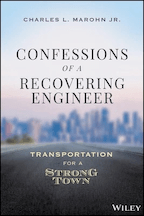
If you have not read it yet, I can’t more highly recommend Confessions of a Recovering Engineer by Chuck Marohn, founder of Strong Towns, for a review of the traffic engineering malfeasance and embedded but never explicit values that got us to this point.

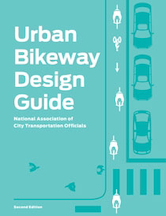
There are a number of existing publications and resources for designing streets, some of them useful, and some us them which got us into this mess to begin with. Here are the ones I recommend that the city use, and not use: