Walkable Sacramento #4: sidewalks

For a series on walkability, you might think sidewalks would come first, not later. The reason they are not first in the series is that sidewalks, relative to other issues, are in decent shape. Yes, vast areas are missing sidewalks, and in many areas that have them, they are not well maintained. But looking at the whole issue of walking, it is crossing roadways that is most dangerous and unpleasant, not walking along roadways.

I do not believe that low speed, low volume residential streets need sidewalks. It is OK that some have them, and it is OK to require them in new developments (to the degree that it is OK to have new developments, which is to say, this should be irrelevant because there should be no new developments). But to build sidewalks on quiet streets that do not have them is not the best use of funds.

The city has a lot of semi-rural areas without sidewalks. Do they not deserve sidewalks? Where sidewalks would provide a route to key amenities such as grocery stores and schools, sidewalks should be provided, or at least paved asphalt paths adjacent to roadways. Too many people die walking on the shoulders of rural and semi-rural roads, so shoulders are not a solution, there must be either sidewalks or separated paths.

The most important point of all about sidewalks is the first bullet, that it is the responsibility of the city to maintain sidewalks. It is irrational to propose that roadways are maintained by the city, but sidewalks are not. If this belief and legal fabrication persists, Sacramento can never be a walkable city.

  • Recognizing that sidewalks are an integral part of the transportation network, sidewalk repair will be the responsibility of the city and not of property owners, except where trees owned by property owners, or disturbance, change or widening is initiated by the property owner.
  • All streets with an ADT over 5000 will have continuous sidewalks of no less than four feet clear path, within five years.
  • All streets with an ADT over 10,000 will have a continuous sidewalk of not less than six feet clear width, within two years.
  • All streets with an ADT over 20,000 will have a continuous sidewalk of not less than six feet clear width, with a buffer of not less than six feet, within six years. Parallel multi-use paths can be used to meet this requirement.
  • Utility poles and other obstructions will not restrict sidewalk width below the minimums above, and where these exist, will either be removed or sidewalks widened. The expense will be borne by the utilities, not city taxpayers.
  • All sidewalks will be maintained in a state of good repair by the city. Any cracks with a vertical displacement of more than one inch will be fixed within two months. The city will evaluate and implement flexible sidewalks for locations with ongoing tree root heaving issues.
  • Timely leaf removal from sidewalks will be the responsibility of the property owner, except for sidewalks with a daily use of over 5000, which will be the responsibility of the city. 
  • All development which requires new sidewalks (greenfield development) will fund a maintenance fund so that existing city residents are not financially responsible for sidewalk maintenance on new sidewalks. 
  • Sidewalks will be continuous across alleyways, in concrete and not asphalt. Every alleyway that is reconstructed or repaved will have this implemented.
time to get off the infrastructure treadmill

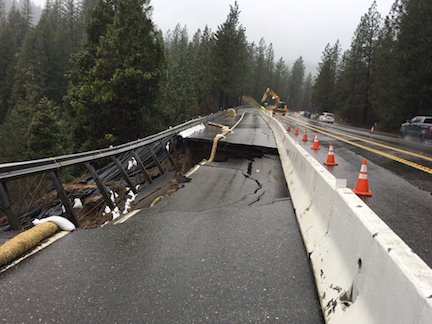
Hwy 50 slide, @kellyinmedia

With the recent storm damage to roadways, as well as some transit and rail lines, the governor has proposed about $600M in quick fixes. This adds on to $59B deferred maintenance on state highways, and $78B on local roads (the actual local roads number is likely much, much higher). Pretty soon, we’re talking real money.

I am not opposed to fixing storm damage, or to keeping roads in a state of good repair, abbreviated SOGR and often called “fix-it-first.” However, if it isn’t obvious by now, let me clearly state that we already have more infrastructure than we can ever afford to maintain. Even without climate change, we probably could not keep up, and with climate change, we don’t have a chance.

We have a transportation system built on the idea that someday there will be enough money, our kids will be richer, the economy will be better, the federal government will offer an infrastructure windfall, a fairy godmother will wave her wand. It’s not going to happen. The bills are already coming due, and there will be far greater bills coming due in the near future. Politicians, and the voters who support them, have been running a growth ponzi scheme (see https://www.strongtowns.org/journal/2009/2/3/the-small-town-ponzi-scheme.html and other Strong Towns references), gathering the political and economic benefits today while putting the costs off to the future.

So, what to do? Well, first, stop digging the hole. We don’t need any new roads or highways, or additional lane miles. We do need to make the ones we have more efficient (defined as the number of people moved per hour per dollar, NOT the number of vehicles moved per hour per dollar), and on the whole, we do need to keep them repaired.

But we also need to realize that we have already overbuilt, and we are going to need to let go of some of it. Return rural roads and residential-only streets to gravel (bicyclists, get your mountain bikes). Stop paving parking lanes to the same high standards we use for the travel lanes, and in many cases, let them return to gravel as well. Or just remove some of them – we don’t need as many cars, either. Where sidewalks are needed and don’t exist, don’t take them out of people’s property, but out of the existing roadway. Where roads have been built wider than will ever be needed, take the extra width out and sell it off, with adjacent property owners getting first right of refusal. If there is no market, then give it away to the adjacent property owner. In suburban Sacramento county, there are streets that go from narrow two lane to four lane to extra-wide four lane and then back down again. These are safety hazards and maintenance nightmares. Let’s put this wasted road space back to productive use.

Katy Freeway (I-10) Texas; By Socrate76 - Own work, CC BY-SA 3.0, https://commons.wikimedia.org/w/index.php?curid=7444029
Katy Freeway (I-10) Texas; By Socrate76 – Own work, CC BY-SA 3.0, https://commons.wikimedia.org/w/index.php?curid=7444029

Freeways are the next big thing to reduce. The major Interstates are economically critical for freight movement and to a lesser degree people movement (though quality rail can take much of the pressure off). But they’ve gone from two lanes per direction to four to six to eight to ten, with Texas holding the record, I believe, at thirteen lanes per direction (in the U.S. at least). What are all the extra lanes for? Mostly commuters, and for about two hours a day. People who have been allowed and encouraged to live a long way from where they work, just to save on housing costs. But the bill has been paid by all of us, private car commuters or not, and we have only just begun to pay this bill. It may be larger than our entire economy. So, let’s shrink the Interstates back down, in most cases to two lanes per direction. The other freeways? Most of them are not needed at all and can be removed in favor of surface streets with a restored street grid. People will adjust over time, make different decisions, and it will take long enough to accomplish that it won’t be a sudden shock.

There is no better time than a crisis to re-think our transportation system. If we don’t think now, we will go back to sleep and assume that it is all going to work out, somehow, someday, some fairy godmother.

Each of these ideas deserves exploration, and I will do that as I can.