SacATC 2024-10-17

The City of Sacramento Active Transportation Commission (SacATC) will meet this Thursday, October 17, 2024, starting at 5:30 PM. The meeting is held at city council chambers, 915 I Street, and can be viewed online via the link available when the meeting starts, on the city’s Upcoming Meetings page. People may comment in person (preferred) or make an eComment on the city’s Upcoming Meetings page. Though all eComments become part of the public record, only those submitted before noon of the meeting date will be seen by the commissioners. The agenda includes three discussion items, below, and is available as pdf.

  1. Fiscal Year (FY) 2025/26 Caltrans Sustainable Transportation Planning Grant
  2. Assembly Bill (AB) 43 Project (speed limits)
  3. Active Transportation Commission 2024 Draft Annual Report

At the last meeting, the commission decided to reduce the list of recommendations to those directly impacting street safety. In the updated draft annual report, these six are:

  1. Increase Funding for Active Transportation Infrastructure Projects
  2. Expand Speed Management Programs
  3. Create a Sacramento Quick- Build Bikeways Program
  4. Re-Establish Slow & Active Streets
  5. Develop a Citywide Safe Routes to School Program
  6. Finalize the Construction Detour Policy

They are listed in inverse order of funding. with #1 requesting the highest level of funding, $3M per year.

It is important for the community to support the annual report with its focus on priority safety actions, to support the report when it goes to city council, and to support the city prioritizing these funds in the mid-year budget revision and in next year’s budget.

The city reduced speed limits in many school zones several years ago, and recently reduced speed limits on a few streets, and is gradually working to reduce speed limits on more streets, including alleys, business districts, local roads, and senior zones. The graphic below shows the approach. The presentation will bring the commission up to date on the project.
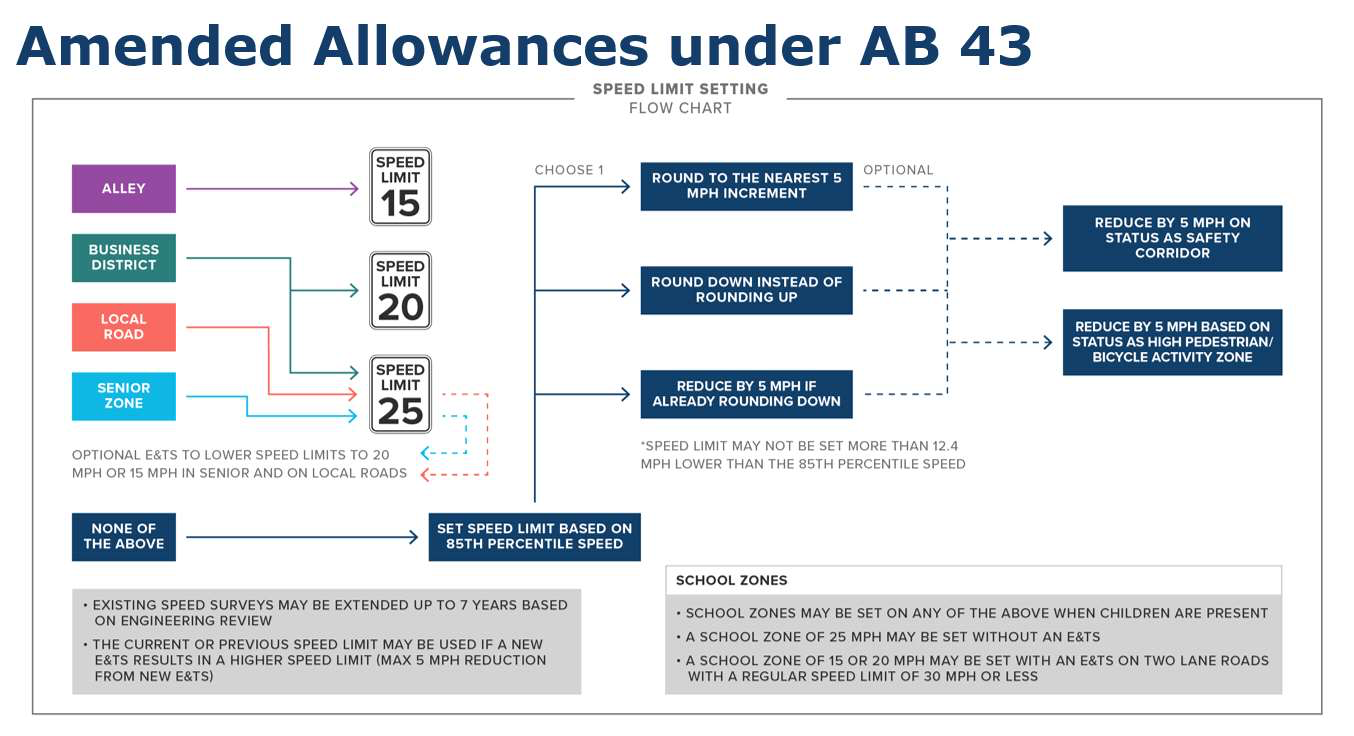
graphic of speed limit setting flow chart

City staff is asking the commission to recommend two grant applications under Caltran’s Sustainable Communities Planning Grants for Transit Needs in Sacramento to meet Climate, Equity and Mobility Goals; and the Walking, Bicycling and Transit Access Wayfinding Project.

The city’s Department of Public Works Transportation Planning Newsletter has more information on these topics and others. I recommend you sign up if you aren’t already getting the email newsletter, which comes out once a month.

Slow Down Sacramento

A new organization and effort has been developed in Sacramento to encourage drivers to slow down, in order to protect walkers and bicyclists from the traffic violence of high speed traffic. You can read the organization intro and charter at Slow Down Sacramento, and sign up to join the effort.

Slow Down Sacramento logo

This organization was created by Isaac Gonzalez, a community activist, in part due to the tragedy of a mother who was killed while waiting to pick up her child at Phoebe Hearst Elementary, the same school as his kids attend (KCRA: Husband of woman killed outside Sacramento school says changes to Folsom Boulevard would save lives for more info).

Gonzalez held a press conference yesterday (Tuesday, 2023-08-29) at Sacramento City Hall to kick off the organization. Isaac spoke at length about the need to improve driver behavior, following the speed limit and being respectful of other road users. He pointed out that though better infrastructure is the ultimate answer to traffic violence, that will be very expensive and very slow, but the solution we have available right now is for drivers to be more responsible. Press conference attendees included many local advocates, parents, and kids, as well as a number of city staff. Four council members attended, and city council members Eric Guerra, Lisa Kaplan, and Mai Vang spoke on the issues. City transportation planning staff also supports the effort.

Isaac Gonzalez speaking at Slow Down Sacramento press conference

I tend to be cynical about the prospect of improving driver behavior. Drivers become aggressive when they get behind the wheel, and infrastructure that prevents their recklessness and aggression is the long term answer. But in the meanwhile, for the many years it will take to create safer streets, drivers can act responsibly. If the Slow Down Sacramento effort saves even one life, it is worth it, but it has the potential to save more. I encourage you to follow the organization’s work. I think the fact that this is a citizen-led effort, rather than the safety theater of government agencies that blames victims more than perpetrators, increases the chances of success.

Strong Towns and speed limits

I am a strong supporter of Strong Towns, and think their analyses of financial and transportation issues is almost always spot on. However, I think there is a blind spot when it comes to speed limits. In a recent broadcast, Chuck Marohn addresses a question from a member about whether it is better to change speed limits street by street, or all at once. In response, Chuck launches into his view that only design changes can control speed. This is the first question in the broadcast, so you can listen from the beginning.

Here is my response:

I have to push back against Chuck’s take on speed limits. Nothing he says is incorrect, but there is an underlying ideology that rejects changing speed limits without changing design, as any part of a solution.

  1. This is not about enforcement. I agree that much of traffic enforcement is pretextual, and intended to oppress people of color and low income. I’m not asking for any more enforcement, and am in complete agreement with the current movement towards removing most traffic enforcement from the responsibilities of armed law enforcement agents. And moving speed and red light running enforcement to automated systems. In high risk, high fatality/injury settings, we could even invest in automated enforcement of failure to yield to people in crosswalks, which is a driver behavior that not only kills people walking but intimidates them out of walking.
  2. Chuck correctly states that drivers respond to roadway design, and consider what feels safe in setting their own speed. However, he misses the fact that drivers also respond to the speed limit. Drivers are very aware of posted speed limits. I constantly hear drivers say things like “I always go 5 mph (or 10 mph, or…) over the speed limit”. If the speed limit is 25, they will go 30, or 35, not just based on roadway design, but on the posted speed limit. If we lower it to 20, they will go 25 or 30. That is a huge difference (see the fatality at various speeds charts), and should not be discounted.
  3. The problem with 85% is not just that it allows drivers to set their own speed limits, but speed creep. If 85% indicates a ‘safe’ speed of 35, and it is posted, then drivers will start going 40, and the next survey will show 40 is the ‘safe’ speed, and so on, ad infinitum. Regardless of the impact on drivers, every increase in actual speeds makes the street less safe for people outside vehicles. Which is why high speeds should be reserved for limited access, designed for higher speeds, roadways. Streets should always be posted for the desired safe speed, no matter the roadway design.
  4. I live in a city where, at the current rate of roadway redesign, it will take about 80 years to create a safe system, and in a county where it will take at least 120 years. I am not willing to accept the death and severe injury that will happen in the meanwhile. We must do anything and everything we can to reduce that trauma, and that includes lowering posted speed limits.
  5. There is evidence from around the world that when speed limits in a city are lowered wholesale, both the rate and severity of crashes also decreases. By as much as we want? No, but to reject this change out of hand for ideological reasons is, in my mind, a huge mistake.
  6. There will always be egregious violators, drivers who drive as fast as they can no matter what. I think these drivers are actually responsible for most crashes. If these drivers can be caught and punished (removal of driving privilege and confiscation of vehicle) by any sort of enforcement, that is great. Redesigning a roadway does not eliminate these drivers or reduce their speed, it just makes it more likely that they will kill themselves along with the other people they are killing. That is small consolation.

I am absolutely in favor of roadways designed to self-enforce lower speeds. I have supported and helped design projects to do exactly that. And at no time have I ever felt that was enough. I think we need to use every action at our disposal (except biased traffic enforcement) to lower speeds. Now, not at some time in the future.

Walkable Sacramento #5: speed

This one is pretty simple, but of utmost importance. Speed kills, but the increasing share of fatalities is walkers. The chart explains why.

Though the primary beneficiaries are walkers, bicyclists and motor vehicle drivers will benefit as well. As with many policies and actions related to walking, this is an interim measure to keep people alive until roadways are redesigned. Roadways design should enforce a desired speed, not allow and encourage a higher speed.

Policies:

  • Any roadway with a history of crashes resulting in serious injury or fatality will have the speed limit reduced by 5 mph until this pattern ceases, and each such crash will result in further reduction, but not below 15 mph. 
  • Speed limits on all roadways will be set at the desired speed, not the design speed and not the actual speed. It will be illegal to consider the 85% criteria for setting speeds.
  • Implement a city-wide base speed of 20 mph, and allow higher speed limits only where the roadway design ensures safety at higher speeds. Safety means no fatalities or serious injuries. The sign below is from the UK (United Kingdom), but many places around the world have now made 20 mph (32 kph) the baseline speed.